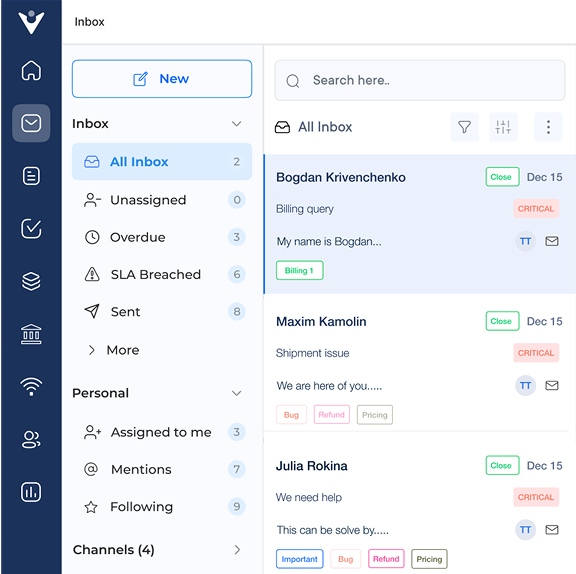
1. Identify Common Customer Issues First
Start by understanding the problems your customers encounter most frequently. It ensures your self service automation addresses real needs rather than rarely occurring issues.
Key questions:
- What are the top 10 support tickets each month?
- Which product features cause the most confusion?
- Which questions appear repeatedly across channels?
- Which issues prompt multiple contacts from the same customer?
Start by hosting regular feedback sessions with your support team since they hear customer frustrations daily. You might also consider setting up exit surveys when customers leave your platform. Social media monitoring can reveal complaints people share publicly but never report directly to your company.
2. Craft Seamless User Experience Design
Creating intuitive interfaces is essential for self-service to work. If the design is confusing, customers end up frustrated and automation creates new problems instead of solving old ones.
Key factors:
- Visual hierarchy: Make the most important actions stand out clearly, with secondary options easy to find but not distracting.
- Progressive disclosure: Keep things simple by showing only the basics upfront, revealing advanced features only when needed.
- Consistent navigation: Maintain the same menu structure and button placement across all self-service pages.
- Error prevention: Build forms and processes that help customers avoid common mistakes before they happen.
Take Amazon’s return process as an example. It looks and works the same whether you’re on the app or desktop, with minimal steps and clear options. Good design reduces effort and makes self-service far more effective.
3. Create Comprehensive Knowledge Base Content
A knowledge base is the core of any self-service system, it’s where customers find the answers they need. Without clear, accurate and well-structured content, even the best AI-powered chatbots or search tool won’t help much.
Key types:
- Getting started guides
- Troubleshooting articles
- Feature tutorials
- Billing and payment information
Think about how Slack organizes their help center with clear categories for different user types and specific use cases. New users get simple setup guides, while developers can find detailed API instructions without digging.
Key takeaways::
- Smart search: Handle synonyms and misspellings to get customers to the right article.
- Content tagging: Use tags so related resources surface automatically.
- User ratings: Let readers mark what’s helpful, so you know where updates are needed.
Most importantly, keep content updated. Outdated instructions cause frustration and undermine trust in your support system.
4. Build Smart Chatbot Conversation Flows
A well-designed chatbot should feel more like talking to a helpful assistant than wrestling with a script. When conversation design is weak, customers get robotic replies, dead ends and mounting frustration.
Design natural language processing capabilities
A good chatbot recognizes intent, not just keywords. Consider, “I can’t log in” and “login broken” should trigger the same support path. Natural language tools help the bot understand context and phrasing instead of relying on exact word matches.
Thoughtful dialogue trees
Conversations aren’t always straightforward. Instead of forcing yes/no answers, design trees that handle gray areas like “yes, but only sometimes.” Anticipating the responses keeps the flow natural and prevents users from getting stuck.
Contextual suggestions
Contextual suggestions help customers navigate conversations when they feel stuck or confused. Smart chatbots offer relevant next steps based on previous responses and current conversation flow. Instead of generic “How can I help you?” prompts, they suggest specific actions like “Would you like to reset your password or update your email address?”
5. Enable Seamless Human Agent Escalation
Smooth escalation is what makes automation and human support work together instead of against each other. If the handoff fails, customers end up repeating their story and feeling more frustrated than when they started.
Recognize limits early
Automation should know when it’s stuck. If the system detects repeated failures or complex issues, it should quickly escalate to human help.
Transform context, not just the call
When Sarah asks to cancel her subscription, the chatbot shouldn’t just pass her to billing, it should send her intent to the agent. It saves Sarah from retelling everything and speeds up the resolution.
Key phrases:
- “Let me connect you with a specialist who can provide personalized assistance.”
- “I’m transferring your conversation to an expert who can resolve this specific issue.”
- “Your details are being shared with an agent who will continue helping immediately.”
6. Personalize Based on Customer Context
Personalization makes self-service tools more useful by adapting to each customer’s needs and history. Without it, people get generic answers that reflect their account details or past interactions.
Personalization connects automation with real customer data to deliver help that actually fits the moment. When someone logs into a support portal, the system already understands their plan, past actions, and recent issues, so support feels relevant instead of repetitive.
Key areas:
- Account Status
- Support History
- Product Usage
Imagine how Netflix suggests troubleshooting steps based on your specific device rather than generic connectivity advice. Their support system knows whether you stream on mobile or smart TV and adjusts recommendations accordingly.
Pro tips:
- Begin with simple personalization, like account details before moving to complex behavior patterns.
- Always allow customers to opt out in case personalized suggestions don’t fit their needs.
7. Monitor Performance and User Feedback
Performance monitoring shows how well self service automation works in real situations. If you’re not conducting regular checks, you risk thinking everything runs smoothly while customers wrestle with broken flows or confusing answers.
Key metrics:
- First Contact Resolution Rate
- Customer Satisfaction Scores
- Automation Deflection Rate
- Average Resolution Time
But how do you know if customers genuinely feel satisfied with their self-service experience beyond just looking at numbers? The answer lies in directly asking them about specific pain points they faced.
Key questions:
- How easy was it to find the information you needed today?
- Did our automated system understand your problem correctly?
- What would have made this self-service experience better for you?
- Would you use self-service again for a similar issue?
8. Improve Automation Tools Performance
Continuous improvement keeps self-service automation useful as customer needs and products change. Without regular updates, even well-built systems quickly fall behind and fail to solve new problems.
Key approaches:
- Content analysis: Track which helps articles get the most views and positive ratings. Use that insight to fix weak content and create more resources that match proven patterns.
- Conversation mining: Review chatbot logs to see where people get stuck or drop off. Update dialogue flows to prevent repeat frustrations.
- Performance benchmarking: Measure your system against past results and industry standards. Set clear goals for resolution rates and satisfaction scores to drive steady progress.
Consider how Spotify continuously updates its help center based on new feature releases and customer feedback patterns. They regularly refresh troubleshooting guides when users report confusion about playlist sharing or premium subscription benefits.
How Self Service Automation Streamlines Customer Service
Check out the ways self service automation streamlines customer service by giving teams more time to focus on complex needs.