Sales Activity Management: Benefits, Tips & Tools
Sales activity management helps teams focus on the right actions that drive revenue. The guide covers key steps, tools, and challenges to improve productivity.
Sales activity management helps teams focus on the right actions that drive revenue. The guide covers key steps, tools, and challenges to improve productivity.
Sales teams often stay occupied throughout the day, yet quota attainment remains inconsistent. Despite the activity levels appearing high, pipelines seeming full, and calendars staying booked, revenue outcomes tell a different story.
The core issue is not effort or motivation. It is the absence of clear visibility into which daily actions genuinely advance opportunities and which merely create a sense of progress. Without structured tracking and analysis, businesses cannot distinguish between actions that drive conversions and those that simply consume time.
Sales activity management brings structure to such uncertainty. It enables businesses to identify the behaviors that correlate with closed deals, standardize those behaviors across the team and eliminate low-impact routines.
Sales activity management refers to the practice of tracking and improving the day-to-day actions your sales team takes to move deals forward. It focuses on monitoring specific behaviors like calls made and emails sent rather than just looking at outcomes. The approach helps sales leaders understand what their team actually does each day and identify which activities drive the best results.
When you manage sales activities well, your team gains clarity about what works and what doesn’t. Leaders can coach more effectively because they spot patterns in successful behaviors. The real power comes from connecting daily actions to revenue outcomes so your salespeople focus their energy where it matters most.
Key examples:
Let’s go through the reasons sales activity management matters, because understanding the actions helps you build a more consistent path to hitting targets.
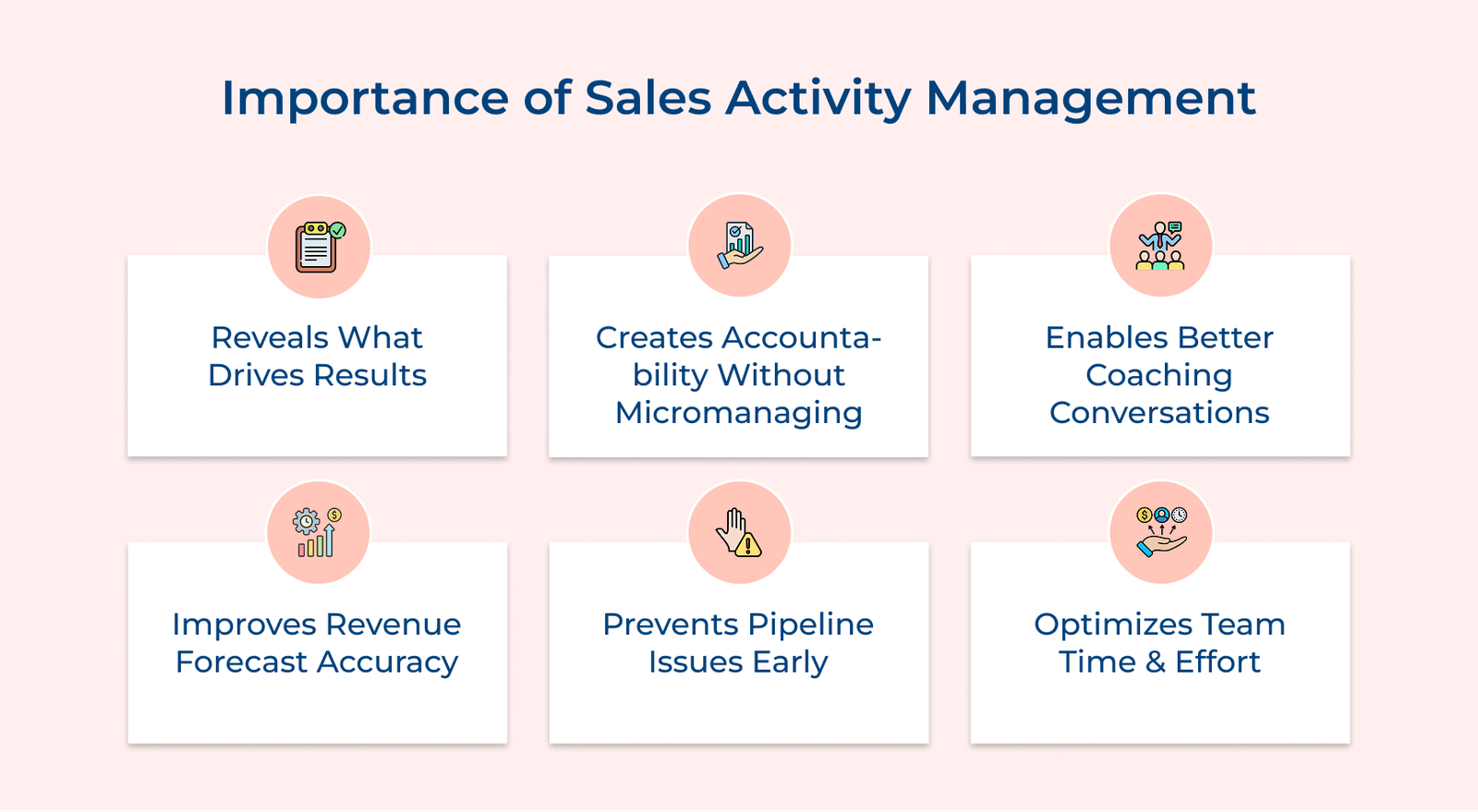
Reveals What Actually Drives Results
Consistent activity tracking shows which actions truly move prospects toward a sale. Instead of relying on instincts, you make decisions based on patterns from your own team’s performance.
Creates Accountability Without Micromanaging
Reps know exactly what’s expected each day and can keep themselves on track. The clarity encourages ownership and reduces the need for constant check-ins from managers.
Improves Coaching Conversations
Managers can address specific habits rather than giving broad or unclear advice. If a rep is falling behind, activity data points directly to what needs to change.
Forecast Revenue More Accurately
Historical activity data shows how many sales calls or demos typically lead to closed deals. You can project future revenue by analyzing current activity levels and knowing your conversion rates at each sales pipeline stage.
Prevents Pipeline Problems Early
Low activity today becomes an empty pipeline tomorrow. You can spot slowdowns early and fix them before they impact revenue by monitoring actions in real time.
Helps your Team Spend Time Wisely
Activity data shows which tasks bring in results and which ones don’t. It makes it easier to cut low-value work and focus on actions that consistently produce new opportunities.
Below are the crucial steps to successfully implement SAM, ensuring your team operates at its maximum potential and consistently reaches its sales objectives.
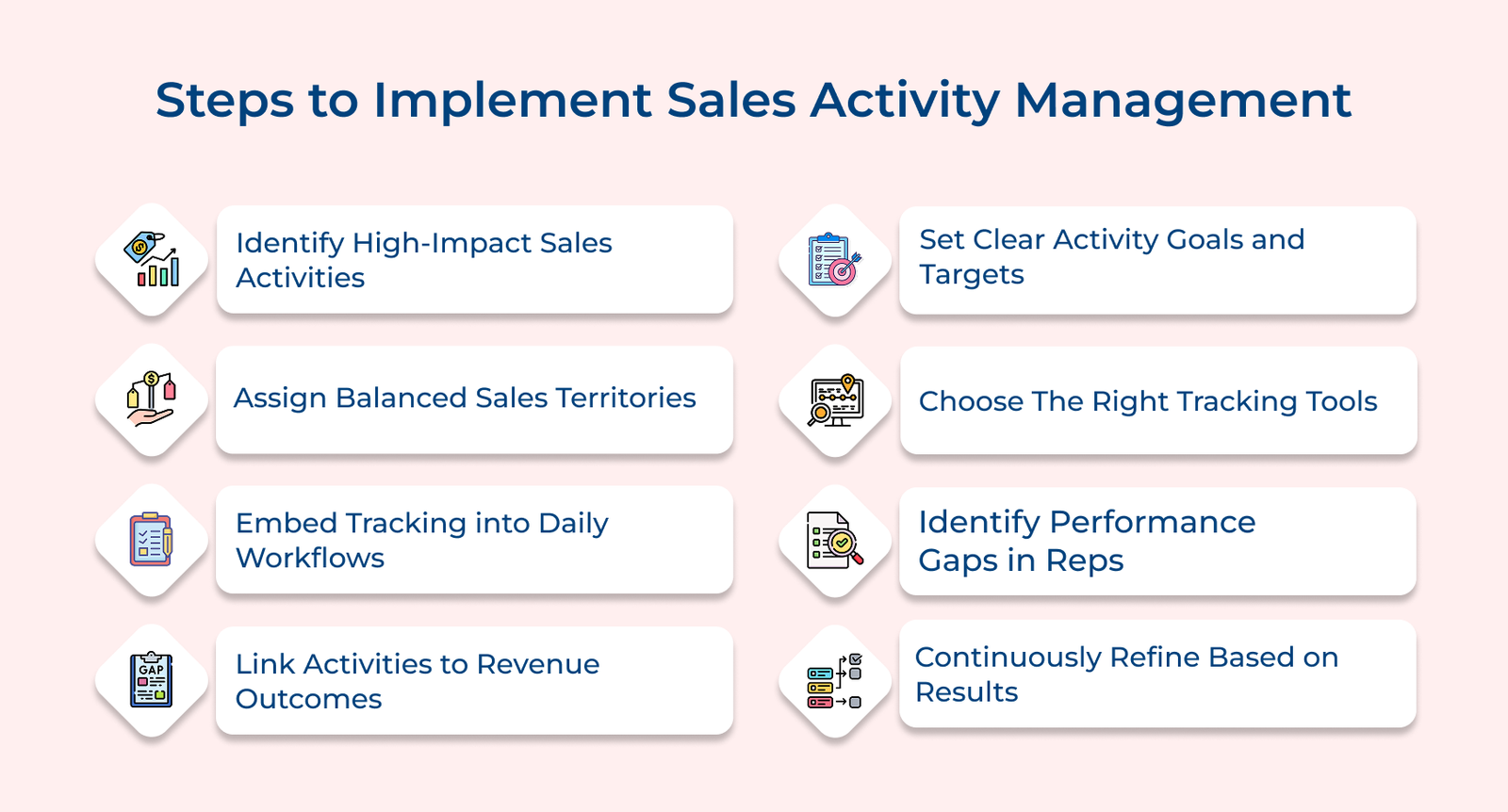
Not every sales action pushes a deal forward. Your job is to pinpoint the handful of activities that consistently move prospects closer to buying, so your team spends time where it actually generates revenue.
Key questions:
Activity goals give your team something concrete to aim for each day instead of waiting for the end of the month to see if they’re on track. When reps know the exact actions that matter, their effort becomes consistent and predictable.
Key ways:
The main risk is setting targets too high or too generic. Start with conservative benchmarks and adjust them quarterly based on what your team actually achieves.
Imagine your average deal requires 12 touchpoints to close over 45 days. If you want each rep closing four deals monthly, they need roughly 48 meaningful activities weekly, plus time for deal progression tasks and internal meetings to hit quota consistently.
Territories decide how much real opportunity each rep gets. When some reps inherit high-potential accounts while others get sparse or slow-moving regions, performance gaps appear that have nothing to do with skill or effort.
A well-designed territory gives every rep a fair shot. It should offer enough qualified accounts to support their activity targets without overwhelming them or forcing them to chase low-quality leads just to stay busy.
Pro tips:
Your tracking tools determine if activity data actually gets captured or remains invisible to your team. If you don’t have the right tools, reps won’t log activities consistently, leaving you with incomplete data and shaky decisions.
Key factors:
Run a two-week pilot with a few reps during real selling situations. Their feedback will reveal what works smoothly and what creates friction before you roll it out to the entire team.
Activity tracking only works when it fits naturally into a rep’s natural selling rhythm. If logging feels like extra work, reps skip it, the data becomes unreliable and the whole system falls apart.
Pro tips:
The biggest challenge is reps viewing tracking as an administrative burden rather than valuable sales intelligence. You can solve it by showing them how activity data highlights patterns that actually help them close more deals, not just fill out fields.
Catching performance issues early lets you coach reps before small habits turn into long-term problems. Instead of guessing why someone is falling behind, you pinpoint the exact behaviors holding them back.
Key questions:
The questions help you look past missed quotas and focus on the real issues. If a rep makes enough calls but never books second meetings, you know exactly where to coach instead of relying on general feedback.
Key metrics:
Once you identify specific underperformance patterns, create improvement plans focused on one or two activities at a time. Trying to fix everything at once overwhelms reps, but targeting high-impact gaps, like better discovery calls, drives measurable improvement within weeks.
Linking activities to revenue shows your team which actions drive deals and which ones are just busy work. Without the connection, reps waste time on low-value activities that feel productive but don’t actually move the revenue needle for your business.
Pro tips:
Imagine one of your reps completes 100 activities monthly but only closes two deals while another does 60 activities and closes five deals. The second rep leans on personalized videos and multi-threaded emails, highlighting which activities actually drive results.
Refining your process is how your activity management system gets sharper and more effective over time. Buyer habits change, industries shift and tactics that worked a few months ago can lose their impact if you never adjust.
Start by reviewing what’s actually producing results. Compare quarterly activity targets with the revenue those activities created. If certain tasks generate lots of motion but little pipeline, that’s a sign your process needs tuning.
Actionable tips:
The following are five platforms that SaaS companies commonly use to manage sales activities effectively.

Veemo Sales helps teams stay on top of their daily work by capturing every sales activity automatically and showing which actions actually move deals forward. Instead of juggling spreadsheets or guessing what’s working, reps get a clear picture of how their efforts translate into real results.
Key features:
A full CRM that tracks activities without extra effort. It automatically logs emails and calendar events and lets managers view the team’s work through customizable dashboards. Einstein AI also suggests useful next steps based on past deals.
HubSpot Sales Hub offers intuitive activity tracking that sales reps actually enjoy using because of its clean interface and simple logging process. The platform tracks email opens and clicks automatically so reps know when prospects engage. Its sequences feature lets you build automated activity workflows that prompt reps when it’s time for the next touchpoint.
Outreach specializes in sales engagement and activity management with powerful sequencing capabilities for multi-channel outreach campaigns. The platform tracks every call, email and social touch while showing which activity patterns get the best response rates. Its AI-powered recommendations help reps prioritize which prospects to contact based on engagement signals and historical conversion data.
The software records as well as analyzes calls and meetings so teams can see what top sellers do differently. It highlights effective talk tracks and surfaces trends such as ideal email length or the best time of day to reach prospects.
Clari focuses on revenue operations and provides deep visibility into how sales activities impact pipeline health or forecast accuracy. The platform links activity data to deal movement so you can see which actions push opportunities forward. Its predictive analytics use activity patterns to flag at-risk deals early so managers can intervene before opportunities slip away.
Check out the common challenges in sales activity management to help you anticipate problems and build more resilient processes from the start.
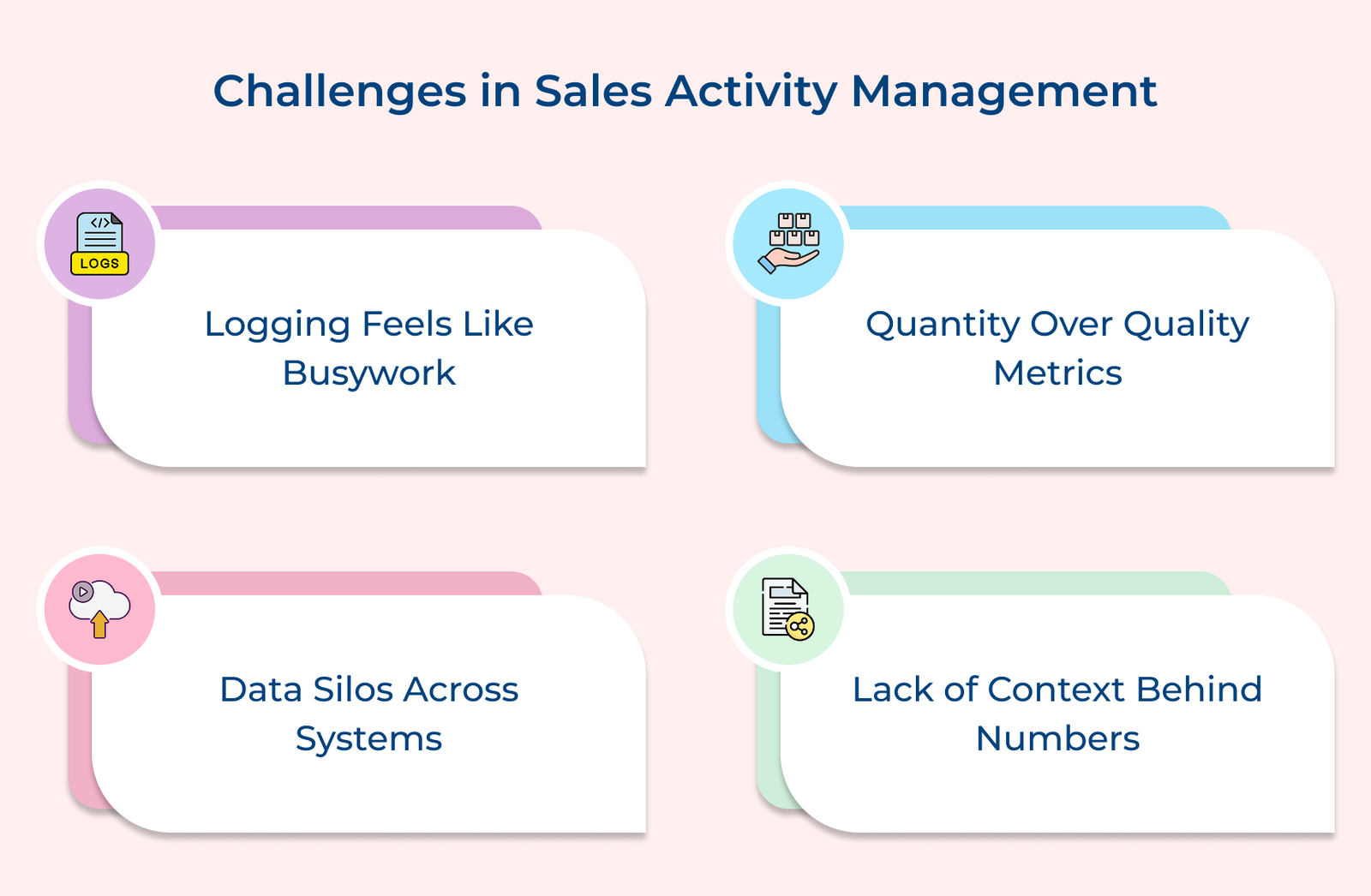
Logging Feels Like Busywork
Reps avoid logging because it feels like admin work that interrupts selling. If they don’t see a direct benefit, they skip steps or enter partial data, leaving you with gaps that make performance hard to understand.
Quantity Overshadows Quality
When teams focus on hitting activity counts, reps start doing quick, low-value touches just to meet numbers. It leads to rushed calls and generic emails that don’t move deals forward.
Data Lives in Separate Tools
Activity data spread across multiple systems makes it hard to see the full story. Managers end up piecing together reports instead of spending time actually helping their reps.
Numbers don’t Explain the Cause
Activity data reveals problems but doesn’t automatically explain how to fix underperformance. You can see fewer discovery calls but data won’t explain whether it’s skill, territory or targeting issues. Turning insights into coaching requires interpretation that raw numbers don’t provide.
Implementation steps:
Sales activity management turns scattered efforts into a steady, repeatable process by showing exactly which daily actions lead to real progress. When you can see what actually moves deals, reps stop guessing and focus on the work that matters.
Start by identifying your highest-impact activities and building tracking into your team’s natural workflow. The right approach uses simple tools, clear targets and regular review so your process improves based on real customer interactions.

Activity management reveals which daily behaviors actually convert prospects into customers so your team focuses energy on high-impact actions. It creates accountability through clear expectations and enables targeted coaching based on specific performance gaps. When reps see how their actions connect to results, they naturally spend more time on the activities that move deals forward.
You need clear definitions of each activity, targets that match reality and tools that track work without adding extra tasks. Regular reviews keep reps on track and ongoing adjustments ensure the team focuses on activities proven to support closed deals.
Track sales metrics like activity volume, like calls or emails, alongside conversion points such as a meeting booked from outreach. Watch response rates to understand quality and measure how long it takes for activities to turn into real opportunities. Activity-to-revenue patterns show which actions are actually worth the time.
Regular tracking provides early warning signals when pipeline problems are developing before they impact revenue months later. It also highlights where individual reps may need help, allowing managers to intervene sooner. Over time, it creates a reliable picture of what works for your market and buyers.
Technology automates activity capture across email, phone and calendar systems so reps spend less time on data entry. It provides real-time dashboards that make performance visible without manual report compilation. Advanced platforms use AI to identify successful patterns and recommend next-best actions based on what’s worked in similar deals.
Activities today shape your pipeline tomorrow. When you know your typical conversion rates, current activity levels make forecasting more accurate. If activity drops, you can spot future pipeline gaps weeks before they appear in end-of-quarter numbers.
Grow Customer Relationships and stronger team collaboration with our range of products across the Conversational Engagement Suite.
Omnichannel Customer Support & Help Desk Software
AI Enabled Business Messaging and Chatbot Software
Sales Engagement & CRM Software
Call Center Software & Virtual Phone System
Product Marketing & Experience Platform
Customer Experience & Feedback Management Software
 Scroll to top