A Guide on Sales Burnout: Benefits, Signs and Steps
Sales burnout affects performance and well-being. Learn key signs, common causes and practical steps to manage stress, stay productive or maintain long-term sales success in high-pressure roles.
Sales burnout affects performance and well-being. Learn key signs, common causes and practical steps to manage stress, stay productive or maintain long-term sales success in high-pressure roles.
Most sales managers recognize their team is burning out only after a top rep has already handed in their notice.
At that point, the warning signs had been there for weeks in the form of shorter calls, missed follow-ups and a rep who stopped challenging deals and started just closing whatever moved fastest.
A survey done by Gartner found that almost 90% of sales employees experience burnout, which is troubling for organizations striving for high performance and retention. It makes it vital for businesses to understand what actually causes sales burnout, the early signals that are often misread as attitude problems or skill gaps and the recovery strategies that hold up across different deal cycles.
Sales burnout refers to a state of ongoing physical and mental or emotional exhaustion caused by constant pressure to meet targets. It goes beyond a rough week and builds over time. When burnout sets in, focus drops, motivation fades and connecting with prospects becomes harder.
Burnout kills motivation and confidence for individual sales reps, the two things you absolutely cannot afford to lose in this profession. The damage goes beyond one person for businesses operating in high-pressure environments like B2B sales or SaaS. You start seeing longer sales cycles, dropping conversion rates and eventually, costly turnover that disrupts your entire pipeline.
Key factors:
Let’s go through the benefits of recovering from sales burnout and how it helps build a more consistent sales approach.
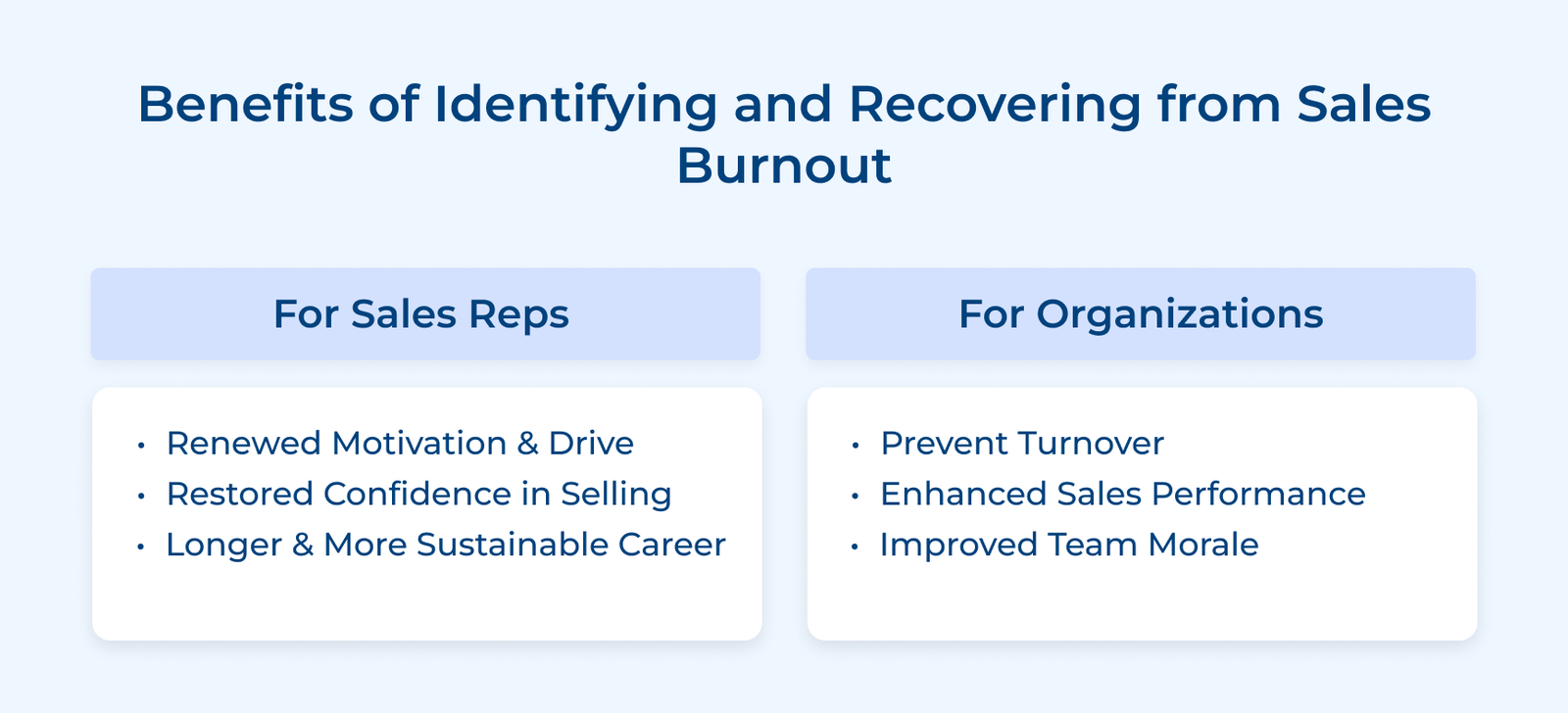
1. Renewed Motivation and Drive
Recognizing burnout and working through it helps bring back genuine motivation. Sales reps move from routine effort to more engaged and purposeful conversations, which reflects in better results.
2. Restored Confidence in Selling
Sales burnout has a nasty habit of making reps second-guess every pitch and every conversation they have. Once they recover, that self-doubt fades and they walk into calls with the kind of natural confidence that actually closes deals.
3. Longer and More Sustainable Career
Learning to manage burnout supports long-term growth. Sales reps build resilience and awareness, helping them stay consistent throughout their careers. It also reduces the risk of frequent burnout cycles.
1. Prevent Turnover
Losing an experienced sales rep can be costly and disruptive. When you identify sales burnout early, you hold onto experienced talent that would otherwise walk out the door and straight to a competitor.
2. Enhanced Sales Performance
Teams perform better when they are mentally focused and engaged. When burnout is addressed at the organizational level, you see healthier pipelines, stronger conversion rates and sales employees who are actually hungry to hit their numbers.
3. Improved Team Morale
Sales burnout can affect the entire team if left unaddressed. Taking visible steps to support reps creates a more positive environment and strengthens overall team engagement. It also encourages open communication around challenges and workload.
The following are the key reasons for sales burnout, highlighting the pressures and patterns that gradually affect performance.
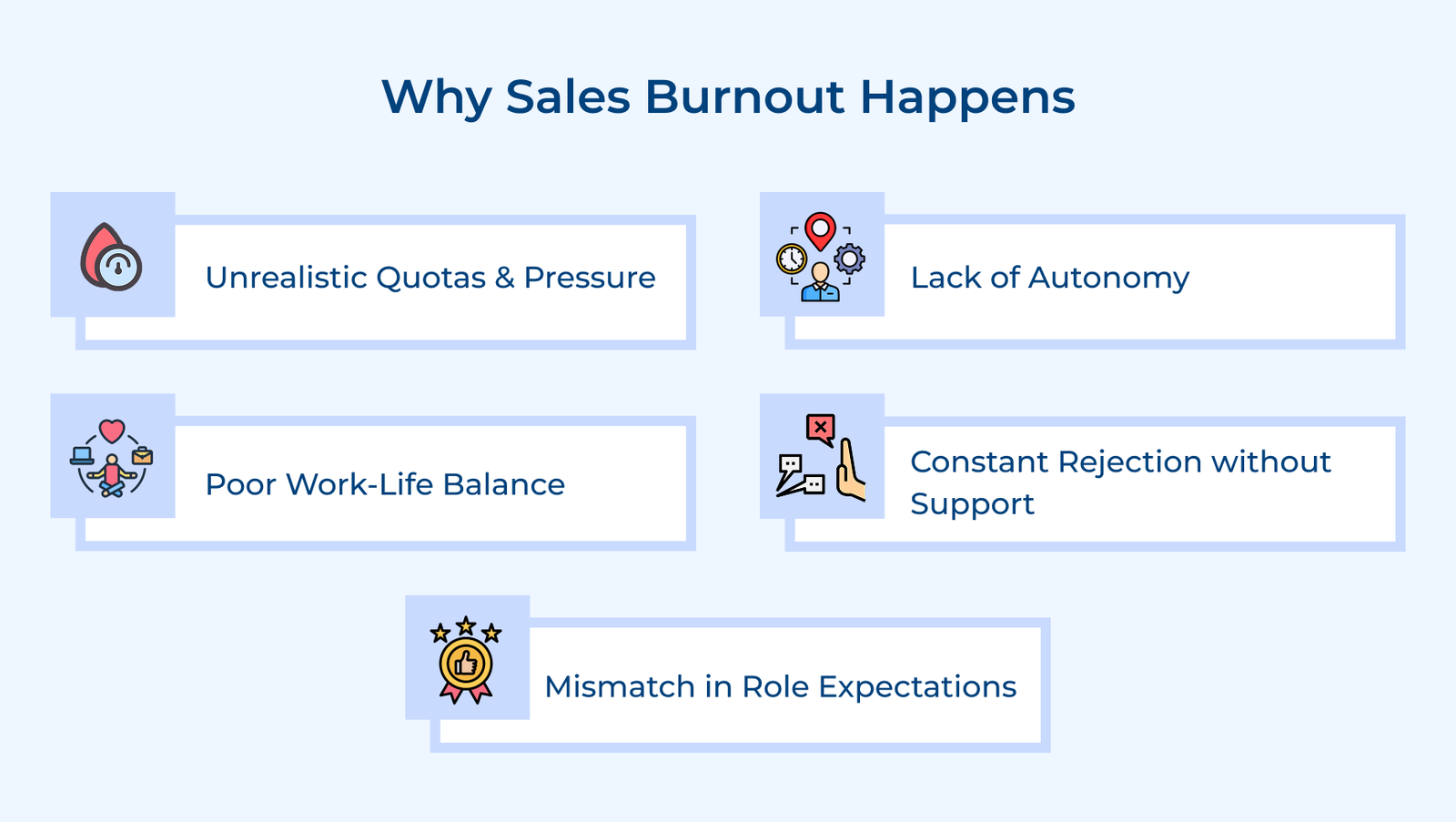
Targets that ignore market realities put constant strain on sales reps. Strong performers can struggle when expectations remain out of reach, no matter the effort they put in. It creates frustration that builds over time and impacts overall performance.
Key ways:
Nothing drains a sales rep faster than feeling like they cannot make a single move without approval. When every email requires approval or every call is closely monitored, reps stop acting independently and begin to rely on constant direction.
Pro tips:
Constant availability is often treated as a requirement in sales roles. The expectation may seem productive at first, but it gradually drains energy and reduces focus over time. Lack of clear boundaries between work and personal time makes it harder to recharge. Reduced recovery leads to lower performance and makes consistent selling more difficult.
Rejection is a natural part of sales. When reps face it constantly without guidance or coaching, even the most resilient start carrying the weight of every lost deal into their next call. Consistent structured reflection helps reps process setbacks, maintain confidence and approach each new opportunity with focus.
Key takeaways:
The issue is more common than many sales leaders acknowledge. When a rep joins with one set of expectations but faces a completely different reality, such as bad leads, broken processes or no marketing support, frustration builds fast.
Best practices:
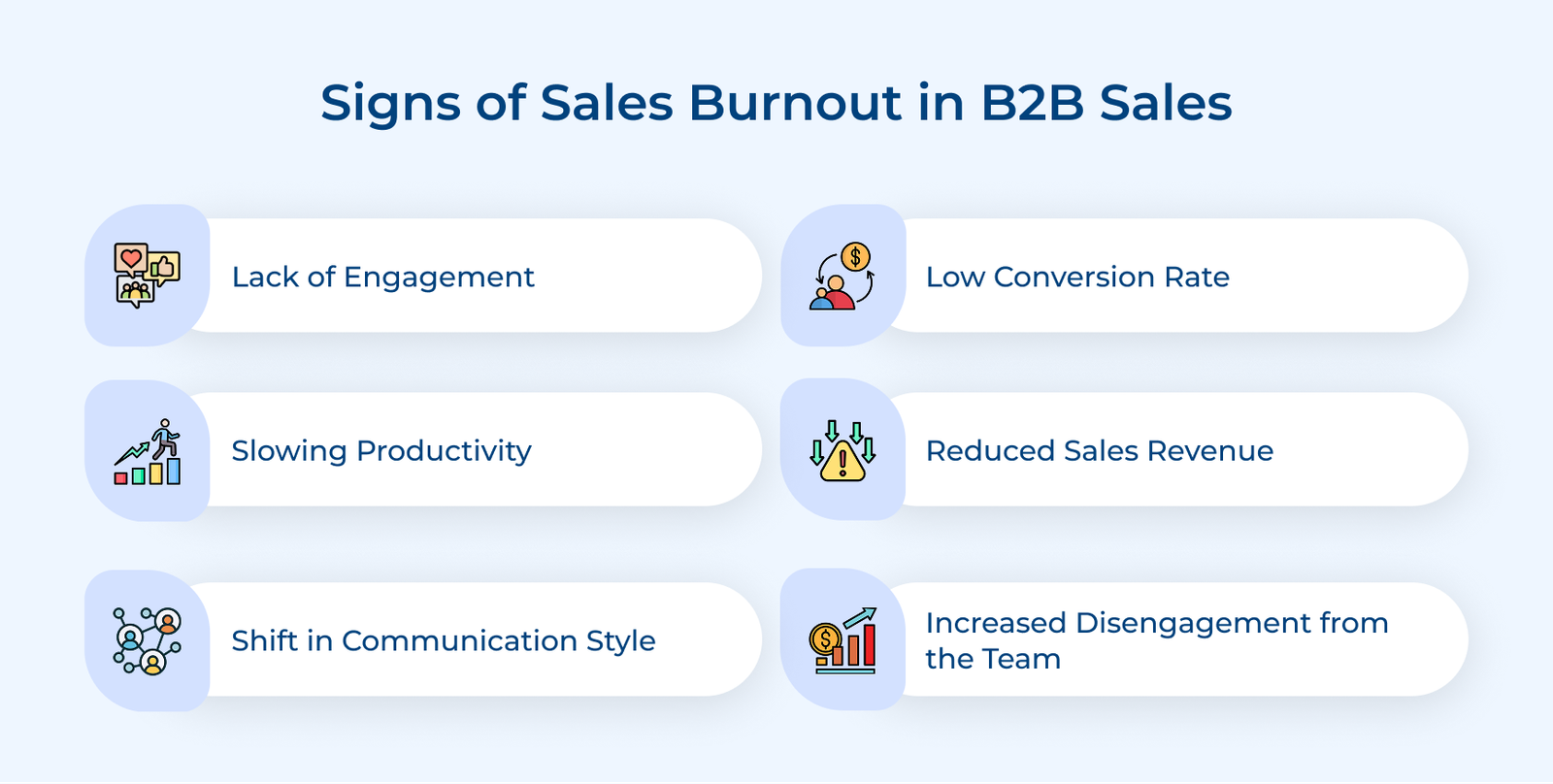
The following are the key signs of sales burnout in B2B sales, helping you identify early warning signals that impact high-pressure selling environments.
1. Lack of Engagement
A burned-out B2B sales rep may still show up, but the involvement is missing. They go through the motions on calls, send templated emails without any personalization and slowly disconnect from the outcomes they used to care deeply about.
The rep who once obsessed over every prospect’s LinkedIn profile before a call now barely glances at the company website. That shift is not laziness; it is a clear signal that something much deeper has gone wrong.
2. Slowing Productivity
A noticeable drop in daily output is often an early sign. Tasks that used to take an hour now stretch across an entire day and the pipeline starts looking thin without any real explanation. The decline often reflects mental fatigue rather than a lack of effort.
Burned-out reps do not suddenly become lazy. They become mentally exhausted to the point where even basic prospecting feels like an impossible task. The slowdown is the body and mind forcing a rest that the rep keeps refusing to take.
3. Shift in Communication Style
Changes in tone can reveal a lot. A person who was once enthusiastic on calls becomes short and transactional and prospects feel that energy shift immediately. The shift often leads to weaker conversations and lower engagement from prospects.
Relationships are everything in B2B sales. When a rep stops asking thoughtful questions and starts rushing through conversations just to get off the call, you are not just seeing sales burnout; you are watching deals die in real time.
4. Low Conversion Rate
A sudden or gradual drop in conversion rate is one of the most measurable signs of burnout sales. When a rep’s conversion rate drops without a clear reason, the issue is often linked to their mental state rather than their skills.
Burned-out reps struggle to build genuine rapport and handle objections with the patience that B2B buying cycles demand. Prospects sense the disengagement and the deal quietly dies, often without the rep even realizing what went wrong.
5. Reduced Sales Revenue
When sales burnout sets in, the revenue impact is not always immediate, but it is inevitable. A rep who is emotionally checked out stops pursuing high-value accounts and starts defaulting to easier but smaller opportunities just to put something on the board.
Over time, the pattern compounds and the revenue gap becomes hard to ignore. The burnout has usually been building for months without anyone addressing it directly, by the time the numbers look bad enough to trigger a conversation.
6. Increased Disengagement from the Team
Burned-out reps often start to withdraw from team interactions. Participation drops and communication becomes limited. It can create gaps in collaboration and reduce overall team effectiveness.
A B2B sales environment depends on team collaboration and shared learning to keep performance strong. When experienced reps go quiet or even worse withdraw, the newer reps lose mentorship and the overall team dynamic starts to suffer in ways that directly impact revenue.
Below are the key ways to prevent and address burnout sales in your team, helping create a more balanced sales environment.
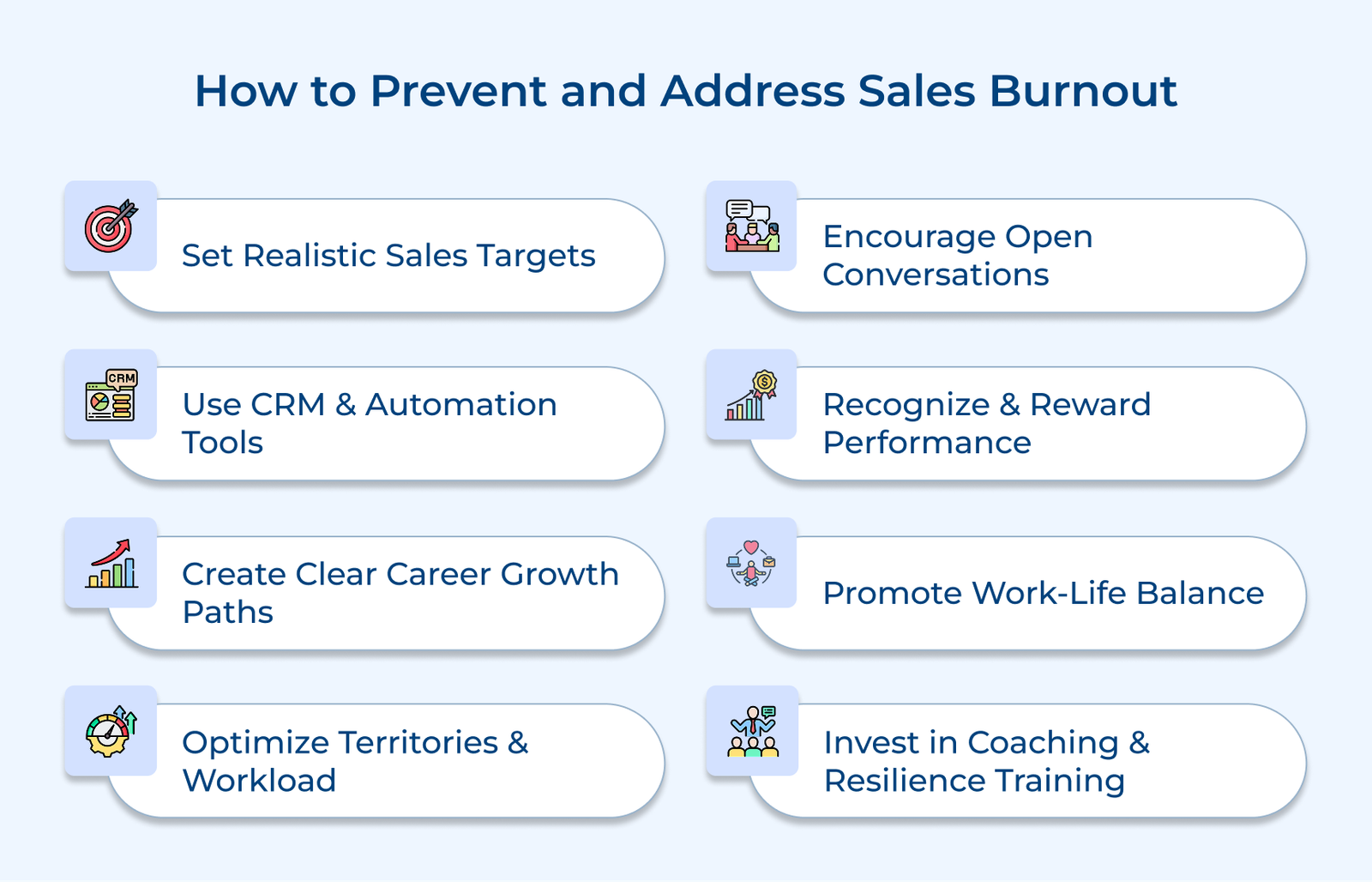
Unrealistic quotas are not a motivation tool. They are a sales burnout accelerator that quietly destroys your best reps before you even notice the damage happening. Numbers disconnected from reality do not drive performance; they drive resignations.
Start by reviewing recent performance data across quarters. Compare results with territory size, lead quality and rep experience to set a clear baseline for targets. It helps ensure targets are grounded in actual performance patterns rather than assumptions.
Pro tips:
Sales burnout cannot be addressed if it is never discussed. A culture where reps feel comfortable speaking up helps identify issues early and prevents them from affecting performance. Create space for honest conversations. Reps are more likely to open up when discussions are separate from performance reviews and focused on their well-being.
Schedule dedicated wellbeing-focused one-on-ones
Separate the conversations from pipeline reviews. A rep will never admit they are struggling when the next agenda item is their conversion rate; the conversations need their own dedicated space entirely.
Train managers to recognize early signs
Managers should be able to notice changes in behavior, such as lower activity levels or shorter calls. Early awareness allows timely support. It helps prevent small issues from turning into larger performance problems.
Create anonymous feedback channels
Not every rep will share concerns directly. An anonymous pulse survey sent bi-weekly gives reps a low-stakes outlet that surfaces real problems before they become expensive turnover situations.
Lack of automation often adds unnecessary workload. Sales reps spend valuable time on repetitive tasks instead of focusing on conversations that drive results. It reduces both efficiency and overall job satisfaction.
Administrative work builds up quickly. Time spent logging calls or updating systems reduces energy for actual selling and affects overall productivity. Over time, the constant drain can lead to frustration and burnout.
Key ways:
Adoption improves when reps are involved in the process. Gradual implementation helps teams adjust without feeling overwhelmed. The approach also builds trust in the tools being introduced.
Recognition that focuses only on closed deals is silently demoralizing your sales team every single month. Experienced sales managers know that sustainable performance comes from recognizing the behaviors that lead to results, not just the results that occasionally follow.
Key questions:
Honest answers to the questions often reveal gaps that affect motivation and engagement. Recognition should reflect the full range of contributions across the team. Start with a simple weekly ritual, a five-minute Slack callout or a brief team meeting shoutout where effort-based wins get named specifically.
Key metrics:
The combination of frequent informal recognition and structured formal rewards keeps reps feeling valued throughout the entire month rather than only on deal-closing days. The approach also builds consistent motivation, ensuring that effort and progress are acknowledged just as much as outcomes.
Key takeaways:
Sales reps start pulling back the moment they cannot picture what comes next for them. The uncertainty slowly turns into disengagement and over time, it leads to burnout, which could have been avoided with clearer direction.
Key checklist:
So what happens when career growth conversations only take place once a year? Most reps have already checked out long before that meeting. Some are quietly exploring other opportunities while still showing up every day, doing just enough to get through.
Best practices:
Uneven territories quietly drain teams. One rep is overloaded with accounts and constant follow-ups, while another is chasing too few real opportunities. Both feel stuck, just in different ways and that imbalance shows up in exits more often than managers expect.
Ignore territory design long enough and performance issues start to look like individual problems. A rep carrying 40% more accounts than peers is not underperforming; they are surviving a situation that was never designed to be sustainable.
Pro tips:
Let’s consider that a SaaS business redistributed territories based on account potential rather than geography, saw immediate improvement in pipeline consistency. Reps who were previously overwhelmed started closing more simply because they finally had bandwidth to nurture deals properly.
Key structure:
Workload imbalance wears people down faster than tough targets ever will. A rep can handle pressure when the playing field feels fair. That sense of fairness disappears quickly when the workload itself feels stacked.
Start with a clear audit of how work is currently spread across the team. Look at account volume per rep, revenue potential in each territory and the split between inbound versus outbound work. Without that audit, any redesign is just rearranging the same problem into a different shape.
Best practices:
Implementing fair territory redesign requires simultaneous buy-in from leadership and the sales floor. Reps need to understand the reasoning behind changes, even positive redistribution gets met with resistance that undermines the entire effort.
Sales coaching that focuses only on skills misses a big part of the job. Reps deal with constant rejection, pressure and uncertainty. Ignoring that side of the role leads to slow burnout, even when performance looks fine on the surface.
Mental resilience can be built with the right structure. Teams that receive consistent coaching handle setbacks better, stay steady during slow periods and keep their activity levels up without feeling drained all the time.
Key ways:
Strong teams are not made up of people who can just push through anything. They are built through consistent coaching that helps reps recover quickly and stay steady over time. Looking beyond numbers and paying attention to what is affecting performance makes a clear difference.
Actionable tips:
Sales burnout rarely shows up all at once. It builds slowly and most teams notice it only after performance drops or good people start leaving. The cost is not just attrition; it shows up in missed targets, weaker pipelines and low energy across the team.
Addressing burnout is a business decision as much as a people decision. When your team feels supported as well as fairly challenged, they stop surviving the job and start excelling at it and that shift shows up directly in revenue.

A clear sign is losing the drive to prospect or feeling a sense of dread before calls. Work starts to feel repetitive and draining, even on days that used to feel rewarding. Small tasks begin to take more effort than usual and progress no longer feels satisfying.
Unrealistic quotas, constant rejection and always-on culture create stress that compounds faster than most reps realize. When those pressures stack without structural support or recovery time, chronic stress crosses directly into burnout territory.
Early signs usually show up in behavior before numbers change. A drop in energy, lower engagement in conversations or hesitation to take initiative are signals worth paying attention to. Fair expectations, open conversations about challenges and regular coaching help keep the team steady.
Recovery starts with honest acknowledgment that burnout has set in, which is harder than it sounds in a performance-driven culture. Structured recovery includes workload adjustment, dedicated coaching support and rebuilding small daily wins that restore confidence progressively.

Grow Customer Relationships and stronger team collaboration with our range of products across the Conversational Engagement Suite.
Omnichannel Customer Support & Help Desk Software
AI Enabled Business Messaging and Chatbot Software
Sales Engagement & CRM Software
Call Center Software & Virtual Phone System
Product Marketing & Experience Platform
Customer Experience & Feedback Management Software

 What is Sales Messaging? Importance, Steps & Best Practices
Scroll to top
What is Sales Messaging? Importance, Steps & Best Practices
Scroll to top