Client vs Customer: What’s the Difference?
Learn the difference between client vs customer. The blog explores how each relationship works in business and why understanding both helps improve long-term growth.

Learn the difference between client vs customer. The blog explores how each relationship works in business and why understanding both helps improve long-term growth.
Many businesses use the terms client and customer interchangeably without realizing the impact that distinction has on revenue, retention and long-term growth. A person making a one-time purchase expects a very different experience from someone building an ongoing business relationship with you.
Knowing the difference between client vs customer is where stronger retention strategies begin because each group responds differently to communication, pricing and service. The blog breaks down the real differences between them, how each relationship functions in business and why that distinction matters for growth.
A client refers to a person or organization that works with a business through an ongoing professional relationship to receive specialized expertise or services. The relationship usually extends beyond a single purchase because the client relies on consistent support, guidance or strategic input over time.
Working with a client goes far beyond completing a one-time transaction. The relationship is built on trust, communication and the expectation that the service will continue delivering value as the client’s needs evolve.
Think of a business hiring a law firm to handle its legal matters year after year. That business is a client and not just a buyer. So, what makes someone a client and not just a buyer? It is the expectation of continuity, personalized service and a professional relationship that grows stronger over time.
Key objectives:
Let’s go through the key characteristics of clients and understand what makes client relationships different from regular customer interactions in real business environments.
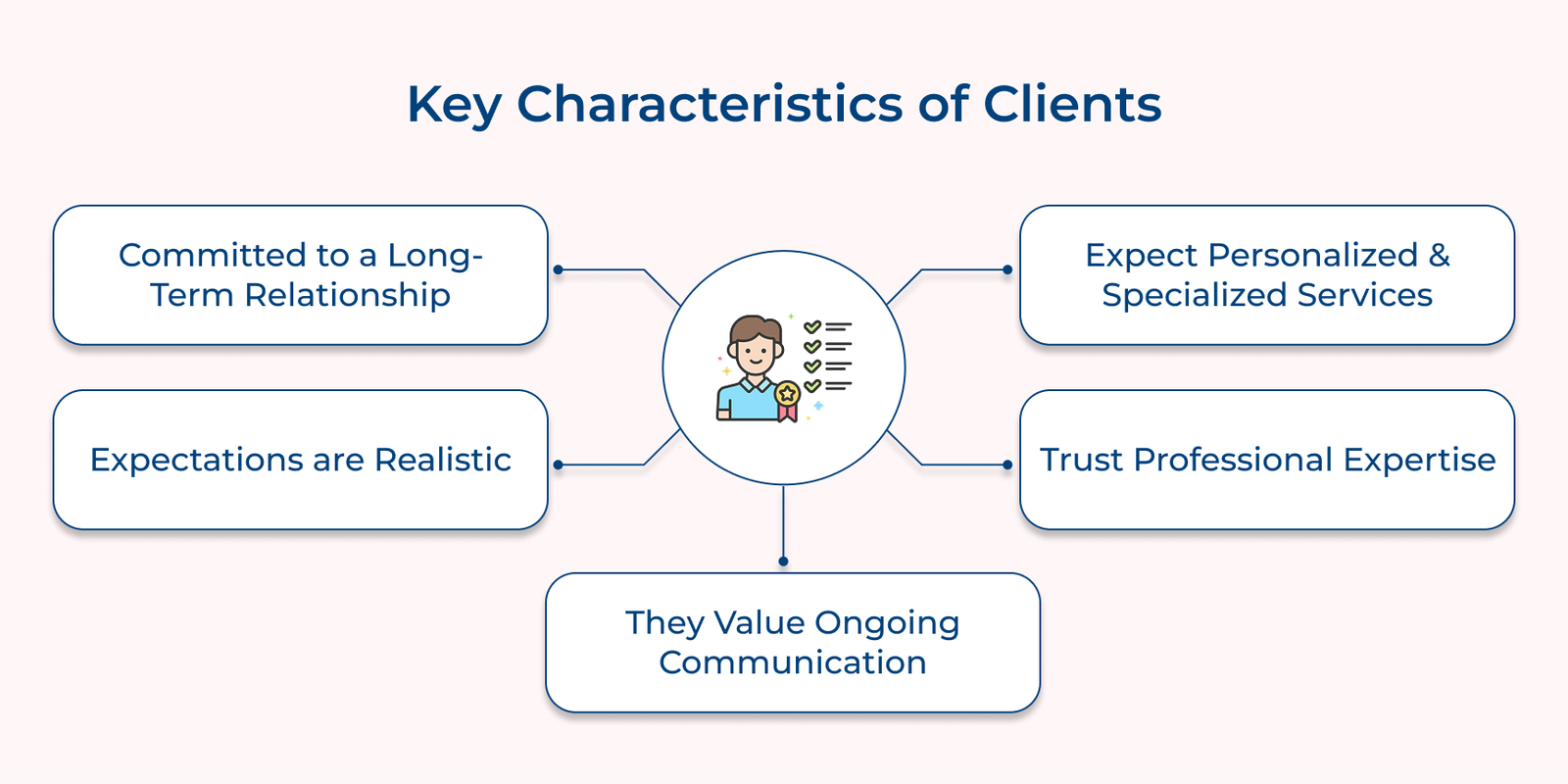
1. Committed to a Long-term Relationship
Clients stay with a business because they see consistent value in the work and the relationship behind it. Their focus is not on a quick transaction but on long-term results that develop over time. Commitment is one of the clearest differences between a client and a one-time buyer. Clients continue working with people they trust because they believe the relationship helps them move closer to their goals consistently.
2. Expect Personalized and Specialized Services
Clients look for solutions designed around their specific needs instead of generic services built for everyone. Personal attention and tailored support are major reasons they choose one business over another. The expectation also makes clients more selective about who they work with. They usually stay loyal to businesses that understand their challenges and deliver solutions that feel relevant to their situation.
3. Expectations are Realistic
Clients understand that meaningful results usually take time, planning and consistent execution. They value the process and expertise rather than expecting instant outcomes. The mindset creates a healthier working relationship because clients trust professional guidance throughout the process. Realistic expectations make communication smoother and collaboration far more productive for both sides.
4. Trust Professional Expertise
Clients hand over important responsibilities because they believe in the expertise and experience of the business they hired. Trust plays a central role in every strong client relationship. They are not constantly questioning every recommendation or decision because confidence has already been established. Earning that level of trust takes time and maintaining it requires consistent delivery and honest communication.
5. They value Ongoing Communication
Clients understand that regular communication is necessary for strong professional relationships. Updates, discussions and feedback help keep both sides aligned throughout the entire process. They stay involved instead of disappearing after the initial agreement because strong outcomes usually come through collaboration. A committed client remains engaged and invested from beginning to end.
A customer refers to a person or organization that buys a product or service from a business in exchange for money. The relationship is usually centered around the transaction itself instead of an ongoing professional partnership.
Customers play a major role in every business because consistent purchases are what keep products and services profitable in the market. Their decisions are often influenced by convenience, pricing, speed and immediate needs rather than long-term relationship building.
Unlike clients, customers are usually looking for a quick and effective solution instead of continuous personalized support. The buying decision often comes down to finding the right offer at the right moment with the least amount of friction.
Key objectives:
Let’s go through the key characteristics of customers and understand what shapes their relationship with businesses across different industries.
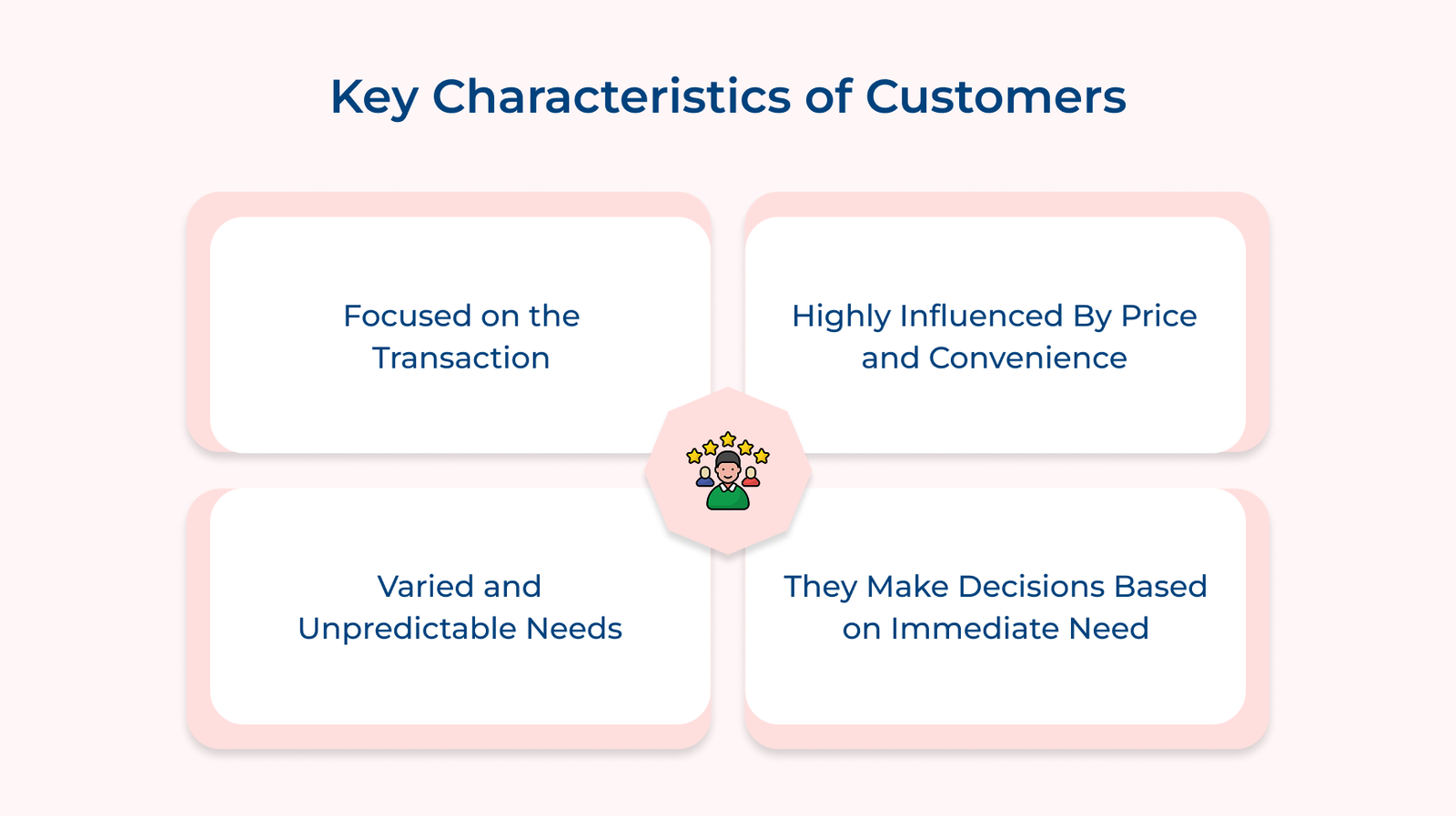
1. Focused on the Transaction
Customers usually approach a business with one immediate goal, which is to purchase something they need quickly and efficiently. Their priority is solving a problem or fulfilling a need rather than building a long-term relationship with the business.
Pro tips:
Once the transaction is complete, the interaction usually ends until another need appears. That does not make customers less valuable. It simply means businesses need to focus on delivering a fast, reliable and straightforward experience every single time.
2. Highly Influenced by Price and Convenience
Customers often make fast buying decisions based on value, pricing and how easy the purchase process feels. A competitor offering a similar product faster or at a lower price can quickly pull their attention away.
Customer loyalty is rarely automatic. Businesses keep customers by making the experience simple, reliable and worth the money every single time they purchase. Customers return to businesses that consistently make purchasing easy, convenient and dependable without creating unnecessary friction in the process.
3. Varied and Unpredictable Needs
Customers come with different expectations, preferences and buying behaviors that can change very quickly. One customer may prioritize price while another cares more about speed, quality or convenience. Customer expectations also shift depending on urgency, budget, personal preference and the type of experience they have with your business.
The variety makes serving customers very different from managing clients. Businesses usually rely on strong systems, efficient processes and consistent customer service standards to handle large customer groups successfully.
4. They Make Decisions Based on Immediate Need
Customers are usually focused on solving a problem as quickly as possible. Speed, availability and convenience often influence the purchase decision more than long term relationship building. Businesses that remove delays and make the buying process effortless are usually the ones customers choose first in urgent situations.
Actionable tips:
Businesses that respond quickly and remove friction from the buying process usually have a major advantage. Customers remember how easy it was to get what they needed at that exact moment. That positive experience often becomes the reason customers return the next time they need a similar solution.
Check out the key differences between clients vs customers and understand why that distinction shapes long-term business growth.
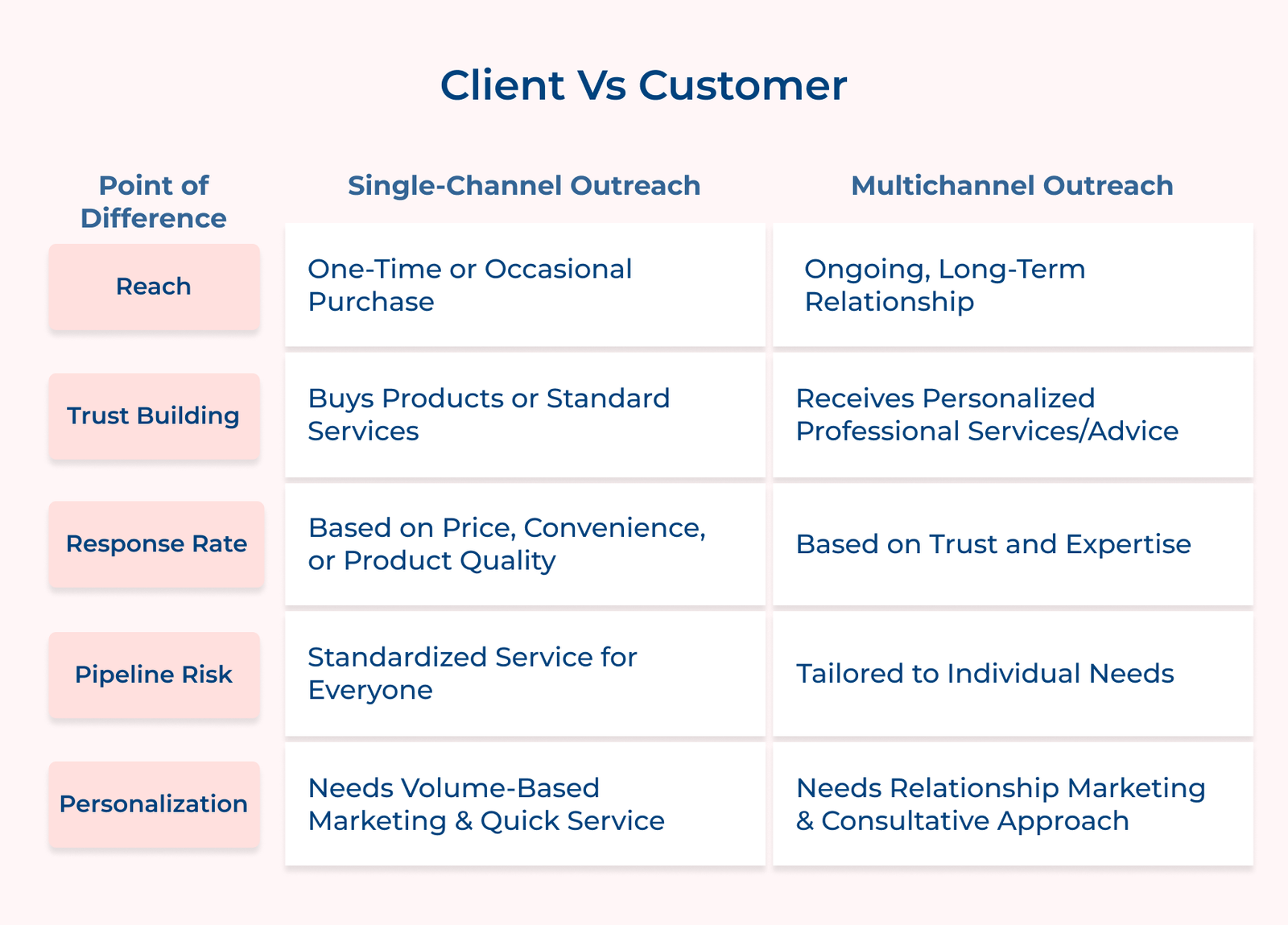
A client relationship is built around ongoing collaboration, trust and long-term commitment. The value of that relationship usually grows stronger over time because the service provider develops a deeper understanding of the goals, challenges and way of operating.
Think of a CFO working with the same accounting firm for five consecutive years. That accumulated context is something no new service provider can replicate. That is exactly why clients stay loyal and why that loyalty is worth protecting at every stage of the engagement.
Pro tips:
A customer interacts with a business for a specific purchase and the relationship rarely extends beyond that single transaction. That absence of continuity is completely normal and businesses must design their operations around that reality.
Clients usually choose a service provider based on expertise, reputation and the confidence that their problem will be handled properly. Trust and proven capability often carry far more weight than price alone during the decision-making process.
A client rarely commits just because of a proposal or presentation. The real deciding factor is usually the belief that you understand their situation deeply and can deliver meaningful results consistently. Clients want confidence that you can handle their challenges responsibly and guide them toward outcomes that genuinely matter to their business.
Actionable tips:
Customers approach decisions very differently. Their focus is usually on pricing, availability and how conveniently they can access what they need right now. Immediate value for money is almost always the deciding factor and brand loyalty comes secondary to that.
Key takeaways:
Clients expect services to be built around their specific goals, challenges and business situation instead of receiving the same solution given to everyone else. Every recommendation, strategy and deliverable should reflect a genuine understanding of what matters most to them.
Clients can quickly recognize the difference between true personalization and simply reusing the same approach with small surface-level changes. Trust starts weakening the moment the service begins to feel generic or disconnected from their actual needs.
Best practices:
A customer is largely served through standardized products and processes because personalization at scale is neither practical nor expected. What customers want is consistency, the same reliable experience every single time they show up.
Pro tips:
Client relationships depend heavily on regular and structured communication because both sides are working toward goals that continue evolving. Ongoing discussions, progress updates and strategic conversations help keep the entire relationship aligned.
Communication problems can damage a client relationship very quickly. Long periods of silence are often interpreted as a lack of progress or lack of attention, even when work is happening behind the scenes. Regular communication reassures clients that their priorities are being actively managed and that the engagement is moving in the right direction.
Best practices:
A customer does not expect regular communication beyond transactional interactions like order confirmations and well-timed promotional offers. Overcommunicating with customers can feel intrusive and end up pushing them away from your brand entirely.
Client relationships are usually priced around expertise, outcomes and long-term value instead of simply charging for time or individual deliverables. Retainers, custom project fees and ongoing contracts are common because the relationship itself continues beyond a single transaction.
Best practices:
A customer transaction is priced on a fixed or market-driven rate that applies equally to everyone buying that product. The pricing is standardized because the product is standardized and that is exactly how customer-facing revenue models are designed to work.
Key takeaways:
Clients place significant trust in your professional judgment because the outcomes attached to the relationship often carry serious business impact. They are relying on your expertise to guide decisions, solve problems and protect results that matter deeply to them.
A startup trusting a consultant, agency or legal advisor with an important part of its business is not simply buying a service. They are depending on someone else’s experience, recommendations and decision-making ability to help move the business forward successfully.
Pro tip:
Customer relationships usually involve a lower level of trust because the transaction itself carries lower risk and less long-term involvement. Customers mainly rely on product quality, pricing, reviews, guarantees and convenience instead of placing trust in an individual professional’s expertise.
Clients often become the strongest source of long-term business stability because they bring recurring revenue, ongoing work and predictable growth opportunities. A single, well-maintained client relationship can generate more long-term value than many one-time customer transactions combined.
Businesses sometimes focus heavily on chasing new sales while overlooking the value of protecting existing client relationships. Long-term clients usually cost less to retain, generate steadier revenue and create stronger growth foundations over time.
Pro tips:
Customers contribute to growth through volume and frequency but their individual impact on revenue stability is considerably lower. A business relying entirely on customer volume must constantly invest in acquisition and that makes long-term planning far more difficult.
Best practices:
Below are the key differences between how client vs customers move through the sales funnel and why each path requires a completely different strategy.
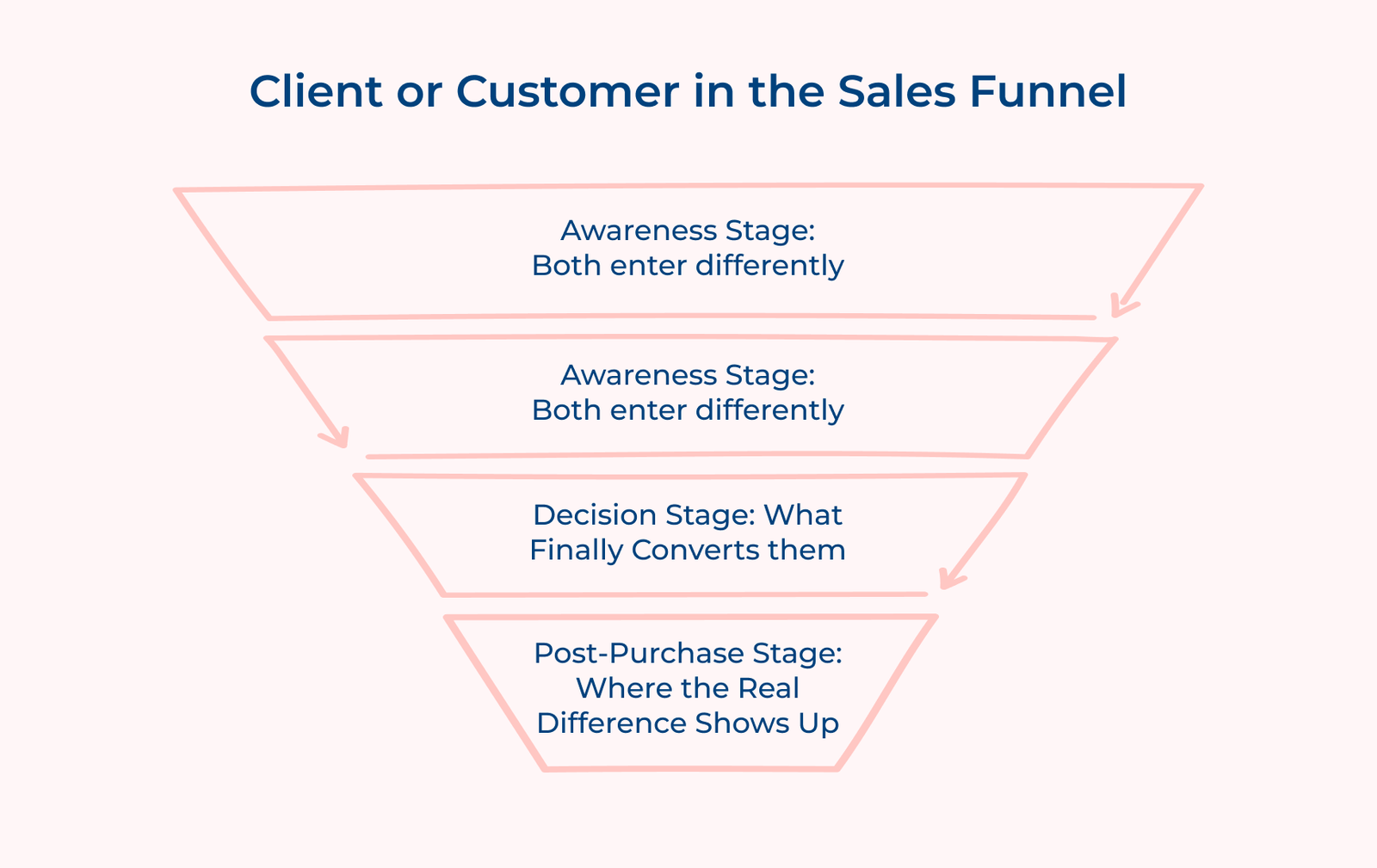
Customers usually discover your business through ads, search engines and social media content because their focus is often tied to an immediate need or quick solution. Their entry point into the sales funnel is broad, fast and heavily influenced by visibility.
A customer compares prices, reads reviews and makes a relatively quick decision based on convenience or and perceived value at that moment. A client evaluates your case studies, your team’s credentials and your track record before they even consider booking an introductory call with you.
Customers usually convert when the pricing feels reasonable and the buying experience feels simple or friction-free. A client converts when trust has been established and they genuinely believe your expertise is the right fit for their specific problem.
A customer’s journey largely ends at the purchase unless a strong retention strategy actively pulls them back into your ecosystem again. A client’s journey is just beginning at the contract stage. The real work of delivering value and deepening the relationship starts right after.
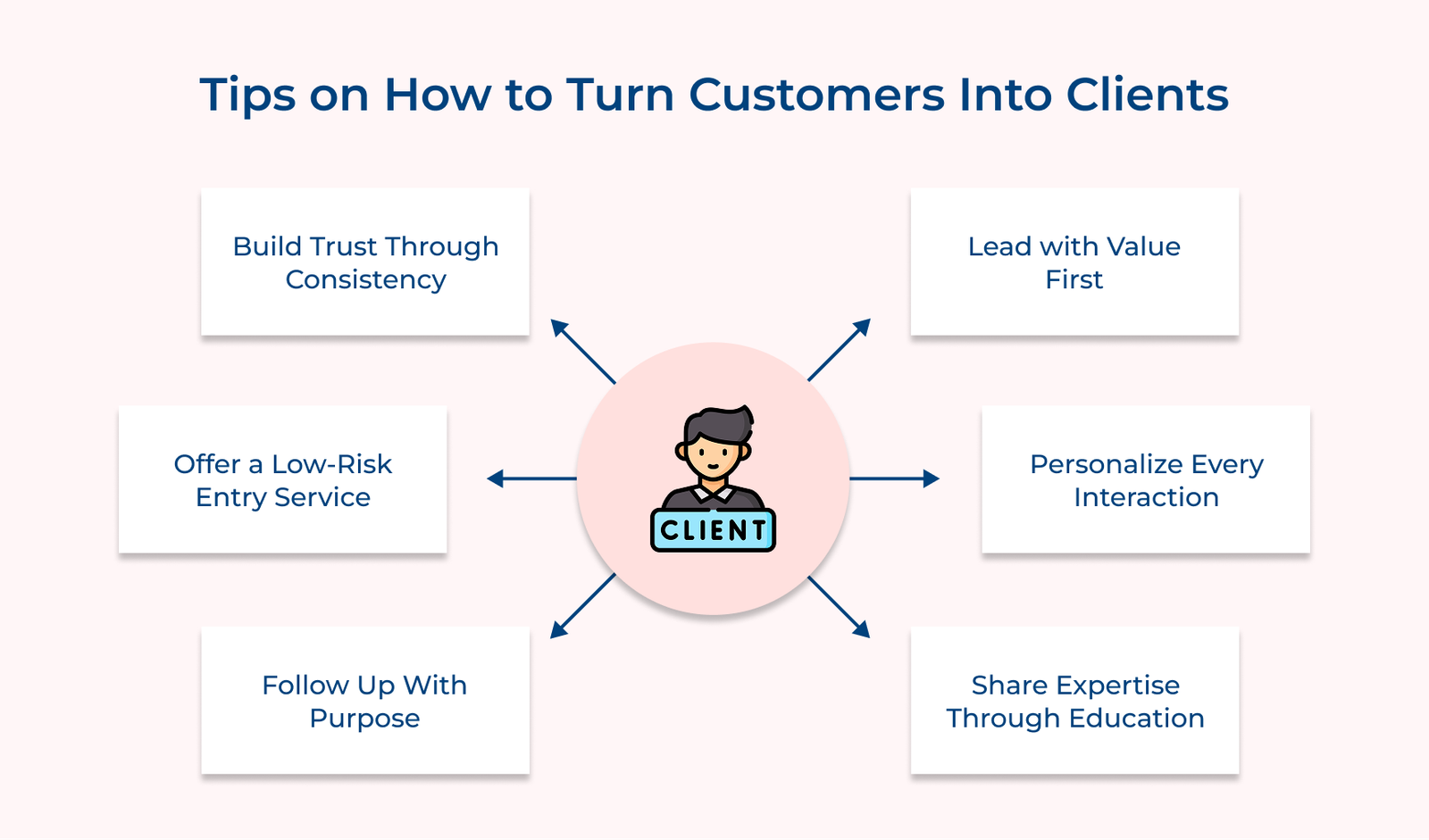
The following are practical ways to turn one-time customers into long-term clients who trust your expertise, stay loyal to your business and continue working with you over time.
Check out the real-world examples below to understand how clients and customers interact with businesses differently.
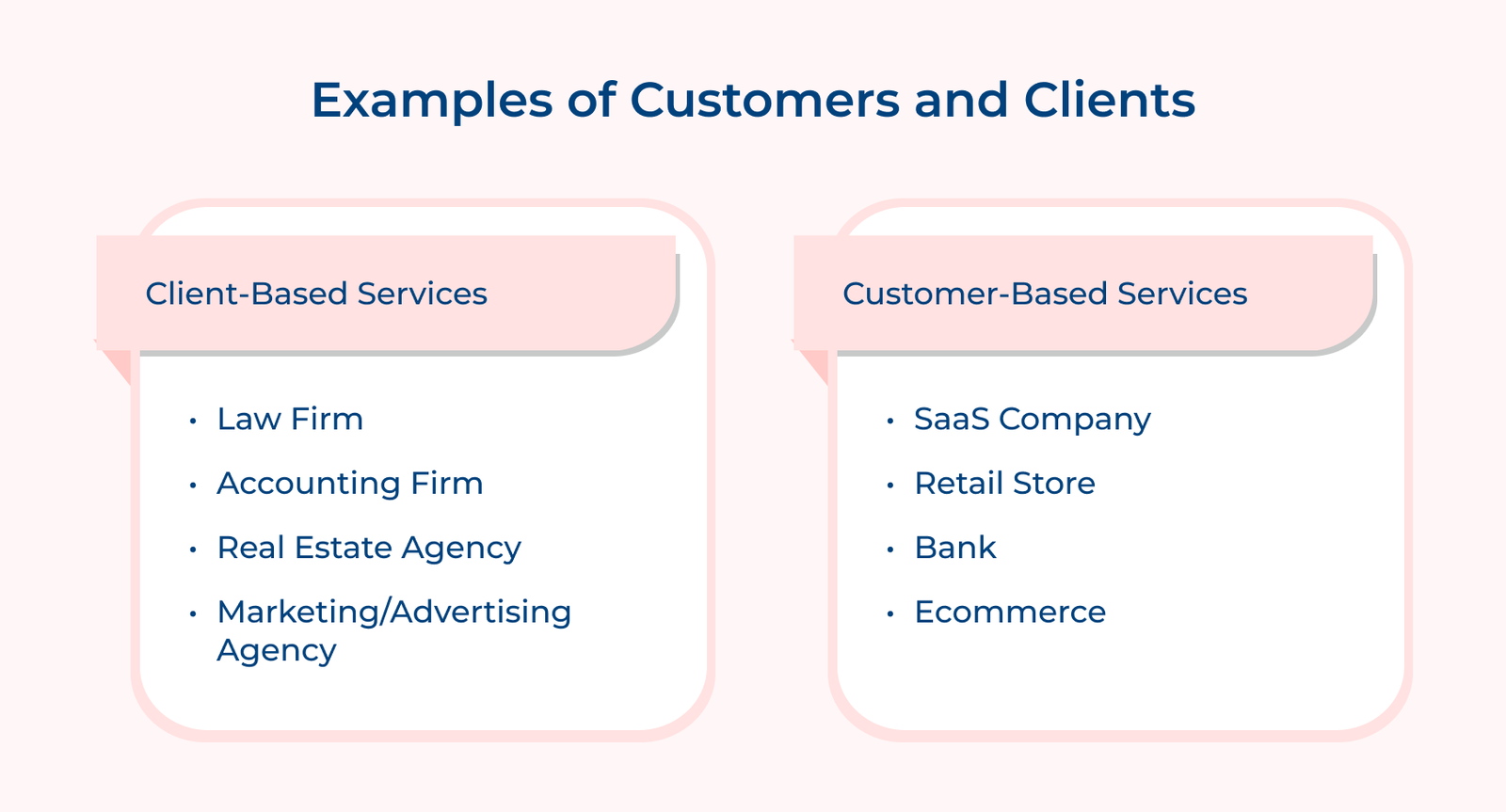
1. Law firm
A business hiring a law firm to manage contracts, compliance or legal disputes is working as a client and not as a one-time buyer. The relationship depends on long-term trust, ongoing communication and legal guidance tailored specifically to the business and its evolving needs.
2. Insurance agency
A company relying on an insurance agency to manage corporate coverage and risk protection is operating within a client relationship. The agency studies the company’s risks, recommends suitable coverage and adjusts those policies as the business changes over time.
3. Accounting firm
A business working with the same accounting firm year after year for tax planning, audits and financial reporting represents a strong client relationship. Long-term accountants carry deep knowledge about the company’s financial structure, operations and history, which makes their role increasingly valuable over time.
4. Marketing/advertising agency
A brand partnering with an agency for ongoing marketing campaigns, brand strategy and market positioning is engaging as a client. The agency invests time in understanding the brand’s voice, audience or goals and that investment only deepens with every passing month.
1. SaaS Company
A person subscribing to a project management software and switching to another platform when a cheaper option appears is operating as a customer. The relationship is mainly transactional because the decision is driven by pricing, features, convenience and immediate usability instead of long-term professional guidance.
2. Retail Store
Someone entering a retail store, buying what they need and leaving after checkout represents a typical customer interaction. The business focuses on delivering a fast, reliable or consistent shopping experience because the relationship usually begins and ends within that single transaction.
3. Banking
A person using a bank for routine services like deposits, withdrawals or a standard savings account is functioning primarily as a customer. Most interactions are system-driven and product-focused without requiring ongoing personalized advice or deep professional involvement from the bank.
4. E-commerce Platform
A shopper browsing an online store, adding products to the cart and completing a purchase reflects a straightforward customer relationship. Purchase decisions are usually influenced by pricing, reviews, product availability and delivery speed, while the business serves large volumes of customers through efficient systems.
Understanding the difference between a client vs customer changes the way a business communicates, delivers value and builds long-term growth. The way you serve, price and communicate changes completely once you understand which one you are actually dealing with.
Key takeaways:
Businesses that succeed long-term understand that the difference between a client and a customer is far more than a label. It shapes how relationships are built, how loyalty develops and how sustainable revenue grows over time.

Understanding the difference helps businesses communicate better, price services more effectively and deliver experiences that match what people actually expect. A business that treats every client as a simple transaction will weaken trust, while a business that treats every customer as a high-touch client will waste time, effort and resources unnecessarily.
Hospitality businesses serving clients need to focus on personalized communication, tailored experiences and proactive relationship management across every interaction. Customers expect speed, convenience, consistency and a smooth experience that makes returning feel easy without requiring extra effort from them.
Clients are the financial backbone of any service-driven business because they bring recurring revenue and long-term stability that customers simply cannot match. A strong client base also reduces your dependence on constant acquisition and gives your business the breathing room to grow with intention.
Customers keep businesses active, visible and competitive through regular purchases and consistent market demand. They also represent the largest pool of potential clients and every positive customer experience is an opportunity to begin building something deeper.

Grow Customer Relationships and stronger team collaboration with our range of products across the Conversational Engagement Suite.
Omnichannel Customer Support & Help Desk Software
AI Enabled Business Messaging and Chatbot Software
Sales Engagement & CRM Software
Call Center Software & Virtual Phone System
Product Marketing & Experience Platform
Customer Experience & Feedback Management Software
 Scroll to top