What Is Social Media Ecommerce & How To Use It Effectively?
Learn how social media ecommerce helps businesses sell directly through social platforms and reach targeted audiences. Learn how you can increase sales with effective commerce strategies.
Learn how social media ecommerce helps businesses sell directly through social platforms and reach targeted audiences. Learn how you can increase sales with effective commerce strategies.
Most ecommerce brands have an active presence on social media, but many still struggle to turn engagement into consistent sales. Social media now connects more than 5.2 billion users worldwide and platforms like Instagram or TikTok continue to expand their shopping capabilities. As a result, the gap between brands that generate sales through social channels and those that only publish content continues to grow.
Social media ecommerce is the practice of using social platforms to attract, engage or convert buyers through content, community or native shopping features, covering organic strategy, UGC, paid social and platform-specific execution. Below we’ll go through the strategies, platforms, metrics and real brand examples that will help you build a social media presence that drives actual sales.
Social media ecommerce refers to the process of using social platforms to promote products, engage with potential customers and generate sales through content, conversations or built-in shopping features. The approach brings product discovery and purchasing closer together by reaching buyers where they already spend a significant amount of their time.
The approach requires a consistent brand presence across platforms where your target buyers actually spend their time. Posting randomly without a clear content plan will not move products or build the kind of audience that converts. Content also needs to balance education, entertainment and product promotion. People engage more with brands that provide useful information and authentic interactions than those that focus only on selling.
Key factors:
Let’s go through the key benefits of social media ecommerce, from increasing brand visibility to supporting long-term business growth.
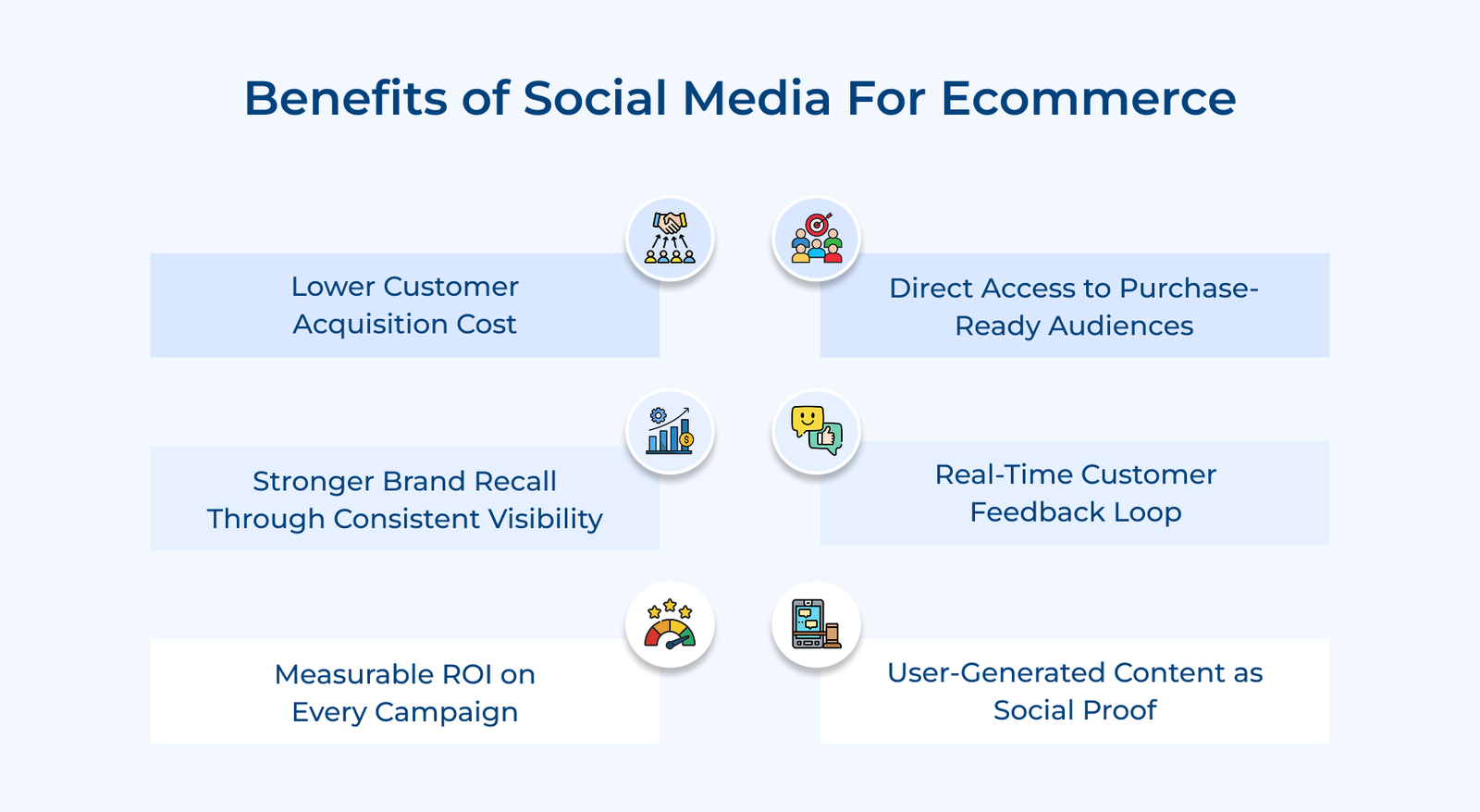
1. Direct Access to Purchase-ready Audiences
Social platforms like Instagram and TikTok have become popular destinations for product discovery or research. Social media platforms help businesses connect with potential customers while they are actively exploring products, comparing options and gathering information before making a purchase.
2. Lower Customer Acquisition Cost
Organic content and community engagement let you attract buyers without spending heavily on paid ads from day one. A well-placed Reel or viral product post can drive hundreds of conversions at virtually zero additional cost.
3. Real-time Customer Feedback Loop
Comments, DMs or reactions provide immediate insight into how customers perceive your products and brand. Social media ecommerce makes the feedback especially useful because businesses can gather opinions and address questions within the same platform where customer interactions take place.
4. Stronger Brand Recall Through Consistent Visibility
When buyers see your content regularly across their feed, your brand becomes their first thought when purchase intent kicks in. Consistent visibility builds the kind of familiarity that turns a cold audience into loyal repeat customers.
5. User-generated Content as Social Proof
Content shared by customers provides authentic examples of people using and enjoying your products. Photos, videos, reviews and testimonials often carry more credibility because they come from real users rather than the brand itself.
6. Measurable ROI on Every Campaign
Social media platforms provide detailed performance data for content, campaigns and advertisements. Social media ecommerce benefits from visibility because businesses can track engagement, clicks, conversions and sales to understand what is contributing to results.
The following are the key strategies that help businesses use social media ecommerce effectively and turn social interactions into consistent sales.
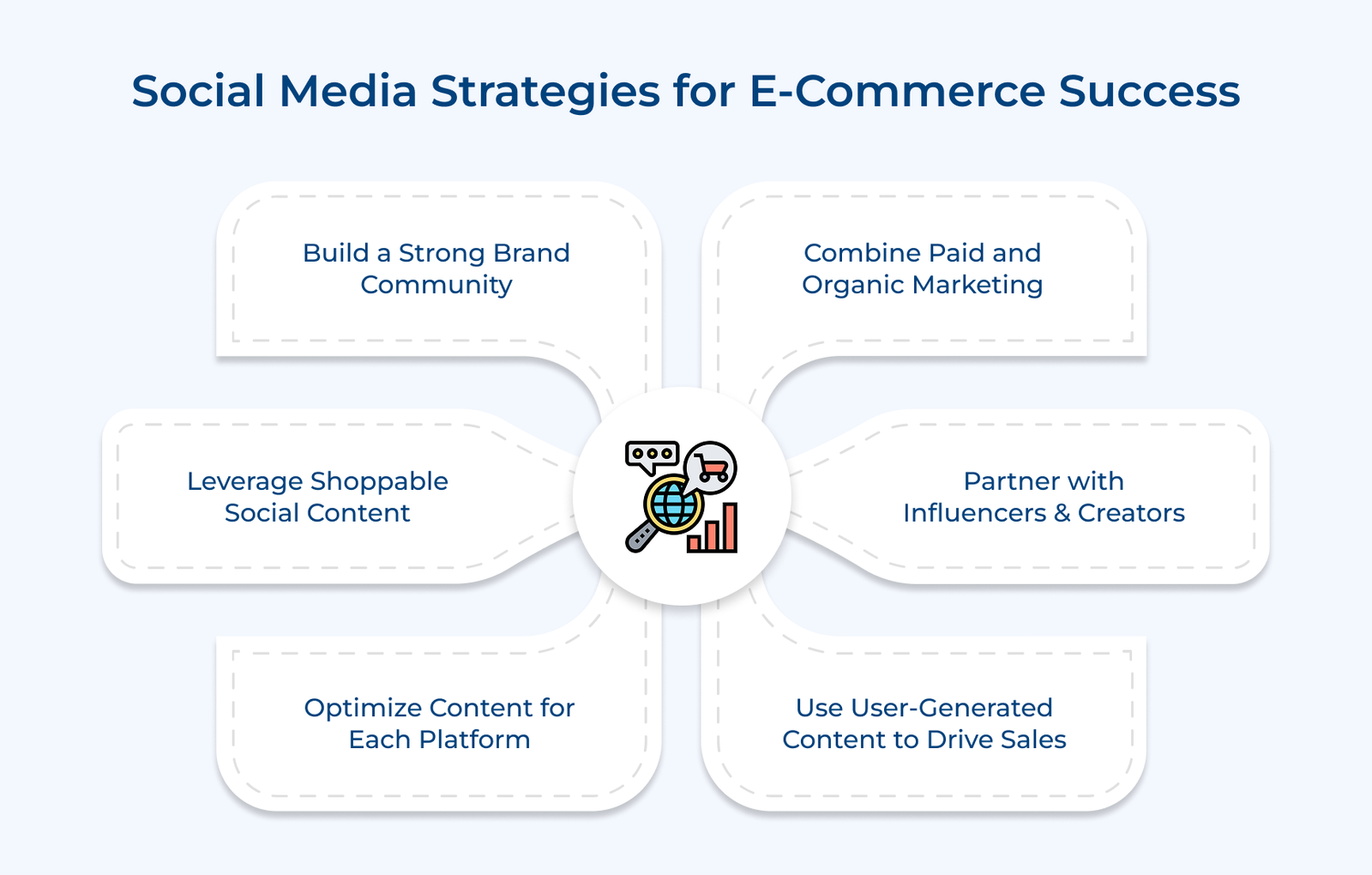
Relying only on paid advertising can increase acquisition costs, while relying only on organic content can limit visibility. Successful social media ecommerce strategies use paid and organic efforts together, allowing each channel to strengthen the other.
A practical approach is to use organic content to understand what resonates with your audience. Posts that consistently generate engagement often provide valuable clues about the topics, formats, and messages people find most interesting.
Key questions:
When you boost a post that already performed well organically, you are not taking a risk. You are investing in something the market has already validated for free. How do you actually combine paid and organic to get the most out of your budget?
Start by running organic content for 7 to 10 days and identify your top performer. Then allocate a small paid budget to amplify it to a lookalike audience built from your existing buyers.
Pro tips:
Influencer marketing in social media ecommerce is not about chasing follower counts anymore. It is about finding creators whose audience already trusts their product recommendations and whose niche aligns tightly with what you sell.
Key factors:
A strong community can become one of the most valuable assets in social media ecommerce. Customers who feel connected to a brand are more likely to stay engaged, make repeat purchases and recommend products to others through their own networks.
Key ways:
The hardest part with community building is getting early traction when your community feels empty. Seed the community yourself by posting conversation starters daily and personally inviting your first 50 to 100 customers to join before opening it up broadly.
Shoppable content helps reduce the distance between product discovery and purchase. Social media ecommerce becomes much more effective when customers can move from seeing a product to buying it without navigating through multiple pages or leaving the platform.
The key consideration here is that shoppable content only works when the product tagging feels natural within the content. Forcing product tags onto content that was clearly not designed for shopping creates friction instead of removing it.
Key practices:
The most important thing you can do right now is audit every step a buyer takes from seeing your post to completing a purchase. If that journey is longer than three steps, you are losing sales that were already within reach and shoppable content is your most direct tool to fix that.
User-generated content is one of the most effective ways to build trust in social media ecommerce. Content created by real customers often feels more authentic because it shows genuine experiences and product usage from people who have already made a purchase.
Feature customer posts on your feed to build authentic social proof
When you regularly feature real customer posts on your brand feed, it signals to new buyers that actual people trust and use your product. The consistency turns your profile into a living proof engine rather than just a promotional channel.
Run campaigns that actively invite product sharing from customers
Customer participation increases when sharing content feels simple and rewarding. Branded hashtags, product challenges and community contests can encourage customers to post about their experiences while creating a steady flow of user-generated content.
Repurpose UGC content across multiple channels
User generated content can be valuable beyond social media. Customer photos, reviews and testimonials often perform well in advertisements, email campaigns, product pages or other customer touchpoints because they add credibility.
Every social platform has its own content style, audience expectations and engagement patterns. Social media ecommerce strategies perform better when content is created specifically for each platform instead of publishing the same message everywhere.
Key formats:
The real implementation shift happens when you stop repurposing one piece of content across all platforms. Build each piece of content natively for the platform it will live on and your engagement or conversion rates will reflect that immediately.
Best practices:
Trust plays a major role in purchase decisions and social proof helps customers feel more confident about choosing your products. Social media ecommerce becomes more effective when reviews, ratings and customer experiences are visible throughout the buying journey instead of being hidden on separate pages.
Showcasing ratings and reviews directly inside your social media posts bridges the gap between product discovery and purchase confidence. When a buyer sees a 4.8-star rating or a detailed customer review inside a post, they are already consuming it, which removes the need to go searching for validation elsewhere.
Key takeaways:
Pin your most specific results-driven testimonials at the top of your profile because the first thing a new visitor does is look for a reason to trust you and a pinned testimonial answers that question before they even scroll. Before-and-after content is one of the most conversion-ready formats in e-commerce because it shows transformation rather than just telling buyers what the product does.
Key ways:
Below are the social media channels that consistently support ecommerce growth, helping brands increase visibility and generate sales across different audience segments.
Instagram continues to be one of the most effective platforms for social media ecommerce because it combines product discovery, engagement and shopping features in a single experience. Reels, Stories or shopping tools make it easier for businesses to showcase products and help customers move from interest to purchase.
Key formats:
TikTok has become a major product discovery platform where users regularly find new brands, explore recommendations and make purchase decisions. Social media ecommerce brands often use TikTok to reach new audiences through engaging content that feels natural to the platform.
Key types:
Facebook remains an important channel for social media ecommerce because it combines detailed audience targeting with strong community engagement opportunities. Brands combining Facebook Ads with an active brand community consistently see stronger retention and lower retargeting costs.
Content formats:
Pinterest attracts users who are actively searching for ideas, products and inspiration, making it a valuable platform for social media ecommerce. Content on Pinterest can continue generating traffic and product discovery long after it is published, helping businesses reach customers during the research and planning stage.
Key formats:
YouTube is where social media ecommerce brands build the deepest buyer trust because long-form video gives you space to demonstrate value that no other format can match. A single well-produced tutorial continues driving conversions for years after it is published.
Key types:
Check out the key metrics that give you a clear and honest picture of how your social media ecommerce is actually performing.
Key questions:
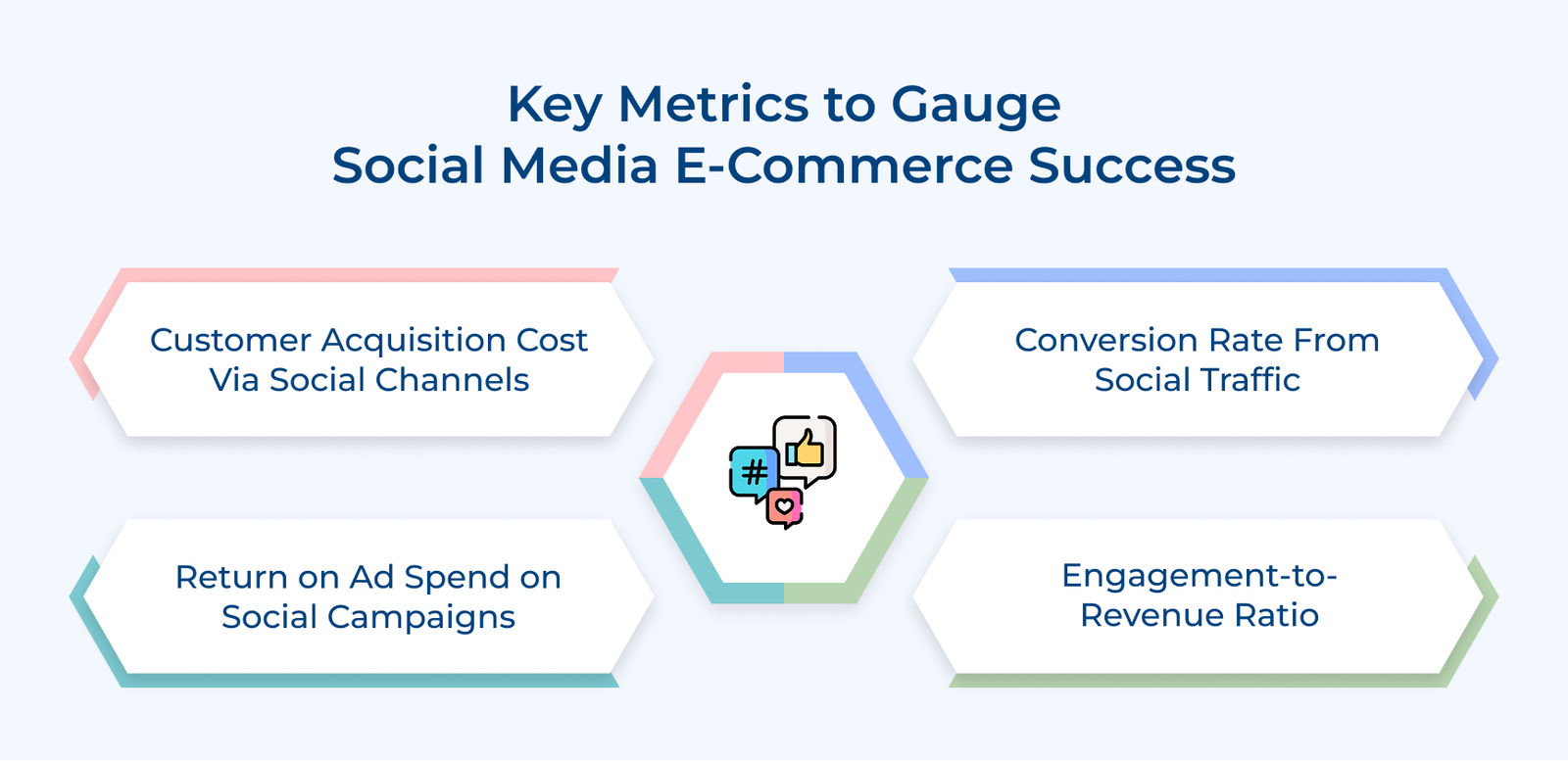
1. Conversion Rate from Social Traffic
Conversion rate shows how many visitors from social media complete a desired action, such as making a purchase or submitting an inquiry. Social media ecommerce success is closely tied to the metric because it reflects how effectively your content and customer journey turn interest into results.
2. Customer Acquisition Cost Via Social Channels
CAC from social tells you exactly how much you are spending to bring in each new buyer through paid and organic efforts combined. Tracking it per platform helps you identify where your budget is working efficiently and where it is quietly bleeding money.
3. Engagement-to-revenue Ratio
Likes, comments, shares and saves become much more valuable when viewed alongside revenue data. Social media ecommerce performance is easier to understand when you can identify which content drives both engagement and actual sales. Tracking the relationship helps reveal the content types that encourage meaningful customer action rather than simply attracting attention.
4. Return On Ad Spend on Social Campaigns
ROAS measures how much revenue is generated from your social advertising investment. Monitoring ROAS at the individual ad level rather than just the campaign level shows you exactly which creatives and audiences are carrying your results.
The following are the three brands that have used social media as a direct and measurable driver of business growth.
1. Cult Beauty
Cult Beauty built a strong social presence by becoming a reliable source of beauty knowledge rather than focusing only on product promotion. Their content includes ingredient education, product guidance and creator collaborations that help shoppers make informed purchasing decisions.
Their success highlights how social media ecommerce can go beyond product promotion and become a valuable channel for customer education and engagement. Their social-first approach cultivated a loyal community that drives consistent repeat purchases and strong word-of-mouth referrals. The result is a brand whose social media functions as a full-funnel sales engine rather than just an awareness channel.
2. Care to Beauty
Care to Beauty used social media to address a common challenge in international e-commerce, helping customers feel more confident when purchasing from another country. Their content focuses on detailed product education, authentic reviews and responsive community engagement that reassures hesitant buyers across different markets.
The approach helped customers make decisions with greater confidence and improved the quality of traffic coming from social channels. Social media became an important touchpoint where customers could learn, ask questions and feel supported before making a purchase.
3. BÉIS
BÉIS grew its brand through social media by leveraging founder Shay Mitchell’s audience and turning it into an engaged travel-lifestyle community around the product. Their UGC strategy consistently amplifies real customer travel content, which makes the brand feel aspirational and accessible simultaneously.
The example highlights how social media ecommerce can benefit from authentic customer participation. Real customer content helps new audiences discover products, learn how they are used and build confidence through experiences shared by other customers.
Social media ecommerce has become an important part of how customers discover products, evaluate options and make purchasing decisions. Businesses that use social media strategically can create stronger customer relationships and generate consistent opportunities for growth.
Key takeaways:
Ready to improve your social media results? Explore our guides on content planning and paid social strategies to continue building a stronger presence. The approach works best when businesses focus on providing value, understanding their audience and showing up consistently over time.

User-generated content helps potential customers see how real people use and experience a product. Genuine customer photos, videos and reviews often provide the reassurance buyers need before making a purchase, helping build confidence throughout the decision-making process.
Tools like Hootsuite, Sprout Social or Later help you schedule content and track performance across social media platforms from a single dashboard. Pairing them with an analytics tool like Triple Whale gives you a clearer picture of which social efforts are directly driving revenue.
Large ecommerce brands can display shoppable social feeds, customer photos and reviews directly on their website using tools like Taggbox or Bazaarvoice to bridge social discovery and on-site conversion. Bringing social content closer to product pages helps customers discover real experiences and access additional information while making purchase decisions.
Platforms like Shopify or WooCommerce have native integrations with Instagram, TikTok and Pinterest that allow direct product syncing and in-app checkout. The integrations ensure your product catalogue updates automatically across all connected social channels without any manual effort.

Grow Customer Relationships and stronger team collaboration with our range of products across the Conversational Engagement Suite.
Omnichannel Customer Support & Help Desk Software
AI Enabled Business Messaging and Chatbot Software
Sales Engagement & CRM Software
Call Center Software & Virtual Phone System
Product Marketing & Experience Platform
Customer Experience & Feedback Management Software

 What is Sales Quota? Types, Strategies and Tips
Scroll to top
What is Sales Quota? Types, Strategies and Tips
Scroll to top