Sales Acceleration

Sales Acceleration Guide: Benefits, Types & Examples

Discover the ultimate sales acceleration guide, covering key benefits, types and real-world examples to help you speed up your sales process. Learn how to boost efficiency and drive revenue growth with proven strategies!

No credit card required. Easy setup

Sales Acceleration

Trusted by Leading Brands

Breakthrough Sales Barriers, Accelerate Toward Success with Sales Acceleration!

Streamline your sales process, close deals faster and drive unstoppable growth with sales acceleration. Unlock your team’s full potential and accelerate toward success today!

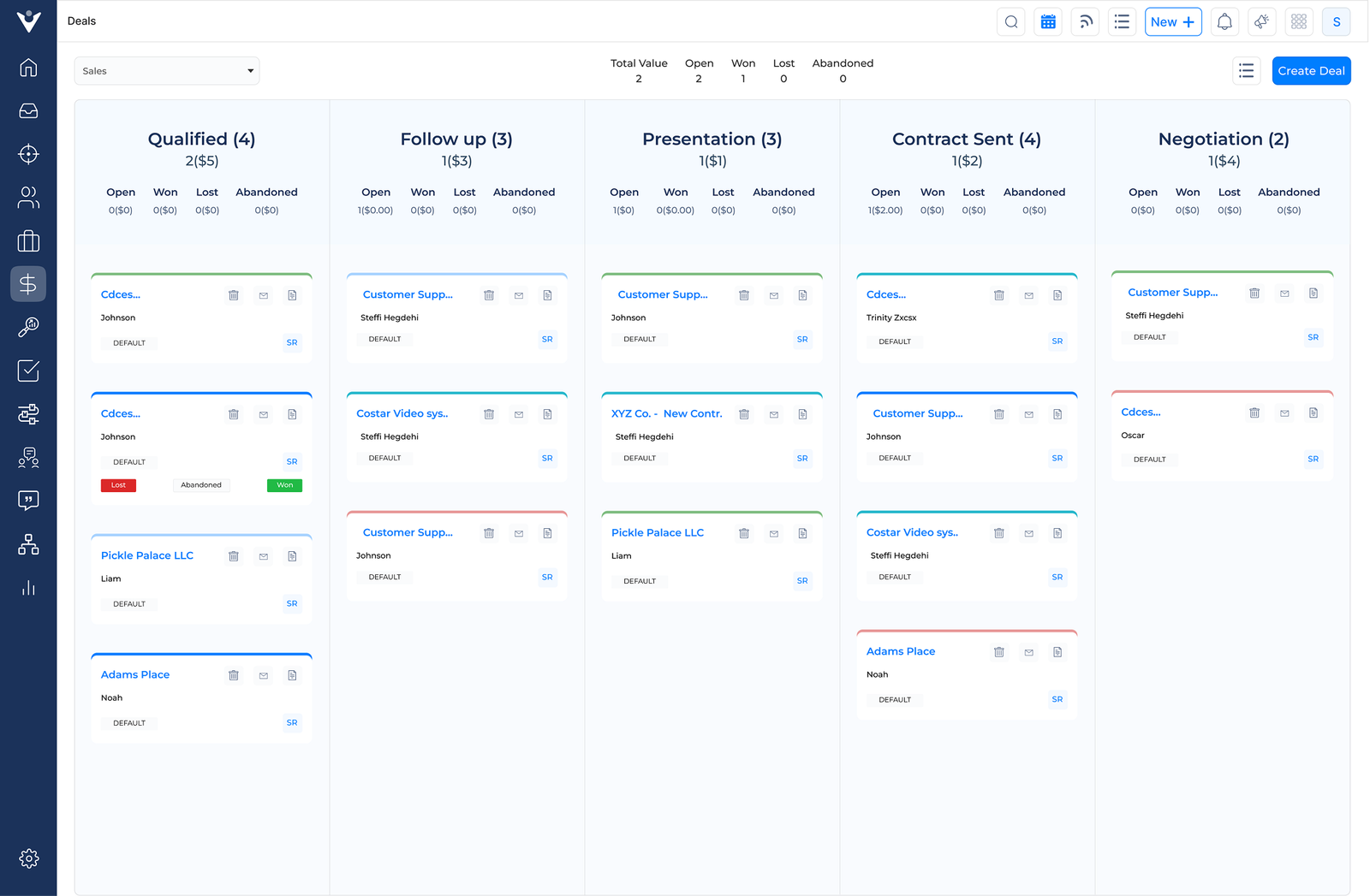
Streamlined Sales Processes

Imagine transforming your sales cycle into a well-oiled machine. Our streamlined sales processes do just that by optimizing every stage of your pipeline.

Advanced Lead Qualification

The feature empowers businesses to elevate their lead scoring and segmentation strategies. Your team can prioritize efforts where they matter most by honing in on high-potential prospects.

Automated Follow-ups

Picture a world where follow-up emails are sent automatically, freeing your team from tedious manual tasks. The feature ensures that every prospect receives timely engagement

Real-time Sales Insights

Having immediate access to performance metrics and analytics is crucial. Real-time sales insights provide your team with the data they need for informed decision-making.

Enhanced Collaboration Tools

The software enables teams to utilize collaborative features to improve team alignment and communication. They can share notes, updates and strategies seamlessly with the sales team.

Personalized Outreach

The feature leverages data to tailor the messaging and approach to each prospect. Teams can create customized engagement strategies that resonate with individual needs and preferences.

Businesses struggle to meet revenue targets, grappling with lengthy sales cycles and inefficient processes. Sales teams are overwhelmed, leads fall through the cracks and growth stagnates. Without a solution, companies risk losing market share to more agile competitors. Sales reps become frustrated, customer relationships suffer and the bottom line takes a hit. The pressure to perform mounts, but traditional sales methods no longer suffice.

Enter sales acceleration – a game-changing approach that combines cutting-edge technology, data-driven insights and streamlined processes to supercharge the sales efforts. Businesses can dramatically shorten sales cycles, boost conversion rates and drive rapid revenue growth by adopting these strategies. Let’s explore!

What is Sales Acceleration?

Sales acceleration refers to a strategic approach aimed at streamlining and optimizing the sales process to increase revenue growth. The function involves leveraging technology, data analytics and innovative methodologies to enhance sales performance.

How does sales Acceleration Work?

Sales acceleration works by integrating various tools and techniques to support sales teams throughout the customer journey. The function includes automating repetitive tasks, providing real-time insights into customer behavior and facilitating effective communication between sales representatives. Companies can identify high-potential leads, personalize outreach efforts and make more informed decisions by utilizing advanced technologies such as AI.

Key objectives:

  • Reduce sales cycle length by eliminating bottlenecks and improving efficiency
  • Increase conversion rates through targeted messaging and timely follow-ups
  • Enhance sales team productivity by automating routine tasks and providing actionable insights
  • Improve customer engagement through personalized interactions and faster response times
  • Boost overall revenue growth by optimizing every stage of the sales process

Key Benefits of Sales Acceleration

Understanding the key benefits of sales acceleration helps businesses leverage the strategies to optimize their sales pipeline.

Benefits of Sales Acceleration

1. Streamlined Lead Generation
Sales acceleration tools automate and enhance lead generation efforts. They utilize advanced targeting algorithms and data analysis to identify high-quality prospects more efficiently. The approach saves time and resources by focusing on leads most likely to convert, improving the quality of the sales pipeline.

2. Sales Efficiency
Sales acceleration platforms significantly boost efficiency by automating routine tasks and providing real-time insights. Sales representatives can spend more time on high-value activities like relationship-building and closing deals, rather than administrative work. The automation leads to shorter sales cycles and increased productivity.

3. Boosted Employee Participation
Sales acceleration tools often incorporate gamification elements and performance-tracking features. The tools motivate sales teams by enhancing healthy competition and providing clear visibility into individual/team progress. Increased engagement leads to higher morale and better overall performance.

4. Effective Lead Scoring
Advanced analytics enable more accurate lead scoring, helping sales teams prioritize their efforts. Assigning values to leads based on behavior, demographics and engagement levels, enables representatives to focus on the most promising opportunities. The feature helps in increasing conversion rates and optimizing resource allocation.

5. Enhanced Sales and Marketing Alignment
Sales acceleration platforms facilitate better collaboration between sales and marketing teams. Shared data enable both departments to work towards common goals, ensuring consistent messaging and a smoother customer journey from initial contact to closing the deal.

6. Scalability Through Automation
Automation is a core component of sales acceleration. Organizations are enabled to handle increased sales volume without a proportional increase in manpower. The tools enable businesses to scale their sales operations efficiently from automated email sequences to AI-powered chatbots, maintaining personalized interactions.

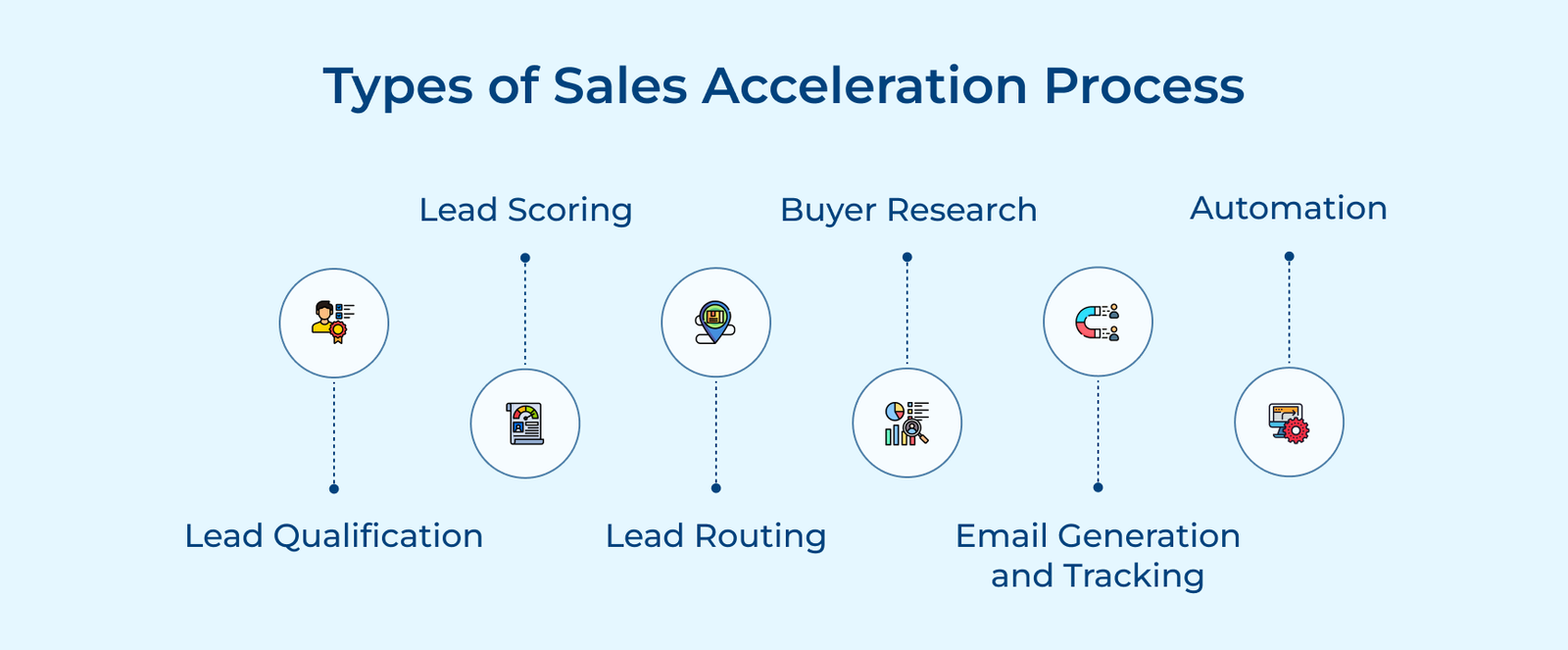
Types of Sales Acceleration Process

Understanding the different types of sales acceleration processes is crucial for selecting the right approach that aligns with the business needs.

Types of Sales Acceleration Process

1. Lead Qualification

Lead qualification is the process of determining if a potential customer fits the ideal buyer profile. The process involves assessing factors like budget, authority, need and timeline (BANT). Effective lead qualification helps sales teams focus their efforts on prospects most likely to convert, saving time and resources. The process typically involves a combination of automated processes and human interaction to gather relevant information about leads.

2. Lead Scoring

Lead scoring assigns numerical values to leads based on various criteria, such as demographic information, online behavior and engagement with marketing content. The feature helps prioritize leads and determines which ones are sales-ready. A well-implemented lead scoring system enables sales teams to concentrate on high-value prospects, increasing efficiency and conversion rates. The system often uses machine learning algorithms to continuously refine the scoring model based on historical data and outcomes.

3. Lead Routing

Lead routing is the automated process of assigning leads to the most appropriate sales representatives based on predefined criteria. The criteria may include factors like geographic location, industry expertise or lead value. Effective lead routing ensures that leads are quickly directed to the right team members, reducing response times and improving the chances of conversion.

4. Buyer Research

Buyer research involves analyzing information about potential customers to understand their needs, pain points and decision-making processes. The process can include studying industry trends, examining company financials and monitoring social media activity. Comprehensive buyer research enables sales teams to tailor their approach, craft more compelling pitches and anticipate objections.

5. Email Generation and Tracking

Email generation tools help create personalized, targeted emails at scale while tracking capabilities provide insights into email performance. It includes metrics like open rates, click-through rates and response rates. Advanced systems can suggest optimal sending times and content improvements based on historical data.

6. Automation

Sales automation involves using technology to streamline repetitive tasks and workflows throughout the sales process. The process can include automating follow-up emails, scheduling appointments, updating CRM records and generating reports. Automation allows sales representatives to focus more on high-value activities like building relationships and closing deals by reducing manual work.

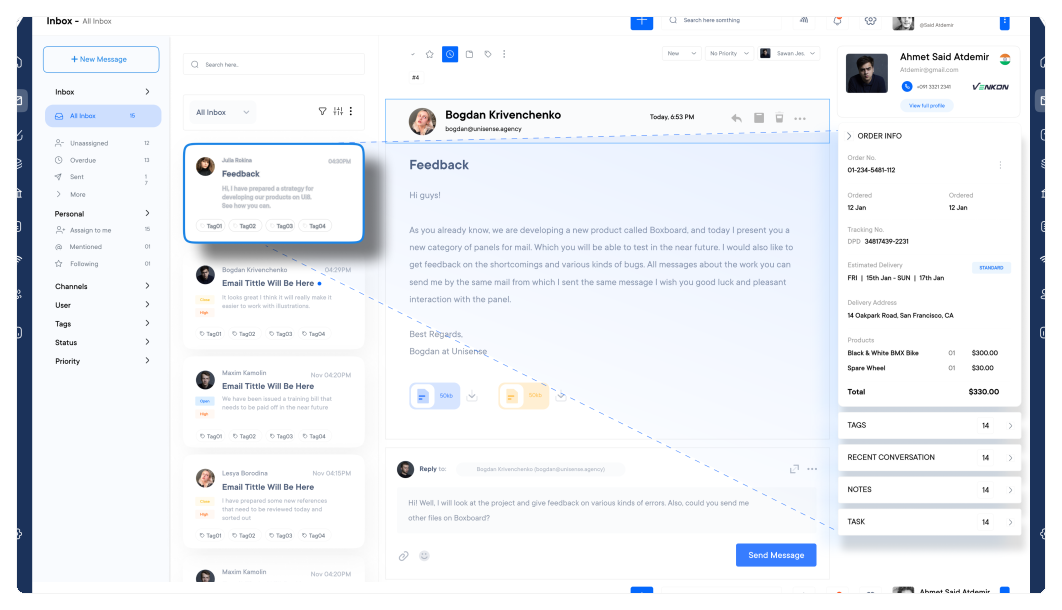
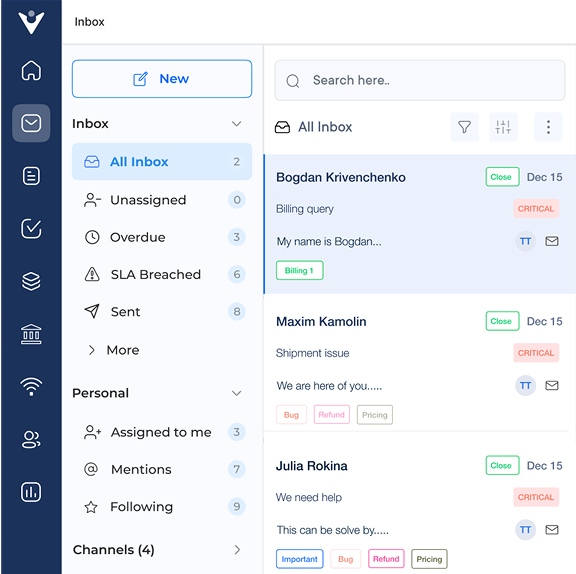
Omnichannel Helpdesk and Ticketing System

Turn Every Support Issues into Personalized Conversations with Veemo’s Omnichannel Helpdesk and Ticketing System. Make customer happiness your top priority with a digital first customer experience (CX) approach

Radically new solutions for data

Sed ut perspiciatis unde omnis iste natus error sit voluptatem accusantium doloremque laudantium, totam rem aperiam, eaque ipsa quae ab illo inventore veritatis et quasi architecto beatae vitae dicta sunt explicabo.

Radically new solutions for data

Sed ut perspiciatis unde omnis iste natus error sit voluptatem accusantium doloremque laudantium, totam rem aperiam, eaque ipsa quae ab illo inventore veritatis et quasi architecto beatae vitae dicta sunt explicabo.

How to Build a Sales Acceleration Strategy?

Let’s explore the fundamental steps involved in building an effective sales acceleration strategy.

How to Build a Sales Acceleration Strategy

1. Building a Sales Acceleration Strategy

Optimizing lead qualification processes is a crucial step in an effective sales acceleration strategy. Implementing a robust lead scoring system can help companies prioritize prospects based on their likelihood to convert. Sales teams are enabled to focus their efforts on high-potential leads.

Developing ideal customer profiles helps identify the characteristics of valuable prospects and streamline the qualification process. Automating initial screening processes through AI-powered tools and chatbots can quickly filter out unqualified leads.

Pro tips:

  • Use data analytics to continuously refine and update the lead scoring criteria.
  • Collaborate with marketing and customer success teams to create comprehensive ideal customer profiles.
  • Integrate automation tools with the CRM system for seamless data flow and lead management.

2. Use Scenario-Based Learning

Sales teams can practice handling various customer interactions and objections in a safe environment by creating realistic sales simulations. The approach allows them to refine their techniques and build confidence before facing real-world situations. Developing role-playing exercises further enhances the learning process.

Sales representatives can step into both customer and seller roles, gaining valuable perspective, and improving their empathy. Analyzing and learning from past sales scenarios provides invaluable insights into successful strategies. Teams can identify patterns for future engagements by examining both successful and unsuccessful sales interactions

Pro tips:

  • Use real customer data and feedback to create authentic scenarios.
  • Incorporate technology like AI to enhance immersion and realism.
  • Establish a regular schedule for scenario training and debriefing sessions.

3. Adopt Value-based Selling

The approach shifts focus from product features to customer outcomes that emphasize the tangible benefits and value a solution brings to the client’s business. Salespeople can demonstrate how their offering addresses pain points and contributes to the client’s success by aligning product features with specific customer needs.

Quantifying the value proposition is essential, as it provides concrete evidence of the solution’s impact on the customer’s bottom line, often through metrics like ROI or productivity gains. The strategy enhances stronger relationships, differentiates from competitors and accelerates the sales process by clearly communicating the unique value offered.

Best practices:

  • Conduct thorough research on each prospect’s industry and specific challenges.
  • Develop customized value calculators to quantify potential benefits for clients.
  • Train sales teams to ask probing questions that uncover the customer’s true pain points and goals.

4. Engage through Social Media

Businesses can leverage platforms like LinkedIn, Twitter and Instagram to connect with potential customers by developing a social selling strategy. The approach involves sharing valuable content that establishes thought leadership in the industry and positions the brand as a trusted source of information and expertise.

The strategy allows for a more personalized approach to sales, as it enables reps to understand prospects’ needs and pain points before initiating direct contact. Social media engagement also provides valuable insights into customer behavior and allows sales teams to tailor their approach.

Pro tips:

  • Optimize profiles with keyword-rich content and professional visuals.
  • Use social listening tools to identify and engage with high-potential leads.
  • Develop a content calendar to ensure consistent, valuable posting across platforms.

5. Enhance Sales Communication

Enhancing sales communication is a crucial step in an effective sales acceleration strategy.
Sales representatives can better understand customer needs and tailor their approach by improving active listening skills. Developing clear messaging ensures that key points are delivered effectively which helps to avoid confusion and information overload.

Utilizing multiple communication channels effectively allows sales teams to reach customers through their preferred mediums and increase engagement. Sales teams can accelerate the sales process, build stronger relationships with prospects and increase conversion rates by focusing on communication enhancements.

Best practices

  • Practice reflective listening by paraphrasing customer statements to confirm understanding.
  • Create a standardized messaging framework that highlights unique value propositions succinctly.
  • Implement an omnichannel approach, integrating email, phone, social media and in-person interactions seamlessly.

6. Promote Collaborative Selling

Collaborative selling is a crucial component of an effective sales acceleration strategy, emphasizing the power of teamwork to drive results. Businesses can leverage diverse expertise and perspectives to address complex customer needs more effectively by enhancing cross-functional collaboration.

The enhanced communication allows for quicker response times and more informed decision-making throughout the sales process. Encouraging knowledge transfer among members creates a culture of continuous learning, enabling the entire sales force to benefit from individual successes and lessons learned.

Pro tips:

  • Establish regular cross-departmental meetings to align goals and share insights.
  • Invest in a robust CRM system that facilitates real-time information sharing and collaboration.
  • Create a mentorship program to pair experienced sales professionals with newer team members.

7. Leverage Customer Success Stories

Leveraging customer success stories is a powerful step in an effective sales acceleration Plan. Businesses build credibility and trust with potential clients by showcasing real-world examples of how the product or service has benefited others. Begin by documenting comprehensive case studies that highlight the challenges faced by customers, the solutions provided and the measurable results achieved.

Use the testimonials strategically in sales presentations to demonstrate value and address specific pain points. Create a diverse library of success stories categorized by industry, use case or problem solved which will allow sales teams to quickly access relevant examples for each prospect.

Pro tips:

  • Develop a systematic process for gathering and updating success stories regularly.
  • Train sales teams on effectively incorporating testimonials into their pitches.
  • Utilize multimedia formats (e.g., video, infographics) to make success stories more engaging and shareable.
Challenges to Implementing Sales Engagement and How to Resolve

Implementing a sales engagement strategy can present several challenges that hinder its success. Let’s go through them along with the solutions to overcome them:

Challenges to Implementing Sales Engagement

1. Resistance to Change
One of the most significant hurdles in implementing sales acceleration strategies is overcoming resistance from sales teams. Many salespeople are accustomed to traditional methods and may be hesitant to adopt new technologies or processes. The resistance can stem from fear of the unknown, concerns about job security or simply being comfortable with existing practices. Overcoming the challenge requires effective change management, clear communication of benefits and comprehensive training programs.

2. Lack of Alignment between Sales and Marketing
Sales acceleration strategies require close collaboration between sales and marketing teams to ensure a seamless process from lead generation to closing deals. Many organizations struggle with misalignment between the two departments, leading to missed opportunities and inefficiencies. Businesses need to enhance communication between sales and marketing to ensure a successful implementation of sales acceleration strategies.

3. Data Quality and Management
Sales acceleration relies heavily on high-quality, up-to-date data to drive insights and automate processes. Maintaining clean and accurate data across multiple systems is an ongoing challenge. Incomplete, duplicate or outdated information can lead to misguided decisions and ineffective outreach. Implementing data governance policies, regular data cleansing processes and fostering a data-driven culture are crucial steps in addressing this challenge.

4. Balancing Automation and Personalization
While sales acceleration technology aims to streamline processes, there’s a risk of over-automation leading to impersonal interactions with prospects and customers. Finding the right balance between automated outreach and personalized engagement is critical. Teams must learn to leverage technology to enhance rather than replace human relationships, using data-driven insights to tailor their approach without losing the human touch.

5. Measuring ROI and Demonstrating Value
Justifying the investment in sales acceleration solutions can be challenging, especially in the short term. Many organizations struggle to accurately measure the return on investment (ROI) of the initiatives. Defining clear key performance indicators (KPIs), establishing baseline metrics and consistently tracking progress are essential. Communicating the long-term value and competitive advantage of the approach to stakeholders is crucial for sustained support.

Role of AI and Automation in Sales Acceleration

AI and automation have revolutionized the sales process, enabling businesses to accelerate their sales cycles.

Role of AI and Automation in Sales Acceleration

1. Lead Qualification and Scoring

AI algorithms can analyze vast amounts of data to identify and prioritize high-quality leads.
AI can score leads more accurately than traditional methods by considering factors such as demographics, online behavior and interaction history. Sales teams can focus their efforts on the most promising prospects which increases conversion rates and reduces time wasted on unqualified leads.

2. Personalized Customer Engagement

AI-powered tools can analyze customer data to create personalized communications and product recommendations. The level of customization helps sales representatives tailor their approach to each prospect’s specific needs.

3. Sales Forecasting and Predictive Analytics

Machine learning algorithms can process historical sales data, market trends and other relevant factors to generate accurate sales forecasts. Businesses are enabled to optimize resource allocation, inventory management and sales strategies. Predictive analytics can also identify potential churn risks that allow sales teams to proactively address customer concerns.

4. Automated Administrative Tasks

AI and automation can handle routine administrative tasks such as data entry, scheduling and follow-up reminders. It frees up valuable time for sales representatives to focus on building relationships and closing deals. Automated CRM systems can also ensure that customer information is consistently updated and easily accessible.

5. Intelligent Chatbots and Virtual Assistants

AI-powered chatbots can handle initial customer inquiries, qualify leads and provide instant support 24/7. The virtual assistants can answer frequently asked questions, schedule appointments and even guide customers through the early stages of the sales process. The automation allows human sales representatives to step in at the most critical points of the customer journey.

Examples of Sales Acceleration

Many brands have leveraged sales acceleration strategies to accelerate their sales and drive more business.

1. Amazon
Amazon is a perfect example of a brand that has mastered the art of sales acceleration.
They make it incredibly easy for customers to purchase with features like one-click purchasing, personalized product recommendations and fast shipping through Amazon Prime. Amazon leverages data analytics to understand customer behavior and tailor their marketing efforts to drive sales even further.

2. Tesla
Tesla, the electric car company, focuses on creating a seamless customer experience to accelerate sales. They offer online ordering, customization options and innovative features like autopilot technology. Tesla also generates hype and demand through limited edition releases, leading to a surge in sales whenever a new product is launched.

3. Starbucks
Starbucks is known for its successful sales acceleration strategies, such as loyalty programs like the Starbucks Rewards program. Starbucks incentivizes customers to make repeat purchases by offering discounts, personalized offers and exclusive benefits to members. They also use mobile ordering and payment options to streamline the ordering process.

4. Nike
Nike excels in sales acceleration through its marketing campaigns and collaborations with athletes. Nike generates excitement by creating buzz around new product launches and limited edition collections. They also use social media platforms effectively to reach their target audience and promote their products, leading to increased sales.

5. Coca-Cola
Coca-Cola has implemented a successful product diversification strategy to accelerate sales and stay competitive in the market. Coca-Cola has introduced new flavors, packaging options and healthier beverage choices to appeal to a wider range of consumers. Coca-Cola has been able to maintain strong sales growth by constantly innovating and adapting to changing consumer preferences.

Sales Acceleration: The Fast Track to Revenue Growth

Sales acceleration is a strategic approach that leverages technology, data and optimized processes to streamline the sales cycle. It’s become increasingly necessary for companies to adopt accelerated sales cycle techniques to stay competitive and meet ambitious growth targets.

Businesses can identify and focus on high-value prospects, personalize customer interactions and make data-driven decisions by implementing a sales acceleration process. It leads to shorter sales cycles, improved conversion rates and increased efficiency. Sales process optimization tools enable sales teams to automate repetitive tasks, freeing up time for meaningful engagements. Accelerated sales cycle is no longer a luxury but a necessity for businesses aiming to thrive.

FAQs about Sales Acceleration

Sales acceleration matters because it can significantly increase revenue, shorten sales cycles and improve business performance. Companies can close deals faster and keep up with the rapidly changing market trends by optimizing the sales process. The acceleration process is crucial for staying competitive and driving growth.

Businesses can increase sales acceleration by implementing effective marketing strategies, offering promotions, providing exceptional customer service and utilizing data analytics. Businesses can drive sales growth and achieve their revenue targets by focusing on the key areas.

Choosing the best sales acceleration platform is crucial for boosting productivity and increasing revenue. Look for features like real-time analytics, AI-driven insights, integration capabilities and a user-friendly interface. Consider the team’s specific needs and budget when selecting a platform. Request demos and trial periods to ensure compatibility before making a final decision.

Sales acceleration tools can vary depending on the specific needs of the organization, but tools include CRM software, predictive analytics software and sales enablement solutions. The tools help sales teams work more efficiently and effectively.

Traditional sales methods often rely on manual processes, such as cold calling and in-person meetings, to move leads through the sales pipeline. Sales acceleration leverages technology, data analytics and automation to streamline the sales process.

Measuring the success of the sales acceleration efforts is crucial to understanding the impact it has on the business. KPIs such as sales cycle length, win rates, conversion rates and average deal size can help the team track progress. Utilize data analytics and reporting tools to gain valuable insights into the sales strategy.