What is an Ideal Customer Profile (ICP) & How to Create It?
An Ideal Customer Profile (ICP) outlines the type of company or individual most likely to benefit from your product. It helps you focus efforts, improve targeting and drive better results.

An Ideal Customer Profile (ICP) outlines the type of company or individual most likely to benefit from your product. It helps you focus efforts, improve targeting and drive better results.
Struggling to connect with prospects who actually need what you offer? Well, it happens to plenty of B2B teams. They pour time and money into leads that never move, or they close deals that fall apart a few months later. That drains the budget and burns out the team because they end up chasing deals that were never a match in the first place.
The real fix starts with a clear ideal customer profile (ICP). Businesses that clearly define their ideal customer profile see win rates jump by 68%. Once you know which companies gain the most from your product, everything changes. Targeting becomes intentional instead of guesswork, and your time goes into prospects with a real chance of turning into long-term customers.
Here’s the thing. You can build an ICP that helps your sales, marketing and product teams stay aligned on who you serve best and why those customers stick around. It starts with studying your strongest success stories and turning those patterns into a profile your entire team can use.
An ideal customer profile (ICP) is a detailed description of the type of company that would benefit most from your B2B solution and provide the highest value in return. It focuses on organizational attributes rather than individual traits, helping you target businesses where your product solves significant problems and creates measurable ROI.
A clear ICP helps your team stop chasing every shiny lead and spend time on people who are most likely to buy, stay and bring real revenue. It keeps sales and marketing focused on prospects with healthy acquisition costs.
Key objectives:
The following are the key reasons an ideal customer profile matters, giving your team a clearer path to finding and working with the right B2B accounts.
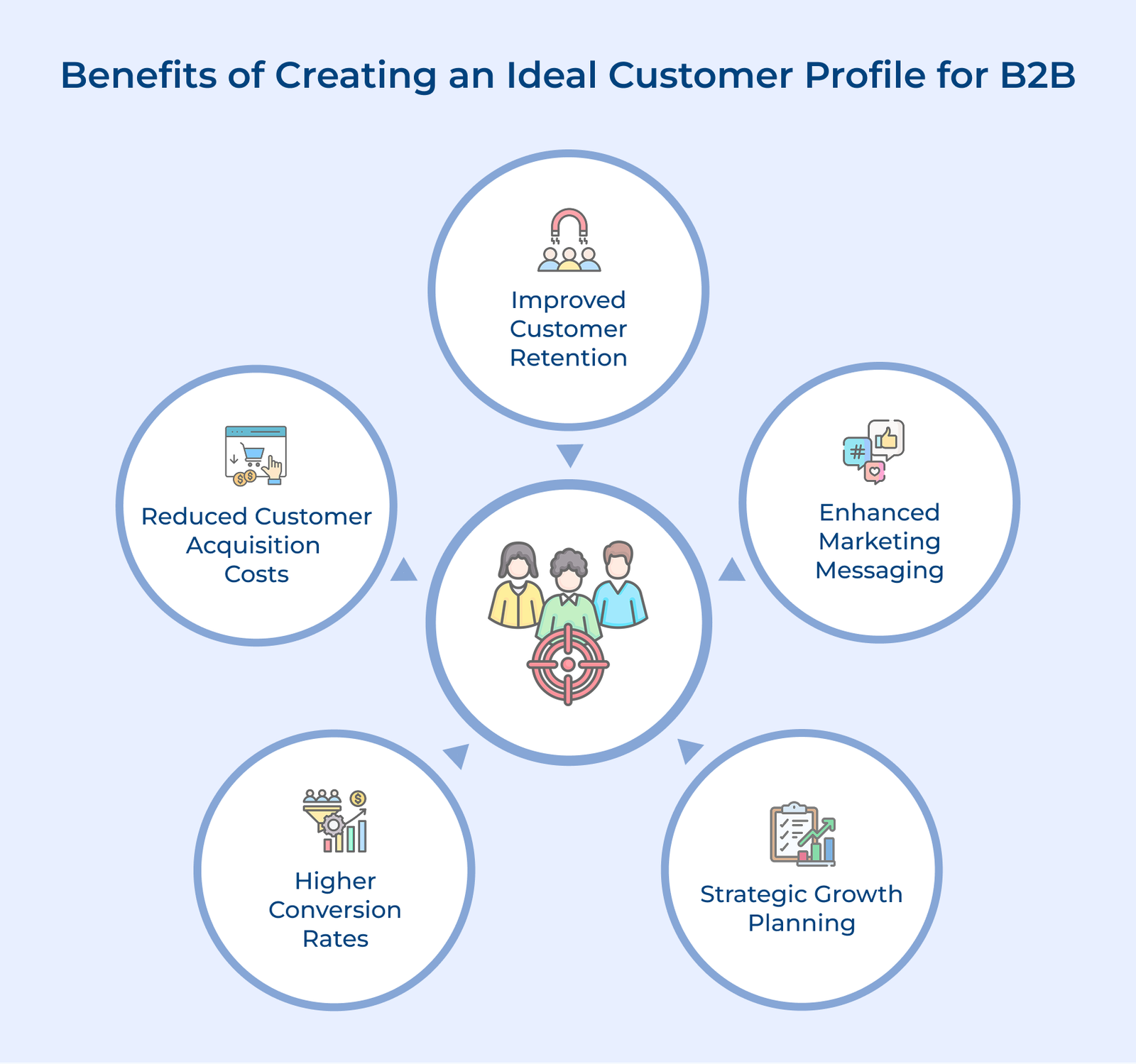
Higher Conversion Rates
When your outreach focuses on companies that closely match your Ideal Customer Profile (ICP), your offer makes immediate sense. The prospects already face the problems you solve, so conversations move faster and deal with less friction.
Reduced Customer Acquisition Costs
Targeting the right prospects means less time chasing leads that won’t convert. Your team works more efficiently, resulting in fewer wasted calls, shorter sales cycles and better results with fewer touches.
Improved Customer Retention
Customers who fit your ICP tend to stick around. They get real value from your product because it was built for their kind of challenges. The fit leads to stronger relationships, less churn and more long-term success stories.
Enhanced Marketing Messaging
An ICP gives you clarity. You can speak to real problems in your audience’s language. Instead of vague promises, your messaging addresses specific concerns and that’s what builds trust.
Strategic Growth Planning
Your ICP helps you grow with purpose. It shows you where to expand, which partnerships to pursue and how to prioritize efforts based on actual alignment, not gut instinct.
A buyer persona refers to a research-based profile that represents the actual people behind purchasing decisions at your target companies. While an ideal customer profile (ICP) helps you identify the types of companies to pursue, buyer personas focus on the individuals who shape or finalize those decisions.
The personas go beyond job titles. They include key details like daily responsibilities, goals they’re working toward and how they evaluate solutions like yours. The insight helps you tailor your outreach to how they think, what they care about and what ultimately drives their choices.
Key factors:
Below let us understand how an ideal customer profile differs from a buyer persona, analysing where each one fits in your overall B2B strategy.
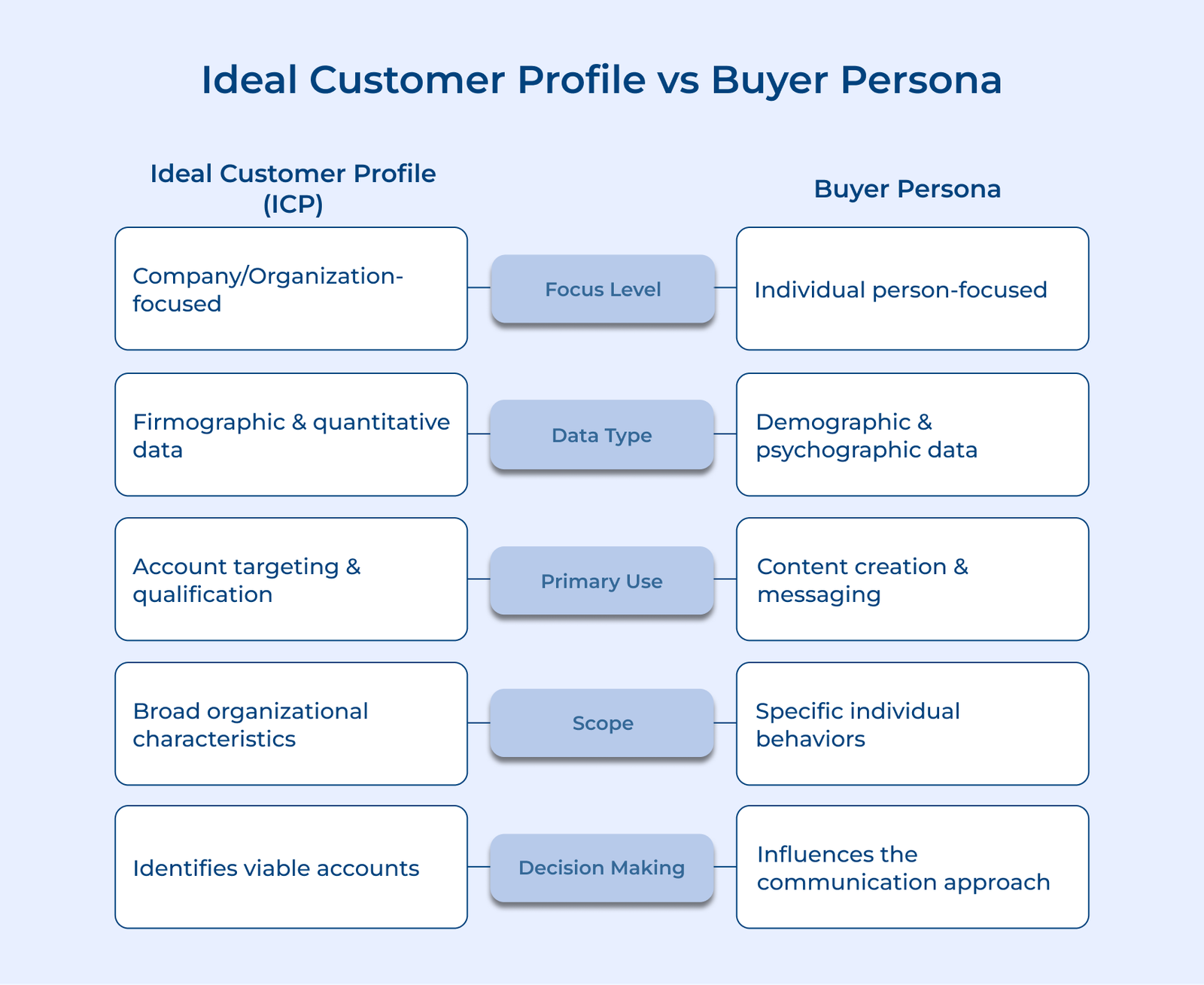
The core distinction is scale. An ideal customer profile looks at the organization as a whole, looking at attributes like industry, size and revenue. The macro-level view helps businesses identify which types of companies are most likely to purchase their products or services.
A buyer persona zooms in on the individuals within the companies, like decision-makers and influencers. It focuses on their roles, goals, and what matters to them in a purchase decision.
ICPs are built using firmographic data, such as company size, revenue, industry and location. They are objective facts that help you filter and segment at the account level.
Buyer personas rely on a mix of demographic (age, job title, education) and psychographic data (goals, pain points, behavior). They help you understand how a person thinks, what they’re trying to achieve and how they prefer to communicate.
An ICP helps sales and marketing teams figure out which companies to go after. It’s used for lead scoring, account targeting and making sure effort goes to high-potential opportunities.
Buyer personas guide content creation, messaging strategies and communication approaches. Marketing teams use them to craft compelling narratives that resonate with specific individuals, while sales teams leverage them to tailor their pitch and approach for different stakeholder types.
ICPs function as gatekeepers, determining which accounts deserve attention and resources. They help teams avoid wasting time on companies that aren’t good fits, regardless of individual interest or engagement levels.
Buyer Personas shape your strategy once you’re in the door. They help tailor conversations, guide presentations and ensure you’re addressing the concerns of the right people.
Let us go through the essential steps to create your ideal customer profile, so you can attract and retain the clients that matter most to your business.
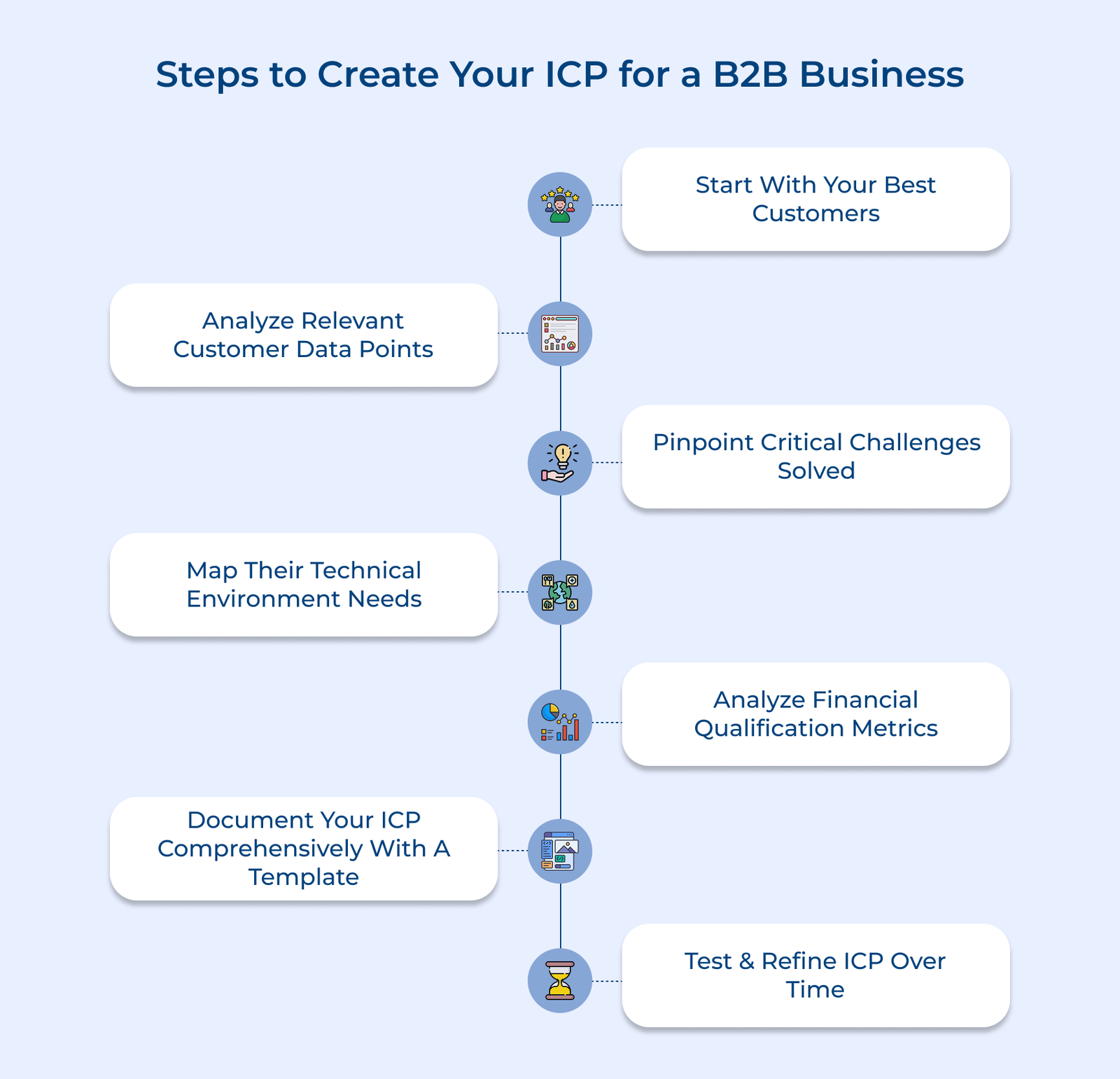
Your current top-performing customers already show you what success looks like. Instead of guessing who your ideal prospects might be, look closely at the customers who stick around, grow their usage and consistently see value in what you offer. They’re the ones who give you a roadmap for finding others like them.
Key types:
Key sources:
Anecdotes can point you in the right direction, but they’re not enough to define a reliable ICP. You need to base your ICP on hard evidence, not assumptions. It means digging into your customer data to find the patterns that correlate with long-term success.
Effective ways:
A strong ideal customer profile (ICP) starts with clarity about the specific problems your solution solves and solves well. Without that clarity, you risk selling to companies who may buy but won’t stick around, because their needs don’t match your strengths.
Identify Specific Pain Points
The most successful B2B relationships begin with specific operational headaches, not vague improvement desires. Examine support tickets, sales call notes and implementation documents to pinpoint recurring challenges that drove customers to seek your solution.
Understand the Cost Implications of Problems
Every problem has a price, be it in the form of lost revenue, wasted time or increased risk. Estimate how much the issues were costing your customers before they found your solution by gathering data on productivity losses, error rates, compliance penalties or missed opportunities.
Measure Impact on Operations
Your solution’s practical effect on daily operations determines its staying power. Document concrete examples of efficiency improvements, error reductions or capability expansions your customers experience.
Even the best product will struggle if the customer doesn’t have the technical setup to support it. That’s why part of building a strong ideal customer profile (ICP) is understanding the technical environment your solution needs to thrive. Ignoring the step leads to selling into companies that look like a great fit until implementation stalls or fails.
Document Compatible Systems Integration
Your product doesn’t operate in a vacuum. It likely depends on or works better with specific tools already in a customer’s tech stack, creating dependencies that affect implementation complexity. Track which systems your best customers use consistently.
Identify Digital Maturity Levels
The technological sophistication of an organization dramatically impacts implementation success and value realization timeframes. Analyze if your most successful customers tend to be digital pioneers, mainstream adopters or cautious followers. Document specific indicators of readiness, like existing automation levels, data management practices or technical staff capabilities that correlate with smooth implementation.
A clear read on a customer’s budget and financial fit saves your team a lot of wasted effort. When you know upfront that a prospect can afford your solution and sees the value in it, the entire sales process moves with purpose. Skip this step and your team risks chasing leads that can’t commit or won’t see a return that makes the purchase worthwhile.
Pro tips:
Creating a clear, accessible record of your ideal customer profile ensures everyone in your organization can understand, reference and apply the insights consistently across departments and initiatives.
An ICP document transforms scattered insights into an actionable resource that guides strategic decisions. Without proper documentation, valuable customer insights remain trapped in spreadsheets or individual team members’ minds. It prevents company-wide alignment and consistent application of your targeting criteria in daily operations.
Effective ways:
Your ICP shouldn’t sit in a drawer gathering dust. It’s a working framework that needs regular attention to stay useful. As your product evolves and the market shifts, so will the traits that define your best-fit customers. Without updates, even the best-crafted ICP will gradually lose its edge, leading to weaker targeting, wasted time and missed opportunities.
Apply the ICP Criteria Systematically
Compare how well different ICP elements line up with outcomes like deal conversion, retention and customer success. Spot patterns in what leads to high-value, long-term customers and also what tends to result in churn or stalled deals. Both are equally valuable for refining your profile.
Analyze Conversion Pattern Elements
Compare how well different ICP elements line up with outcomes like deal conversion, retention and customer success. Spot patterns in what leads to high-value, long-term customers and also what tends to result in churn or stalled deals. Both are equally valuable for refining your profile.
Check out how different functions within your organization can effectively apply the ICP to achieve unified success.
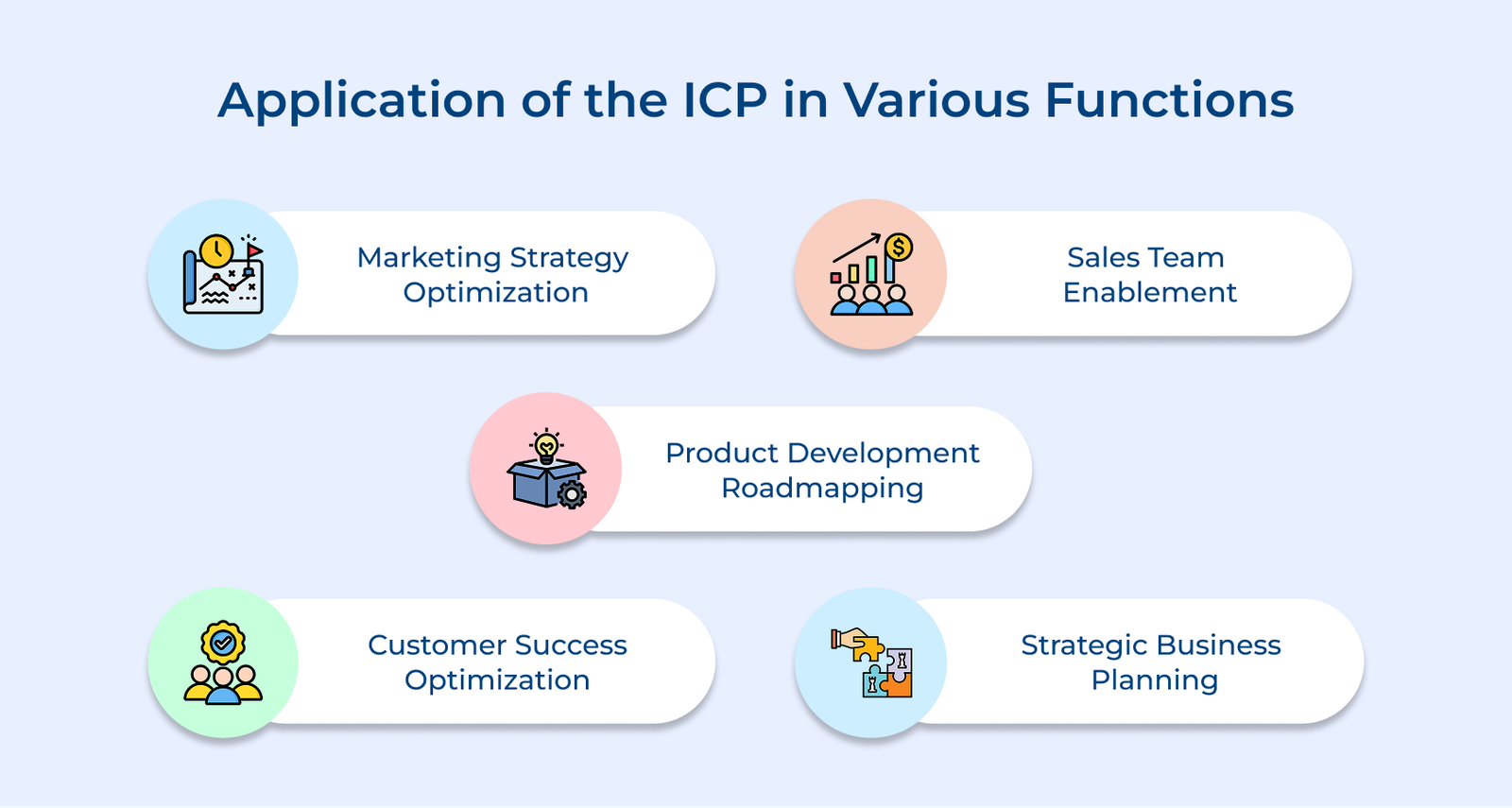
Your ICP helps shift your marketing approach from casting a wide net to speaking directly to the right audience. Instead of trying to appeal to everyone, you focus on businesses that benefit from what you offer. Here’s how that plays out in practice:
A clear ICP gives your sales team direction and purpose. Instead of chasing every lead, reps know who to focus on and how to engage them. The focus helps them use their time more effectively and have better conversations with the right prospects.
Your ideal customer profile keeps product development on track by anchoring decisions to the real needs of your best-fit customers. It helps teams avoid chasing one-off feature requests that don’t serve your core market and ensures your roadmap delivers meaningful improvements where they matter most.
The proactive approach improves retention by addressing the specific implementation and adoption barriers common among ideal customers.
Onboarding specialists can create implementation playbooks customized for the technical setups and team structures common in ICP organizations, helping customers see results faster. Customer success leaders can spot likely challenges ahead of time and tackle them proactively, keeping satisfaction high and issues from slowing progress.
Your ICP provides crucial guidance for long-term business decisions, from market expansion to product diversification to partnership development. The strategic alignment ensures growth initiatives build upon your core strengths rather than diluting them through unfocused expansion.
Partnership managers can concentrate on vendors serving the same type of customers, creating a network that adds real value to your offering. Investor relations teams gain more credibility when they clearly show how current initiatives connect to their ideal market and strengthen the company’s position.
Below are companies that primarily operate as consumer brands, each having robust B2B divisions that rely on carefully defined ICPs to guide their strategy.
Amazon Web Services (AWS)
Amazon’s cloud computing division began by identifying technical startups as its ideal customers, organizations needing enterprise-level infrastructure but lacking capital for traditional IT investments.
The impact of the focused approach turned AWS from a side project into Amazon’s most profitable division. AWS created services perfectly aligned with their requirements, built a developer-friendly ecosystem around these needs and established itself as the default cloud provider for an entire generation of tech companies before expanding to enterprise markets.
Nike’s B2B Distribution Channel
Nike didn’t chase shelf space everywhere; they chose retail partners that fit their brand and delivered the right customer experience. Their ideal partners had strong regional influence, could maintain premium presentation and attracted the same audience Nike designs for.
The selective approach helped Nike avoid overexposure, protect its brand image and strengthen relationships with retailers that genuinely added value. It was about the right presence, in the right places, with the right partners.
Puma’s Team Sport Division
Puma’s team sports division built an ideal customer profile targeting professional clubs, college athletic programs and sports associations. They focused not just on performance needs, but also on shared values, cultural fit, visibility opportunities and the potential for long-term collaboration. It keeps the meaning, reads smoothly and feels more conversational.
Puma stayed competitive against bigger rivals by focusing on partnerships where their strengths truly stood out. It allowed them to make the most of their resources and create meaningful impact.
A well-defined ideal customer profile gives your business direction. Instead of trying to appeal to everyone, you focus on the companies that are most likely to benefit from what you offer and stick around for the long haul.
You can create a practical guide that helps every team work toward the same goals with the right people in mind by looking closely at your best customers and identifying what they have in common.
The clarity leads to better conversations, smarter product decisions, and stronger customer relationships. When you focus your energy on the right companies, growth becomes more consistent and more meaningful.

Yes, you need both because they serve complementary purposes. Your ICP identifies which organizations to target at a company level based on attributes like industry, while buyer personas help you understand the individual decision-makers within those companies, their roles, challenges and motivations that drive purchasing behavior. Together, they create a complete targeting strategy.
An ICP keeps your marketing focused. Instead of guessing or speaking in general terms, you create messages, campaigns and content that speak directly to businesses who are more likely to need and value what you offer. It also helps you choose the right channels, set better priorities and measure success in terms that matter.
Without an ICP, it’s easy to chase leads that aren’t a good fit, resulting in longer sales cycles, low conversion or unhappy customers. A clear ICP helps you spot the companies most likely to succeed with your product, making sales more efficient and increasing the chances that customers stick around.
ICPs are becoming more flexible and data-driven. Instead of being one-off documents, they’re shifting toward models that update in real time as customer behavior and market conditions change. AI is starting to uncover patterns we’d otherwise miss and companies are moving beyond surface-level traits to include things like intent signals or behavioral data.

Grow Customer Relationships and stronger team collaboration with our range of products across the Conversational Engagement Suite.
Omnichannel Customer Support & Help Desk Software
AI Enabled Business Messaging and Chatbot Software
Sales Engagement & CRM Software
Call Center Software & Virtual Phone System
Product Marketing & Experience Platform
Customer Experience & Feedback Management Software
 What is Lead Follow-up? Best Practices to Improve Conversion
Scroll to top
What is Lead Follow-up? Best Practices to Improve Conversion
Scroll to top