How to Identify Customer Needs? 7 Effective Ways in 2026
Check out how to identify customer needs to uncover what matters and how to turn insights into value. Identifying customer needs involves listening actively and asking the right questions.
Check out how to identify customer needs to uncover what matters and how to turn insights into value. Identifying customer needs involves listening actively and asking the right questions.
Many teams pour time and money into products based on gut instinct, only to realise too late that customers wanted something else. The fallout shows up everywhere in the form of low demand, confused messaging and resources spread thin. 63% of consumers expect businesses to know their unique needs and expectations, while 76% of B2B buyers expect the same thing.
Competitors who listen more closely end up ahead because they ask smarter questions, collect real feedback and adjust their offerings based on what people actually do. That gap in understanding slowly eats into your marketing and chips away at trust. It also hits revenue harder than most teams admit.
This isn’t a dead end. You can swap guesswork for real insight with a simple, structured approach to identify customer needs. Here’s the thing – once you know what people care about, you make better decisions across the board. Let’s walk through the practical methods that help you uncover what matters to your customers so you can build something they genuinely value.
Customer needs refer to the real-life problems, desires and expectations that drive people to look for a product or service. The needs can be practical, like wanting faster service, or emotional, like feeling valued during a purchase. Customer needs highlight the gap between where someone is and where they want to be. The needs show up in everyday life. Some needs are obvious and urgent, while others are subtle, something people don’t know they want until it’s presented to them.
The most successful businesses don’t just react to complaints or requests. They go deeper. They study behavior, listen closely and pay attention to what’s not being said. Interviews, surveys, data analysis and simply watching how people interact with products all help uncover needs that aren’t always easy to express.
Key goals:
Let’s go through the key types of customer needs that you should be aware of to elevate your business strategy and resonate more profoundly with your target audience.
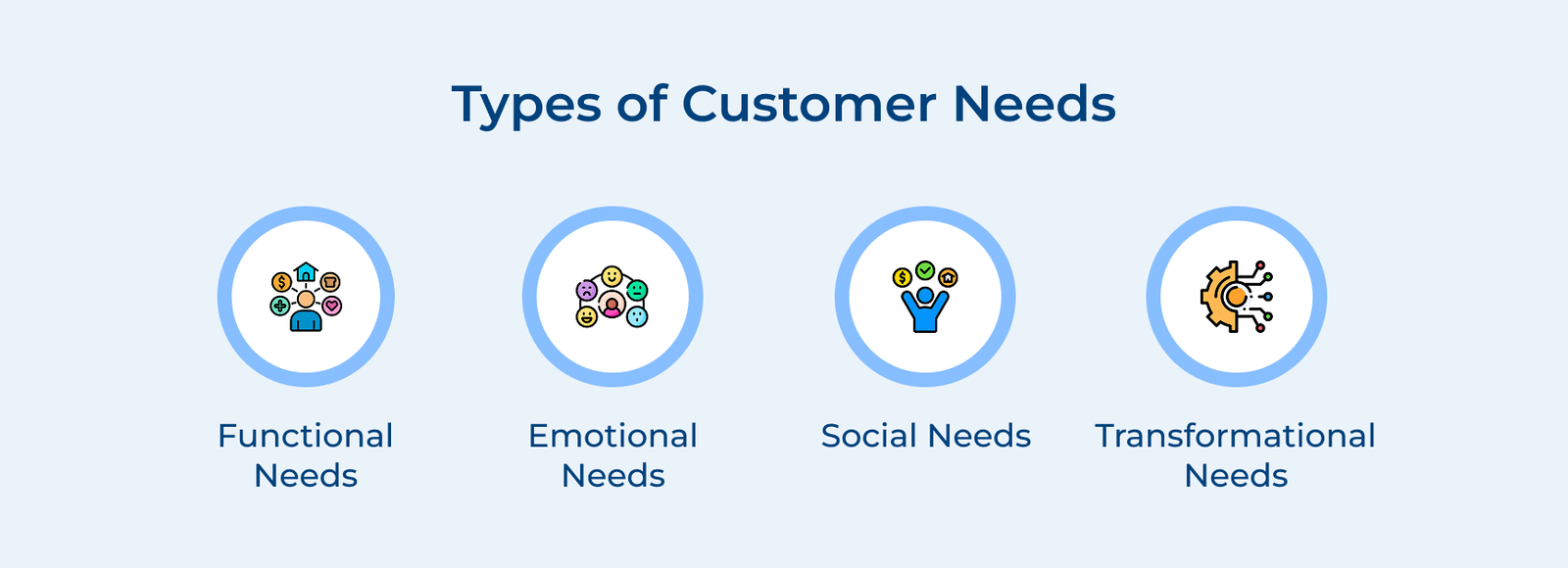
They are the straightforward, practical reasons someone buys a product or service. People want things that work, solve problems and make life easier.
People also buy things because of how they make them feel. The needs often influence purchasing just as much, if not more than, practical ones.
A luxury watch tells the same time as a basic one. The difference is what it means to the person wearing it. It can feel like pride, a reward for hard work, or a small piece of identity they carry on their wrist.
What we buy often says something about us and helps us connect with others. The needs are about belonging, recognition and shared values.
The needs relate to who people want to become. It aims for growth, improvement or a better version of themselves.
Here’s the thing about online courses. People don’t sign up just to watch lessons. They’re chasing a shift in who they can become. A solid course makes them feel equipped to take on bigger roles, unlock new opportunities and carry themselves with more confidence in their work. It’s the promise of that transformation that really drives the decision to invest.
Below are the significance of understanding customer needs and providing actionable strategies to help businesses thrive.
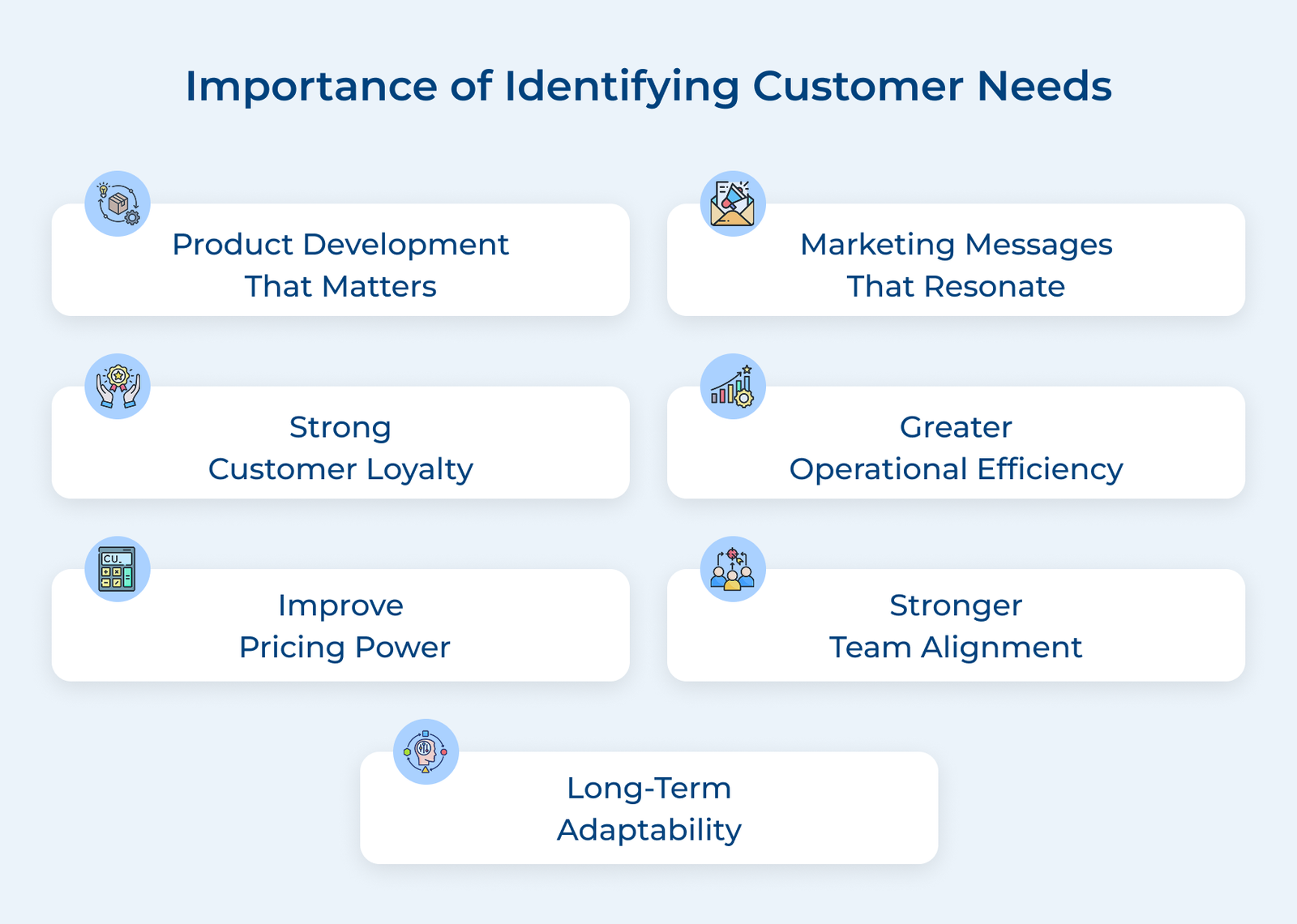
1. Product Development that Matters
When you understand what customers are trying to solve, your product decisions become sharper. You stop adding features no one uses and focus instead on what truly helps. It saves time, money and frustration for your team.
2. Marketing Messages that Genuinely Resonate
Understanding your customers’ needs means you can speak their language. Your marketing stops sounding like empty slogans and starts sounding helpful. It connects because it’s rooted in what real people care about, not what you think they might care about.
3. Customer Loyalty that Withstands Competition
People stick with brands that “get them.” When customers feel understood, they’re more likely to return even when cheaper or flashier alternatives appear. Loyalty comes not just from satisfaction, but from feeling seen.
4. Operational Efficiency that Reduces Waste
Clear insight into customer needs helps you stop doing what doesn’t help. That means fewer wasted features, fewer unnecessary processes and more energy spent where it counts. It results in a leaner, more focused business that delivers better outcomes.
5. Adaptability that Ensures Relevance
Customer needs don’t stay still and neither should you. When you keep listening, you see shifts coming before they hit. It helps you adapt your products, messaging and strategy early so you stay useful, not outdated.
Check out the effective ways to identify customer needs, helping you transform insights into action and enhance lasting relationships with your clients.
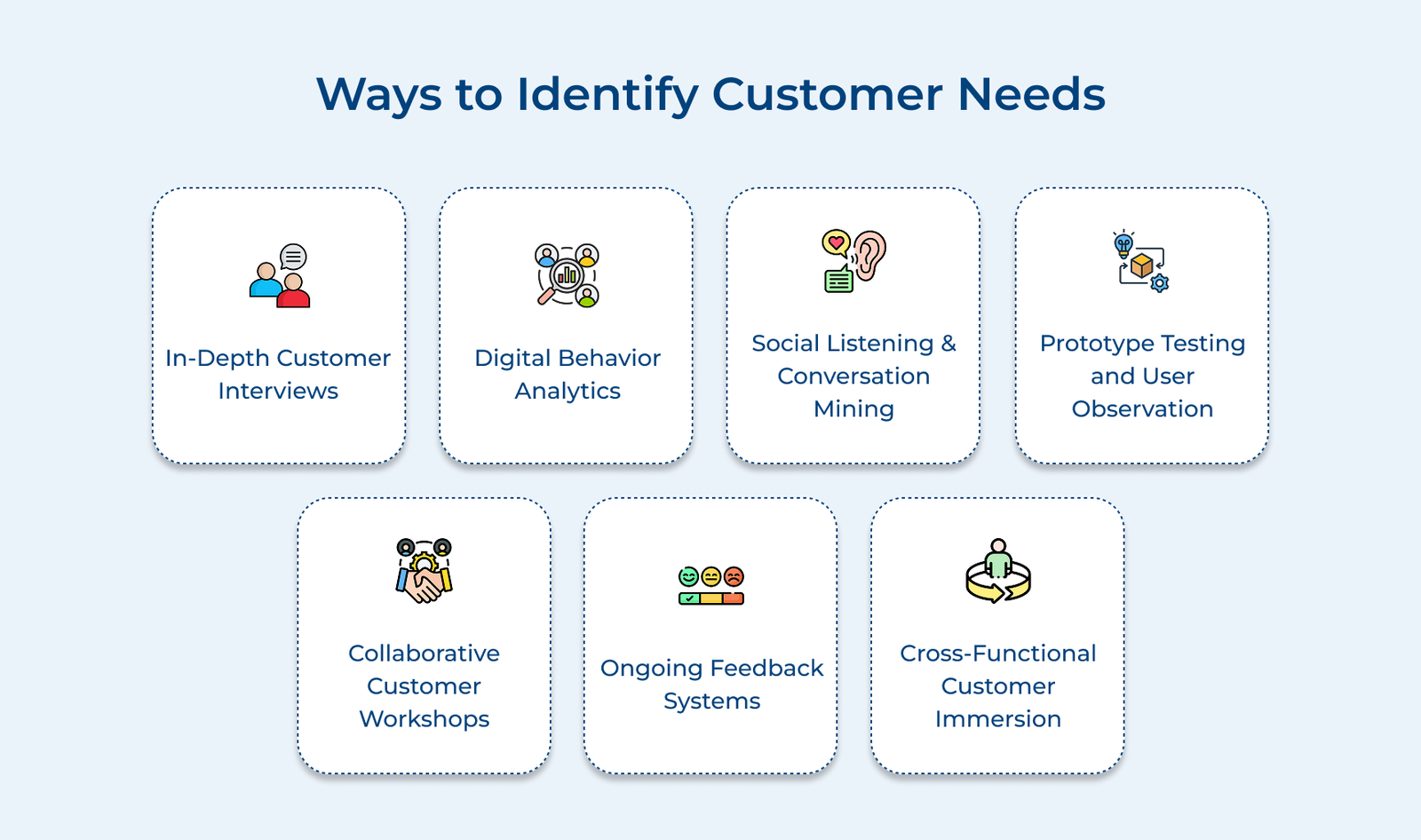
In-depth customer interviews are one-on-one conversations that go beyond surface-level feedback. Instead of ticking boxes, you’re listening to stories. The goal is to understand not just what customers say, but what they mean and how they feel. Done right, the interviews reveal what customers truly need, not just what they think they want.
Key questions:
Strong interviews go beyond questions. Use projective techniques like card sorting or simple completion exercises to cut past surface-level responses. Share rough, unfinished sketches to spark honest critique without putting people on the defensive.
Ask directly for unfiltered feedback so participants feel free to speak plainly. Record sessions with permission to catch the subtle reactions you might miss live. Those small cues often reveal the deeper emotions driving their choices.
Instead of relying on what customers say, digital behavior analytics looks at what they do. It tracks how people move through your website or app, where they pause, what they click and when they leave. It gives you a direct window into what’s working, what’s confusing and what’s missing.
Think of it as reading your customers’ digital body language. If someone clicks a button that isn’t clickable, or searches for something and finds nothing useful, they’re showing you a need, even if they never say it out loud.
Key metrics:
Social listening mining helps you track and understand real discussions happening around your product, service, competitors and the wider industry. You watch how people talk on social platforms, forums, review sites and other digital spaces, then study those conversations to spot opportunities you might otherwise miss.
The method works because it taps into raw, unfiltered feedback. Customers describe their needs in their own words, which gives you a clearer view of their frustrations, expectations and hopes. You get to see how they speak when no one is guiding the conversation and that’s where the real insights usually show up.
Tracking Mentions Across Digital Platforms
Track hashtags, product mentions, complaints, comparisons and relevant keywords. Look for patterns in how people describe their experiences and what they wish worked better..
Analyzing Emotional Sentiment Patterns
Use sentiment analysis tools to spot where emotions run high, be it the frustration over a confusing feature or enthusiasm for something that finally worked well. The emotional spikes often reveal critical needs, even if customers don’t spell them out directly.
Finding Gaps through Competitor Reviews
Study what customers say about competitor products or services, especially in detailed reviews explaining why they switched to or from alternatives. The comparative discussions frequently reveal critical needs your offering might address inadequately or opportunities competitors haven’t fully satisfied. The competitive intelligence helps identify customer needs that represent strategic opportunities for differentiation.
Prototype testing and user observation involve creating simplified versions of your product or service and watching how real users interact with them in controlled or natural settings. The method is essential for identifying customer needs because it moves beyond what customers say they want to reveal how they behave when using a solution.
Conducting Think-aloud Interaction Sessions
Testing a prototype in a controlled room only tells you so much. Try observing people using it in the real context where it’s meant to live, like their kitchen, office, or shop floor. You’ll see how distractions, habits or space limitations influence behavior.
Observing Users in Natural Environments
Place your product or service prototype in the actual context where customers would normally use it, be it their home, workplace or public setting. Watch how environmental factors, interruptions and real-world constraints affect usage patterns.
Instead of relying solely on one-on-one interviews, customer workshops bring people together to uncover needs through group discussion and hands-on activities. The sessions tap into shared experiences, spark new thinking and often surface problems that individual conversations miss.
When customers need a product or service, workshops can be structured around specific activities designed to surface different types of information. Problem definition exercises help articulate existing pain points, while future scenario activities explore emerging needs.
Key takeaways:
Instead of waiting for quarterly reports or annual reviews, continuous feedback systems let you hear from customers while they’re actively using your product or service. The real-time insights are more accurate and specific because they’re based on fresh experiences, not distant memories.
Key questions:
Cross-functional customer immersion pulls teams out of their bubble and drops them into the way real people actually live and work. Engineers, marketers, designers and even senior leaders see the product in the wild instead of staring at filtered reports.
Teams watch how customers move through the experience, where they get stuck and what genuinely delights them. The feedback hits harder because it’s unfiltered, immediate, and impossible to ignore.
Primary effects:
Let’s assume that a kitchen appliance company sends its entire product team into customers’ homes during busy dinner prep. While watching a parent try to clean their blender while holding a baby, the team identified an unmet need for truly one-handed operation and cleaning that hadn’t emerged in focus groups.
Check out the brands that have developed modern systems to continuously discover what customers truly want.
1. IKEA’s Home Visits Program
IKEA sends teams directly into people’s homes, observing how people live in their spaces. The visits reveal the small, daily challenges people often don’t mention, like cramped hallways, cluttered entryways or deep cabinets where things get lost.
The insights gathered from these home visits directly influence IKEA’s product development process. Solutions like their narrow hallway storage units and modular kitchen systems address specific living challenges observed during these visits.
2. Zappos’ Extended Customer Service Conversations
Zappos allows its customer service representatives to spend unlimited time on calls without scripts or time targets. Reps ask open-ended questions about how customers use their products and listen for unstated needs beneath purchase inquiries.
The approach has created a continuous feedback loop that informs Zappos’ inventory decisions and website improvements. The company has developed a reputation for deeply understanding customer preferences, which translates into exceptional loyalty. Their customer-centric philosophy builds emotional connections that extend beyond transactional relationships, making customers feel genuinely understood rather than merely served.
3. Netflix’s Comprehensive Viewing Analysis
Netflix analyzes not just what shows customers watch but how they watch them, tracking pauses, rewinds and abandonment points. Their platform captures countless micro-interactions, like which scenes viewers rewatch or which episodes cause people to binge versus take breaks.
The deep understanding of viewing patterns enables Netflix to create content that aligns precisely with audience preferences. Their original programming decisions are heavily influenced by behavioral insights rather than traditional demographics or focus groups. The approach has allowed them to develop highly targeted content that resonates deeply with specific audience segments, creating viewing experiences that feel personally curated.
Truly understanding customer needs starts with empathy, not just spreadsheets. It’s about seeing the world through their eyes, like what frustrates them, what excites them and what they’re trying to achieve. The most effective organizations build systems that listen, learn and adapt constantly.
You get a fuller picture by combining different methods such as interviews, behavior analysis, observation and feedback. What customers say, what they do and how they feel don’t always match, but together, they reveal the real story.
Importantly, the understanding shouldn’t sit in a report or with one team. When everyone, from designers to salespeople, has access to customer insights, better decisions happen everywhere. They create simple feedback loops that help them stay in tune, adjusting products, messages and services as customers evolve.
Key takeaways:

Personas turn general data into relatable profiles, people with specific goals, frustrations and behaviors. They help teams build empathy, design with real users in mind and avoid vague assumptions about the “average customer,” who rarely exists in reality. Well-developed personas also guide research by focusing attention on the needs of clearly defined user types.
Customers often struggle to articulate their deeper needs, focusing on features rather than outcomes. Research can be biased toward vocal minority opinions. Organizations frequently mistake customer wants for fundamental needs. Balancing quantitative data with qualitative insights presents ongoing difficulty. Bridging the gap between research findings and actionable development priorities remains persistently challenging.
A mix of methods works best. Watching people use a product in real-life situations can uncover pain points they don’t mention. One-on-one interviews help reveal motivation and context. Website analytics and behavior data show what people do, not just what they say. Testing early prototypes helps verify if assumptions hold up. Collecting ongoing feedback keeps understanding up to date.
Customer journey mapping software visualizes the entire experience to identify pain points. Heat mapping tools reveal digital behavior patterns. Voice-of-customer platforms aggregate feedback across channels. Text analytics software finds patterns in qualitative data. Prototyping tools enable rapid concept testing. Customer data platforms connect behavior across touchpoints for a unified view of needs.
Constantly. While some needs stay steady, others shift with trends, technology, or life changes. Light monitoring should be ongoing via support conversations, usage data or feedback forms. Deeper research should happen regularly and any major shift in the market or drop in performance is a clear signal to recheck assumptions.
Look beyond what customers say to observe what they do. Pay attention to emotional responses that signal deeper importance. Use projective techniques like “five whys” to uncover root motivations. Compare stated preferences with behavioral data to find discrepancies. Create scenarios that force trade-off decisions, revealing what customers truly value when they can’t have everything.

Grow Customer Relationships and stronger team collaboration with our range of products across the Conversational Engagement Suite.
Omnichannel Customer Support & Help Desk Software
AI Enabled Business Messaging and Chatbot Software
Sales Engagement & CRM Software
Call Center Software & Virtual Phone System
Product Marketing & Experience Platform
Customer Experience & Feedback Management Software

 9 Best Sales Funnel Templates To Get More Leads in 2026
Scroll to top
9 Best Sales Funnel Templates To Get More Leads in 2026
Scroll to top