What is Sales Growth? Definition and How to Calculate
Sales growth measures how a company's revenue increases over time. The blog explores its importance, key types, benefits and examples to help businesses boost long-term success.

Sales growth measures how a company's revenue increases over time. The blog explores its importance, key types, benefits and examples to help businesses boost long-term success.
Many B2B companies hit a revenue ceiling not because they lack effort, but because they don’t fully understand what fuels consistent sales growth. Without a clear way to measure progress or apply the right strategies, it’s easy to fall behind while competitors move ahead despite similar or even greater effort. 54% of salespeople are already finding contacting prospects more difficult now than 5 years ago.
When growth stalls, the impact spreads in the form of market share shrinks, recruiting strong talent gets harder and investment in innovation slows. Meanwhile, others in your space are seizing the chances you’re missing, making it harder to catch up. The guide breaks down the basics of sales growth, how to track it, what drives it and how to apply strategies that move the needle. You’ll also find real examples of what sustainable growth looks like in practice.
Sales growth in a B2B context refers to increasing the revenue a business earns from selling its products or services to other companies over a defined period. It’s a measure of how well your business attracts new clients, strengthens relationships with existing ones and increases the value of each transaction. It shows how effectively you’re gaining ground in the marketplace.
When sales grow steadily, the entire organization benefits. It brings in the funds needed to improve products, hire skilled people and explore new opportunities. It also builds trust with stakeholders who want to see consistent results and smart decisions.
Key objectives:
Check out the importance of sales growth, how it creates room for innovation without raising costs across the board.
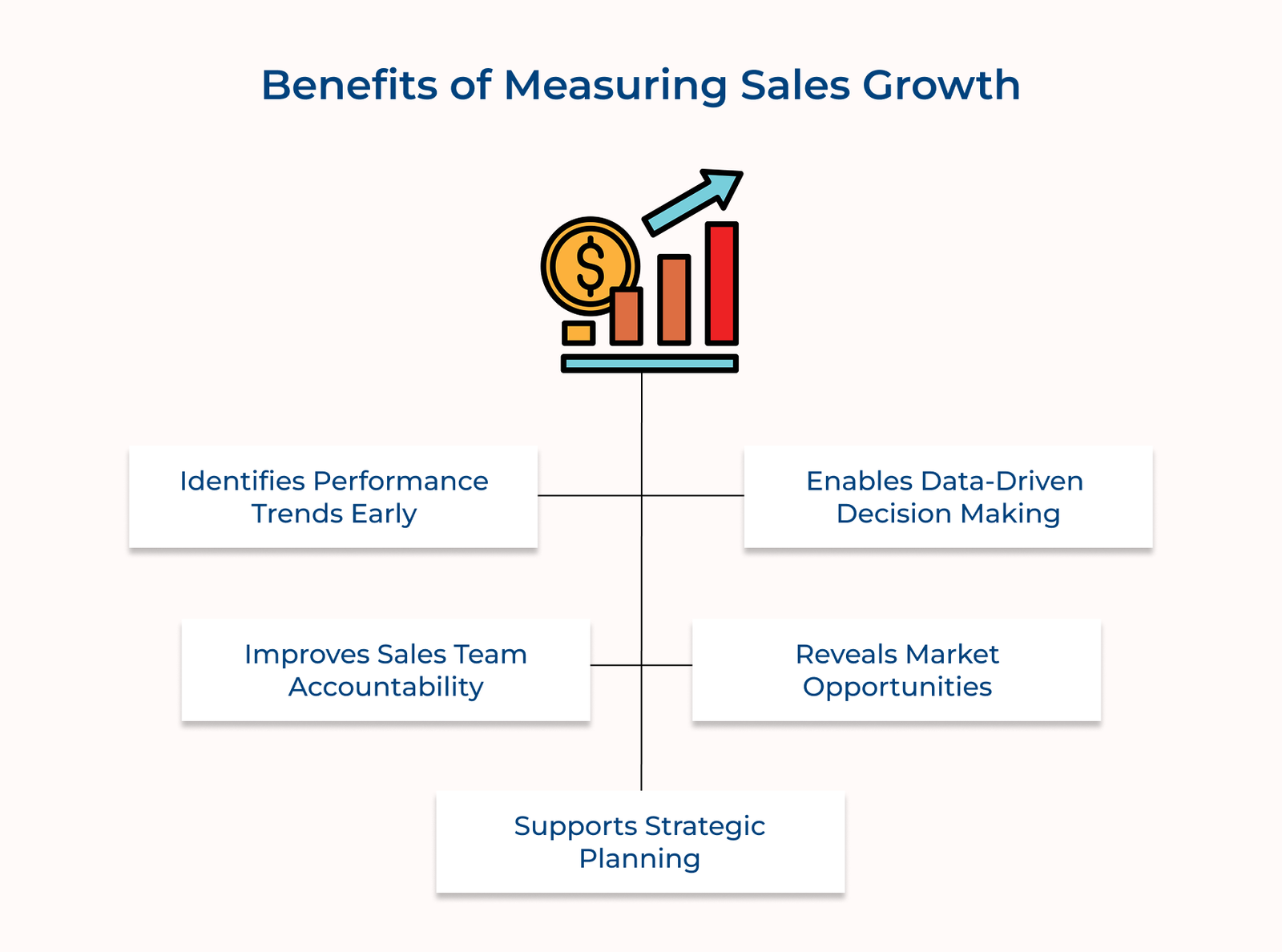
Identifies Performance Trends Early
Tracking your numbers regularly helps you notice when sales start slipping in a region or when a new strategy is paying off. It gives you time to act before problems get bigger or opportunities pass.
Enables Data-driven Decision Making
Instead of guessing where to invest time and money, use actual sales data to guide you. Focus on what’s clearly working and cut out what isn’t. It’s about using facts, not hunches.
Improves Sales Team Accountability
When everyone knows what the goals are and how they’re measured, it’s easier to stay on track. Reps see how they’re doing and managers can offer better support where it’s needed.
Reveals Market Opportunities
Metrics show where growth is happening, specific products, customers or regions and where it’s not. The insight helps you shift your efforts to areas with the most potential.
Supports Strategic Planning
Looking at past performance helps you set realistic goals and prepare for future demand. It’s how leadership avoids overpromising and underdelivering when it comes to hiring, stock or budgets.
Let’s go through the simple steps to calculate your sales growth rate so you can track progress, spot trends early and make informed decisions with real numbers.
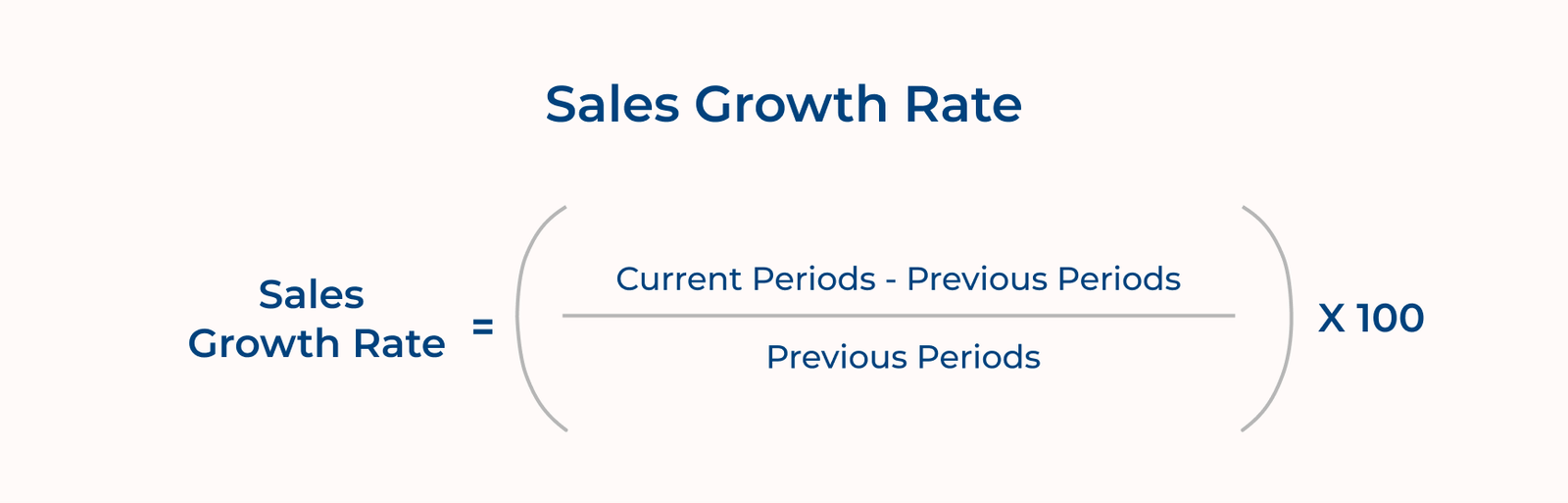
Sales Growth Rate = ((Current Period Revenue – Previous Period Revenue) / Previous Period Revenue) × 100
Most successful B2B companies aim for annual sales growth between 15-25% depending on their industry and where they are in the market lifecycle. Established companies often target 10–15% for steady progress, while startups chase more aggressive growth. The goal isn’t explosive numbers; it’s consistent, manageable gains that your team and systems can support.
Define your time period: Pick a consistent timeframe like month-over-month or year-over-year. Both periods must be the same length so your numbers reflect actual changes, not timing differences.
Gather revenue data: Pull total sales figures for both periods from accurate sources. Make sure the data is based on the same accounting methods and includes the same kinds of revenue.
Calculate revenue difference: Subtract the previous period’s revenue from the current one. It gives you the raw dollar increase or decrease in sales.
Apply the growth formula: Take the difference, divide it by the previous period’s revenue and multiply by 100. The result is your sales growth rate as a percentage, simple, consistent and easy to compare across time or teams.
Below is a practical example using a software company’s quarterly results to demonstrate how the calculation works in real business scenarios.
Scenario: TechSolutions Inc. wants to calculate its Q2 to Q3 sales growth rate using the following revenue data:
– Q2 Revenue: $850,000
– Q3 Revenue: $1,020,000
Step-by-Step Calculation:
1. Revenue Difference = $1,020,000 – $850,000 = $170,000
2. Growth Rate = ($170,000 ÷ $850,000) × 100 = 20%
Result: TechSolutions Inc. achieved a 20% quarterly sales increase rate, which falls within the ideal benchmark range for B2B companies. The positive growth indicates strong market performance and suggests their sales strategies are effectively driving revenue expansion. The company can use the 20% baseline to set realistic targets for Q4 and evaluate the success of new initiatives they implement.
Below are the top strategies that can help drive your sales forward, ensuring your business not only survives but thrives
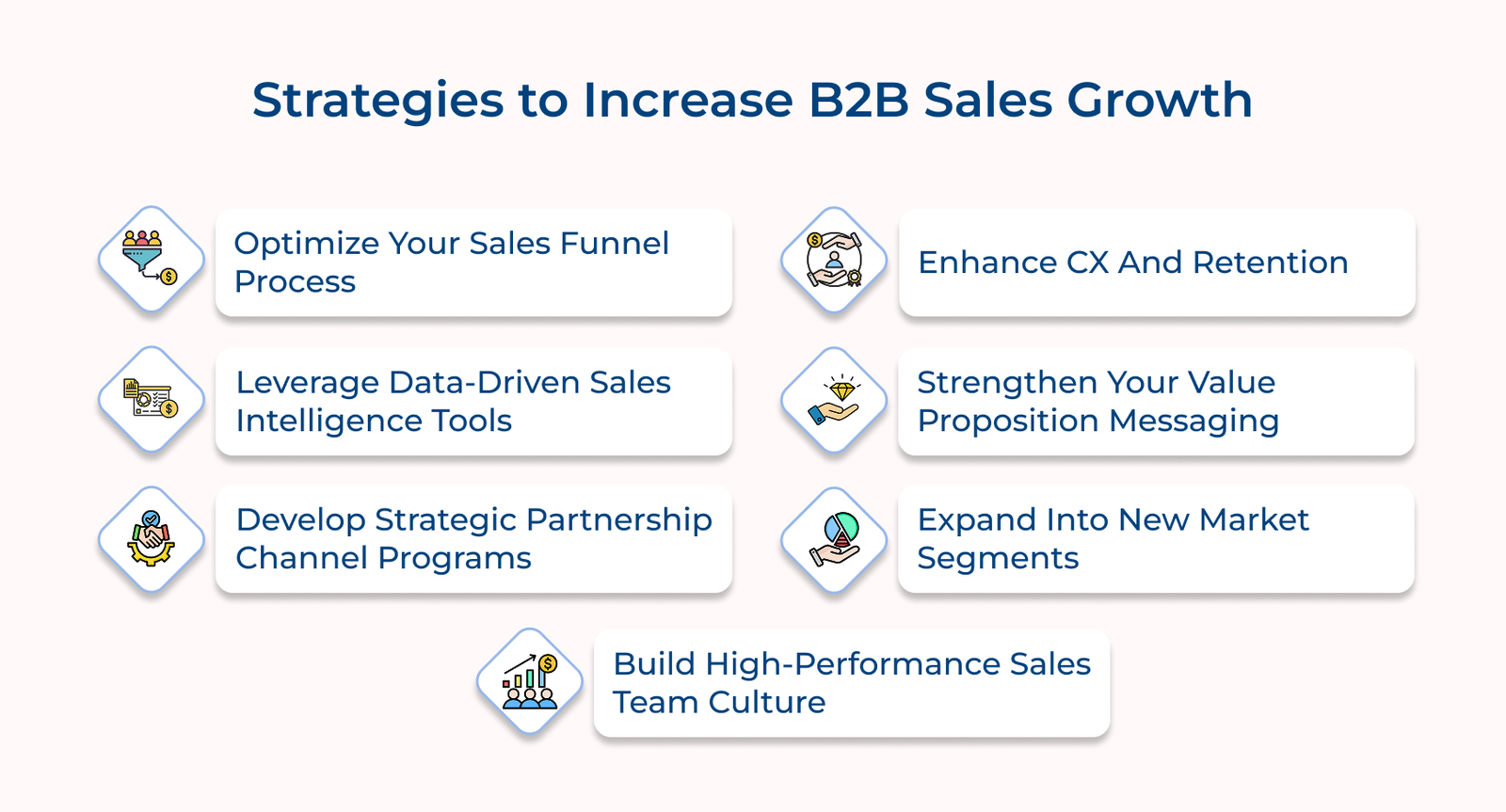
A sales funnel maps the path potential buyers follow from first hearing about you to finally making a purchase. When that path is slow, confusing or full of friction, people drop off and sales stall.
Improving your funnel matters in B2B sales because even small changes can have a big impact. Let’s assume that a software company found that over half of its leads bailed when asked to book a demo. They boosted conversions massively in just three months by just simplifying that step.
Key methods:
Think of it like clearing obstacles from a stream- when you remove what’s blocking the flow, more leads make it to the end.
Sales intelligence helps you work smarter, not harder. It combines data and analysis from various sales tools to show who’s ready to buy, what they care about and when to reach out. Relying on guesswork or outdated lead lists won’t cut it.
Key questions:
Understanding the questions helps you choose tools that align with your sales process and deliver measurable results instead of just collecting data. Four essential data-driven sales intelligence tools can dramatically improve your team’s effectiveness and conversion rates:
Sales intelligence transforms guesswork into a strategic advantage by providing the insights your team needs to close more deals effectively.
Strategic partnerships aren’t about handshakes and logos; they’re about working closely with other companies to reach new customers and experience sales growth faster than you could alone. The right partnership can open doors to markets that would otherwise take years to enter and it can give your sales team instant credibility with buyers who already trust your partner.
Customer experience personalization involves tailoring every interaction to match individual client needs, preferences and business challenges they face. The approach becomes essential because B2B buyers expect the same customized treatment they receive as consumers in their personal purchasing decisions. Enhanced customer experience directly drives sales growth by building stronger relationships that lead to higher conversion rates and increased deal sizes.
Personalization amplifies customer experience benefits by making each touchpoint feel specifically designed for that particular client’s unique situation and business requirements. Here are four powerful personalization strategies:
Account-based marketing sales alignment involves coordinating marketing and sales efforts to target high-value accounts with personalized campaigns. The strategy becomes crucial because it eliminates the disconnect between marketing-generated leads and sales-qualified opportunities that often waste valuable resources.
Coordinate targeted campaigns for high-value accounts
Marketing and sales should sit down together to pick the accounts that matter most. Once you’re aligned, every campaign is aimed at the same companies. The marketing doesn’t generate leads that sales can’t use and sales don’t waste time on cold prospects.
Align sales and marketing messaging consistency
When a buyer sees your ad, reads your email or talks to a rep, the message should be the same. You want a clear, consistent story across all channels. It builds trust fast.
Create personalized content for decision makers
Generic messaging to “CFOs” or “decision makers” isn’t enough. Create content that speaks to the individual concerns of the people involved in the deal.
Expanding business with your current clients often delivers better returns than chasing new ones. Retention-driven growth is simpler, more cost-effective and builds on the trust you’ve already earned.
Key methods:
Think of retention like caring for a long-term partnership. When you grow with your clients, they’re more likely to stay, spend more and advocate for your brand without needing to be asked.
Sales techniques, buyer expectations and tools are always changing. Without regular training, even experienced teams can fall behind. Keeping your team sharp isn’t a luxury; it’s a necessity. Here are four types of training that can make a real difference:
Think about it like would you rather have a sales team that learned their skills five years ago and never updated them or a team that continuously sharpens their abilities with fresh techniques? Training creates confidence, which translates directly into better conversations with prospects and ultimately sales growth for your organization.
Below are the indicators that help you understand what’s working and where improvements are needed most.
Key questions you must consider:
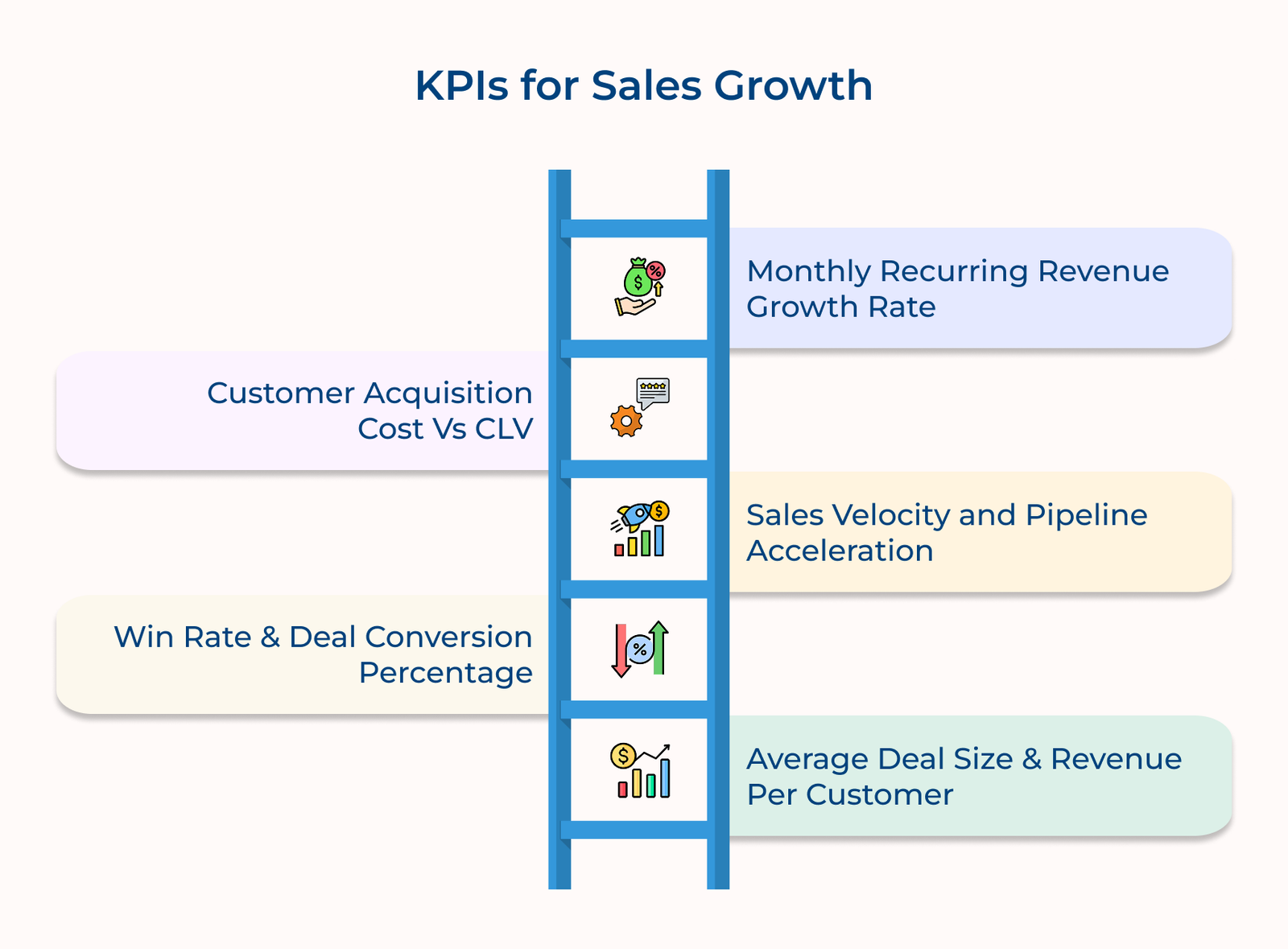
1. Monthly Recurring Revenue Growth Rate
The monthly recurring revenue growth rate tracks how much your recurring revenue is increasing month over month. It’s especially useful for subscription-based businesses that rely on steady, predictable income.
2. Customer Acquisition Cost vs Customer Lifetime Value
The ratio shows if you’re spending wisely to gain new customers. Ideally, the value a customer brings in over time should be at least three times what it costs to win them.
3. Sales Velocity and Pipeline Acceleration
Sales velocity tells you how fast deals move from first contact to closing. Pipeline acceleration helps you see if that speed is improving and where delays are slowing things down.
4. Win Rate and Deal Conversion Percentage
Win rate shows how often your sales team turns opportunities into closed deals. Conversion percentage tracks how leads move through each stage, highlighting where you lose the most potential business.
5. Average Deal Size and Revenue Per Customer
Average deal size reflects the typical value of a closed sale. Revenue per customer looks at total earnings from each client, including follow-up sales. Growing the numbers can be more efficient than chasing new customers.
Check out the real-world examples that demonstrate how different approaches can generate remarkable sales growth across various industries.
Amazon – Data-Driven Personalization and Ecosystem Expansion
Amazon strengthens its B2B growth through AWS by using client data to recommend helpful tools and services. Instead of just selling products, Amazon focuses on becoming an essential part of how its clients operate. They make it hard for customers to switch and easy to stay, increasing the value of every client relationship over time by offering a wide range of connected services.
Airbnb – Platform Network Effects and Trust Building
Airbnb grows its business travel segment by making the platform trustworthy and easy to use. More hosts attract more travelers and more bookings build confidence in the system. Their review system and booking simplicity make corporate travel managers return without needing much direct sales effort. The more the platform grows, the more it fuels itself.
Nike – Direct-to-Consumer Strategy and Brand Partnerships
Nike grows its B2B presence by working directly with companies and forming smart brand partnerships. The relationships go beyond product sales; they include custom programs for teams and events. Direct sales give Nike more control and insight, while partnerships widen its reach without needing extra infrastructure. It results in stronger loyalty and the ability to charge more for quality.
Apple – Ecosystem Integration and Premium Positioning
Apple focuses on how its products work together to support real business goals. Instead of competing on price, it highlights the long-term value of tools that just work well together. Businesses that adopt Apple often stick with it, not because it’s the cheapest, but because it simplifies work, boosts output and stays reliable.
Think of sales growth as the engine that keeps your business moving forward, fueled by steady improvements and clear results. The strategies we’ve covered aren’t quick fixes, but tools to help you build revenue while earning deeper trust from your customers.
Real change takes time. Instead of trying to do everything at once, choose one or two approaches that fit where you are right now. Focus on doing them well. As you start to see progress, you’ll build momentum and that’s what leads to long-term, lasting success.

Sales growth keeps your business alive and moving. It gives you the money to hire, build, improve products and stay ahead of competitors. Without it, you’re stuck, unable to invest, adapt or survive tough times. Growth also builds trust. It tells investors, customers and partners that your business is headed in the right direction.
Subtract the previous period’s revenue from the current period’s, divide by the previous period’s revenue and multiply by 100. Track it monthly, quarterly or annually, just stay consistent and adjust for seasonal changes.
Real growth comes from steady work across your business. It means improving how you close deals, using data to make better decisions, forming smart partnerships and making customers feel understood. Pick a few strategies, stick with them and adjust based on what works, not guesswork.
Start by looking at your past numbers, how leads moved through your pipeline, how fast deals closed and how customers behaved. Then, consider outside forces: What’s happening in your industry, with your competitors or in the economy? Mix the data with common sense and you’ll have a clearer picture of what’s coming next.
Grow Customer Relationships and stronger team collaboration with our range of products across the Conversational Engagement Suite.
Omnichannel Customer Support & Help Desk Software
AI Enabled Business Messaging and Chatbot Software
Sales Engagement & CRM Software
Call Center Software & Virtual Phone System
Product Marketing & Experience Platform
Customer Experience & Feedback Management Software
 Overcoming Sales Objections: Reasons, Types & Key Steps
Scroll to top
Overcoming Sales Objections: Reasons, Types & Key Steps
Scroll to top