8 Top Lead Conversion Metrics For Businesses in 2026
Explore the key lead conversion metrics that reveal how effectively businesses turn prospects into customers. It covers measurement methods, benchmarks and strategies to improve sales performance.
Explore the key lead conversion metrics that reveal how effectively businesses turn prospects into customers. It covers measurement methods, benchmarks and strategies to improve sales performance.
Your business may attract plenty of leads, but without knowing which ones turn into customers or why others don’t, you’re left guessing. The guesswork costs both sales and wasted effort.
Each day, missed opportunities slip through because weak points in your sales funnel go unnoticed and you can’t tell which channels bring in real buyers. Competitors who track the right numbers are improving steadily while you rely on assumptions.
You gain a clear view of what truly drives revenue by focusing on the right lead conversion metrics. The essential metrics will show you where to adjust, helping you refine your process and convert more leads into long-term, profitable customers.
Lead conversion refers to the process of turning interested prospects into paying customers. It shows how effectively you move people from first inquiry to purchase. It reveals how well your marketing and sales efforts work together to generate actual revenue.
A good lead conversion rate depends entirely on your industry and business model. Some businesses succeed with 2–3% conversion rates, while others require higher rates to stay profitable. The key is understanding your specific market dynamics and continuously improving your conversion process rather than chasing arbitrary benchmarks.
Key objectives:
Lead conversion metrics refer to the metrics for tracking how effectively you turn prospects into customers. They highlight strong and weak points in your sales process. It shows where to improve and how effectively you’re acquiring customers.
Lead conversion rate calculation involves dividing the number of customers who purchased by the total number of leads you generated during a specific time period. You then multiply the result by one hundred to express it as a percentage. The simple calculation gives you a clear picture of your conversion effectiveness.
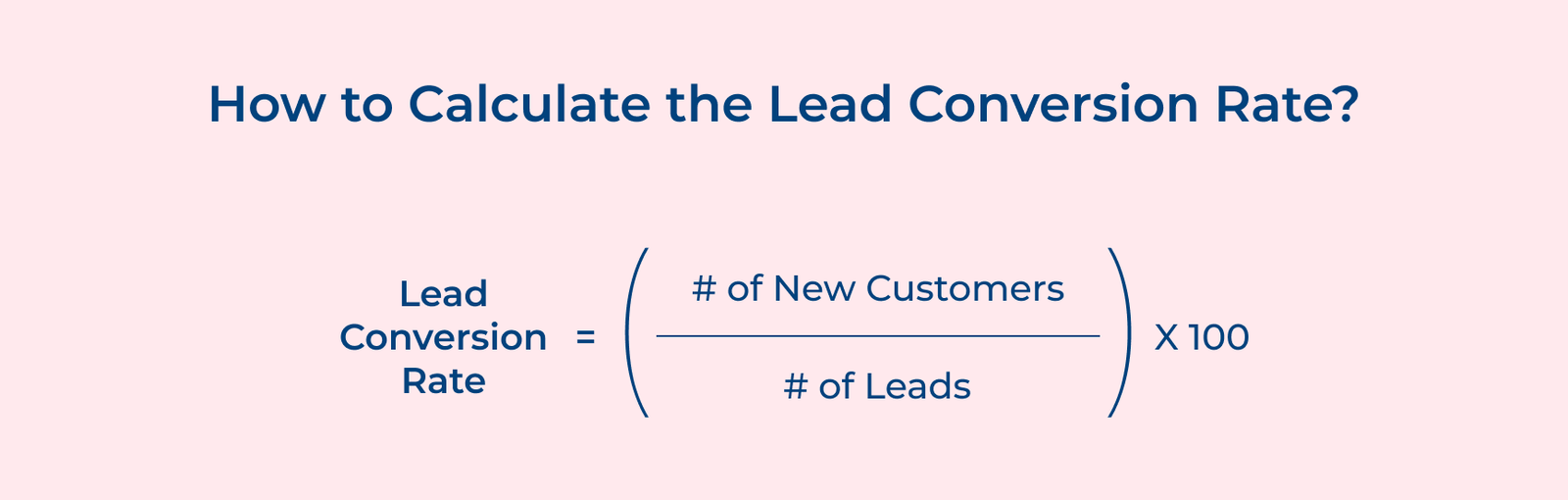
Formula for Calculation:
Lead Conversion Rate = (Number of Conversions ÷ Total Leads) × 100
Key components:
Calculation Example:
Let’s say your business generated 500 leads last month and 25 of them became paying customers. You would divide 25 by 500 to get 0.05, then multiply by 100. It gives you a lead conversion rate of 5 percent for that month.
Let’s go through the benefits of using lead conversion metrics for businesses. The insights help guide smarter decisions that turn more prospects into loyal customers.
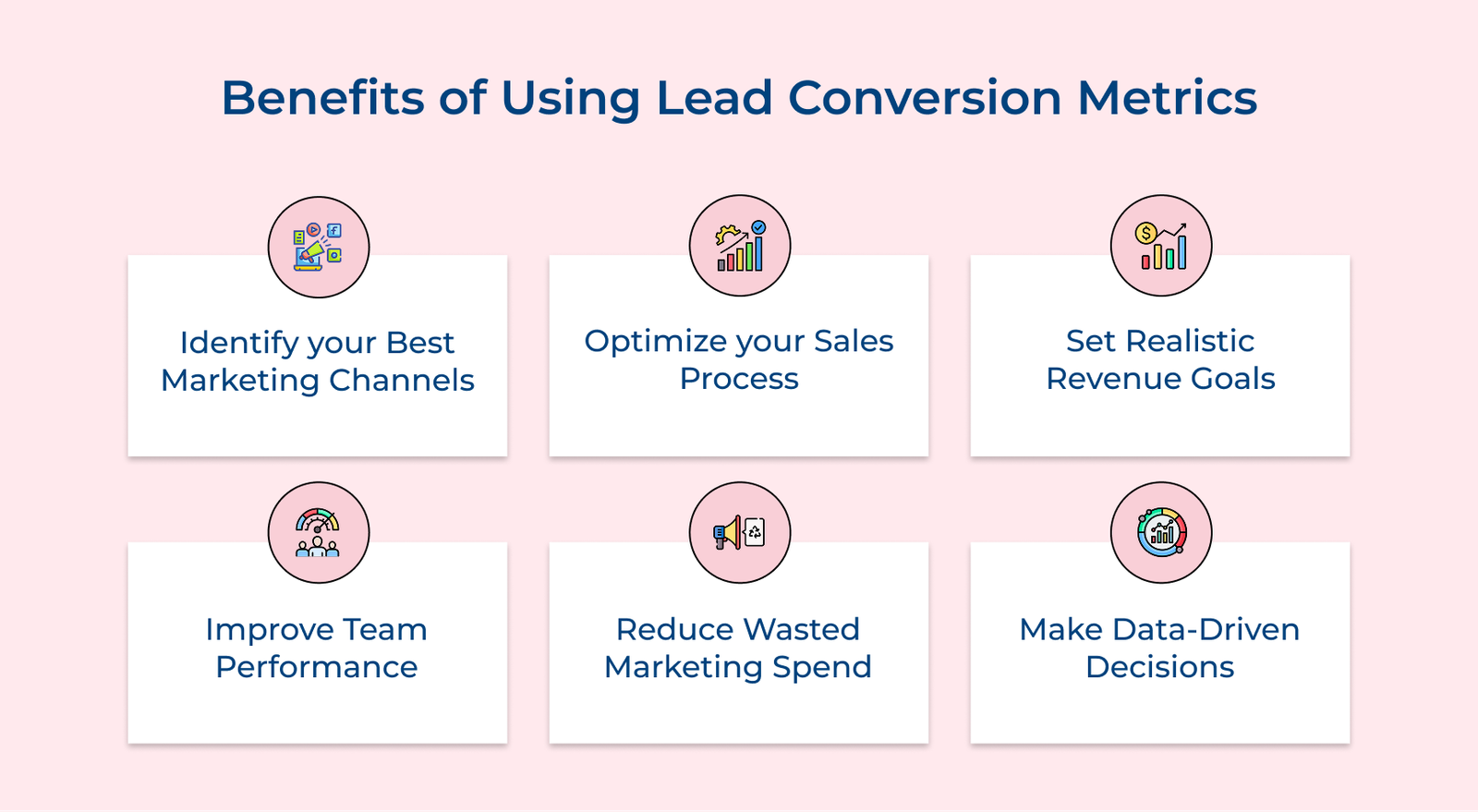
Identify Your Best Marketing Channels
Lead conversion metrics show which marketing channels bring paying customers. Instead of guessing, you can see which campaigns generate revenue and focus your budget on what truly works.
Improve Your Sales Process
Metrics highlight where prospects drop out of your funnel. Maybe interest fades after the first call or your pricing page confuses. Identifying the weak spots helps you fix them.
Set Clear Revenue Goals
Knowing your conversion rates lets you forecast sales more accurately. You can link the number of leads generated to expected income, making financial planning simpler and more reliable.
Improve Team Performance
Lead nurturing data helps you see which sales team members excel at closing deals and which ones need additional training. You can identify best practices from your top performers and share the techniques with the entire team.
Reduce Wasted Marketing Spend
You stop wasting money on campaigns that bring interest but not sales by focusing only on leads that convert. It ensures your marketing budget is used more effectively.
Make Data-driven Decisions
Instead of relying on guesswork, you use solid numbers to test, compare and refine your strategies. It helps you see exactly what improves your conversion rates.
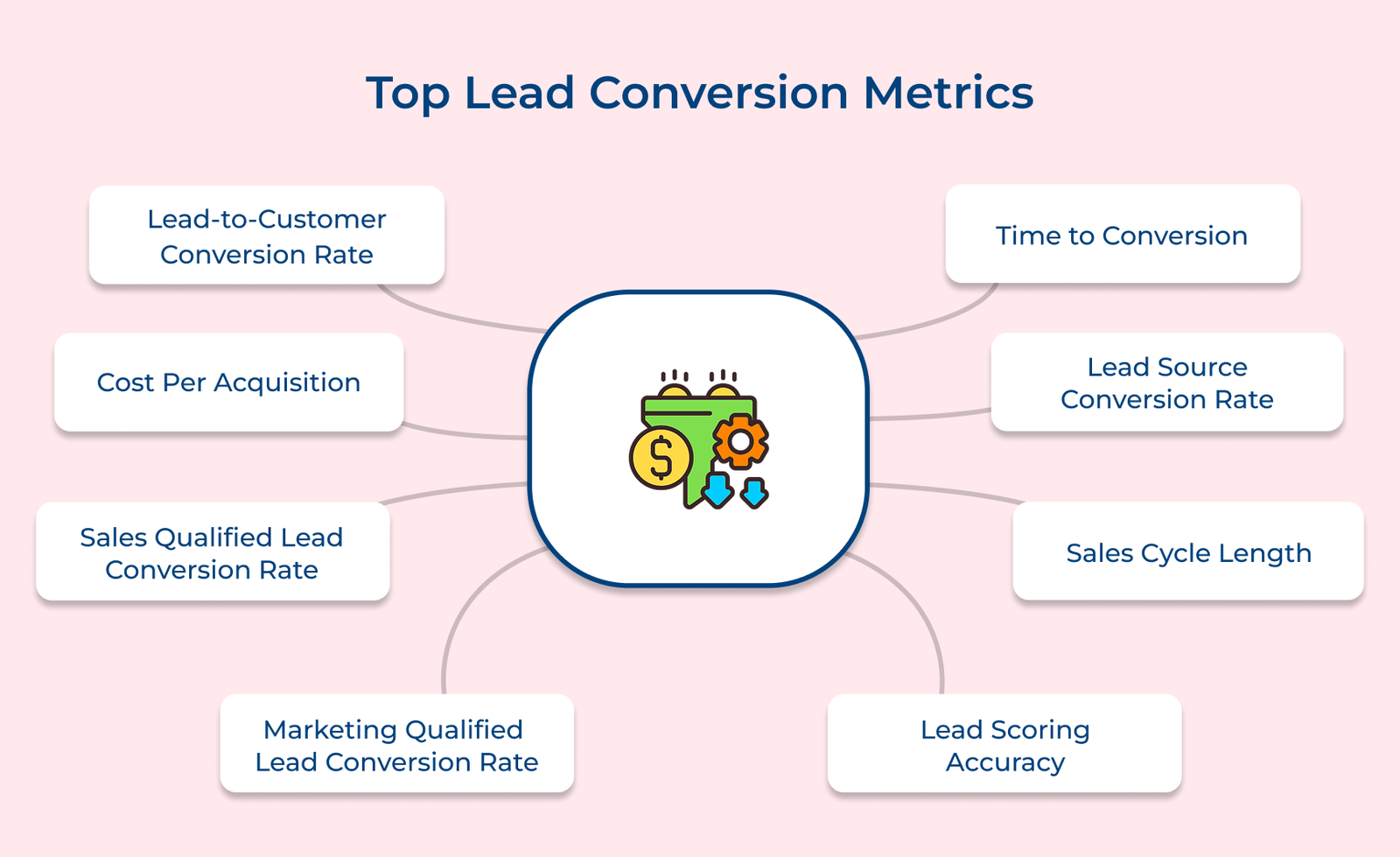
The following is a list of the top lead conversion metrics that successful businesses rely on to ensure growth and maximize ROI.
The metric shows the percentage of leads that turn into paying customers. It’s the clearest way to measure how effectively your sales and marketing efforts create revenue.
Formula: (Number of Customers ÷ Total Leads) × 100
Conversion benchmarks vary by industry, but many businesses see 2–5% as a reasonable starting point. The right target depends on your pricing, audience and market conditions.
Pro tips:
Cost per acquisition measures how much you spend to gain one new customer. It shows which marketing channels actually pay off and helps keep growth sustainable.
Key methods:
Formula: Total Marketing Spend ÷ Number of New Customers
If you spent $10,000 on marketing last month and acquired 50 new customers, your cost per acquisition would be $200 per customer. The calculation helps you determine if your marketing investment generates profitable returns for your business.
The metric shows what percentage of sales-qualified leads turn into paying customers. It reveals how well your sales team closes deals with prospects already vetted as good fits.
Sales Qualified Lead Conversion Rate = (Sales Qualified Leads Converted ÷ Total Sales Qualified Leads) × 100
A strong rate means both your qualification process and sales approach are working. A weak rate may point to issues in how leads are screened or how sales conversations are handled.
Actionable tips:
The metric tracks what percentage of marketing-qualified leads turn into paying customers. It shows how accurately your marketing team identifies prospects with real buying intent.
Formula: (Marketing Qualified Leads Converted ÷ Total Marketing Qualified Leads) × 100
A healthy benchmark is often around 10-15%, though your rate will vary depending on your industry and how strictly you define an MQL.
Use cases:
If your marketing team qualified 200 leads last quarter and 30 became customers, your conversion rate would be 15 percent. The calculation helps you understand if marketing identifies prospects who genuinely want to buy your product or service.
Time to conversion measures how long it takes for a lead to become a paying customer. It highlights the length of your sales cycle and helps you plan revenue timing as well as the cash flow.
Formula: Total Days from Lead Generation to Customer Conversion ÷ Number of Converted Customers
Ideal Benchmark: Most B2B businesses see conversion times between 30-90 days, while B2C companies often convert within 7-30 days, depending on purchase complexity.
Example Calculation:
Focus on removing friction points in your sales funnel and providing faster response times to prospect inquiries. Consider offering limited-time incentives to encourage quicker decision-making from qualified leads.
The metric shows which marketing channels bring in leads that become customers. It helps you see where your best customers come from, not just where the most leads appear.
Key questions:
Calculate the metric by tracking conversions from each source and comparing rates to identify your most valuable channels for sustainable growth. Most businesses see 2–3 channels generate the most high-converting leads, while others mainly build awareness.
Formula: (Customers from Specific Source ÷ Total Leads from That Source) × 100
If Google Ads generated 100 leads and 8 became customers, the conversion rate for that channel would be 8%. Comparing it with email or social media helps you decide which channels deserve more attention.
Sales cycle length shows the average time it takes for a qualified lead to become a paying customer. Tracking the metric helps you anticipate revenue timing and spot slowdowns in your sales process.
Formula: Total Days in Sales Process ÷ Number of Closed Deals
B2B companies typically see sales cycles between 60-180 days, while B2C businesses often close within 7-30 days, depending on product complexity. SaaS and professional services firms should track it closely since longer cycles directly affect revenue forecasts.
Key strategies:
Track each deal from the first sales contact to the signed contract, then divide the total days by closed deals. Consider that if five deals took 45, 60, 75, 30 and 90 days, your average cycle length would be 60 days.
Lead scoring accuracy shows how well your scoring system predicts which leads will actually become customers. It’s especially important for businesses with lots of leads or limited sales capacity, since it ensures time and effort go to the right prospects.
Key benefits:
Formula: (High-Scored Leads Who Converted ÷ Total High-Scored Leads) × 100
Calculate the metric by tracking your highest-scored leads over time and measuring their actual conversion rate against your predictions. Most effective lead scoring systems achieve 20-30 percent accuracy rates, meaning one in four high-scored leads becomes a customer.
Below are the best practices to increase lead conversion, focusing on simple improvements that help turn more prospects into loyal paying customers.
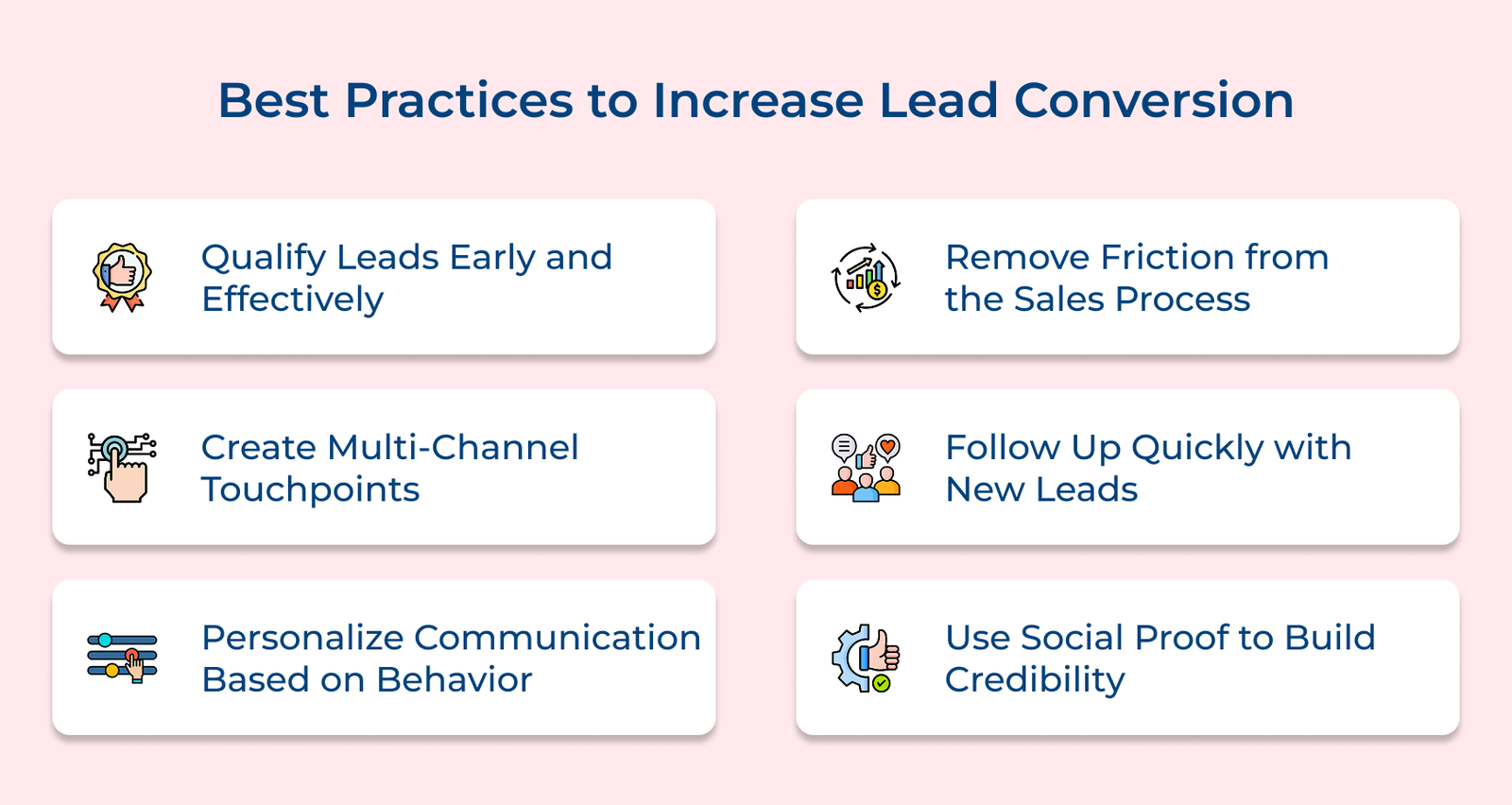
Qualify Your Leads Early and Thoroughly
Ask direct questions from the start to see if prospects truly need your product and can afford it. It saves time for both sides and keeps your focus on serious buyers.
Use Multiple Touchpoints Across Channels
Most people need to hear from you several times before they feel comfortable making a purchase decision, so use email, phone calls and social media strategically. Each touchpoint should provide valuable information rather than just pushing for a sale to build trust over time.
Personalize Communication by Lead Behavior
Pay attention to which pages prospects visit on your website and what content they download, then tailor your follow-up messages accordingly. Someone looking at pricing deserves a different conversation than someone still learning the basics.
Remove Friction from Your Sales Process
Keep the buying process simple. Use short forms, ask only for essential details and provide clear next steps. Every extra step risks losing an interested customer.
Follow up Quickly with New Leads
Responding fast matters. Getting back to new leads within an hour greatly improves your chance of building a real connection and moving them forward in the process.
Provide Social Proof and Build Credibility
Share customer testimonials, case studies and customer reviews throughout your sales process to help prospects feel confident about choosing your solution over competitors. It builds trust and reassures prospects that they’re making the right choice.
Lead conversion metrics transform your sales approach from guesswork into a precise science that drives real business growth. The measurement tools reveal exactly which prospects become paying customers and help you understand the specific steps that turn interest into revenue.
When you consistently track and optimize your conversion metrics, you create a predictable system for turning prospects into profits. They help you see what truly works, focus your efforts and cut out activities that don’t lead to sales.

Lead conversion metrics track how many potential customers actually buy from you. They matter because they show the true effectiveness of your sales process, not just initial interest. Without them, you’re making decisions in the dark.
Use your CRM to track each lead from first contact to final purchase. Record lead sources and outcomes consistently so your data stays accurate. Review results weekly to catch trends before they become bigger problems.
A good conversion rate varies dramatically by industry, but the key is understanding your baseline and consistently working to improve it over time. Qualify leads early and simplify your sales process instead of chasing arbitrary targets. Small improvements compound into significant revenue increases when maintained consistently.
The metrics reveal which parts of your sales process work well and which need immediate attention so you can allocate resources more intelligently. They help you identify your most profitable lead sources and understand the true cost of acquiring new customers. The data becomes the foundation for making strategic decisions about team training and marketing investments.
Most modern CRM systems, like HubSpot or Salesforce, offer built-in analytics dashboards that update automatically as your team enters new data. Google Analytics tracks website behavior, while tools like Mixpanel follow user actions through your sales funnel. Choose tools that work well together to avoid scattered data
Review your conversion metrics weekly to catch trends early, but avoid making major strategy changes based on short-term fluctuations in the numbers. Monthly reviews reveal seasonal trends, while quarterly reviews guide major sales adjustments. Consistent monitoring prevents small problems from becoming major revenue losses.
Grow Customer Relationships and stronger team collaboration with our range of products across the Conversational Engagement Suite.
Omnichannel Customer Support & Help Desk Software
AI Enabled Business Messaging and Chatbot Software
Sales Engagement & CRM Software
Call Center Software & Virtual Phone System
Product Marketing & Experience Platform
Customer Experience & Feedback Management Software
 Scroll to top