Product Led vs Sales Led: The Key Differences
The blog explains the differences between product led vs sales led strategies. It highlights how each approach drives growth, influences customer acquisition and shapes revenue generation.
The blog explains the differences between product led vs sales led strategies. It highlights how each approach drives growth, influences customer acquisition and shapes revenue generation.
Choosing between product led vs sales led growth can feel like standing at a fork in the road with no clear signposts. Both models are known to build strong companies and both of them come with convincing arguments.
The thing is, a growth model is not just a marketing choice. Many companies lose years chasing a model that looks impressive on the surface but clashes with their product complexity or target market.
A high-touch sales engine struggles when the product should sell itself. A pure product-qualified led motion falls flat when buyers expect guidance, demos and negotiations. The result of going with the wrong approach is not slow growth alone, but confused positioning and a team that is constantly compensating for structural misalignment.
Product-led growth refers to a strategy where the product itself drives customer acquisition and expansion. Instead of relying heavily on sales teams or marketing campaigns, users experience the product directly through free trials or freemium models. The product does the heavy lifting by demonstrating its worth and naturally encouraging users to upgrade or invite others.
The approach fundamentally changes how SaaS companies operate and scale. It creates a more efficient growth engine because satisfied users become advocates who spread the word organically. It shortens sales cycles by letting prospects evaluate the product independently, without waiting for demos or long negotiations.
Key objectives:
Let’s go through the key benefits that make the product led approach so powerful for modern businesses.
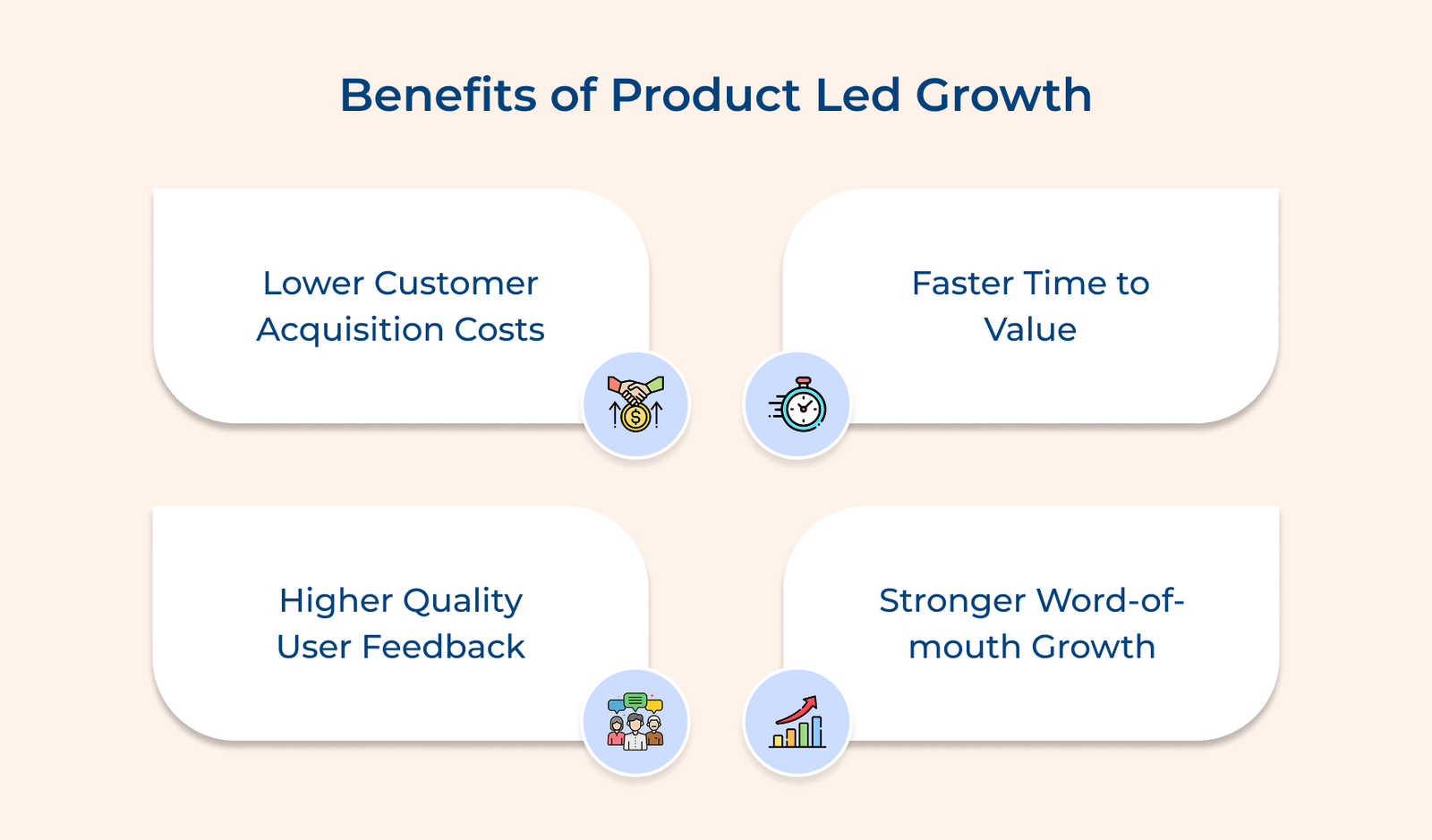
Lower Customer Acquisition Costs
When the product drives growth, you spend less on acquiring customers. Users discover and try it on their own, reducing reliance on costly sales calls or campaigns. Immediate value encourages upgrades naturally.
Faster Time to Value
Users start solving problems within minutes of signing up instead of waiting for lengthy onboarding. Quick results keep them engaged and increase the likelihood of becoming paying customers.
Higher Quality User Feedback
Direct product interaction from day one gives authentic insights into what works and what frustrates users. Real usage data uncovers opportunities that sales conversations alone might miss.
Stronger Word-of-mouth Growth
Users who find value independently become natural advocates. They share positive experiences with colleagues who face similar challenges. The organic product growth compounds over time as each satisfied user potentially brings in several others.
Sales led growth refers to a business strategy where dedicated sales teams drive customer acquisition through direct outreach and relationship building. Companies invest in sales reps who find prospects and guide them through a structured buying process. The sales team drives revenue by demonstrating value and addressing business needs throughout the evaluation process.
The model builds stronger customer relationships as prospects work directly with sales reps who understand their challenges. It allows companies to sell complex or expensive solutions that require customization and careful explanation before purchase.
Key objectives:
Let’s go through the key benefits that make the sales led approach valuable for certain businesses.
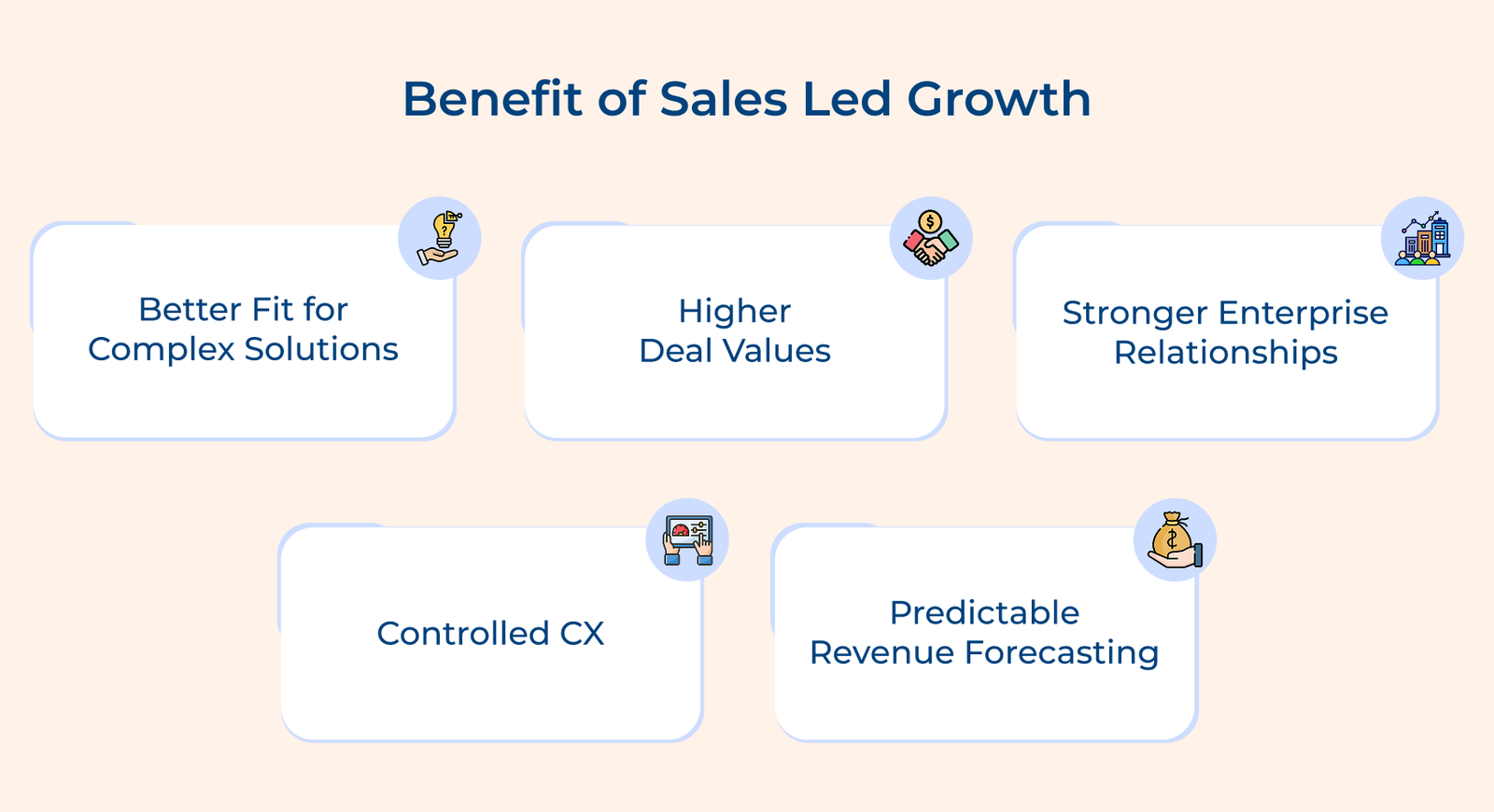
Better Fit for Complex Solutions
Sales reps can clearly explain intricate features and customization options that would overwhelm someone exploring a product alone. They guide prospects through technical requirements and integration challenges, ensuring customers fully understand what they’re buying.
Higher Deal Values
Direct conversations uncover additional needs and allow reps to propose comprehensive solutions that justify premium pricing. Bundled features and tailored contracts often lead to larger initial commitments than self-service models.
Stronger Enterprise Relationships
Early engagement with key decision-makers builds trust that extends beyond the first sale. Sales reps navigate complex organizations and address concerns from multiple stakeholders who influence purchasing decisions. The relationships become valuable assets for future expansion and renewals.
Controlled Customer Experience
Sales teams manage which prospects enter your ecosystem and ensure proper onboarding from day one. It prevents poor-fit customers, maintains product quality and sets realistic expectations, reducing churn risk.
Predictable Revenue Forecasting
Pipeline management gives you visibility into upcoming deals and their likelihood of closing within specific timeframes. The predictability enables better financial planning, resource allocation and proactive deal management rather than relying on self-service conversions.
Below are the two approaches that differ fundamentally in how they acquire customers and deliver value.
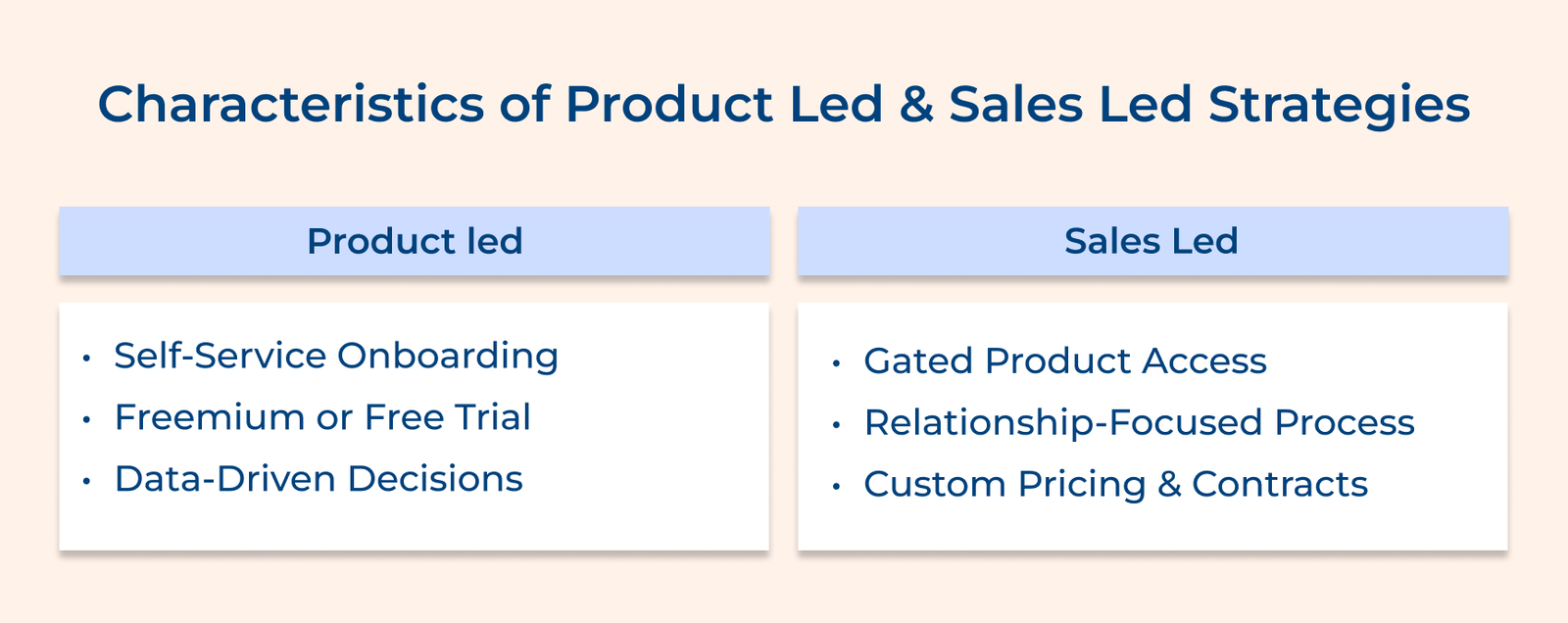
Check out the key distinctions of product led vs sales led motion that could transform your growth trajectory and elevate your business to new heights.
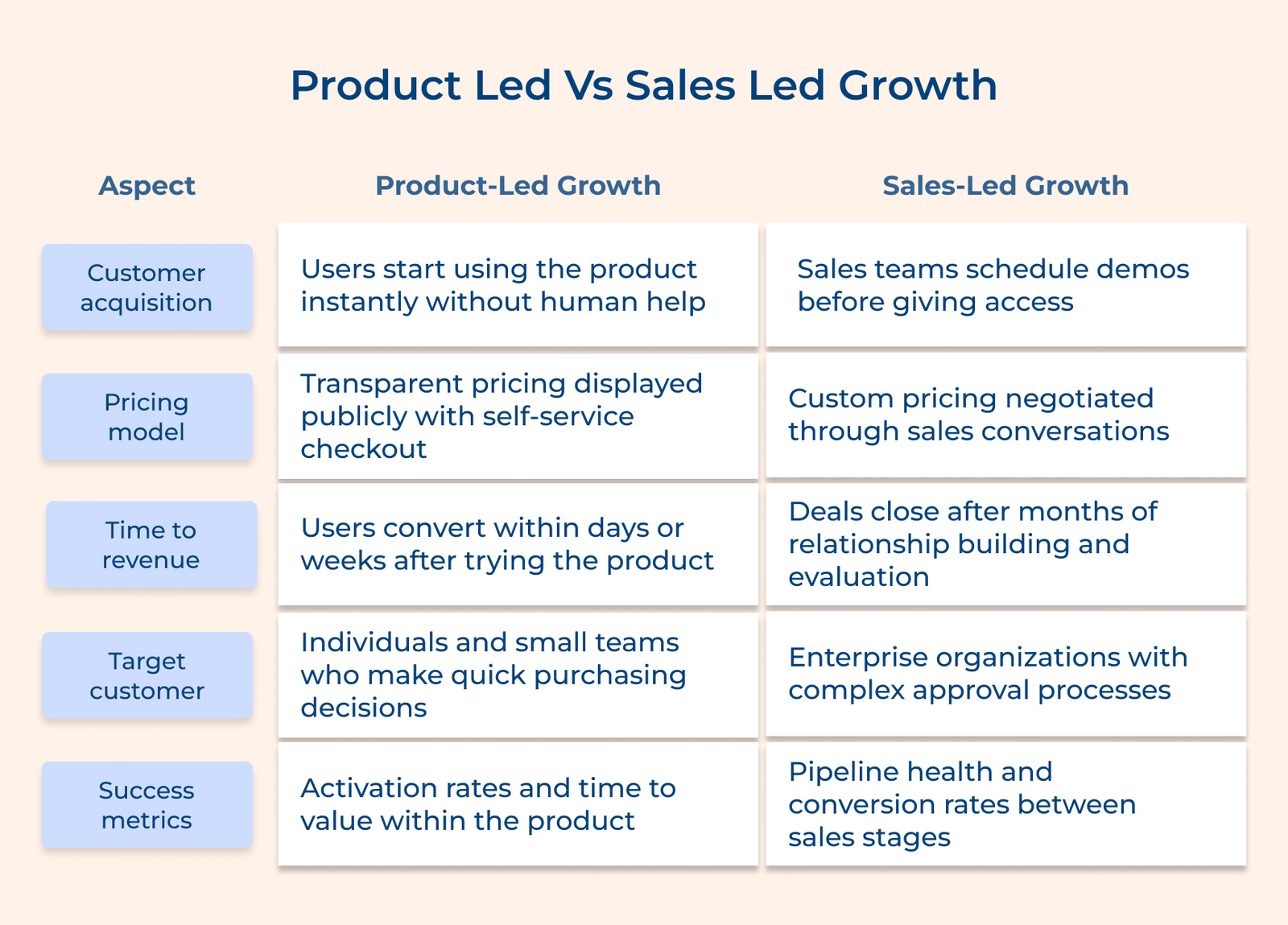
The product does the talking in a product-led model. Users can sign up independently and start experiencing value without talking to anyone from your company. The experience itself shows the value, which makes adoption feel natural rather than forced.
Sales-led growth depends on reps to find and engage potential customers. Sales reps contact leads or respond to inquiries to arrange demos. The sales team controls access to the product and guides prospects through a structured evaluation process.
Pro tips:
Product-led companies often see paying customers within days or weeks of signup. Since users can try the product immediately, they find out quickly if it solves their problem. Revenue usually starts small but can grow as users expand their usage over time.
Sales-led companies spend months nurturing relationships and proving value before closing a deal. Enterprise buyers move slowly because multiple people need to approve decisions. The payoff comes through larger contract values that justify the time spent nurturing each opportunity through the pipeline.
Product-led timeline:
Sales-led timeline:
The fundamental difference here affects cash flow and how quickly you can iterate based on market feedback. Product-led companies earn smaller, faster revenue from many customers, while sales-led ones take longer but close larger, more sustainable deals.
Product-led companies post clear pricing on their websites, showing exactly what each plan includes. Users know upfront what they’ll pay and can upgrade without back-and-forth emails or negotiations. Pricing usually scales by usage or team size, making it easy to understand and compare options.
Sales-led companies hide pricing since each deal is customized by company size and needs. Sales reps adjust pricing and features based on the value of each account. The opacity allows for negotiation but can frustrate buyers who want straightforward information.
Actionable tips:
Product-led growth is most effective for individuals or small teams that can make quick decisions without lengthy approval chains. The users usually have simpler needs and smaller budgets, but they come in higher volumes. The model thrives on scale, thousands of paying users adding up to steady recurring revenue.
The customers typically have simpler needs and lower budgets, but they come in much larger volumes. The model thrives on attracting thousands of users who each pay relatively modest amounts that add up to significant recurring revenue.
Product-led customer characteristics:
Sales-led customer characteristics:
The customer profile fundamentally shapes everything from your product design to your support infrastructure and company culture. Product-led companies build for simplicity and self-service because their customers demand frictionless experiences.
Product-led companies focus on how quickly users find value after signing up. They measure things like activation rates, time to first value and how many users complete key actions during trials. The faster someone experiences real results, the stronger the signal that the product sells itself.
Key questions for product-led fit:
Key questions for sales-led fit:
Understanding which metrics matter most helps you build the right team and allocate resources effectively as you scale your business. Product-led companies hire engineers and product managers to improve conversion funnels through better user experiences.
Product-led companies build teams around improving how users experience and adopt the product. Engineers, designers and product managers collaborate to remove friction from signups, guide users to quick wins, and make the product so useful it spreads naturally.
Product-led team focus:
Sales-led team focus:
Your team structure directly impacts your company culture and the types of people who thrive in your environment. Product-led organizations attract builders who love iterating based on data and seeing their work directly impact growth metrics.
Product-led companies focus on instant access and quick wins. New users can sign up, explore the product and see results within minutes, no setup calls or manuals required. The product guides them naturally with helpful prompts or short walkthroughs that appear when needed.
Sales-led strategy uses guided implementation, with teams helping customers set up over several weeks or months. The careful process suits complex solutions, but delays when customers actually start seeing benefits.
Key takeaways:
Product-led companies learn from what users actually do inside the product. Every click and drop-off point tells the team what’s working or what needs fixing. The data-driven view helps prioritize updates that benefit the largest group of users rather than relying on assumptions or opinions.
Sales-led strategy gathers feedback through account conversations where customer success managers discuss satisfaction and future needs. The qualitative approach creates strong relationships, but it can skew product direction toward the loudest customers rather than what the broader market needs.
Best practices:
Check out the real-world examples of companies that mastered sales-led and product-led growth. See how each approach shaped their long-term success.
Neither product-led nor sales-led growth is inherently superior because the right choice depends entirely on your target customer and product complexity. Product-led models suit simple tools people can grasp quickly, while sales-led approaches work best for larger organizations that need personal guidance.
Many successful companies use a mix of both as they grow into new markets. Start by understanding how your customers actually buy and how much help they need to see value. Let the insights shape your strategy instead of copying whatever’s trending in the industry..

Product-led growth lowers acquisition costs because users discover value on their own without needing a salesperson. It scales easily since many people can sign up and convert at once. Happy users naturally share their experiences, bringing in more customers through genuine word-of-mouth.
Sales-led growth enables you to close larger deals with enterprise customers who have substantial budgets and complex needs requiring human guidance. Sales reps build personal relationships, tailoring solutions to each client’s situation. The approach also provides predictable revenue forecasting since your pipeline visibility shows upcoming deals.
Focus on delivering your first meaningful value moment within minutes of signup so users immediately see how your product solves their problem. Remove unnecessary steps and let people try core features before asking for payment. Use behavioral triggers to identify when users hit natural upgrade moments based on their usage patterns.
A product-led strategy offers a free trial or freemium plan so users can start solving problems on their own. Your product guides users with built-in tips and prompts instead of external documentation. You track activation metrics obsessively and run experiments to improve conversion rates at each step of the user journey.
Grow Customer Relationships and stronger team collaboration with our range of products across the Conversational Engagement Suite.
Omnichannel Customer Support & Help Desk Software
AI Enabled Business Messaging and Chatbot Software
Sales Engagement & CRM Software
Call Center Software & Virtual Phone System
Product Marketing & Experience Platform
Customer Experience & Feedback Management Software
 Scroll to top