Buyer Enablement vs Sales Enablement: 8 Key Differences
The blog explains the key differences between buyer enablement vs sales enablement. It highlights how each approach supports decision-making, improves engagement and drives better outcomes.

The blog explains the key differences between buyer enablement vs sales enablement. It highlights how each approach supports decision-making, improves engagement and drives better outcomes.
Your sales team continues to miss quota despite repeated training sessions and a steady rollout of new tools every quarter. Management keeps investing in enablement programs with the expectation that performance will improve, yet deals continue to stall and prospects often disappear midway through the pipeline.
The issue rarely lies with the people on your team or the product they represent. The real gap appears when enablement efforts remain focused only on internal teams while the buyer’s decision journey receives little attention or guidance.
Sales enablement prepares your team to sell effectively, yet buyer enablement helps prospects move through their decision process with clarity and confidence. Recognizing the difference between buyer enablement vs sales enablement is significant in reshaping how organizations support deals from the first conversation to the final decision.
Buyer enablement refers to the practice of equipping potential customers with the right information they need to make confident purchasing decisions. It shifts focus from pushing sales messages to helping buyers navigate their own evaluation process. The approach recognizes that modern buyers want to research and decide on their own terms.
Buyers with educational content and decision-making tools at each stage of their journey. Sales teams share relevant case studies and comparison guides when buyers need them most. The goal is to remove friction from the buying process rather than controlling it.
Key factors:
Let’s go through the key pros and cons of buyer enablement to understand how it shapes smoother purchase decisions.
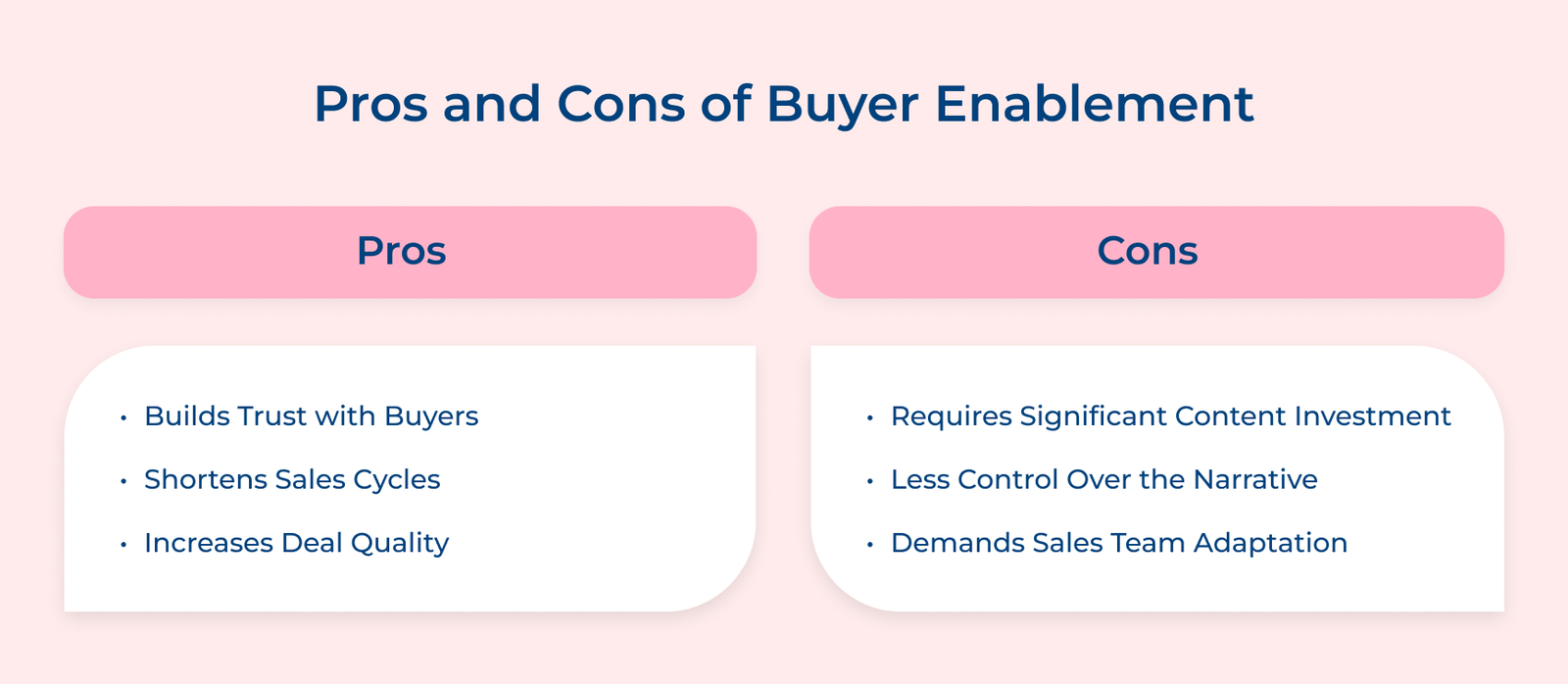
Builds Trust with Buyers
When you share useful information without pushing for a sale, buyers feel respected and more comfortable moving forward. They see you as someone who wants to help, not pressure them, which sets a good foundation for a long-term working relationship.
Shortens Sales Cycles
Well-informed buyers move faster. When they can get clear answers on their own time, they avoid unnecessary meetings and can move to real discussions sooner.
Increases Deal Quality
Buyers who take time to understand your product on their own usually know exactly what they’re looking for. It means they come into conversations with realistic expectations, leading to better-matched deals and smoother customer experiences.
Requires Significant Content Investment
Building useful buyer resources takes real time and effort. Your team needs clear case studies, honest comparisons and step-by-step guides for different buyer types. Maintaining and updating this content library becomes an ongoing commitment.
Less Control Over the Narrative
When buyers explore on their own, they may run into reviews, competitors’ claims or outdated information before hearing your side. You don’t get to frame the conversation first and that can shape expectations in ways you can’t fully manage.
Demands Sales Team Adaptation
Traditional salespeople who rely on controlling information flow struggle with the buyer-centric approach. They need new skills in facilitation and consultation rather than persuasion. Some team members resist changing their established methods and mindsets.
Sales enablement refers to the practice of giving your sales teams the knowledge, tools and support they need to do their job well. It includes creating simple product explanations, conversation guides and other resources that help reps speak confidently with prospects. The goal is to make sure your team feels prepared throughout the entire sales process.
Sales enablement starts by understanding where your team struggles, maybe they’re unsure about a product feature or don’t know how to handle certain objections. The enablement team then builds practical resources and runs training sessions to fill the gaps. As products evolve and customer expectations shift, the support continues so reps can keep improving their approach.
Key objectives:
Below are the key pros and cons of sales enablement, giving you a clear look at how it can strengthen your team while also introducing challenges you’ll need to manage.
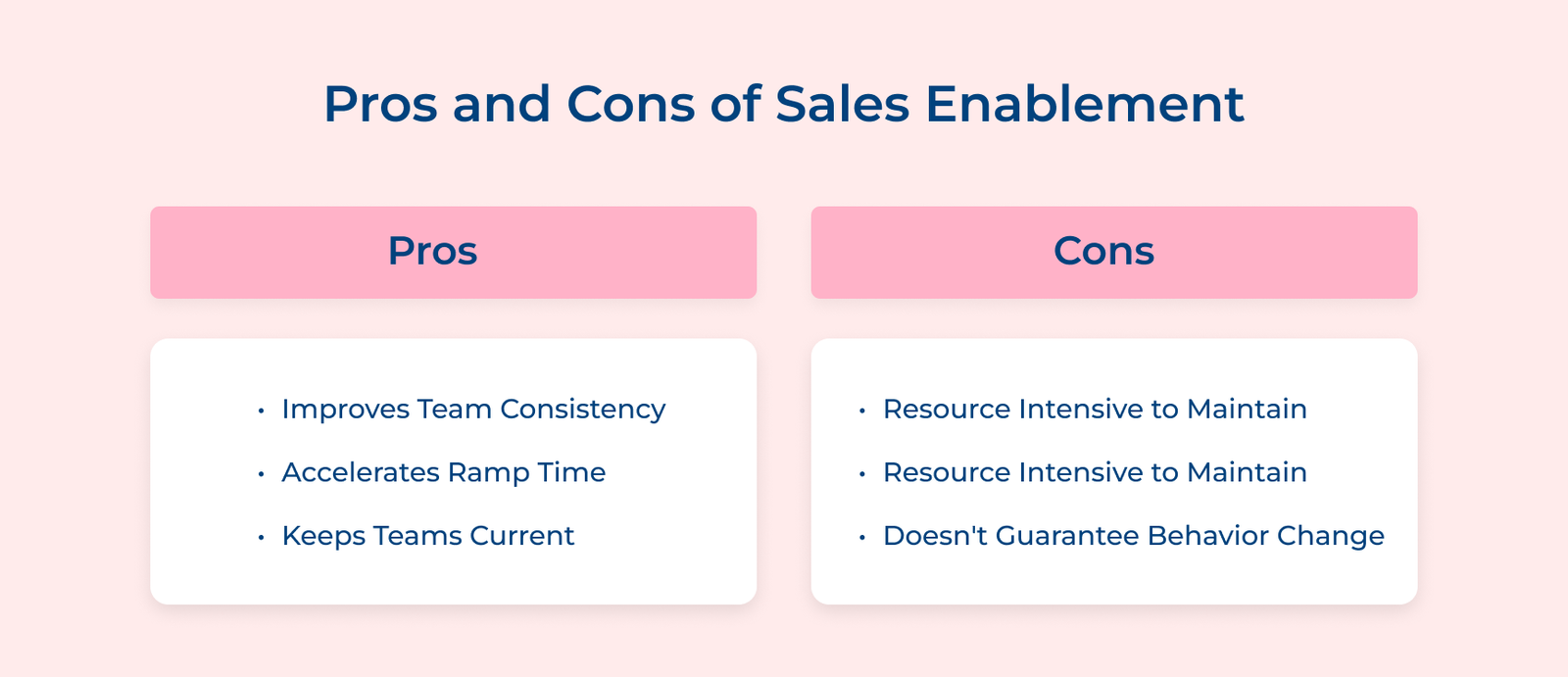
Improves Team Consistency
When everyone learns the same basics and works from the same materials, your team speaks with one clear voice. New reps follow approaches that already work instead of guessing their way through early calls. Buyers get steady, reliable information no matter who they’re talking to.
Accelerates Ramp Time
Good training helps new hires get comfortable and effective much faster. They know how to run a solid discovery call, ask useful questions and handle common concerns right from the start. It cuts down the time it takes for them to contribute meaningfully.
Keeps Teams Current
Regular training helps reps stay aligned with product updates and changes in the market. They hear about new features, competitor shifts and messaging updates as soon as they matter. It keeps conversations accurate and prevents outdated explanations from slipping into calls.
Resource Intensive to Maintain
Building effective enablement requires dedicated staff who create content and coordinate training sessions continuously. Someone needs to keep materials updated as products evolve and gather feedback from the field. Smaller companies often struggle to justify full-time enablement roles.
Can Create Information Overload
Reps often end up with more content than they can realistically use. When everything looks important, nothing feels useful. Without clear guidance on what to prioritize, reps spend time digging instead of selling.
Doesn’t Guarantee Behavior Change
Training doesn’t automatically translate into new habits. Some reps slide back into old patterns once they’re on calls. Others use only the parts that feel comfortable. It makes it hard to know if enablement is actually influencing results.
Check the key differences of sales enablement vs buyer enablement to craft a more integrated approach that meets the needs of both parties, enhancing the customer experience and boosting conversion rates.
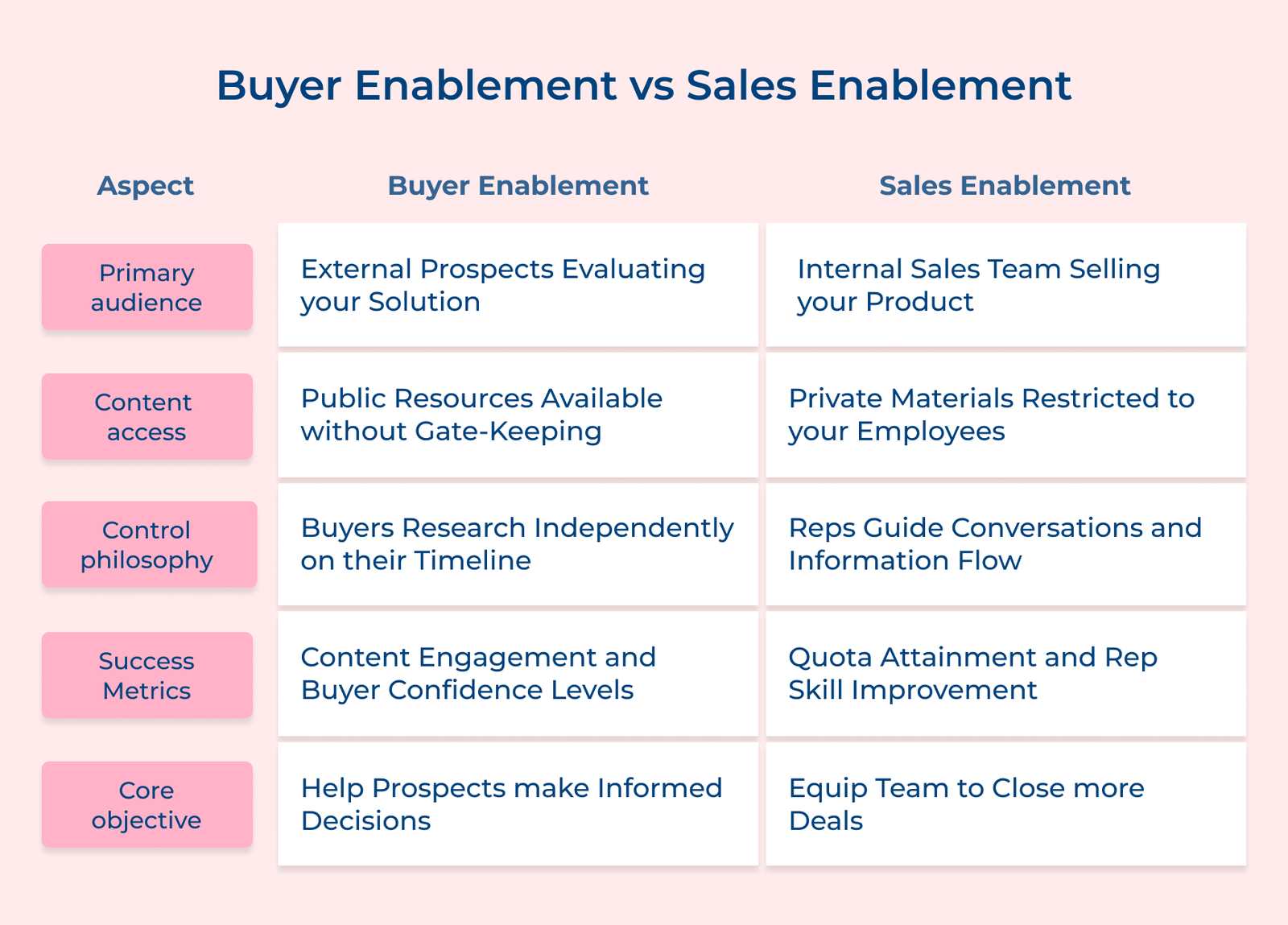
Sales enablement is all about your internal sales. It strengthens their skills, fills knowledge gaps and gives them practical tools to handle real conversations. The goal is to help your salespeople do their jobs more confidently and consistently.
Buyer enablement speaks directly to potential customers. It gives them the clarity they need to make decisions on their own, if that’s through pricing pages, comparison charts or setup guides. Instead of pulling buyers into calls, it lets them explore on their own terms.
Pro tips:
Sales enablement content lives behind closed doors where only your team can access it. The materials include competitive intelligence and internal playbooks that you wouldn’t want prospects to see. The content often reveals your selling strategy and how you position yourself against competitors.
Buyer enablement content takes the opposite approach. It’s open, easy to find and designed for anyone evaluating your product. Prospects can read, compare and understand key details without filling out a form or waiting for a meeting. The idea is that people make better choices when they have clear information.
Key approaches:
Sales enablement judges success by how much better your team performs after getting support. You look at things like higher win rates, stronger quota attainment or bigger deal sizes. The focus is on what your own people achieve.
Buyer enablement tracks how prospects engage with content and whether they progress through their decision process. You track if they read guides, use tools and bring more stakeholders into the process. Success means buyers feel confident enough to move forward.
Actionable tips:
Sales enablement follows your company’s set process, where reps decide what information to share and when. The flow is structured and prospects usually receive details in a controlled sequence.
Buyer enablement accepts that prospects do their own research long before speaking to anyone. They explore on their own timeline, often learning key details before your team ever reaches out.
Key ways:
Sales enablement is built on the idea that your team needs to be sharper, faster and better prepared than competitors. It focuses on equipping reps with the knowledge and skills to influence outcomes in conversations.
Buyer enablement starts from a belief that people make better decisions when they have honest, easy-to-understand information. Instead of trying to control the process, it lets buyers learn at their own pace and choose based on fit rather than pressure.
Key questions:
Sales enablement leans on teaching skills. Your team needs people who understand how adults learn, how to design useful training and how to coach reps through real conversations. Think of it as running an internal learning program that helps employees improve through practice, feedback, and repetition.
Buyer enablement demands skills in content marketing and understanding the buyer’s journey from their perspective. Your team needs empathy for what prospects struggle with when evaluating complex solutions. The focus shifts from teaching employees to educating an external audience with different motivations.
Key takeaways:
Sales enablement measures ROI by tracking how training and tools improve your team’s performance. You can compare revenue per rep before and after new programs, making the impact easier to quantify because you’re evaluating a defined group of employees.
Buyer enablement is harder to measure. Many prospects read your content anonymously, so you see interest but can’t always tie it directly to revenue. Attribution becomes complicated when buyers move through the process on their own.
Best practices:
Sales enablement works within your existing sales framework. It gives reps practical tools for each stage, including prospecting, discovery and negotiation, so they can follow the process more consistently.
Buyer enablement accepts that real buyers don’t move in a straight line. They jump ahead, revisit steps and research long before they talk to anyone. A prospect might read case studies before a first call or download an implementation guide before a demo. It forces teams to rethink how sales and marketing should coordinate.
Key questions:
The sales process debate gets to the heart of who controls the buying experience in your organization. Traditional sales enablement tools trains reps to follow a set sales process and lead buyers through each step.
Modern buyer enablement suggests the buyer’s natural research pattern should dictate the process instead. It creates tension between leaders who want predictable pipelines and those who prioritize buyer freedom. You need enough process to forecast revenue, but enough adaptability to meet buyers where they actually are in their journey.
Below are five steps that will guide you from understanding your buyers to measuring what actually works.
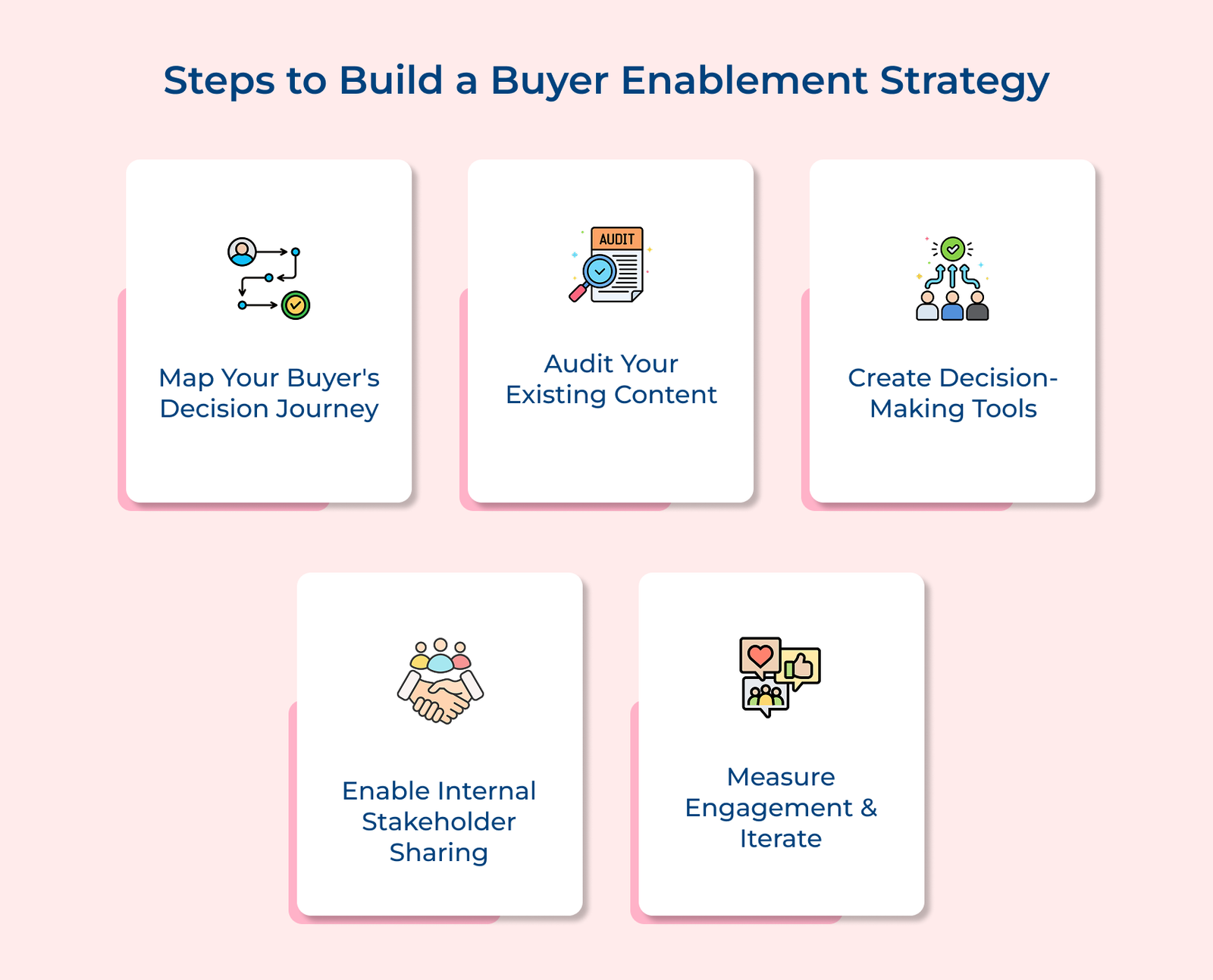
1. Map your Buyer’s Decision Journey
Begin by understanding how buyers actually make decisions, not how you hope they do. Talk to recent customers and learn what they were trying to figure out at each step and who they turned to for answers.
Key factors:
Your sales team only sees the moments when buyers choose to talk. Most of the real decision-making happens long before a scheduled call, which is why direct customer interviews are so valuable.
2. Audit your Existing Content
Review everything you currently share with prospects, including slide decks and case studies and product documentation. Map each piece to the stages in the buyer journey you documented to see which stages lack helpful resources.
Key factors:
The audit often reveals that ninety percent of materials focus on early awareness, while buyers struggling with implementation planning have nothing useful.
3. Create Decision-making Tools
Build resources that genuinely help buyers compare options and justify their decisions internally. Go beyond promotional material and focus on tools they can actually use.
Key ways:
The hardest part is embracing transparency over persuasion. Truly useful decision tools acknowledge tradeoffs and help buyers determine genuine fit.
4. Enable Internal Stakeholder Sharing
Recognize that your primary contact rarely makes purchasing decisions alone and needs to convince others inside their organization. Create shareable resources that your champion can forward to their boss or IT team.
Best practices:
Most B2B decisions involve multiple people who never meet your sales team. When you make it easy for your champion to bring others on board, you strengthen your chances of moving the deal forward.
5. Measure Engagement and Iterate
Track which resources buyers actually use and how that activity connects to deal progress. Monitor downloads, viewing time and how often materials get shared inside the buyer’s organization.
Key takeaways:
Let actual buyer behavior shape what you create next. Review your data regularly, drop content no one uses and invest more in the pieces that clearly help buyers move toward a decision.
Let’s go through the key steps that will help you create a program that actually improves how your reps sell.
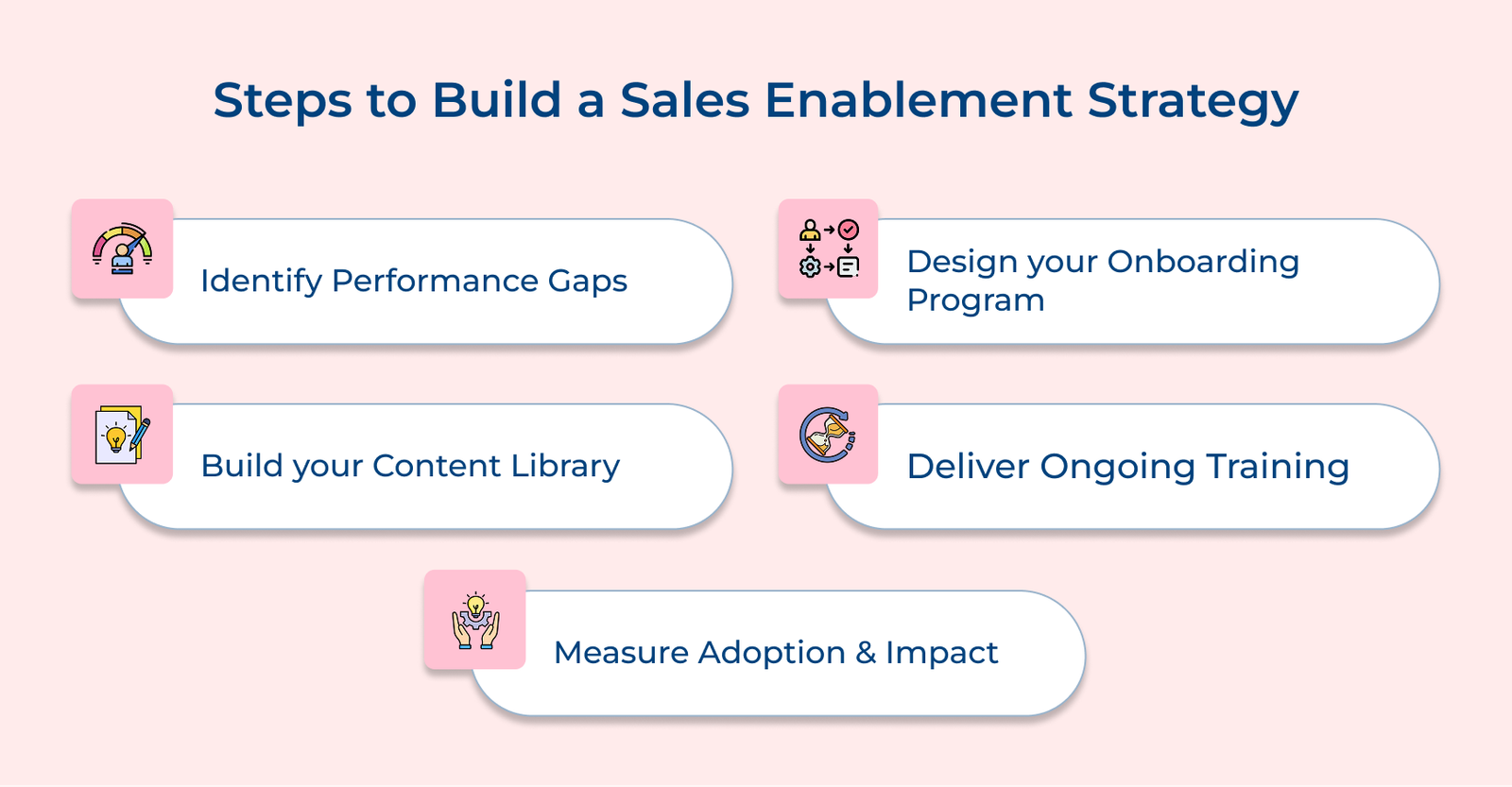
1. Identify Performance Gaps
Begin by looking closely at where your sales team runs into trouble during real conversations with prospects. Review win-loss reports to see why deals slipped away and listen to call recordings to spot moments where reps hesitate, miss key questions or lose control of the conversation.
Key ways:
You’ll often find that your top performers naturally do things that struggling reps haven’t figured out yet. The goal is to make the winning behaviors repeatable across your entire team through targeted enablement.
2. Design your Onboarding Program
Build a structured onboarding plan that helps new hires become confident and effective without relying on guesswork. Outline what they should learn in their first 30, 60 or 90 days and include checkpoints where they must show they can apply what they’ve learned before handling real deals.
Key elements:
Most companies throw new hires into deals too quickly and then wonder why they struggle for six months. A deliberate onboarding program might feel slow initially but it prevents expensive mistakes and shortens overall ramp time.
3. Build your Content Library
Create the essential materials your reps need for everyday conversations and keep everything stored in one easy-to-find place. Focus on resources that help reps handle real situations, not an endless list of documents nobody touches.
Key ways:
The mistake many enablement teams make is creating too much content that nobody uses. Start with the materials that address your most frequent selling scenarios before building resources for edge cases.
4. Deliver Ongoing Training
Schedule regular skill-building sessions beyond initial onboarding because one-time training never sticks. Run monthly workshops on specific topics like negotiation tactics or competitive positioning. Use role-play exercises where reps practice new techniques in safe environments before trying them with real prospects.
Key approaches:
Training works best when it’s bite-sized and immediately applicable rather than full-day sessions packed with theory. Reps need to practice new skills within days of learning them or the knowledge disappears.
5. Measure Adoption and Impact
Track if the reps actually use the tools and training you provide because adoption matters as much as creation. Look at content downloads, workshop attendance and certification completion to see who’s applying what they learn. Then compare results between reps who consistently use enablement resources and those who don’t.
Key performance indicators:
The real test is if your enablement efforts translate into revenue improvements. If win rates stay flat despite heavy training investment, then something in your approach needs to change. Use the data to double down on what works and eliminate programs that don’t move the needle.
The move from traditional selling to an enablement mindset reflects how buyers now prefer to research independently before speaking to anyone. Sales enablement strengthens your team’s skills, while buyer enablement supports prospects who want to explore on their own terms.
The most successful companies now balance both approaches rather than choosing one over the other. Train your reps to facilitate informed decisions instead of controlling information flow for better long-term results.

Buyer enablement puts prospects in control by giving them clear information they can explore on their own time. Sales enablement equips your team to guide conversations more intentionally. One supports independent research, while the other supports structured interaction.
They work together when your trained reps know how to share buyer-friendly resources at the right moments. Your sales team becomes facilitators who point prospects toward helpful content rather than gatekeepers controlling information. The combination builds trust while maintaining human guidance through complex decisions.
Sales enablement provides reps with training on product knowledge and selling techniques they need for different situations. It creates materials like talk tracks and battlecards that give consistent messaging across your team. The result is faster onboarding and more predictable performance from everyone.
Buyer enablement offers practical tools, like comparison guides, calculators and shareable summaries that help prospects weigh options or get internal approval. Buyers feel more certain because they can evaluate decisions with solid information, not guesswork.
Sales enablement relies on platforms that train and track rep performance, such as LMS systems, CRM tools and call analysis software. Buyer enablement uses public-facing content hubs, analytics tools and interactive resources that prospects can access directly.
Start by training your B2B sales team to recognize when buyers need self-service resources versus human guidance during their journey. Build content that answers common questions so reps can share it confidently without worrying it replaces them. Align both strategies around the goal of informed buyers making good decisions quickly.
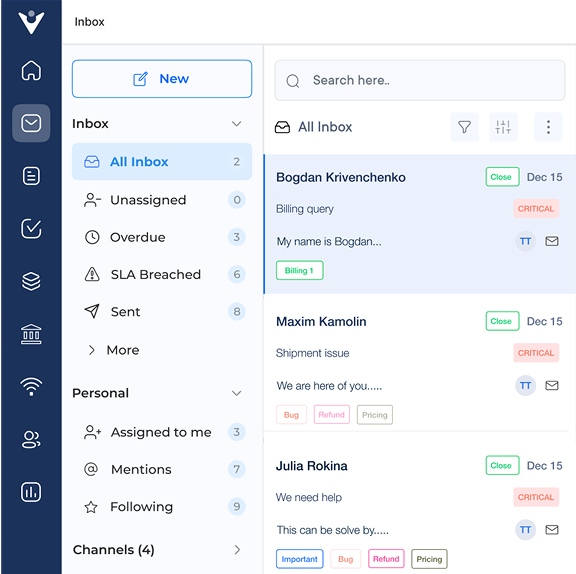
Grow Customer Relationships and stronger team collaboration with our range of products across the Conversational Engagement Suite.
Omnichannel Customer Support & Help Desk Software
AI Enabled Business Messaging and Chatbot Software
Sales Engagement & CRM Software
Call Center Software & Virtual Phone System
Product Marketing & Experience Platform
Customer Experience & Feedback Management Software

 What is CRM Customer Experience? Importance, Metrics & Examples
Scroll to top
What is CRM Customer Experience? Importance, Metrics & Examples
Scroll to top