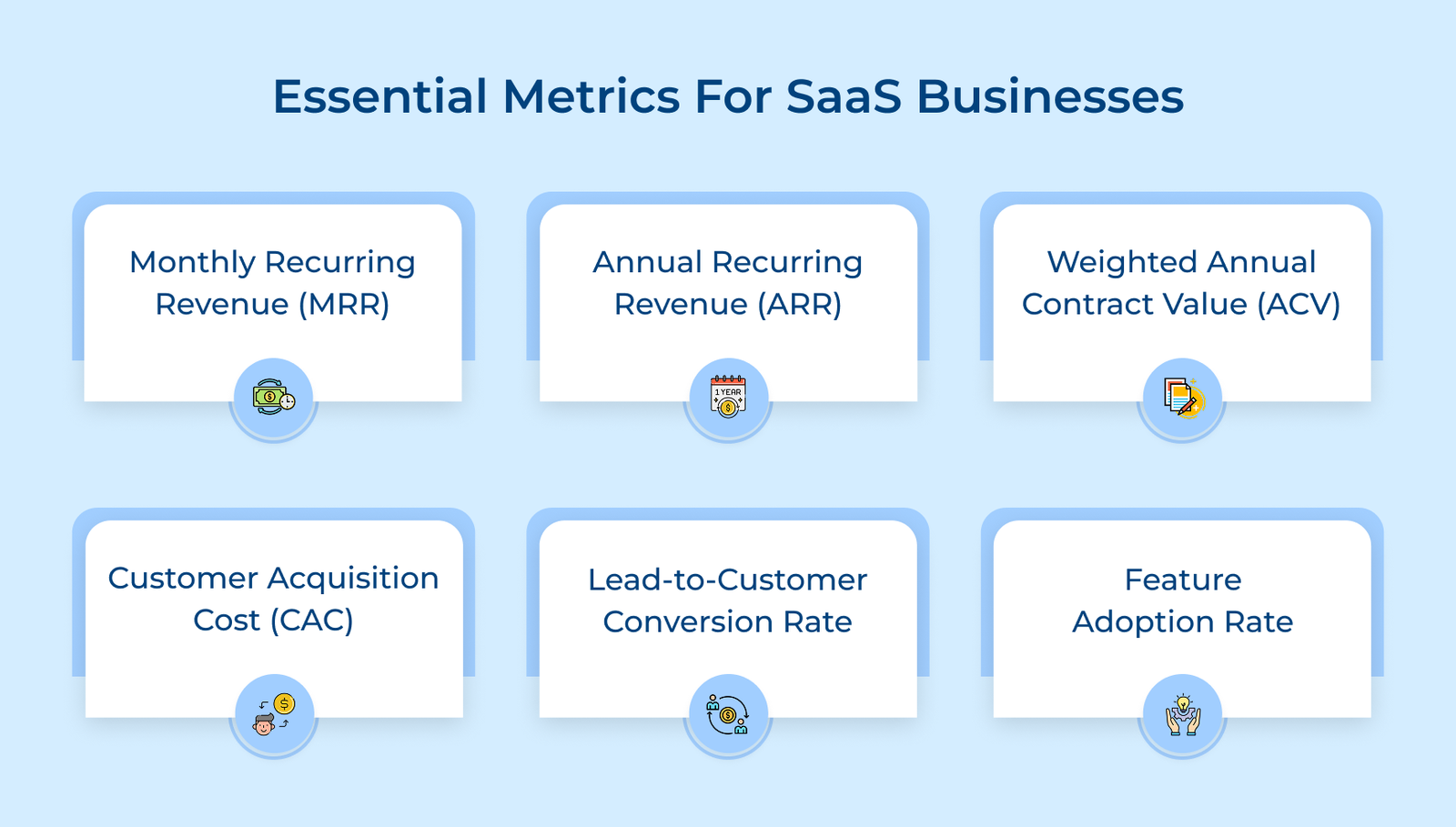
SaaS Growth Metrics
Monthly Recurring Revenue (MRR)
MRR tells you how much predictable revenue your subscription business brings in every month. It serves as your baseline income and helps you plan with greater certainty.
Formula: MRR = Number of active customers × Average monthly revenue per customer
Multiply your total active subscribers by what they pay you on average each month. Include all subscription fees but exclude one-time charges or variable usage fees. Healthy SaaS companies typically aim for 10-20% month-over-month MRR growth in their early stages. You can improve it by reducing churn and focusing on upselling existing customers to higher-tier plans.
Annual Recurring Revenue (ARR)
ARR shows how much subscription revenue you can expect to earn in a year. It helps you understand the size of your business and is one of the first numbers investors look at.
Formula: ARR = MRR × 12 or the sum of all annual contract values
Early-stage companies should target 100% year-over-year ARR growth, while later-stage companies typically see 30-50% growth rates.
Pro tips:
- Grow existing accounts: Offer useful upgrades such as more seats or advanced features.
- Lower annual churn: Keep a close eye on accounts showing early signs of leaving and step in before they cancel.
Revenue Growth Rate
Revenue growth rate shows how quickly your recurring revenue is increasing and whether your momentum is improving or slowing down.
Formula: Revenue Growth Rate = ((Current Period Revenue – Previous Period Revenue) / Previous Period Revenue) × 100
You calculate the metric by subtracting last month’s revenue from this month’s revenue, dividing by last month’s revenue, and then multiplying by 100 to get a percentage. Fast-growing SaaS startups aim for triple-digit growth rates in year one, with the rate naturally declining to 40-100% in year two and stabilizing around 20-40% as the company matures.
Net Revenue Retention (NRR)
NRR shows how much revenue you keep and grow from your existing customers after accounting for upgrades, downgrades or cancellations. It’s one of the strongest indicators of long-term SaaS health because it reveals whether your customer base naturally expands even without new sales.
Formula: NRR = ((Starting MRR + Expansion MRR – Churned MRR) / Starting MRR) × 100
Standard benchmarks:
- World-class SaaS companies maintain NRR above 120%, meaning existing customers spend 20% more each year.
- Good performers hit 100-110% NRR, while anything below 100% signals your customers are shrinking in value over time.
Actionable tips:
- Create simple upgrade paths: Make it easy for customers to move to higher plans as their usage grows.
- Highlight high-value features early: Introduce customers to the tools that typically lead to expansions during onboarding.
SaaS Revenue Metrics
Average Revenue Per Account (ARPA)
ARPA shows how much revenue the average customer brings in each month. It helps you understand whether your pricing makes sense and how valuable each account truly is.
Formula: ARPA = Total MRR / Total number of customers
You calculate ARPA by dividing your total monthly recurring revenue by your current number of active paying customers. It gives you the average monthly value per account.
Best practices:
- Add usage-based elements so heavier users naturally pay more.
- Focus on customer segments that can support higher price points.
ARPA varies widely by market. Small-business SaaS often sees $100–$500 per month, while enterprise accounts may range from $1,000 to well over $10,000.
Weighted Annual Contract Value (ACV)
Weighted ACV shows the average yearly value of your contracts while accounting for different deal sizes and lengths. It helps you understand what a “typical” deal looks like and whether your team can realistically hit revenue targets.
Formula: Weighted ACV = Total contract value / Contract length in years
The beauty of weighted ACV lies in how it accounts for multi-year deals and contract variations in your cheat sheet. A customer signing a three-year contract worth $90,000 has a weighted ACV of $30,000 per year.
Expansion Revenue
Expansion revenue tracks the additional money you earn from existing customers through upgrades, cross-sells or add-ons. It’s often easier to grow revenue and it signals strong product-market fit.
Expansion Revenue = Upsells + cross-sells + add-ons
Key features:
- Companies with healthy expansion revenue see 20-30% of their total revenue coming from existing customer growth each year.
- Best-in-class SaaS businesses generate 30-40% of new revenue from expansion, reducing their dependence on costly new customer acquisition.
Offer upgrades when customers hit certain usage levels or reach important milestones. Equip your team to identify expansion opportunities during regular check-ins rather than waiting for renewals.
SaaS Operational Metrics
Customer Acquisition Cost (CAC)
CAC measures how much you spend to acquire a new customer and shows how the metric is beneficial in the SaaS cheat sheet. Understanding the cost helps you determine if your business model is sustainable and profitable.