8 Enterprise Customer Engagement Strategies to Drive Growth
Discover how enterprise customer engagement helps businesses build stronger customer relationships and drive long-term growth.

Discover how enterprise customer engagement helps businesses build stronger customer relationships and drive long-term growth.
Why do enterprises lose customers even when their product works fine? Usually, because every department sees only part of the customer journey, customers have to repeat information and piece the experience together themselves.
The challenge matters more than ever, with more than 85% of companies competing primarily on customer experience rather than price or product. Enterprise customer engagement brings customer data, AI and cross-functional teams to create consistent, personalized interactions across every touchpoint. Let’s dive in to understand how it has become a core business priority for organizations serving large customer bases.
Enterprise customer engagement refers to how large organizations build consistent, meaningful interactions with customers across every touchpoint. It combines customer data, technology and human interactions to deliver connected experiences at scale, instead of treating every conversation as a separate interaction.
Why does scale make such a difference? A small business can often rely on familiar customers and simple processes, but an enterprise serving millions needs systems that capture context and make it available whenever a customer reaches out.
Key objectives:
Let’s go through the key reasons enterprise customer engagement matters. Strong customer engagement helps enterprise brands improve loyalty and build long-term growth.
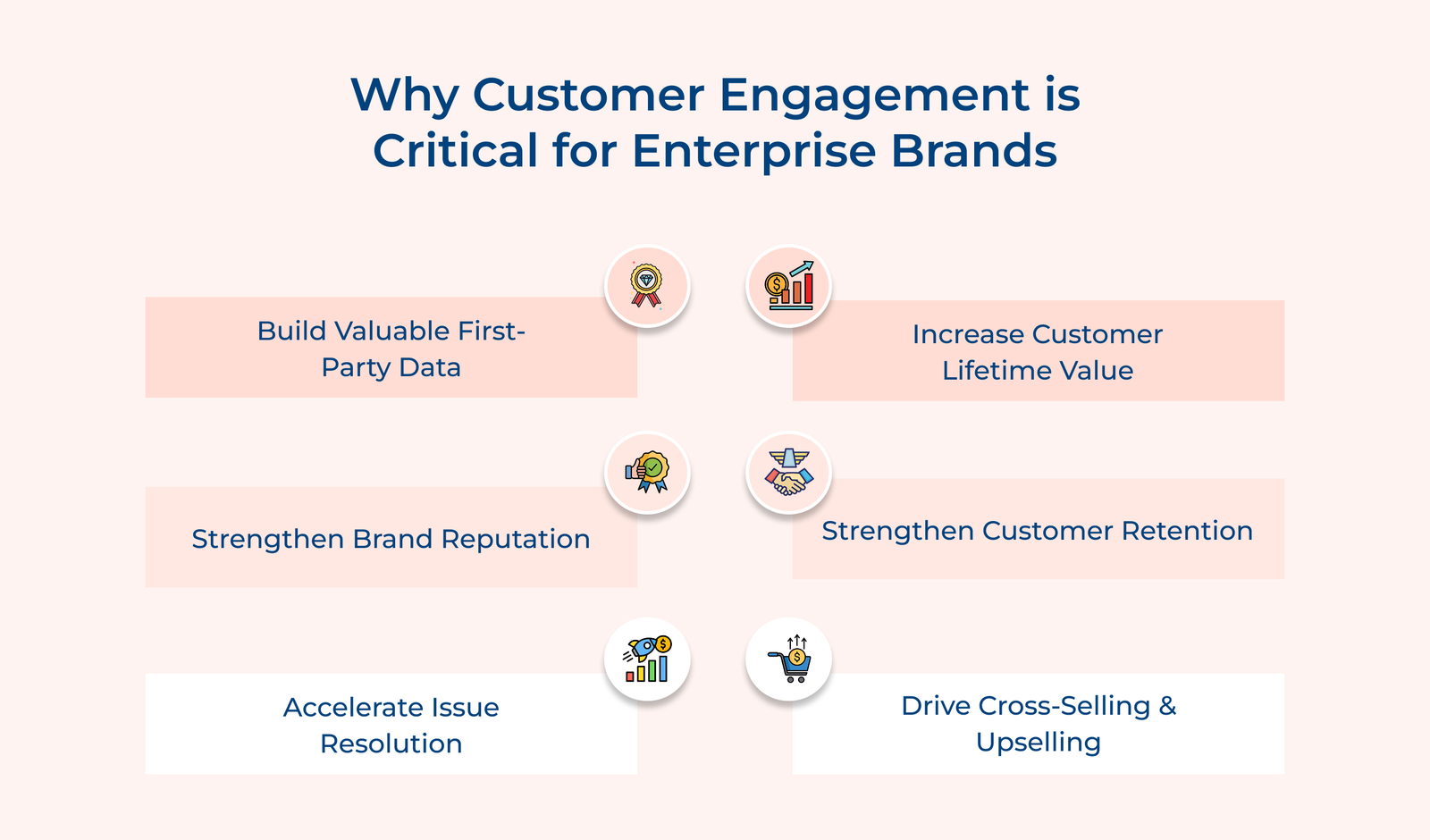
Higher Customer Lifetime Value
Engaged customers buy more often and are more likely to try new products over time, increasing the value of every customer relationship. Strong enterprise customer engagement supports steady growth in a way that one-time transactions cannot.
Stronger Retention Rates
Customers who receive consistent, personalized experiences across every channel are less likely to switch to another brand. Retention becomes the result of positive experiences instead of repeated recovery efforts.
Better Cross-sell and Upsell Opportunities
Customer engagement data helps businesses understand when someone is ready for a relevant recommendation. Enterprise engagement makes it easier to present the right offer at the right time, leading to better conversion rates.
Faster Issue Resolution
Connected customer data gives support teams the context they need from the start of every interaction. Customers spend less time repeating information and issues are resolved more quickly.
Improved Brand Reputation
Consistent, thoughtful enterprise customer engagement builds customer trust over time and satisfied customers are more likely to recommend the brand to others. Genuine customer experiences often have a greater impact than advertising alone.
Valuable First-party Data
Every customer interaction provides insights that help businesses understand preferences, improve experiences and make better decisions. First-party data also becomes more valuable as privacy expectations and regulations continue to evolve.
The following strategies can help enterprises strengthen customer engagement and create experiences that encourage customers to keep coming back.
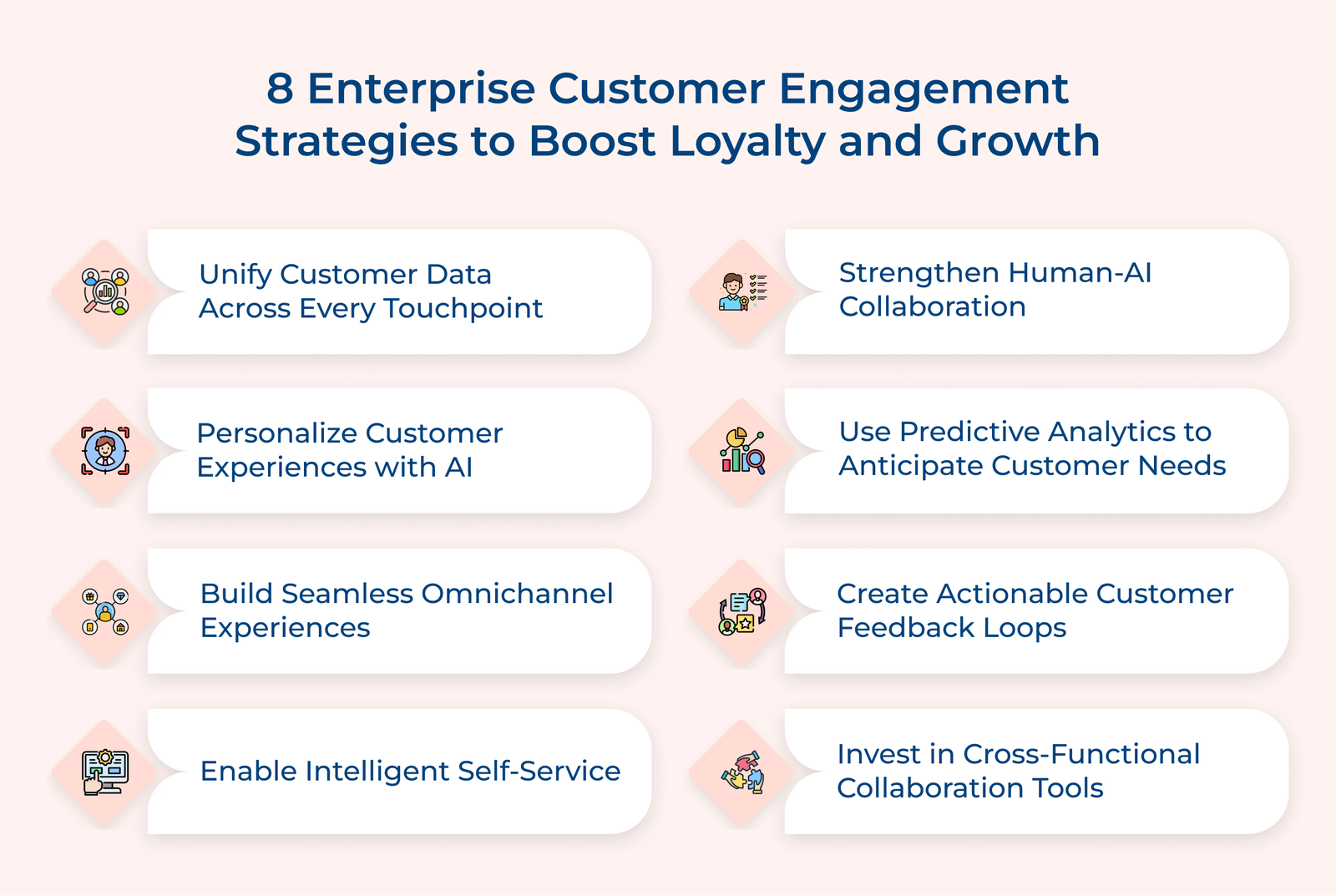
Unifying customer data means bringing every customer interaction into one complete, accessible record. Enterprises often rely on multiple disconnected systems and the separation makes enterprise customer engagement feel inconsistent instead of connected.
Key ways:
Personalization at scale uses AI to deliver relevant experiences to millions of customers without relying on manual effort. Enterprise customer engagement becomes more meaningful when every interaction reflects a customer’s preferences, behavior and history instead of generic messaging.
Successful personalization starts with accurate customer data, clear customer consent and systems that update information quickly. Missing any of the elements can make personalized experiences feel inaccurate or intrusive.
Omnichannel engagement connects every customer channel into one continuous experience instead of treating each interaction separately. Enterprise customer engagement becomes more consistent because customers can move between channels without losing context.
Seamless handoffs allow a conversation to continue from one channel to another without customers repeating information. Connected systems and shared customer data make this possible across every interaction.
Actionable tips:
Self-service automation helps customers resolve common issues on their own instead of waiting for support. Enterprise customer engagement improves when customers can get quick answers while support teams spend more time on complex issues that need human attention.
AI chatbots resolve instantly
AI chatbots answer routine questions at any time of the day, reducing wait times for customers. Human agents can then focus on conversations that require problem solving, empathy and informed decisions.
Knowledge bases reduce ticket volume
A well organized knowledge base gives customers access to answers before they contact support. Many common questions can be resolved without creating a support ticket, reducing workload for service teams.
Human and AI collaboration works best when AI handles repetitive tasks while people focus on conversations that require judgment, empathy or problem solving. Enterprise customer engagement improves when customers receive quick responses without losing access to human support when it matters most.
Key questions:
Predictive analytics uses historical and behavioral data to identify customer needs before they become support requests. Enterprise customer engagement becomes more proactive because businesses can respond early instead of waiting for problems to grow.
Key questions:
Feedback loops collect customer input and send it to the teams responsible for making improvements. Enterprise engagement becomes stronger when customers see that their feedback leads to real changes instead of being stored in reports.
Let’s consider a customer giving a low rating after a support interaction. The feedback reaches the team lead immediately and a support representative follows up within hours to understand and resolve the issue. Ignoring customer feedback gradually reduces trust. Customers are less likely to share their opinions when they believe nothing will change as a result.
Best practices:
Cross-functional collaboration tools give every customer-facing team access to the same customer information instead of keeping data inside separate systems. Enterprise customer engagement improves because teams can work together with shared context and respond more quickly to customer needs.
Key areas:
Below are the top enterprise customer engagement platforms that help businesses unify customer interactions and deliver consistent experiences.
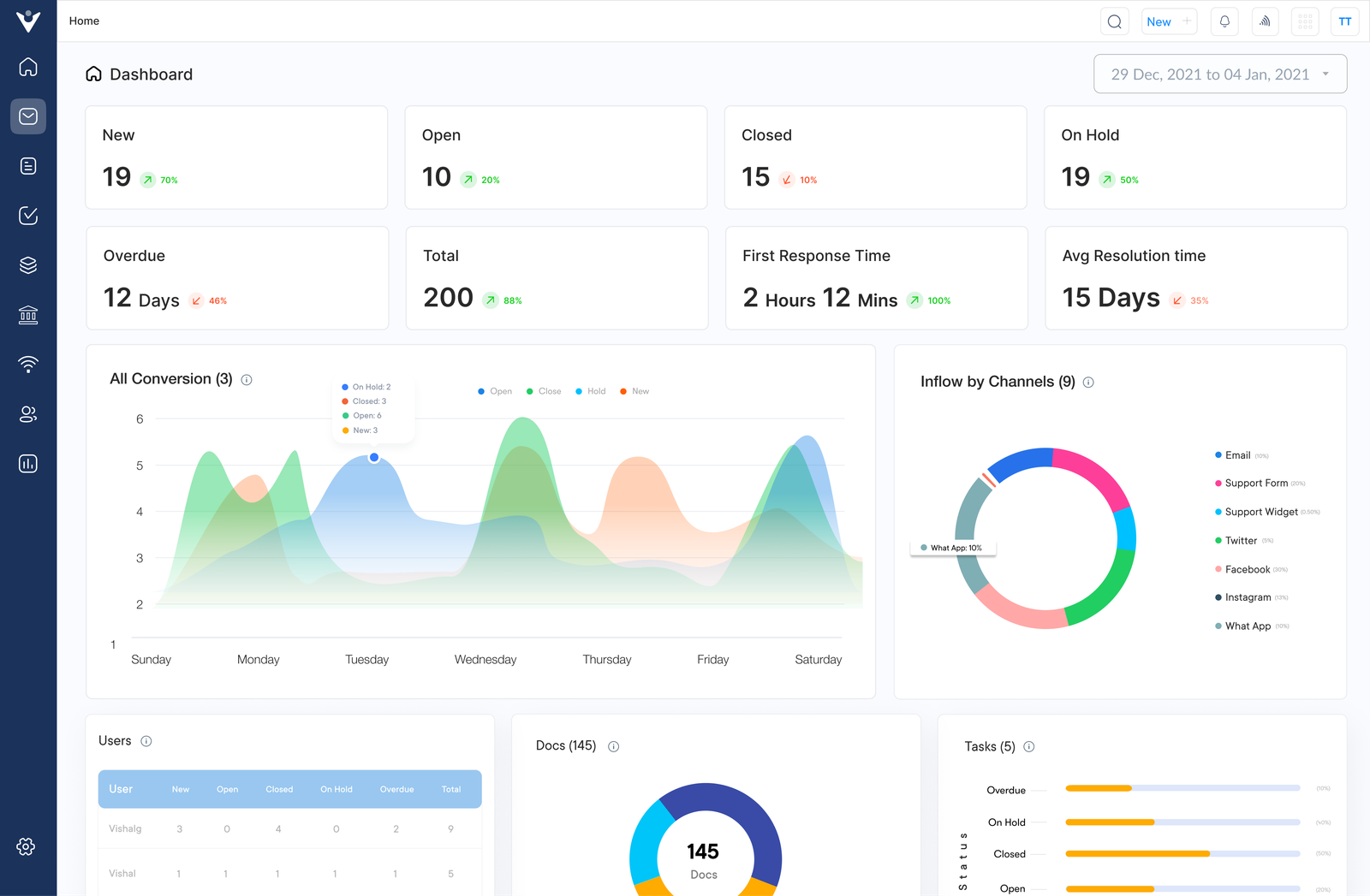
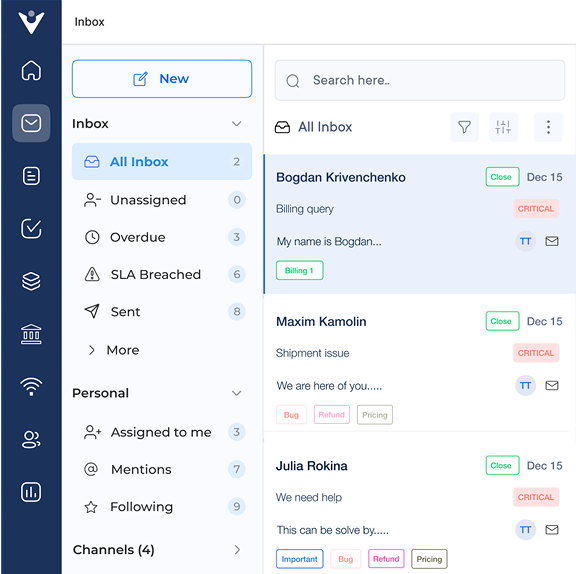
Veemo is a unified customer engagement suite built to help enterprises market better, sell faster and support smarter from one connected platform. It is designed to strengthen enterprise customer engagement by unifying all customer data in one place, enabling contextual responses and a 360-degree view of the customer lifecycle without switching tools.
Key features:
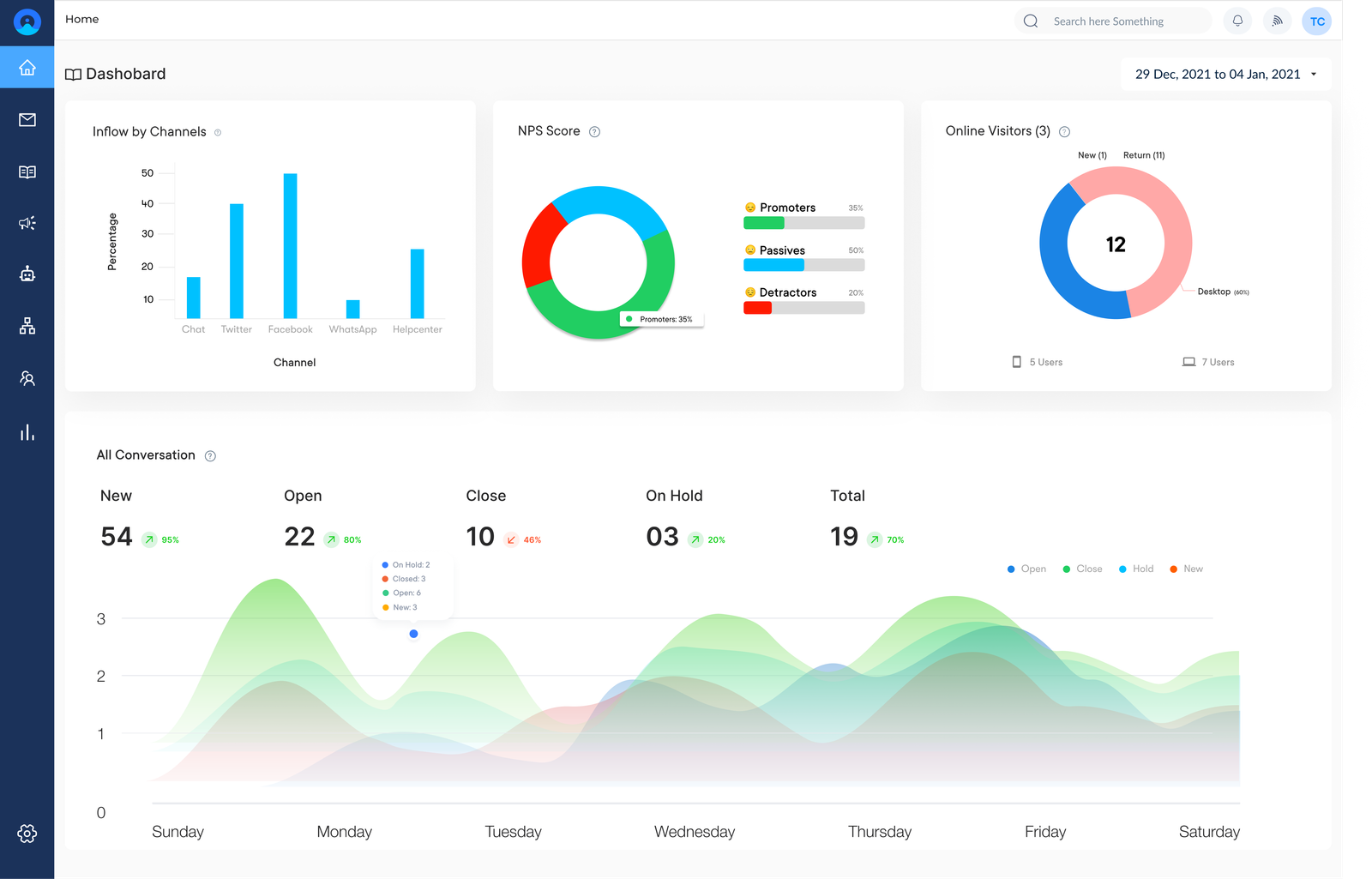
Omni24 is an AI-powered customer engagement platform that brings customer conversations, support and sales into one connected system. Enterprise engagement becomes easier to manage because teams can access customer context, automate routine work and deliver consistent experiences across every channel.
Core features:
Zendesk has grown from a customer support ticketing system into an AI-powered customer service platform, introducing what it calls the Autonomous Service Workforce, where specialized AI agents work across channels alongside human teams. Its unified support capabilities help enterprises strengthen enterprise customer engagement by delivering faster, more consistent and context-aware customer experiences.
Intercom rebranded its parent company to Fin in 2026, highlighting the growing role of its AI agent across the platform. Fin now operates across the full customer lifecycle, handling sales conversations and routing high-intent buyers using shared context. It works best for enterprises wanting AI-first engagement built natively into the platform.
Check out the most common challenges enterprises face when managing customer engagement at scale, from disconnected data to growing customer expectations.
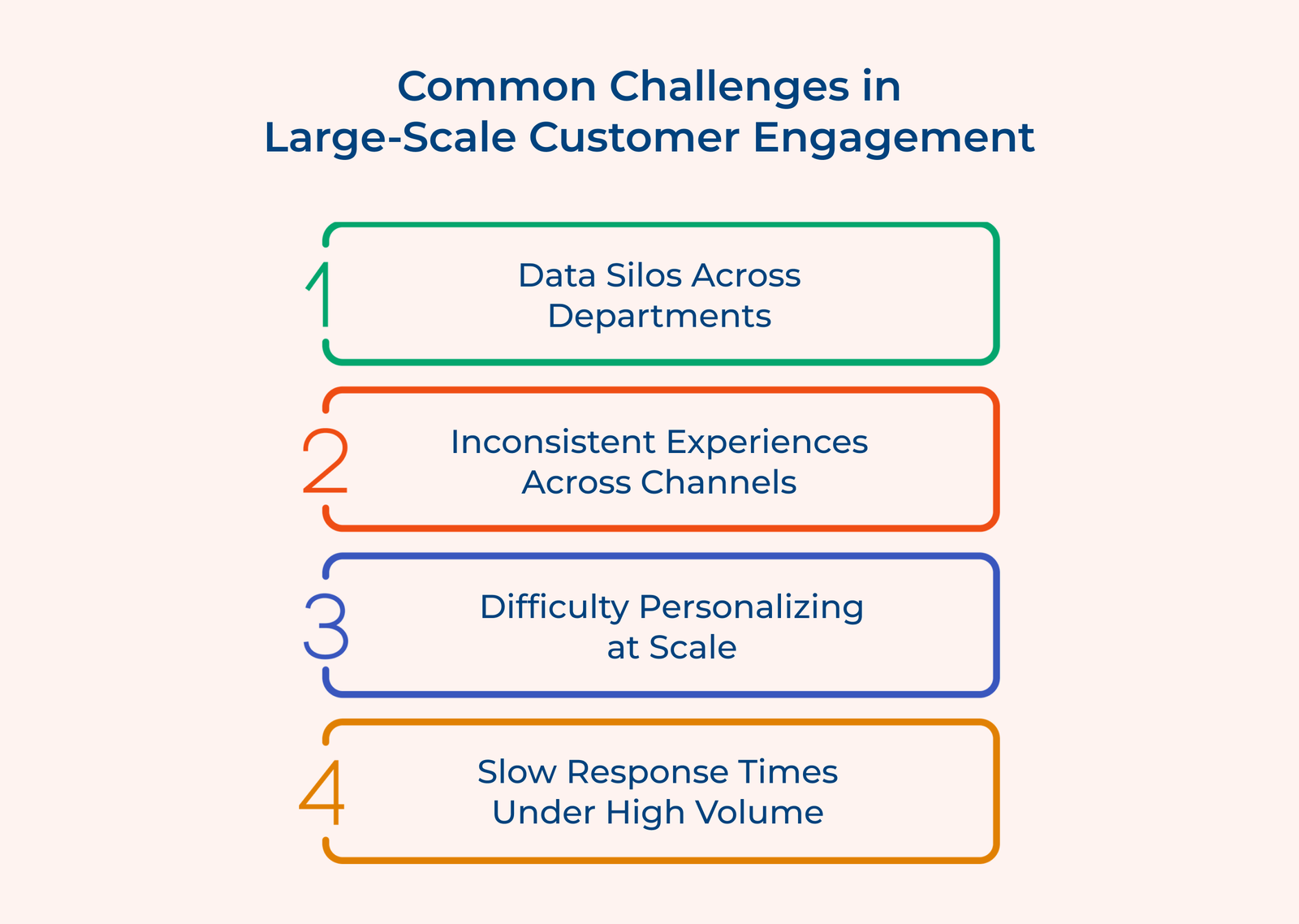
Data Silos Across Departments
Customer information often stays separated across marketing, sales and support systems, making it difficult for teams to see the complete customer journey. The disconnected systems weaken enterprise customer engagement, leading to repeated questions, inconsistent service and unnecessary effort across teams.
Inconsistent Experiences Across Channels
Customers expect continuity, but most enterprises deliver fragmented interactions instead. Context resets every time someone switches channels mid-conversation, forcing customers to repeat themselves and explain their issue all over again.
Difficulty Personalizing at Scale
Personalization is easier with smaller customer groups and reliable data. Enterprise customer engagement becomes much harder when customer data is incomplete or outdated, making personalized experiences feel generic instead of relevant.
Slow Response Times Under High Volume
As ticket volume grows, response times stretch far beyond acceptable thresholds for most customers. Customers notice the delay almost immediately, long before leadership ever sees it reflected in any internal dashboard.
Implementation steps:
Enterprise customer engagement delivers the best results when customer data, AI and teams work together instead of operating in separate systems. Organizations that connect the areas are better equipped to deliver consistent customer experiences as they grow.
Key takeaways:
Review the platform evaluation questions covered earlier in this guide before comparing vendors. Our guide on customer engagement strategies is a helpful next step if you want practical advice on putting these ideas into action. Enterprise customer engagement succeeds when scale never comes at the cost of context.

Enterprise engagement involves managing large customer bases, multiple departments and complex technology systems. SMBs usually serve fewer customers, rely on simpler processes and build relationships with fewer tools.
Enterprises engage customers through email, live chat, social media, mobile apps, phone support, messaging platforms and self-service portals. Connected systems help keep customer information and conversations consistent across every channel.
Consistent and personalized experiences help customers feel recognized as well as valued throughout their journey. Positive interactions build trust over time, encouraging repeat purchases, stronger retention and long-term loyalty.
The technologies that usually support enterprise customer engagement are:
These tools all work together. The enterprises get the infrastructure needed to engage customers consistently at scale.
Clean first-party customer data combined with AI helps businesses understand customer behavior and deliver relevant experiences automatically. Customers receive more useful recommendations and support without relying on manual effort for every interaction.
Grow Customer Relationships and stronger team collaboration with our range of products across the Conversational Engagement Suite.
Omnichannel Customer Support & Help Desk Software
AI Enabled Business Messaging and Chatbot Software
Sales Engagement & CRM Software
Call Center Software & Virtual Phone System
Product Marketing & Experience Platform
Customer Experience & Feedback Management Software
 Scroll to top