20+ Best Sales Discovery Questions to Win More Deals
Explore the best sales discovery questions to uncover customer needs and qualify prospects. Learn to drive better conversations with practical questions.

Explore the best sales discovery questions to uncover customer needs and qualify prospects. Learn to drive better conversations with practical questions.
Do you know why so many promising leads quietly disappear before a deal ever closes? Most of the time, it isn’t bad luck or poor product fit. The real reason is that the wrong questions got asked too late or the right ones never got asked at all.
Sales discovery questions are structured questions used early in a conversation to uncover a prospect’s problems, priorities, budget and buying authority. Industry data shows that 67% of lost sales opportunities result from sales reps not properly qualifying leads before pursuit. So let’s dive in to learn more about these questions, their different types and examples across industries.
Sales discovery questions refer to structured questions sales reps ask early in a conversation to uncover a prospect’s challenges, goals and buying process. They help separate genuine opportunities from conversations that sound promising but are unlikely to turn into a sale.
Ask yourself one question every experienced rep eventually learns to ask: would the prospect lose sleep without your product? If the answer is no, the conversation may be positive, but it isn’t a genuine opportunity. A well-timed sales discovery question brings that clarity within the first few minutes of the call.
Let’s go through the main types of sales discovery questions that help uncover customer needs and guide more productive sales conversations from the very beginning.
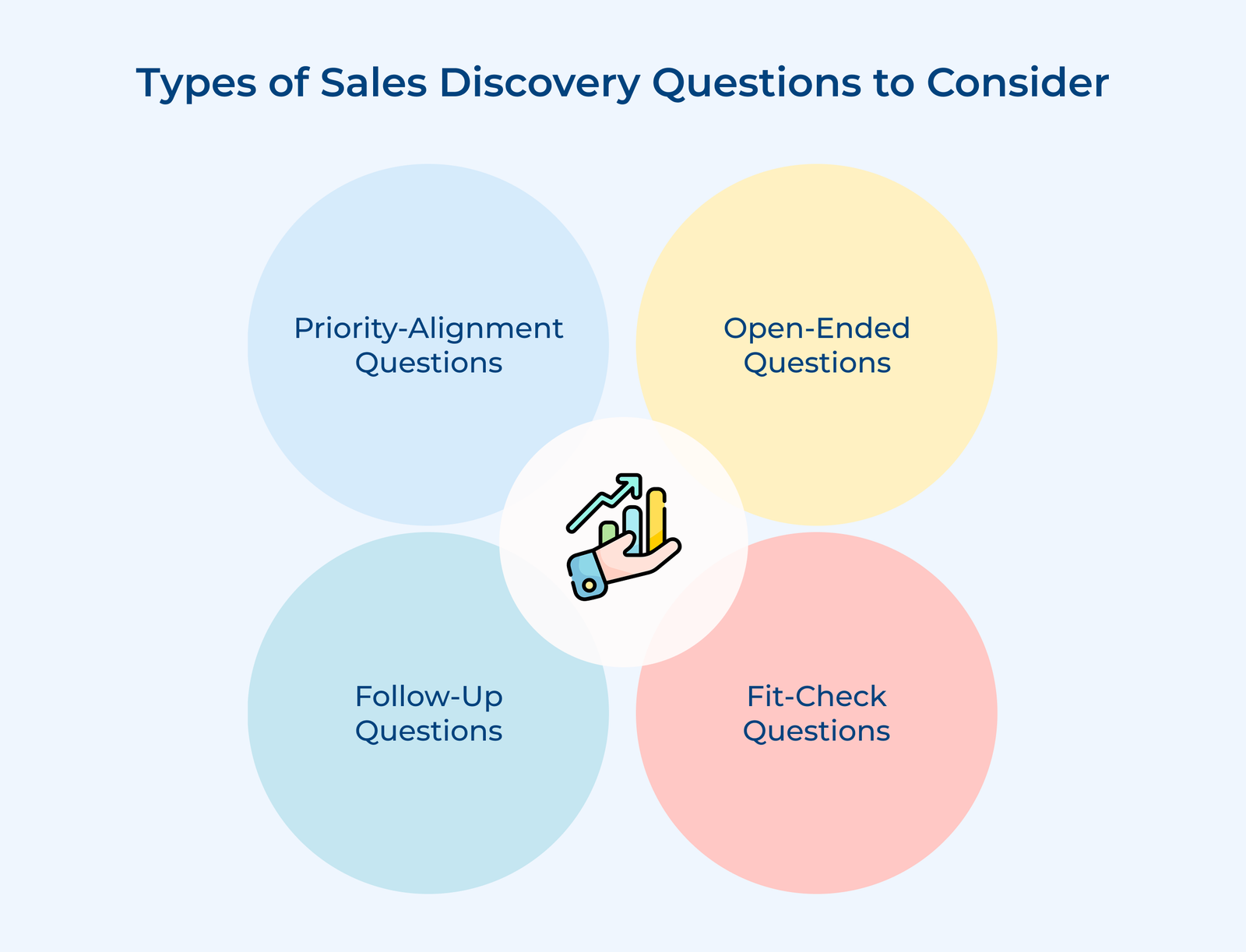
Open-ended sales discovery questions encourage prospects to share detailed answers instead of responding with a simple yes or no. They reveal context, challenges and priorities that often stay hidden when the conversation is limited to short, direct questions.
The questions are most effective at the beginning of a conversation, before discussing products or solutions. Giving prospects space to explain their situation naturally leads to more meaningful insights and a clearer understanding of what really matters to them.
Pro tips:
Priority-alignment sales discovery questions help confirm that the prospect’s problem is important enough to receive attention, budget and action. A challenge mentioned during a conversation doesn’t always become a priority once internal decisions begin.
Deals that stall right at the finish line usually trace back to a priority that was never confirmed. Asking directly about priority early saves significant time across a busy pipeline and it prevents false confidence from creeping into forecast numbers.
Key questions:
Fit-check questions help confirm that your solution genuinely addresses the prospect’s needs. Forcing a bad fit through the finish line usually backfires later, through churn, refunds or a frustrated customer who never should have signed.
Key questions:
Good fit-check questions protect both sides the buyer and the seller from a mismatch. Walking away from the wrong opportunity often strengthens credibility more than forcing a deal that was never a good fit.
Follow-up sales discovery questions explore answers that are incomplete or too general. The most valuable insight often appears after the first response, not during it. They help uncover the reasoning, context and details that prospects often leave out initially.
The first answer on a call is usually a starting point, not a finished conclusion. A simple “tell me more” often uncovers the real decision-making driver behind a deal, the kind that never shows up in a first response.
Core questions:
The following are the key categories to qualify prospects faster, each with proven questions and the strategic reasoning behind them.
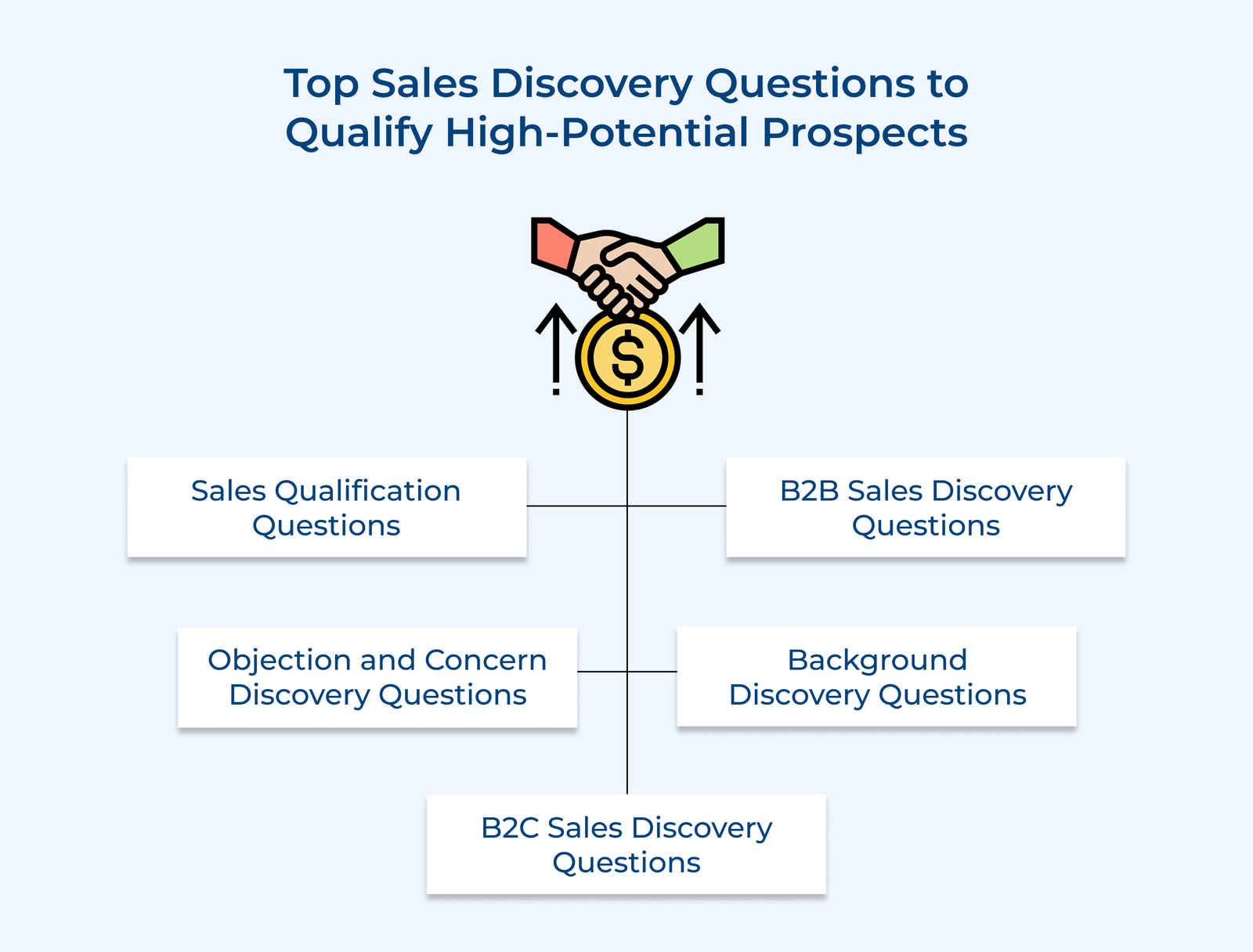
1. Who else is involved in evaluating the decision internally?
A single enthusiastic champion can still lose a deal if other stakeholders never join the conversation. It is one of the most valuable sales discovery questions because it identifies everyone who can influence the final decision before the buying process moves forward.
Key patterns:
2. What’s the approval process once a decision gets made?
Some companies can approve a purchase within days; while others move every deal through procurement, legal review and multiple approvals. Understanding that process early leads to more accurate timelines and prevents deals from looking closer to the finish line than they really are.
3. How is the problem currently being measured internally?
A prospect already tracking lost revenue, support ticket volume or churn has a stronger business case than one relying only on opinions. It is one of the most valuable questions because it shows how important the problem already is inside the organization.
Key ways:
4. What budget cycle does the purchase need to fit into?
Timing matters just as much as interest. A prospect with a budget available today is very different from one waiting until the next planning cycle. This question helps distinguish immediate opportunities from deals that need more time before they can realistically move forward.
5. What’s the cost of doing nothing about this right now?
Putting a number on inaction, like lost hours, missed revenue or compliance risk, often creates more urgency than any product demonstration. It is one of the most effective sales discovery questions because it helps prospects understand the real cost of delaying a decision.
Key forms:
6. What does the current process look like from start to finish?
Asking a prospect to walk through the entire process instead of giving a quick summary reveals details that often stay hidden. Real friction usually appears in the small steps, not in broad descriptions of how things work.
Key points:
7. How long has this particular problem existed?
A problem raised for the first time today carries very different urgency than one that’s been accepted for years. It is one of the most revealing questions because it shows how established the challenge has become inside the business.
Key situations:
8. What prompted the decision to start looking for solutions now?
Every active opportunity starts with a trigger, such as a missed target, new leadership, rapid growth or a change in business priorities. Understanding that trigger gives you valuable context and a reference point you can return to if the deal slows later.
9. How is the team currently working around the limitation?
Detailed workarounds, like rebuilding the same spreadsheet every Monday, often reveal stronger buying intent than a simple statement of interest. It is one of the most practical sales questions because it highlights the time and effort the team spends managing the problem.
10. What does success look like six months from now?
A specific outcome, like reducing onboarding time by half, is far more useful than a general goal like making things easier. Clear success measures also create a benchmark that helps demonstrate value after implementation.
11. Who has been impacted most by the ongoing challenge?
The people dealing with the problem every day aren’t always the ones approving the purchase and understanding that difference matters. It is one of the most valuable sales discovery questions because it identifies who feels the greatest impact and who is most likely to support a solution.
12. What made you start looking into it today?
Buying decisions rarely happen without a reason, even when a prospect describes it as casual browsing. A response like “my lease ends next month” carries much more urgency than “I’m just exploring,” and each calls for a different conversation.
13. Have you tried solving it on your own before?
Someone who has already tried a solution and reached a dead end is often more open to guidance than someone researching the problem for the first time. It is one of the most revealing sales discovery questions because it uncovers what has already been attempted and why it didn’t work.
14. What’s most important to you in making the choice?
People buying the same product often make their decision for completely different reasons. Asking the question helps you focus on what matters most instead of assuming every prospect values the same benefit.
Key priorities:
15. How soon are you hoping to have it resolved?
A prospect who starts with “no rush” and mentions needing a solution this weekend is revealing far more urgency than their first answer suggests. It is one of the most useful sales discovery questions because it uncovers the timeline driving the decision.
16. What would make the purchase feel like the right call?
The answer often reveals motivations that go beyond product features or pricing. Understanding what gives a prospect confidence helps you focus the conversation on the outcome they care about most.
17. Is the decision yours alone or shared with someone else?
A deal that looks ready to close can slow down simply because another decision-maker hasn’t joined the conversation. It is one of the most important sales questions because it identifies everyone involved before the buying process reaches the final stage.
Key dynamics:
18. What’s holding you back from moving forward today?
Asking the question directly often leads to a more honest conversation than waiting for objections to appear later. It is one of the most effective sales discovery questions because it uncovers the real reason a prospect is hesitating instead of leaving room for assumptions.
19. What would need to be true for this to feel low-risk?
Some prospects need a trial, others want customer references, while some simply want a clear explanation of what happens after they buy. The question identifies the reassurance that matters most instead of offering answers the prospect never asked for.
Key types:
20. Have you had a bad experience with something similar before?
A disappointing experience with a previous provider often shapes how a prospect approaches every future conversation. It is one of the most valuable sales discovery questions because it uncovers past experiences that may influence the current decision.
21. What’s the biggest unknown still standing in the way?
A response like “I need to think about it” becomes much easier to address once the real concern is identified. The question helps turn a vague hesitation into a specific issue that can be discussed and resolved.
22. Who else might need convincing before it moves forward?
A deal can lose momentum because another decision-maker raises concerns after the conversation ends. It is one of the most important sales questions because it identifies everyone who can influence the final decision before the buying process stalls.
23. What would happen if the decision gets delayed further?
Looking at the cost of waiting often changes the conversation. Missed deadlines, rising costs or ongoing inefficiencies can make the impact of delaying the decision much clearer than discussing the solution alone.
24. If this solves your problem, what’s the next step internally?
A clear answer like “I’d send it to my manager for approval by Friday” usually signals genuine momentum. It is one of the most valuable sales discovery questions because it reveals the remaining steps before the prospect can move forward.
25. What timeline are you working with for a final decision?
A prospect saying “sometime this quarter” is in a very different position from one saying “we need this live by the fifteenth.” The question brings clarity to the buying timeline and helps separate active opportunities from early-stage conversations.
26. Is the budget already allocated or does that still need approval?
Knowing if funding is already available or still needs approval changes how the conversation should progress. It is one of the most practical sales discovery questions because it shows how prepared the prospect is to move ahead financially.
27. What would disqualify this option from consideration entirely?
The question surfaces hard requirements, like a specific integration or compliance standard, that might rule out the deal entirely before more time gets invested. Knowing a deal-breaker early protects credibility far better than discovering it during a final-stage negotiation.
Key categories:
28. Who needs to sign off before it becomes official?
The most engaged person in the conversation isn’t always the one with final approval. It is one of the most important sales discovery questions because it identifies who has the authority to make the final decision.
29. On a scale of interest, where does it rank today?
Asking for a simple rating often leads to a more honest response than asking how someone feels. A prospect who rates their interest as a six instead of a nine allows you to understand what’s holding them back before assuming the deal is moving forward.
Below are the key principles to separate questions that genuinely qualify a prospect from those that just fill airtime.
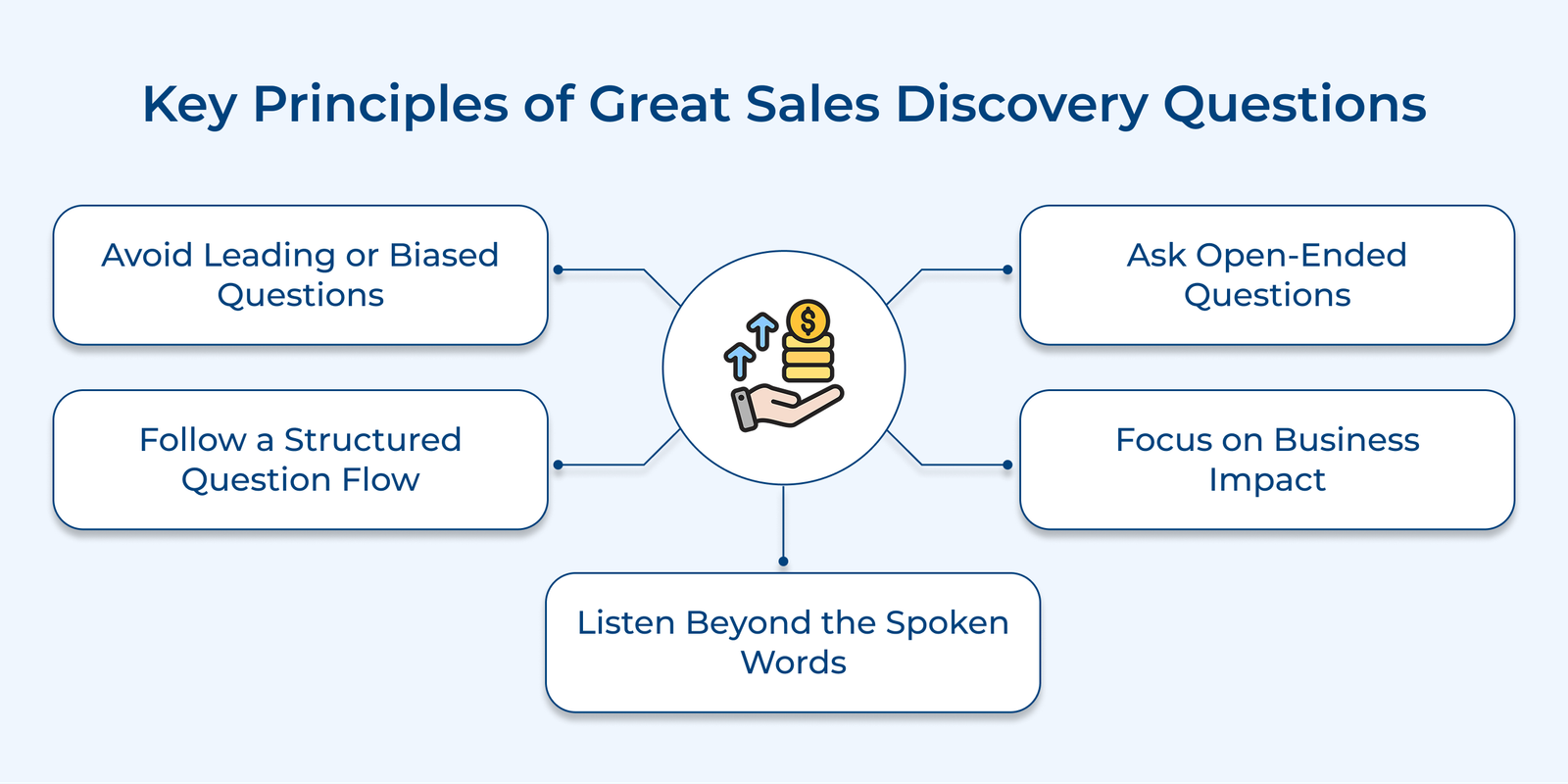
Open-ended sales discovery questions encourage prospects to explain their situation instead of giving one-word answers. Simple prompts like “walk me through” or “what does that look like” uncover details that closed questions often miss.
Key openers:
Starting with open questions helps prospects feel comfortable sharing more about their situation. People who feel listened to usually offer insights that never come out through short, direct questioning.
Pro tips:
Sales discovery questions become much more valuable when they focus on business impact instead of product features. Asking “what happens if it stays unsolved” encourages prospects to explain the real consequences instead of describing only the problem.
Actionable tips:
The best sales discovery questions don’t just generate answers, they create space for prospects to think. A short pause after asking a question like”what’s the real cost of waiting” often leads to insights that wouldn’t have surfaced in a rushed conversation.
Silence can feel uncomfortable, which is why many people jump in too quickly with another question or explanation. Giving prospects a few extra seconds to think often leads to more honest, thoughtful answers and a much deeper conversation.
The order of your sales discovery questions matters just as much as the questions themselves. Jumping into budget or timelines can make the conversation feel rushed, while starting with context makes later qualification questions feel natural.
Key steps:
The same question can get very different responses depending on when it’s asked. A budget question in the first few minutes often feels premature, while the same question later in the discussion feels relevant because enough context has already been established.
Sales discovery questions work best when they invite honest answers instead of steering prospects toward one. A question like “wouldn’t it help to fix this faster?” suggests the response you want, while a neutral question gives prospects room to explain their own perspective.
Key ways:
Leading questions often create agreement without revealing what the prospect actually thinks. Honest answers uncover real concerns early, making it much easier to address them before they become obstacles later in the sales process.
Check out the following sales discovery question examples across industries to see how different businesses uncover customer needs.
SaaS Discovery Questions
SaaS buying decisions often involve multiple stakeholders, product evaluations and technical requirements that can slow progress if they aren’t discussed early. Sales discovery questions should uncover business needs, technical fit and potential roadblocks before the evaluation moves too far
Key questions:
Real Estate Discovery Questions
Real estate decisions depend on both financial readiness and personal timing. Sales questions should uncover a buyer’s motivation, budget and timeline early so everyone knows if the opportunity is realistic.
Core questions:
Financial services discovery questions
Financial services usually involve careful planning, internal approvals and risk assessment. Sales discovery questions should uncover financial goals, decision criteria and compliance requirements before recommendations are made.
Key questions:
Strong discovery comes from asking questions that reveal real urgency, budget and authority before time gets invested in the wrong deal. Sales discovery questions help identify genuine opportunities and keep conversations focused on prospects who are ready to move forward.
Key takeaways:

The sales discovery process is the first stage of a sales conversation where reps ask structured questions to understand a prospect’s challenges, goals, decision-making process and buying readiness. It helps determine if the opportunity is worth pursuing.
Discovery questions explore a prospect’s broader situation, including goals and challenges, while qualification questions specifically confirm budget, authority or timeline. Discovery happens first; qualification narrows the field afterward.
Discovery calls help reps identify serious opportunities before investing time in proposals or product demonstrations. Clear answers early in the conversation lead to stronger recommendations and more productive sales discussions.
Many sales discovery questions work across industries, but the wording should reflect the prospect’s business and priorities. Tailoring questions to the conversation usually leads to more relevant and useful answers.
The most common mistake is rushing past vague answers without asking a single follow-up question. Surface-level answers rarely reveal the real problem, urgency or buying authority underneath them.
Grow Customer Relationships and stronger team collaboration with our range of products across the Conversational Engagement Suite.
Omnichannel Customer Support & Help Desk Software
AI Enabled Business Messaging and Chatbot Software
Sales Engagement & CRM Software
Call Center Software & Virtual Phone System
Product Marketing & Experience Platform
Customer Experience & Feedback Management Software

 Fast Customer Service Guide: Key Strategies, Tools and Metrics
Scroll to top