Automotive Chatbot Guide: Benefits, Use Cases and Examples
Learn how automotive chatbots improve support, qualify leads and schedule test drives. Now deliver faster, personalized experiences across the customer journey.
Learn how automotive chatbots improve support, qualify leads and schedule test drives. Now deliver faster, personalized experiences across the customer journey.
Many car dealerships lose potential customers simply because inquiries go unanswered after business hours. A recent BotsCrew study found that more than 90% of U.S. dealerships now use chat or messaging tools to engage buyers online, making quick response times increasingly important.
An automotive chatbot is an AI-powered conversational tool designed for dealerships, helping automate lead qualification, service scheduling, inventory inquiries and other customer interactions. Let’s understand how it works, its benefits, use cases, examples and leading platforms worth considering.
An automotive chatbot refers to an AI-powered conversational tool designed for dealerships, OEMs and service centers. It helps manage tasks such as test-drive bookings, service appointments, lead qualification and customer inquiries without requiring constant human support.
How does it know what a customer is asking? Natural language processing analyzes the customer’s message to identify the request and key details. A message like “Book a service for my Honda City” is understood as a service request, along with the vehicle model and scheduling intent.
Key factors:
Let’s go through the key benefits of an automotive chatbot to understand how it helps dealerships improve customer support and deliver faster customer experiences.
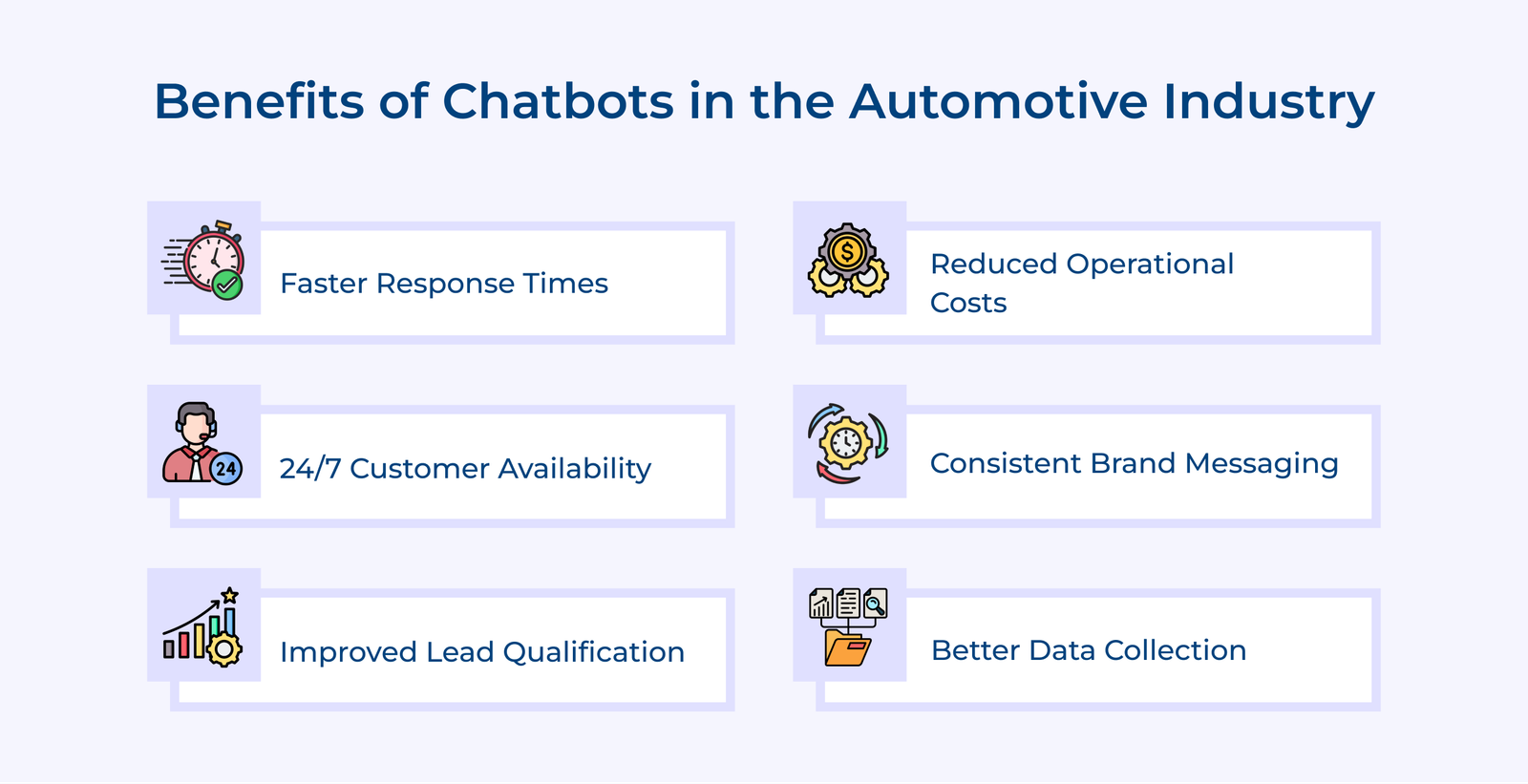
1. Faster Response Times
Customers expect quick answers when they have questions about vehicles, pricing or services. Automotive chatbots respond within seconds, keeping conversations active and reducing the chances of customers leaving before getting the information they need.
2. 24/7 Customer Availability
Dealership hours no longer limit how customers reach out for information. A chatbot handles inquiries at midnight or early morning, capturing interest that would otherwise go unanswered until the next business day.
3. Improved Lead Qualification
Not every visitor is ready to speak with a sales representative. An automotive chatbot asks qualifying questions early in the conversation, helping sales teams identify serious buyers and prioritize follow-ups more effectively.
4. Reduced Operational Costs
Routine customer questions can take up a significant amount of staff time. Chatbots handle repetitive inquiries automatically, allowing employees to focus on customer conversations that need personal attention.
5. Consistent Brand Messaging
Different employees may explain the same information in different ways. An automotive chatbot delivers accurate and consistent responses across every conversation, helping customers receive reliable information every time.
6. Better Data Collection
Every customer conversation provides useful information about interests, preferences and buying intent. An automotive chatbot captures these details automatically and stores them in the CRM, giving teams better insights for future interactions.
The following are the most common automotive chatbot use cases, showing how dealerships automate customer interactions and improve experiences across multiple touchpoints.
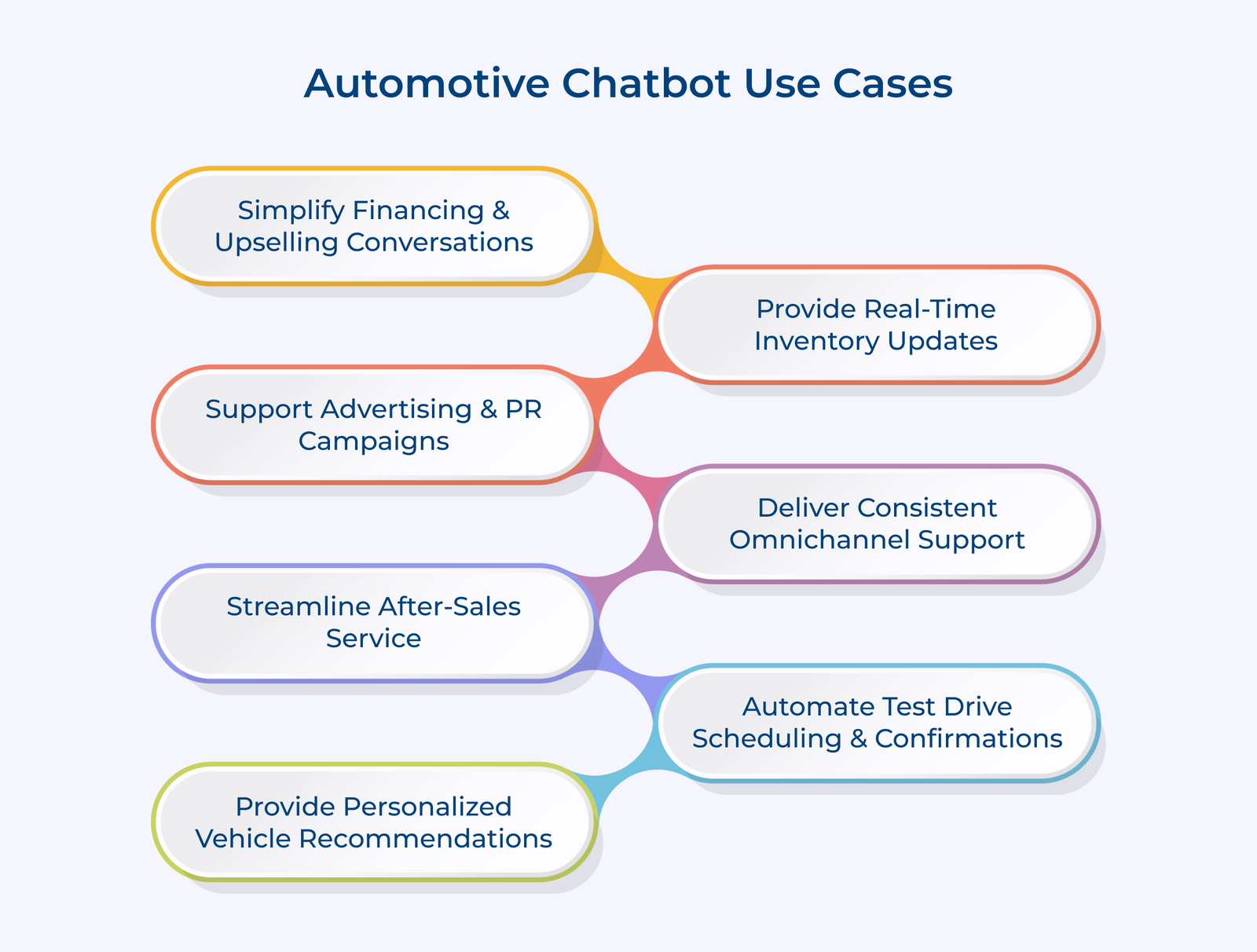
Financing is often one of the most confusing parts of buying a vehicle, especially for first-time buyers. Automotive chatbots explain EMI options, interest rates and down payment scenarios through simple conversations, helping customers understand their choices with confidence.
Why does it matter during the buying journey? Customers who clearly understand their financing options are more likely to continue with the purchase instead of leaving halfway through. An automotive chatbot can calculate estimated EMIs based on loan amount and tenure, helping customers make quicker decisions.
Relevant recommendations also become easier once the customer’s needs are understood. A chatbot can suggest extended warranties, service packages or accessories based on the selected vehicle, making the conversation feel helpful instead of sales-focused.
Nothing frustrates customers more than asking about a vehicle only to find out it is no longer available. A chatbot for automotive connected to the DMS displays current inventory, helping customers see accurate vehicle availability instead of outdated information.
What happens when inventory is not updated in real time? Customers may inquire about a specific model or variant only to discover it was sold earlier. Accurate inventory updates help dealerships avoid these situations and build customer confidence from the start.
Key considerations:
Accurate inventory depends on reliable data and regular updates. Small delays can quickly create confusion and unnecessary customer disappointment. Customers are far more likely to trust dealerships that provide accurate availability from the very first interaction.
Key gaps:
Marketing campaigns often bring a sudden increase in customer inquiries that sales teams cannot always handle immediately. Automotive chatbots respond instantly, capture leads and answer common questions across campaign landing pages.
Why do campaign-specific chatbots work better than standard contact forms? They continue the conversation started by the advertisement instead of asking customers to begin again. A campaign promoting a new SUV launch, for instance, can launch a chatbot conversation focused on that model, its features and available offers.
Key elements:
Customers often contact dealerships through WhatsApp, Instagram and website chat, sometimes switching between channels during the same conversation. An automotive chatbot keeps the conversation connected, so customers do not have to repeat the same information every time they change platforms.
Consistency is very important, as repeating the same questions or explaining the same issue again creates unnecessary frustration. A connected automotive chatbot remembers previous conversations and continues the discussion with the right context, even after a customer switches channels.
Key touchpoints:
Building consistency is rarely just a technical integration problem. Tone and response style also need to stay aligned, even though each platform has its own conversational norms. Customers should receive the same clear and reliable experience, regardless of where the conversation begins.
Key factors:
After-sales service plays a major role in keeping customers satisfied long after they purchase a vehicle. Automotive chatbots manage service booking, appointment reminders, repair updates and common customer questions without requiring a phone call for every request.
Businesses often wonder how an after-sales chatbot is different from one used during the buying journey? The focus shifts from helping customers choose a vehicle to keeping them informed throughout the service process. An automotive chatbot provides timely updates that reduce uncertainty and unnecessary follow-up calls.
Key points:
Scheduling a test drive involves more than simply picking a time. Chatbots for automotive check vehicle availability, salesperson schedules and customer preferences before confirming an appointment, making the booking process more organized.
Manual test drive bookings often create problems. Phone bookings can lead to scheduling conflicts or unavailable vehicles. An automotive chatbot checks calendars and inventory in real time, helping dealerships avoid these issues and provide accurate appointment confirmations.
Automated reminders also help reduce missed appointments. Customers receive confirmations, reminders and dealership directions before their visit, making the experience smoother from the start. Clear reminders also help customers arrive prepared and on time, reducing scheduling disruptions for the dealership.
Generic vehicle suggestions often leave customers searching through options that do not match their needs. An automotive chatbot asks about budget, driving habits, family size and preferred features to recommend vehicles that fit the customer’s requirements.
Relevant recommendations also create opportunities to introduce useful add-ons during the conversation. Customers comparing two vehicles may also receive suggestions for accessories, insurance or service packages that match their selected model. Good personalization depends on asking the right questions without making the conversation feel too long.
Key mistakes:
Check out the top automotive chatbots helping dealerships improve customer communication and manage sales conversations more efficiently.
Veemo Chat is an AI-powered customer communication platform that combines live chat, automated chatbots and a unified inbox in one place. As an automotive chatbot, it helps dealerships manage customer conversations, automate routine tasks and handle high chat volumes across teams. It sits at the intersection of help desk software, live chat software, AI customer service and CRM-lite, making it a strong fit for inbound-heavy automotive support teams handling high conversation volumes daily.

Key features:
Omni24 is an omnichannel customer experience platform designed for automotive businesses, bringing together live chat, AI chatbots, ticketing and analytics in one place. As an automotive chatbot platform, it helps dealerships manage customer conversations across multiple channels, automate routine support and keep every interaction organized through a single system.
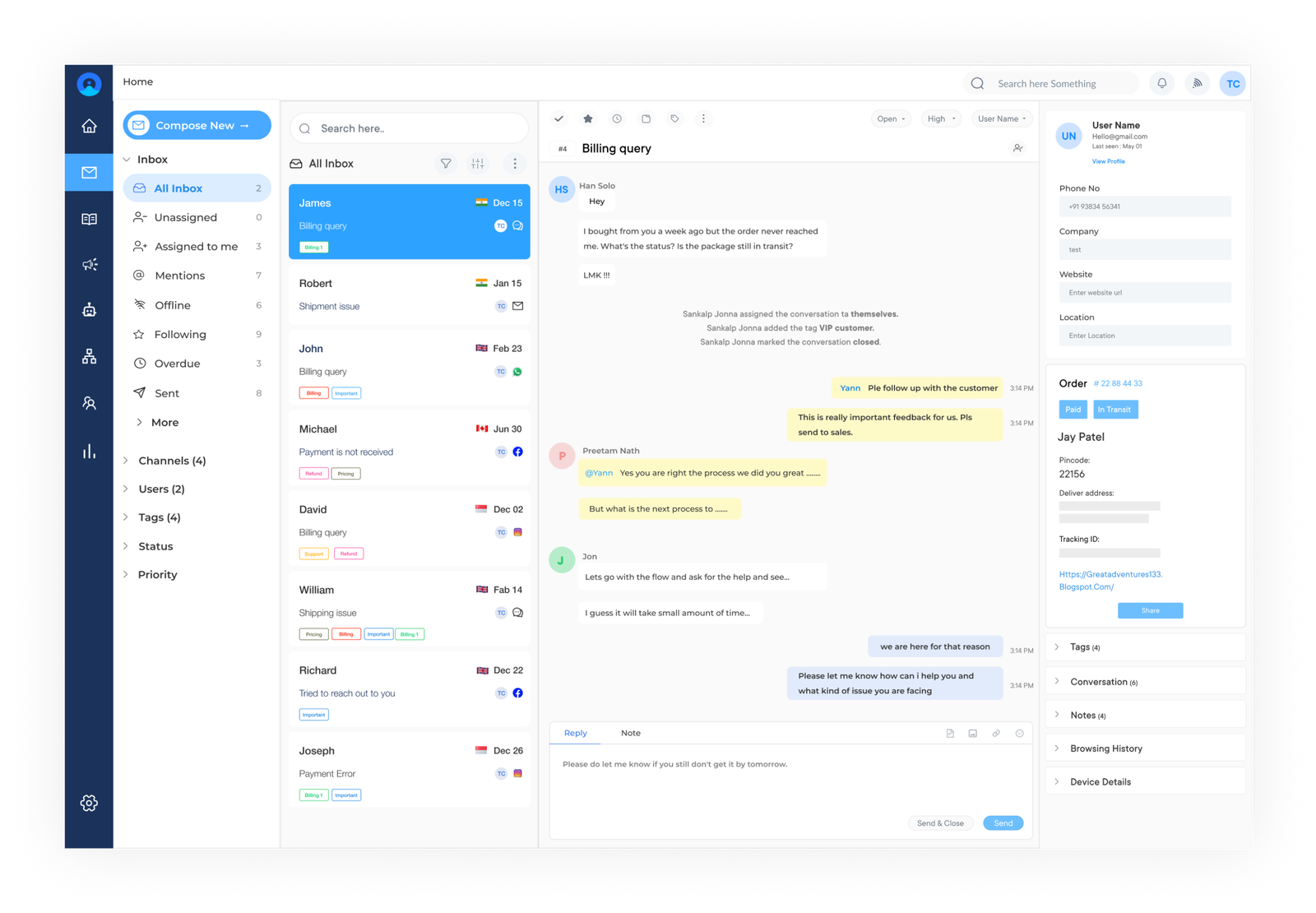
Key elements:
HubSpot offers two chatbot solutions. Chatflows is a free, rule-based chatbot designed for FAQs, lead capture and meeting bookings. Breeze Customer Agent is its AI-powered solution that can also serve as an automotive chatbot, helping dealerships handle customer inquiries, qualify leads and schedule appointments. Customer information remains within the HubSpot CRM, as native DMS integration is not available.
Podium is a customer messaging platform that includes its AI assistant, Jerry, to help dealerships manage customer conversations and appointment bookings. It also supports bi-directional DMS integration, allowing customer and dealership data to stay synchronized instead of relying on read-only access.
Let’s go through some real-world automotive chatbot examples that show how leading automotive brands use AI to improve customer communication.
BMW
BMW partnered with Sinch to launch a WhatsApp chatbot called “Follow Now,” allowing customers to check their vehicle repair status by entering a simple code in the chat. The automotive chatbot handles most routine service inquiries during busy tire change seasons, giving customers quick updates without calling the service center.
The rollout significantly reduced call volumes at BMW’s Munich service center. Around 80% of routine customer questions are resolved through the chatbot, allowing support teams to spend more time on complex cases.
Toyota
Toyota built an in-house chatbot using large language model technology to manage thousands of customer-service requests across its dealer network each week. It also introduced a proactive voicebot called “eCare” that contacts drivers when dashboard warning lights appear.
The operational savings here are substantial and well-documented industry-wide. The automation drives savings of more than 70,000 human work-hours annually, letting service teams prioritize higher-value, complex customer issues instead.
Ford
Ford partnered with AI company Impel to improve dealership chatbot performance across the U.S. network. The automotive chatbot supports service scheduling, lead generation and customer conversations across teams.
Early results show measurable operational gains across dealership functions using the approach. Retailers have reported higher appointment rates by using chatbots to schedule appointments off hours, directly improving service department revenue without adding staff.
Mercedes-Benz
Mercedes-Benz Cars Middle East launched a Facebook Messenger chatbot that allows customers to schedule test drives and explore the newest Mercedes-Benz models directly within the chat interface. The extended the brand’s showroom experience into a channel customers already used daily.
The campaign delivered strong customer engagement and conversion results. Similar automotive chatbot deployments across the region achieved conversion rates of around 20%, showing how conversational AI can support both customer service and vehicle sales.
Automotive chatbots have evolved from simple FAQ tools into practical systems that support sales, service and customer communication throughout the dealership journey. The right deployment directly improves response speed, lead quality and after-sales retention across every customer touchpoint.
Key takeaways:

Automotive chatbots answer customer questions instantly, qualify leads, schedule appointments and stay available at any time. Quick responses, personalized conversations and timely updates make the buying and ownership experience much more convenient.
AI powers predictive maintenance, personalized recommendations, demand forecasting and conversational support simultaneously. Beyond chatbots, it also assists with autonomous driving features, supply chain optimization and fraud detection during financing approvals.
Key features include DMS integration, multilingual support, omnichannel availability and intelligent lead scoring. Many platforms also provide service booking, inventory checks, financing assistance and smooth handoffs to human agents when needed.
Future automotive chatbots will lean heavily on voice integration, predictive personalization and deeper in-vehicle connectivity. Expect tighter CRM synchronization, proactive maintenance alerts and conversational AI embedded directly into dashboards.
No. Automotive chatbots handle routine conversations, answer common questions and qualify potential buyers. It allows sales teams to focus on detailed discussions, negotiations and building customer relationships that require human expertise.
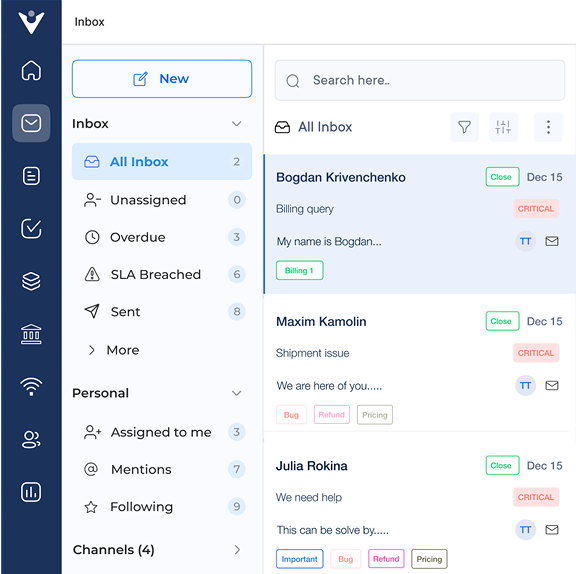
Grow Customer Relationships and stronger team collaboration with our range of products across the Conversational Engagement Suite.
Omnichannel Customer Support & Help Desk Software
AI Enabled Business Messaging and Chatbot Software
Sales Engagement & CRM Software
Call Center Software & Virtual Phone System
Product Marketing & Experience Platform
Customer Experience & Feedback Management Software
 Scroll to top