Customer Service Forecasting: Benefits, Steps & Challenges
Customer service forecasting helps businesses predict demand, optimize staffing and improve response times. Explore its benefits, key steps and challenges to enhance service efficiency.

Customer service forecasting helps businesses predict demand, optimize staffing and improve response times. Explore its benefits, key steps and challenges to enhance service efficiency.
Customer service demand can change fast and if you’re not prepared, your team pays the price. Without proper forecasting, businesses often scramble to respond, leading to long wait times, overworked staff and unhappy customers. It’s a cycle that’s hard to break once it starts.
You don’t need advanced tools or complex math to build a solid customer service forecasting model. A practical, data-informed approach helps businesses anticipate customer needs, plan staffing efficiently, and keep support consistent even during busy periods. No matter if you’re just starting out or managing a large team, learning the basics of forecasting can help you stay ahead instead of playing catch-up.
Customer service forecasting refers to a strategic process that helps organizations plan ahead by estimating how much support they’ll need to provide at any given time. It involves analyzing historical data, trends and patterns to anticipate how many customer interactions a company will need to handle during specific periods, from daily intervals to yearly projections.
The process starts with collecting historical data and spotting trends. Let’s assume that a retail company finds that its support requests spike during holiday shopping or after product launches. Good forecasts also factor in outside influences like marketing pushes or technical issues that drive up contact volume.
Key principles:
Let’s go through the significant benefits of customer service forecasting, highlighting how it empowers businesses to not only meet but exceed customer expectations.
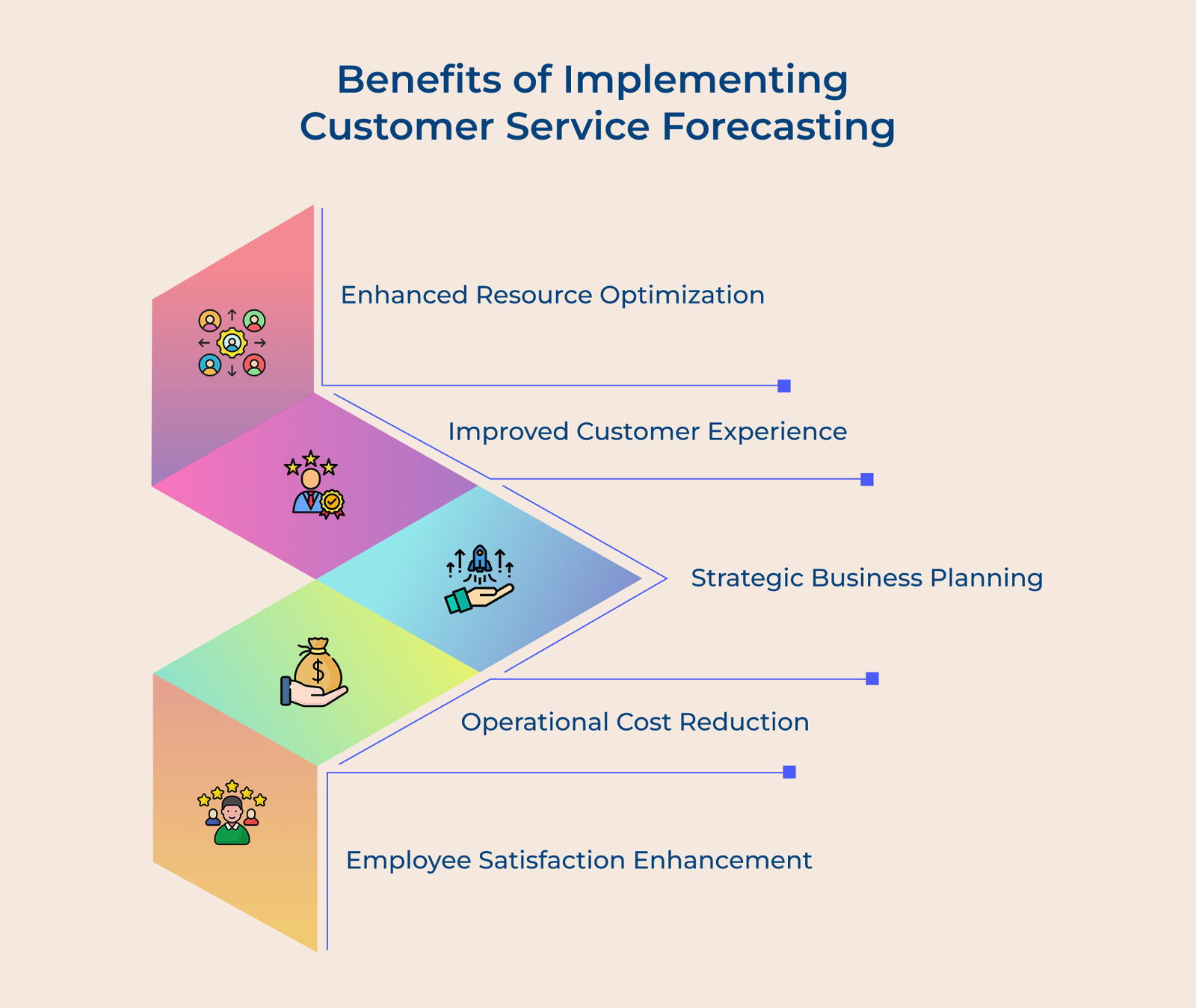
1. Enhanced resource optimization
You know when support demand will rise or fail with solid forecasting. It lets you schedule the right number of staff at the right times, avoiding both understaffing during busy periods and unnecessary coverage when things are quiet. It’s a practical way to keep operations smooth and costs under control.
2. Improved customer experience
When you’re prepared for busy periods, customers don’t get stuck in long queues or bounce between agents. They get quick, competent help from someone who knows what they’re doing. The consistency builds customer trust and keeps them coming back.
3. Strategic business planning
Forecasting gives leaders the data they need to make smart choices about hiring, training and expanding service channels. It helps connect the dots between customer support needs and overall business strategy.
4. Operational cost reduction
A great center forecasting method means fewer surprises. You can cut down on expensive last-minute overtime, avoid wasted resources and keep schedules efficient. It’s a steady way to trim costs without cutting corners on service.
5. Employee satisfaction enhancement
Balanced workloads lead to better morale. When teams aren’t constantly playing catch-up, they do better work and feel more in control. It means fewer burned-out employees and a more stable support team over time.
Check out the essential steps to establish a robust call center forecasting model, allowing you to stay ahead of customer needs and elevate your support strategy to new heights.
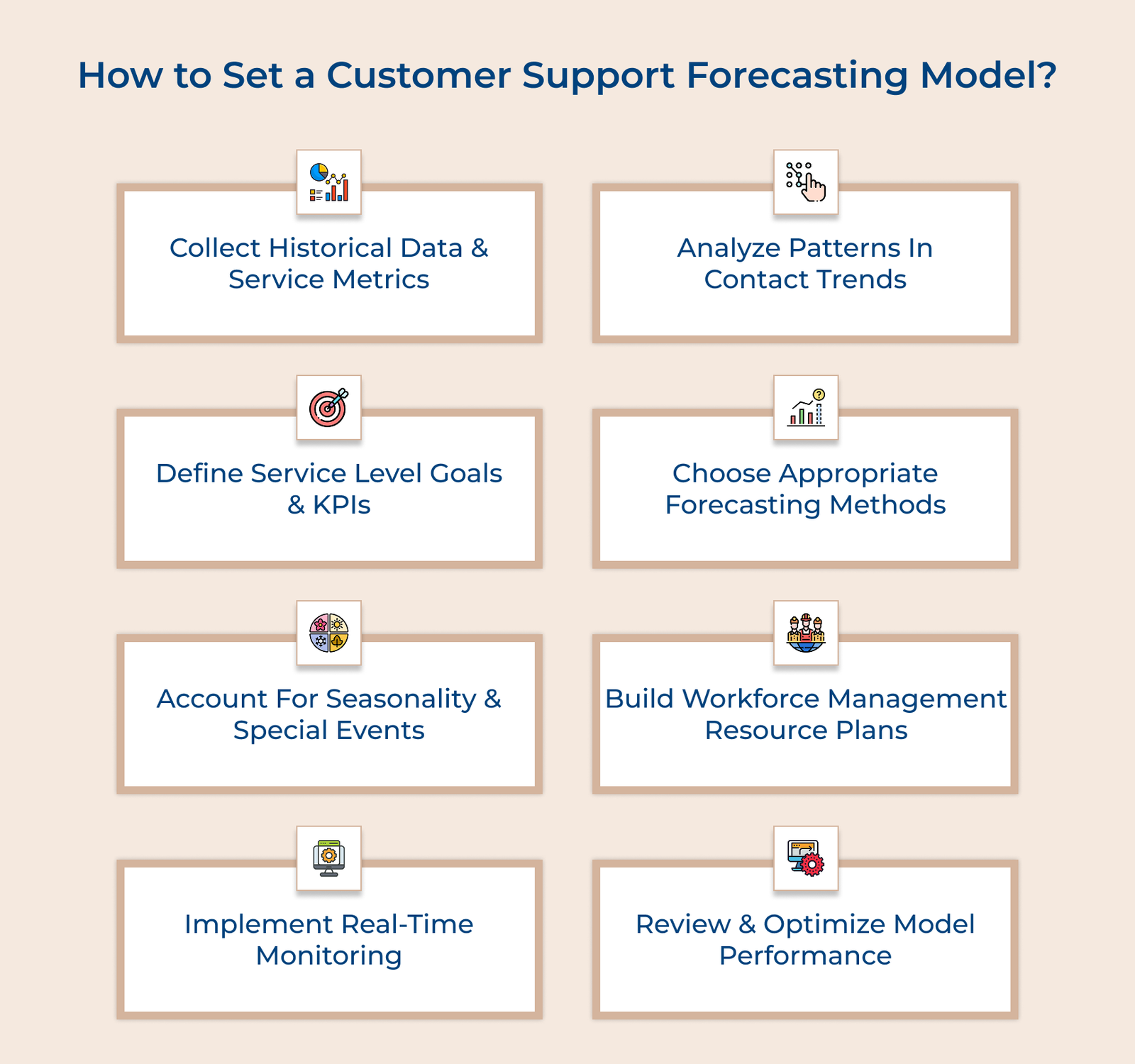
Building a reliable forecasting model starts with solid historical data. The step isn’t only helpful but essential. You can spot trends, seasonal spikes, and long-term shifts in customer behavior by analyzing 12-24 months of past service activity. It means collecting everything from call volumes to live chat logs.
Use a centralized database that keeps things organized and accessible. It should sort data by category, channel or time and flag issues like missing records or duplicate entries. Regular checks and cleanup routines help keep your data accurate.
Pro tips:
Pattern analysis turns raw service data into useful insights. It helps you see when and how customers typically reach out, information that directly shapes your staffing or scheduling decisions. Start by identifying recurring spikes in activity: certain hours of the day, days of the week or times of the year often show consistent volume increases.
Don’t just stop at overall volume. Break the data down by communication channel. You might find that calls surge in the morning, while chat traffic picks up in the evening. Recognizing the differences lets you staff more precisely and deliver consistent service across all platforms.
Actionable tips:
Setting clear service-level goals and performance metrics gives your forecasting efforts direction. The targets help you plan resources, track progress and stay aligned with what your customers expect. Start with response time goals. A phone call might need a response within seconds, while a support email could allow for a few hours.
Define expectations by channel and make sure your goals reflect urgency as well as realism. Use channel-specific metrics to get a full picture. A fast response means little if the answer isn’t helpful. Scorecards should track both speed and quality.
Best practices:
Choosing the right forecasting method directly affects how accurately you can predict customer service demand. It’s not about picking the most advanced model but about choosing the one that fits your data and goals. If your contact volumes follow a steady pattern, simple techniques like moving averages may be enough.
Short-term and long-term forecasts serve different purposes. Short-term models (hourly or daily) help with shift planning, while long-term models handle (monthly or quarterly) information for hiring, budgeting and strategy. Whichever method you choose, test it against actual results. Accuracy checks and adjustments are essential.
Key takeaways:
Planning for seasonality and special events helps your forecasting model reflect the real patterns behind customer service volume changes. The step is essential to avoid being caught off guard by predictable spikes or lulls in demand.
Use adjustment factors in your forecasts. The factors tweak the baseline predictions based on what happened during similar events in the past. Also, prepare for the unexpected with contingency plans for issues like system outages or product recalls.
Pro tips:
Workforce management turns your forecasts into real staffing plans. It’s the step where gap numbers on a spreadsheet become actual shifts and schedules for your team. Start by matching your predicted contact volumes with your service goals. It tells you how many agents you’ll need for each channel.
Build shift patterns that reflect when your customers are most active. Your schedules should match daily and weekly contact trends, with more staff during busy times. Volume spike planning includes strategies like flexible breaks, identifying standby staff and cross-training agents to handle multiple channels during unexpected surges.
Actionable tips:
Real-time monitoring is your first defense when reality doesn’t match your forecast. It helps you catch shifts in demand so you can respond before service levels slip. Your live dashboards should track essential metrics like queue lengths, wait times and contact volume by channel.
Set clear triggers for actions. If contact volume rises more than 15% above forecasts, team leads get notified and can roll out contingency steps. The events should also be logged so you can improve your forecasting accuracy next time.
Best practices:
Continuous review is what keeps your forecasting model sharp. Business needs shift, customer habits change and your model has to keep up. Regular checks help you catch the shifts early and keep predictions useful.
Pay attention to repeated patterns in over- or under-forecasting. When your forecast is off, dig into why. The insights will tell you if you need to tweak your formulas, gather better data or revise assumptions about seasonality.
Key takeaways:
Let’s go through the metrics you should consider to achieve accurate customer support forecasting and empower your team to meet, if not exceed, customer expectations.
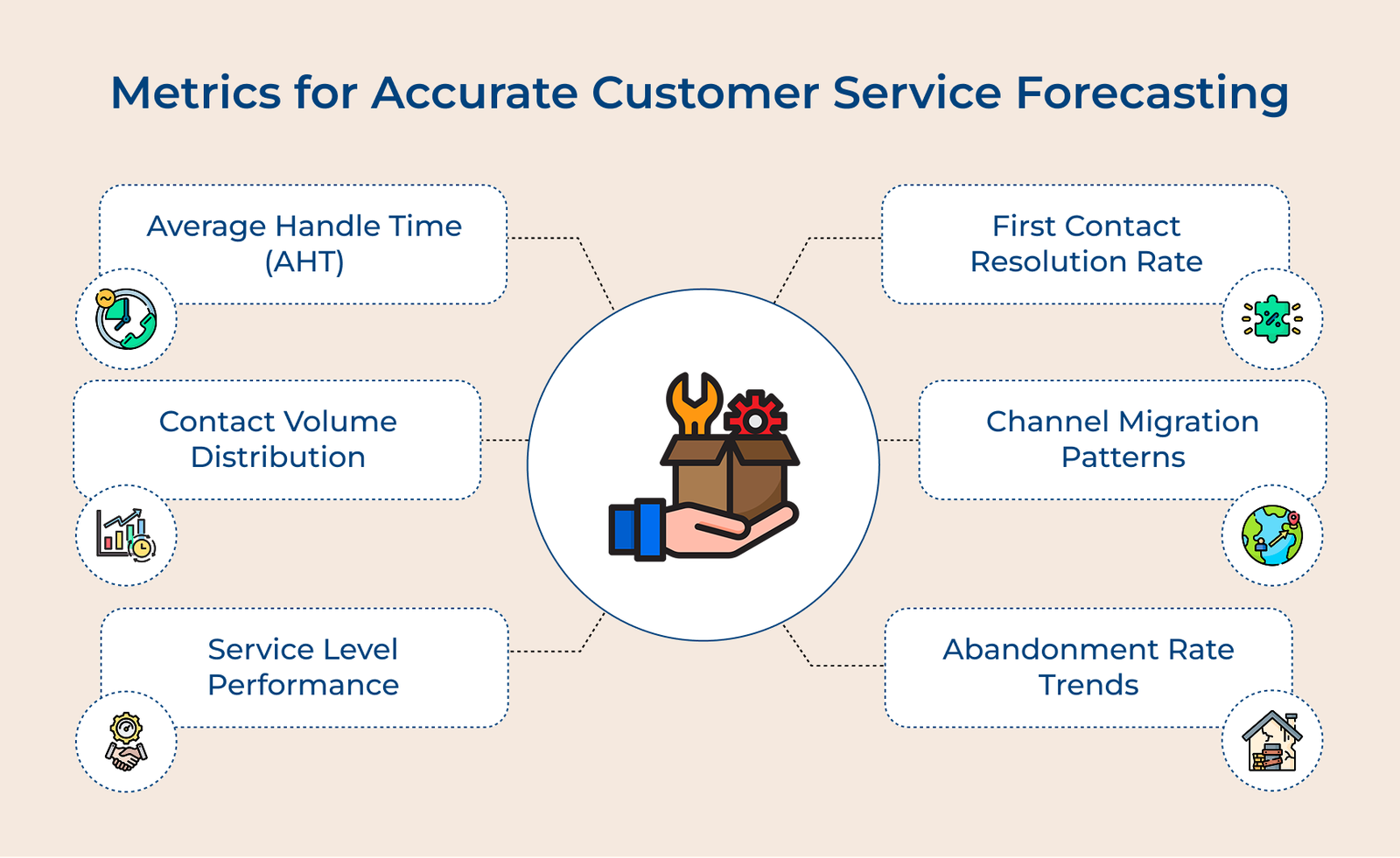
1. Average handle time (AHT)
Average handling time measures how long it takes to complete a customer interaction, including talk time, hold time and any follow-up work. It’s essential for calculating how many agents you need at different times. If AHT starts creeping up, it may signal more complex issues or training gaps.
2. Contact volume distribution
The metric shows when and how often customers reach out like by hour, day or month. Patterns emerge over time, like Monday morning surges or holiday slowdowns. Knowing the rhythms helps you schedule agents effectively and anticipate future contact trends.
3. Service level performance
Service level performance tracks how often your team responds within set timeframes, be it answering incoming calls within 30 seconds or replying to emails within 4 hours. It’s a key input for forecasting because it directly connects response times to staffing needs.
4. First contact resolution rate
FCR shows how often issues are solved in the first interaction. If resolution rates drop, expect more follow-up calls or chats. Keeping an eye on the trend helps you forecast both initial and repeat contacts with greater accuracy.
5. Channel migration patterns
The metric tracks when customers switch from one contact method to another—say, from chat to phone. The shifts tell you where to expect demand next and allow you to balance staffing across channels, not just in silos.
6. Abandonment rate trends
The metric shows how often customers leave before getting help, often because wait times are too long. High abandonment rates point to understaffing during specific windows. Tracking the trend lets you fine-tune your forecasts to prevent service breakdowns.
Below are the most common challenges in customer service forecasting and strategies to overcome them for a more exceptional customer experience.
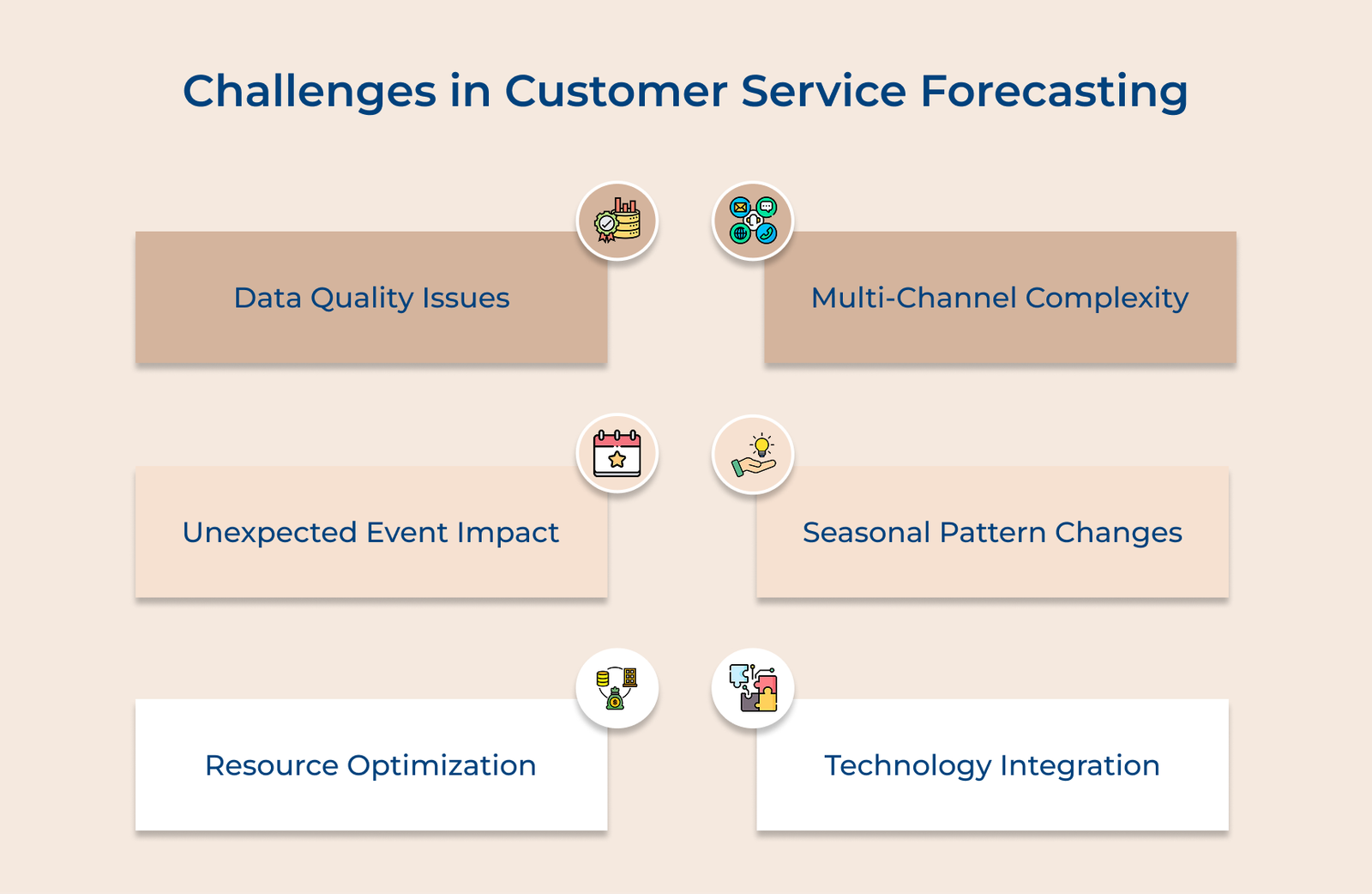
If your data is messy, missing records, inconsistent categories or poorly tracked interactions, your forecasts won’t be reliable. It becomes hard to spot real patterns or make confident decisions.
Set up clear rules for how data should be collected across all channels. Use automated tools to clean and organize your data regularly. Make sure everyone entering information knows the correct procedures and use checks to catch errors early.
Each support channel behaves differently. Phone calls might peak in the morning, while chat will be busier in the evening. Forecasting gets grader when trying to handle all the patterns together.
Build separate forecasts for each channel, then connect them through a single system that tracks how customers move between them. Use data to understand how one channel affects another and plan accordingly.
Unplanned events, like a bug in your app or a viral tweet, can cause a sudden jump in support requests. The situations make forecasts inaccurate and staffing levels hard to manage.
Include buffer zones in your plans. Build flexible models that can respond to last-minute changes. Keep a record of past disruptions to help you recognize early warning signs and react faster next time.
Customer habits don’t always follow the same rules year after year. New products, shifting trends or changes in your business can make past seasonal data less useful.
Don’t rely too much on old patterns. Refresh your forecasts often, especially with recent data. Use models that adjust themselves as new information comes in. Be ready to change staffing plans if demand doesn’t follow past trends.
Having too many agents wastes money. Having too few hurts the service. Matching staffing levels with predicted demand, while considering skills and availability, is a constant balancing act.
Use workforce tools that work with your forecasts. Offer flexible schedules. Train agents to handle more than one channel so you can shift them as needed. Create layers of staffing so you can scale up quickly when needed.
Forecasting tools often need to connect with systems you already use, like CRMs or scheduling platforms. Poor integration can lead to delays, data mismatches and headaches for your team.
Choose tools that are built to connect easily with others. Plan out your integrations in detail, and test them regularly. Work closely with your vendors to troubleshoot issues and keep things running smoothly.
Let’s go through notable companies that have implemented forecasting strategies to enhance their customer service operations and drive business success.
Amazon
Amazon uses a highly detailed forecasting system that pulls data from across its entire operation such as website visits, app usage and past support history. It updates predictions in real-time, adjusting to current buying behavior and key events like Prime Day.
The setup allows Amazon to plan ahead and stay responsive, even when customer demand spikes. Their ability to forecast accurately means shorter wait times and fewer service disruptions, especially during busy periods. It’s a big part of how they’ve managed to scale support without sacrificing speed or consistency.
Netflix
Netflix tracks how people watch content and uses the platform to predict when customer support will be needed. They watch for technical issues, streaming quality drops and user behavior, especially during big content releases or platform updates.
The approach helps Netflix stay ahead of demand. When a major show drops, they’re ready for a potential uptick in support needs. The preparation keeps their service running smoothly and reduces frustration for users during high-traffic times.
Spotify
Spotify focuses on when and where users are most active. Their forecasting system looks at trends like how people use new features, where traffic is growing and how past releases affected support volumes.
The system shines during big music events like album drops or festivals, when support demand often spikes. Spotify avoids service slowdowns and keeps its help channels running smoothly during peak times by preparing in advance.
Customer service forecasting has moved beyond its old role as a scheduling tool. It’s a critical part of how companies plan, operate and meet customer expectations. Businesses can now predict demand with a high degree of precision with better access to historical data, real-time insights and more accurate models.
Looking ahead, the real strength of forecasting will come from how well companies adapt it to changing conditions. Customer behavior keeps shifting and service happens across more channels than ever. The ability to adjust forecasts quickly and build flexible systems around them will be key to staying reliable.
Key takeaways:

Forecasting in business process outsourcing (BPO) is the process of estimating future workload based on past trends. It looks at historical contact volumes, like calls, emails or chats and uses that information to predict what’s coming. It helps BPO contact centers plan, schedule staff, prepare for busy periods and ensure smooth operations across different time zones.
Good forecasting helps teams stay ahead of the curve. It shows when things will get busy, when it’s likely to slow down and how contact patterns change over time. Managers can build smarter schedules, make sure the right people are available when needed and avoid scrambling to catch up. It reduces stress, prevents long wait times and keeps service levels steady.
Accurate forecasts help strike the right balance between too few and too many staff. If you can predict how many contacts are coming in and when, you can make sure enough trained agents are available to handle them without overstaffing during quiet times. It keeps customer wait times low while also avoiding wasted costs.
Teams use a mix of methods depending on the situation. Simple tools like moving averages work well for short-term trends. For more complex patterns, like seasonal shifts or long-term changes, they might use methods like Holt-Winters or regression analysis. Some teams also use machine learning models that can spot patterns in large data sets and adjust predictions as things change.
Seasonal trends, like holiday rushes, back-to-school surges or end-of-quarter spikes, can change demand in predictable ways. But the patterns also shift over time. What happened last year might not happen the same way again. Accurate forecasting means constantly updating your models based on what’s happening now, not just what happened before, so your team can stay prepared.
Grow Customer Relationships and stronger team collaboration with our range of products across the Conversational Engagement Suite.
Omnichannel Customer Support & Help Desk Software
AI Enabled Business Messaging and Chatbot Software
Sales Engagement & CRM Software
Call Center Software & Virtual Phone System
Product Marketing & Experience Platform
Customer Experience & Feedback Management Software

 What is Predictive Lead Scoring? Benefits, Challenges & Metrics
Scroll to top
What is Predictive Lead Scoring? Benefits, Challenges & Metrics
Scroll to top