10 Sales Follow-Up Emails Templates That Boost Conversion
Sales follow-up emails keep deals moving by reinforcing value, addressing concerns and staying relevant. A clear, timely approach helps build trust and increases the chances of closing deals.
Sales follow-up emails keep deals moving by reinforcing value, addressing concerns and staying relevant. A clear, timely approach helps build trust and increases the chances of closing deals.
Most sales reps send one follow-up email, maybe two at best, then quietly move on to the next prospect. Meanwhile, the deal they worked three weeks to open just went cold. No, it didn’t happen because the buyer lost interest, but because no one showed up consistently enough to earn their trust.
Research backs it up in an uncomfortable way – 80% of deals close somewhere between the fifth and twelfth touchpoint. The majority of reps abandon the conversation after the second. Now that’s a persistence problem hiding inside a process gap.
First impressions open doors, but the follow-up sequences close them. So below we’ve listed the best sales follow-up templates and examples built for overcoming real selling problems.
A sales follow-up email refers to a message sent after an initial interaction to keep the conversation going. Its purpose is to guide the prospect closer to a decision through steady and relevant communication.
Sales follow-up emails are more than simple reminders. They are strategic touchpoints that build trust at every stage of the buying journey. Each follow-up should add something new to the table rather than simply asking if the prospect saw the last email.
Most prospects take time and multiple interactions before making a decision. A thoughtful follow-up helps maintain interest, address concerns and keep the momentum going.
Key objectives:
Let’s go through the key benefits sales follow-up emails bring to business growth and customer relationships.
Key statistics:
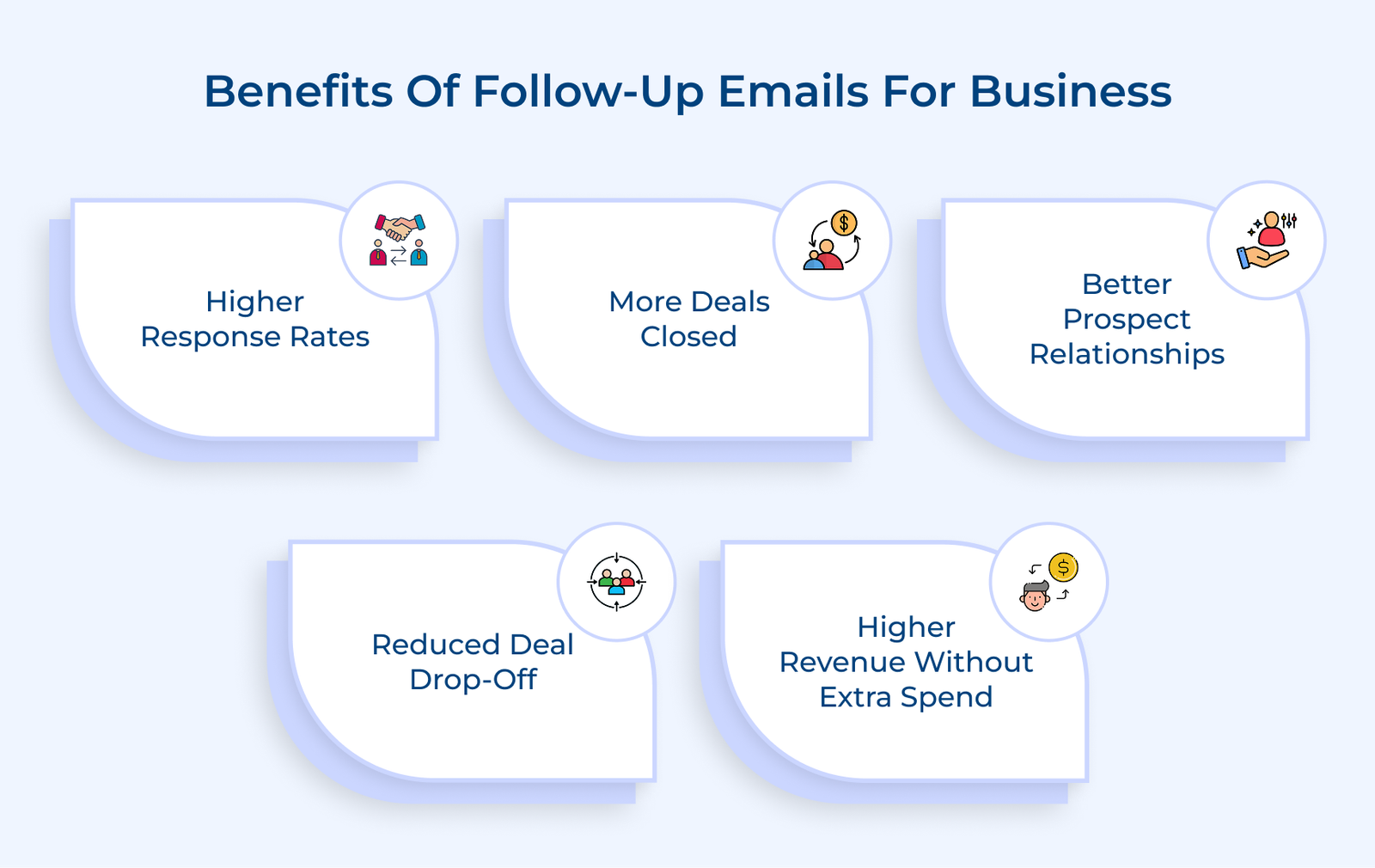
Higher Response Rates
A single sales follow-up email can increase reply rates by nearly 50% compared to sending just one email. Prospects are often busy and a timely follow-up reaches them when they are more likely to respond.
More Deals Closed
Most deals do not close after the first or second interaction. Consistent follow-up keeps you in the conversation long enough to reach the point where decisions actually get made. It also shows persistence and keeps your solution top of mind during the decision process.
Better Prospect Relationships
Sales follow-up emails create multiple opportunities to stay relevant and build familiarity. Thoughtful communication helps turn an initial contact into a more comfortable and engaged conversation.
Reduced Deal Drop-off
Many deals stall not because the prospect lost interest but because there was no nudge to move forward. A timely follow-up keeps the deal from going cold and reactivates conversations that would otherwise die in the inbox.
Higher Revenue Without Extra Spend
Follow-ups require time and consistency but no additional budget. A structured follow-up approach helps convert more of the existing pipeline into actual results. It allows you to get more value from opportunities that are already in progress.
Below are the simple steps that help you create sales follow-up emails and keep prospects engaged throughout the sales process.
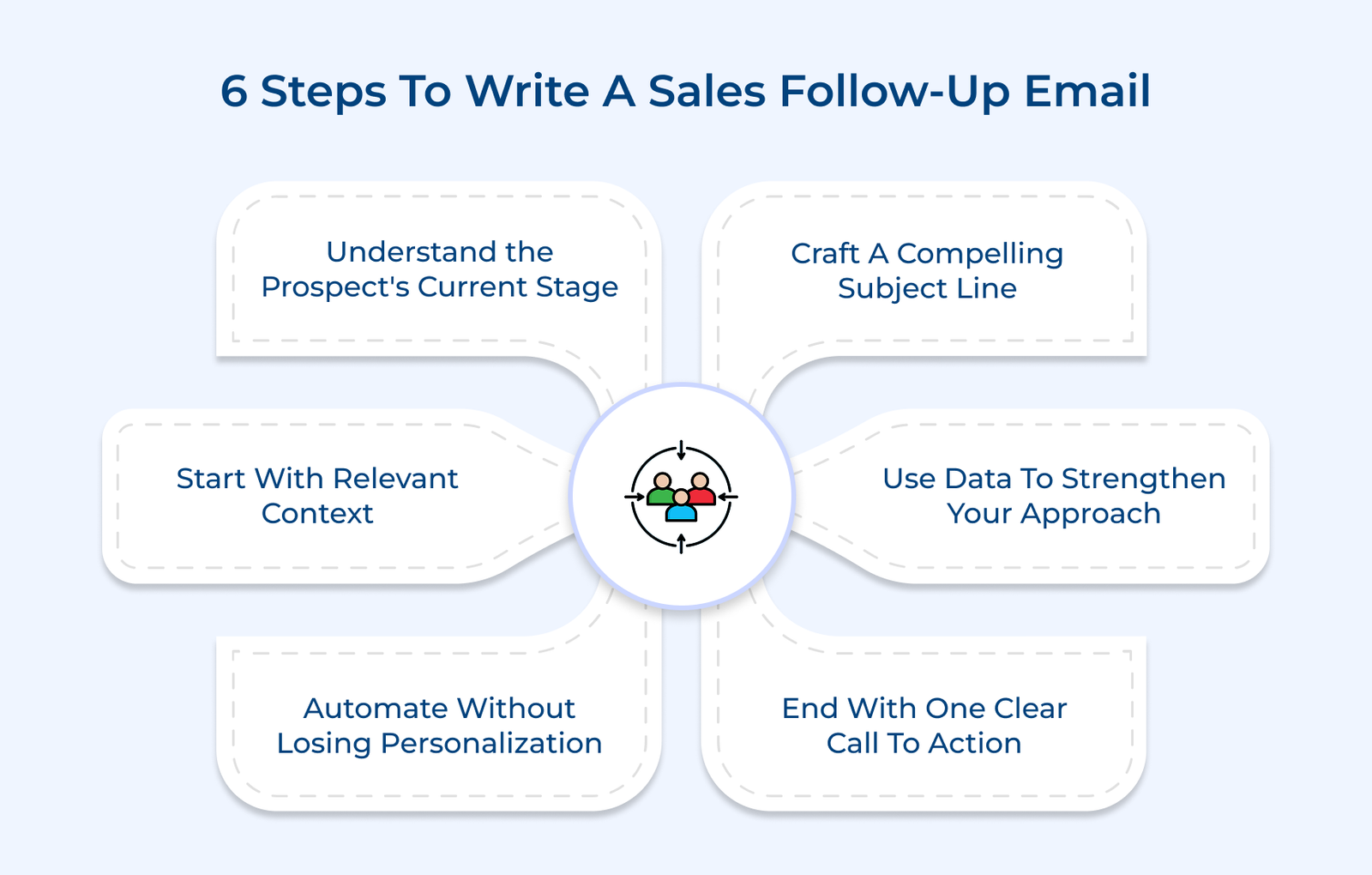
Start with a clear view of the prospect’s journey before writing anything. Check their history in the CRM and understand the last interaction in detail. A follow-up without context feels random and is easy to ignore.
A follow-up that builds on the last interaction feels like a natural continuation. A message that ignores it feels disconnected and easy to dismiss. It also signals a lack of attention, which can reduce the prospect’s interest in continuing the conversation.
Key questions:
The answers should shape how the email is written and what it focuses on. Skipping this step often leads to generic messages that fail to hold attention. It also makes it harder to address what actually matters to the prospect at that point.
Key signs:
The email subject line decides if your email gets opened or ignored. Even a well-written follow-up will not work if the subject line fails to catch attention. It sets the tone for the entire message before the prospect reads a single line.
What makes an email subject line worth opening? Clarity and relevance matter more than clever wording. Generic lines get lost in crowded inboxes, while specific ones stand out and feel worth a click.
Pro tips:
Avoid starting a follow-up with phrases like “Just checking in” or “Following up on my last email.” These openings add no value and are easy to ignore. They also make the message feel routine instead of purposeful.
Reference the last interaction and connect it to something genuinely valuable within the first two lines. A strong opening reads like a natural continuation of a real conversation, not a nudge reminding someone they owe a reply.
Actionable tips:
The difference between a weak opener and a compelling one comes down to relevance. When the first line feels specific and intentional, the rest of the email is far more likely to be read. It also sets the tone for a more meaningful and focused conversation.
Data should guide every follow-up decision instead of relying on instinct. Patterns in timing and response rates give clear signals on what is working or what needs to change. It helps make each follow-up more intentional and easier to improve over time.
Is the team using performance data to improve follow-up sequences each week? Many teams track deals but do not review which messages or approaches are actually getting replies. It leads to repeated efforts that may not improve results.
Best practices:
When results are not improving, change the overall message approach instead of making small edits. Repeating the same idea with slight variations rarely leads to better outcomes. A fresh angle is often needed to get a different response.
Key metrics:
Manual sales follow-up emails do not scale well and often lead to missed opportunities. Automation helps maintain consistency and ensures no prospect is forgotten. It also allows reps to focus more on conversations instead of managing reminders.
Can automation still feel personal to the person receiving it? Yes, when the message is tailored to a specific type of prospect instead of using the same generic template for everyone. Personal details and relevant context make the message feel more thoughtful.
Key steps:
The goal is to automate the timing and delivery while keeping the message natural and relevant. The sales emails that sound generic are easy to ignore, even when they are well-timed. A message that feels specific and thoughtful is far more likely to get a response.
Key signs:
Timing plays a major role in follow-up success. Waiting too long after an interaction reduces interest and makes it harder to restart the conversation. Even a small delay can shift the prospect’s attention elsewhere and weaken momentum.
What is the biggest mistake at the end of a follow-up? Ending with something vague like “let me know your thoughts” puts all the effort on the prospect without giving them a clear direction. It often results in no response because the next step is not clearly defined.
Key mistakes:
Every follow-up should end with one clear and simple next step. A specific action helps the prospect respond faster and removes confusion. It also makes it easier for them to decide what to do next without overthinking.
Key phrases:
Check out the practical email templates and subject lines that help you follow up with prospects effectively.
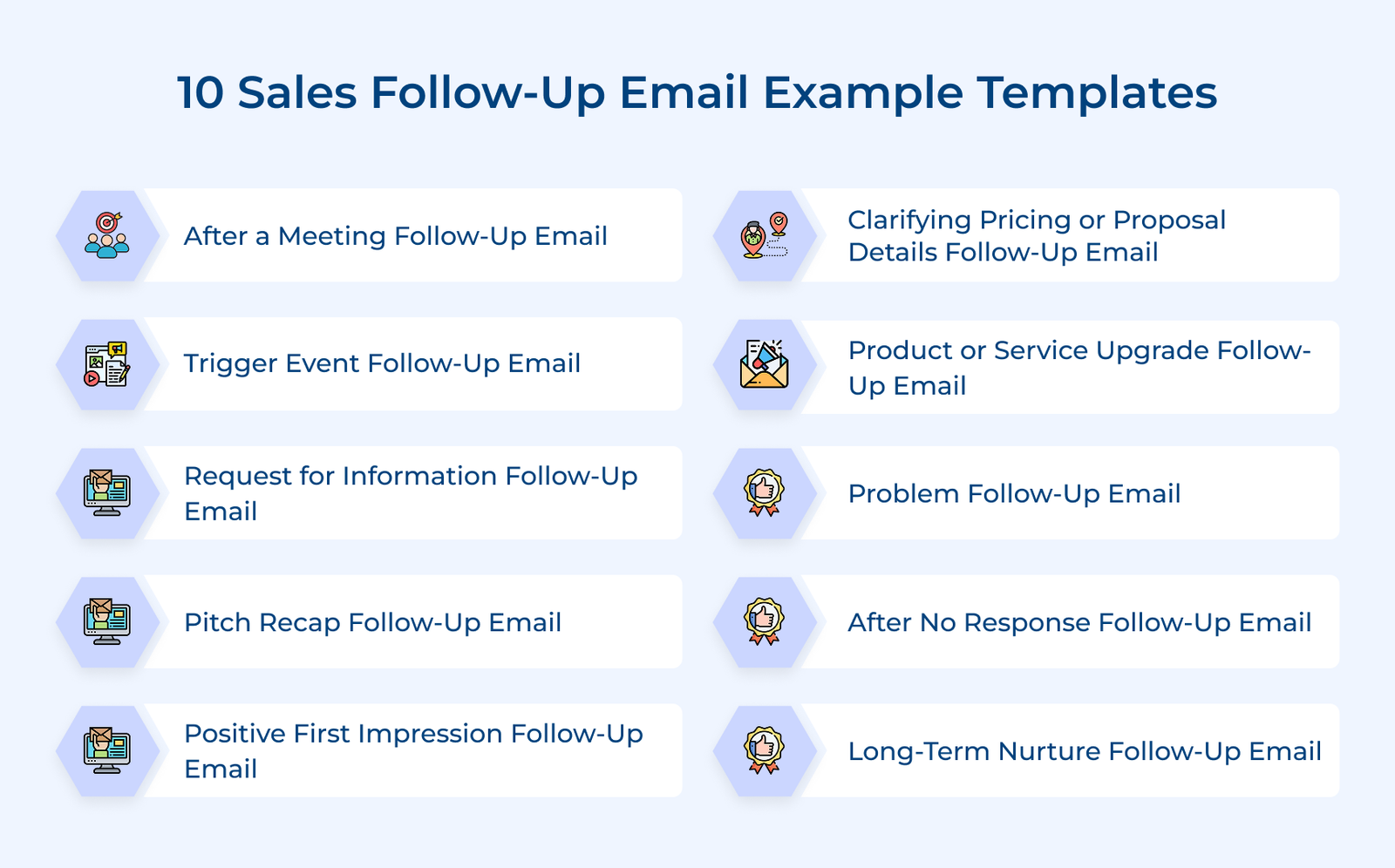
The template is best used within 24 hours after a discovery call or demo, while the conversation is still fresh. A timely follow-up helps reinforce key points and keeps the discussion moving forward.
The focus should not be on repeating everything discussed but on summarizing what matters and clearly outlining the next step. Strong post-meeting sales follow-up emails position the sender as organized and serious about delivering real value.
Subject Line: “Quick recap from today’s call and next steps.”
Template:
The template is best used within 24 hours after a discovery call or demo, while the conversation is still fresh. A timely follow-up helps reinforce key points and keeps the discussion moving forward.
The focus should not be on repeating everything discussed but on summarizing what matters and clearly outlining the next step. Strong post-meeting sales follow-up emails position the sender as organized and serious about delivering real value.
Subject Line: “Quick recap from today’s call and next steps.”
Template:
———–
Hi [First Name],
Enjoyed our conversation today about [specific topic discussed].
Here is a quick recap:
– [Key point 1 from the meeting]
– [Key point 2 from the meeting]
– [Action item or next step agreed upon]
The next step would be [specific action]. Would [date and time] work for a follow-up call?
[Your Name]
A trigger event like funding, a new hire or a product launch creates a natural reason to reach out. The template works because the outreach is timely and directly tied to something real happening in the prospect’s world.
The strength of the approach comes from acknowledging the event early and connecting it to a relevant challenge or need. Prospects are more open to conversations when the outreach clearly relates to their current situation.
Subject Line: “Congrats on [trigger event] and a quick thought.”
Template:
——–
Hi [First Name],
Saw that [Company Name] recently [specific trigger event, e.g., closed a Series B or launched a new product].
Companies going through [similar milestone] often face [specific challenge] and that is exactly what [Your Company] helps solve.
Worth a quick 15-minute call to see if it is relevant for your team?
[Your Name]
The template is used when a prospect asks for more details about a product, service or pricing structure. It is one of the strongest follow-up scenarios because interest is already clearly shown.
A common mistake is overloading the email with too much information and no direction. The goal should be to share what was requested simply and then guide the conversation toward a discussion if needed.
Subject Line: “Here is the information you requested [Company Name]”
Template:
—-
Hi [First Name],
Sharing the details you requested on [product/service/pricing details].
Here is a quick summary:
[Brief overview of key points in 2–3 lines]
Happy to explain this in more detail on a quick call since it often helps clear up any remaining questions. Would [date] work for you?
[Your Name]
—
After a pitch, prospects usually take time to review and discuss internally. A clear recap helps them revisit the key points without going through everything again. It also makes it easier for them to share the information with others involved in the decision.
The pitch recap is especially powerful in multi-stakeholder deals because it gives the primary contact something concrete to forward. Keeping it focused on outcomes rather than features makes it far more effective.
Subject Line: “Recap of [Your Company] pitch and key takeaways.”
Template:
——
Hi [First Name],
Thank you for your time today. Sharing a quick recap of what was discussed.
The core problem: [One line]
How we address it: [One line]
Expected outcome: [One line]
Happy to clarify anything ahead of the next step. Would [date] work to reconnect?
[Your Name]
—
The template is best used immediately after the first interaction in which the prospect showed strong interest. It works because it capitalizes on positive energy from the conversation before that momentum naturally fades.
The tone should stay warm and confident without feeling rushed. Mentioning something specific from the conversation makes the message feel natural and personal. It also shows that you were paying attention and valued the discussion.
Template:
Hi [First Name],
Really enjoyed the conversation, especially your point about [specific thing the prospect said].
It seems like [specific value point] could align with what [Company Name] is working toward right now.
Would you be open to exploring it further? Does [date and time] work?
[Your Name]
Pricing discussions often go silent because prospects are reviewing options or discussing them internally. A timely follow-up helps bring clarity and keeps the conversation moving. It also gives you a chance to address concerns before they slow down the decision.
The focus should be on addressing common questions and making the proposal easier to understand. Simple explanations reduce hesitation and help the prospect move closer to a decision.
Subject Line: “Quick note on the proposal and a couple of clarifications.”
Template:
Hi [First Name],
Following up on the proposal shared on [date]. Wanted to check if any questions have come up around pricing or structure. Happy to clarify anything that might help move things forward. Also, open to adjusting details to better fit your current needs.
A few points that might help:
[Clarification point 1, such as flexible payment terms]
[Clarification point 2, such as pricing based on team size]
Happy to walk through it together. Would [date] work for a quick discussion?
[Your Name]
The template works well with existing customers already using your product or service. The focus is on showing added value based on how they are currently using it. It helps them see practical benefits they can gain from the upgrade.
The message should highlight what they could gain from upgrading in a way that connects to their current usage. Referencing a known challenge makes the suggestion feel relevant and useful.
Subject Line: “You might be missing out on [specific benefit].”
Template:
Hi [First Name],
Noticed how [Company Name] has been using [Product/Service] and saw a few areas where additional features could help with [specific challenge].
Teams using [plan or tier name] often see [specific outcome such as faster onboarding or improved efficiency].
Worth a 15-minute call to see if it makes sense right now?
[Your Name]
The template is useful when a prospect shared a clear challenge earlier, but the conversation stopped before a solution was discussed. It brings the focus back to what matters most to them. The template also helps restart the conversation with context instead of starting over.
Referencing the exact problem shows you were paying attention and remember their situation. Connecting that problem to a practical example makes the message feel relevant and worth revisiting.
Subject Line: “Still dealing with [specific problem]? Thought it might help.”
Template:
Hi [First Name],
Earlier, you mentioned that [Company Name] was facing [specific problem discussed].
Wanted to share how [similar company] tackled the same challenge using [Your Product/Service] and achieved [specific outcome].
Would you be open to revisiting it for a quick 15 minute conversation?
[Your Name]
—
The template is useful when multiple follow-ups have gone unanswered. A simple and direct message helps acknowledge the silence without creating pressure. It also makes it easier for the prospect to respond without feeling obligated.
The no-response sales follow-up emails should be short, low-pressure and easy to reply to with a single word. Giving the prospect a simple way to either re-engage or opt out keeps the relationship intact regardless of the outcome.
Subject Line: “Still worth a conversation or should we close this out?”
—
Template:
Hi [First Name],
Reached out a couple of times and understand if now is not the right time.
If [specific challenge] is still something you are working on, happy to reconnect and keep it short. If priorities have shifted, just let me know and will close it out. Either way, a quick update would really help me close the loop on my end.
[Your Name]
The template is built for prospects who showed interest earlier but did not move forward. A fresh and relevant reason to reach out helps restart the conversation without relying on past interactions.
The long-term nurture follow-up is one of the most underused yet highest-ROI touchpoints in a well-built pipeline. Timing it around a relevant industry development or product update gives it a natural and credible reason to land in the inbox.
Template:
Hi [First Name],
It has been a while since we last spoke about [topic or challenge]. Reaching out as there has been an update that could be relevant.
Since then, [Your Company] has [specific update related to their earlier interest].
Would it make sense to reconnect for a quick 15 minute conversation to see if this fits better now?
[Your Name]
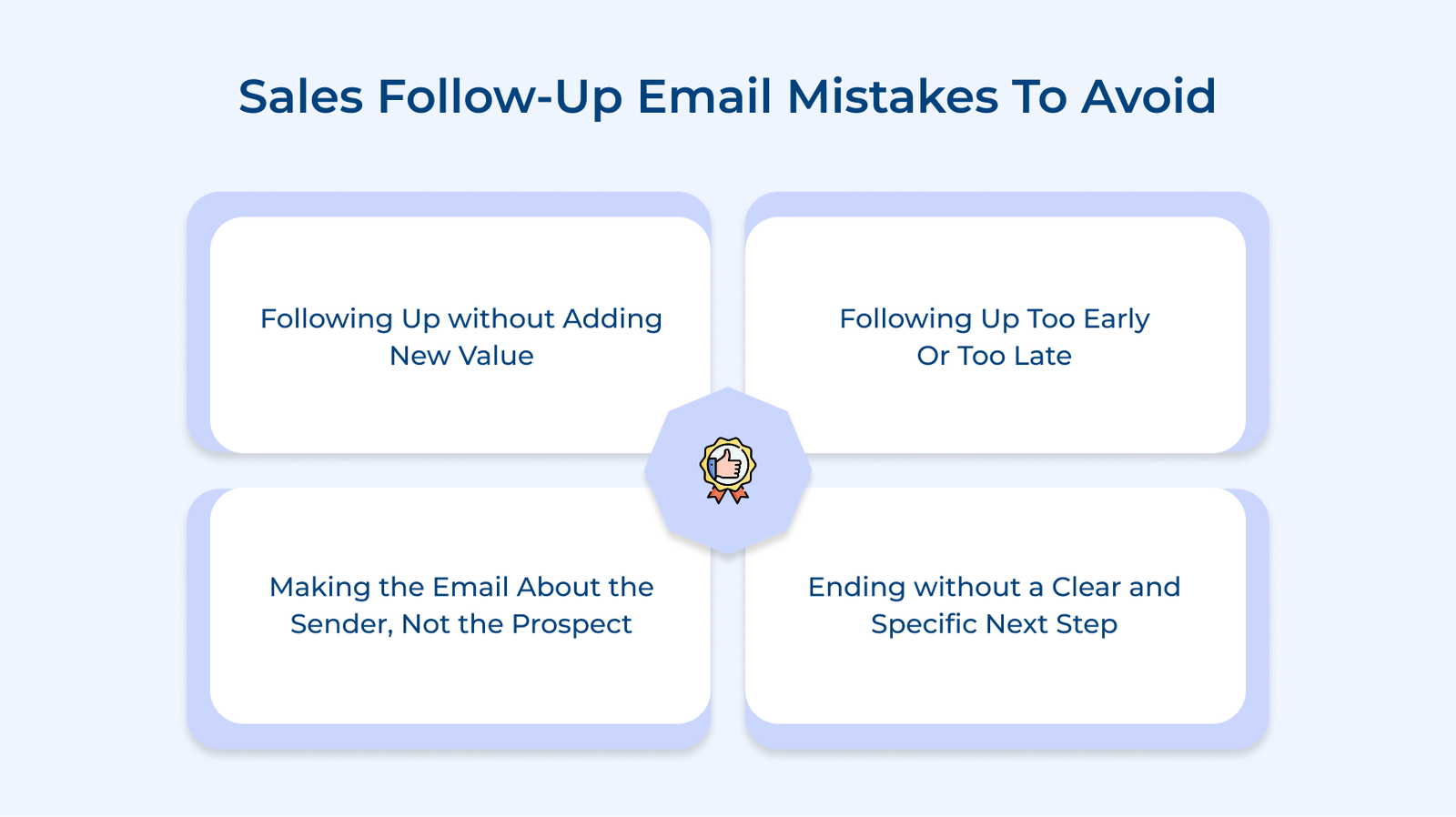
The following are the most common sales follow up email mistakes that can reduce replies and slow deals, along with what to avoid to keep your outreach clear.
1. Following Up without Adding New Value
Sending sales follow-up emails that simply say “just checking in” is easy to ignore. Each email should add something useful, like a new insight, a relevant example or a clear response to a concern.
2. Following Up too Early or too Late
Sending a follow-up too soon can feel rushed and reduce interest. Waiting too long can make the conversation lose momentum and become harder to restart. Finding the right timing helps keep the interaction natural and effective.
3. Making the Email About the Sender, Not the Prospect
Sales emails that lead with “We offer” or “Our product does” immediately lose the prospect’s attention. The entire email should stay centered on the prospect’s specific challenges and the outcomes they care about, not the seller’s agenda.
4 Ending without a Clear and Specific Next Step
Ending with “let me know your thoughts” leaves the next move unclear. A simple action makes it easier for the prospect to respond and keeps the conversation moving. It also reduces hesitation by giving them a clear path to reply.
Key solutions:
Check out the key sales follow-up email best practices that help improve response rates, keep conversations active and move prospects forward with clear communication.
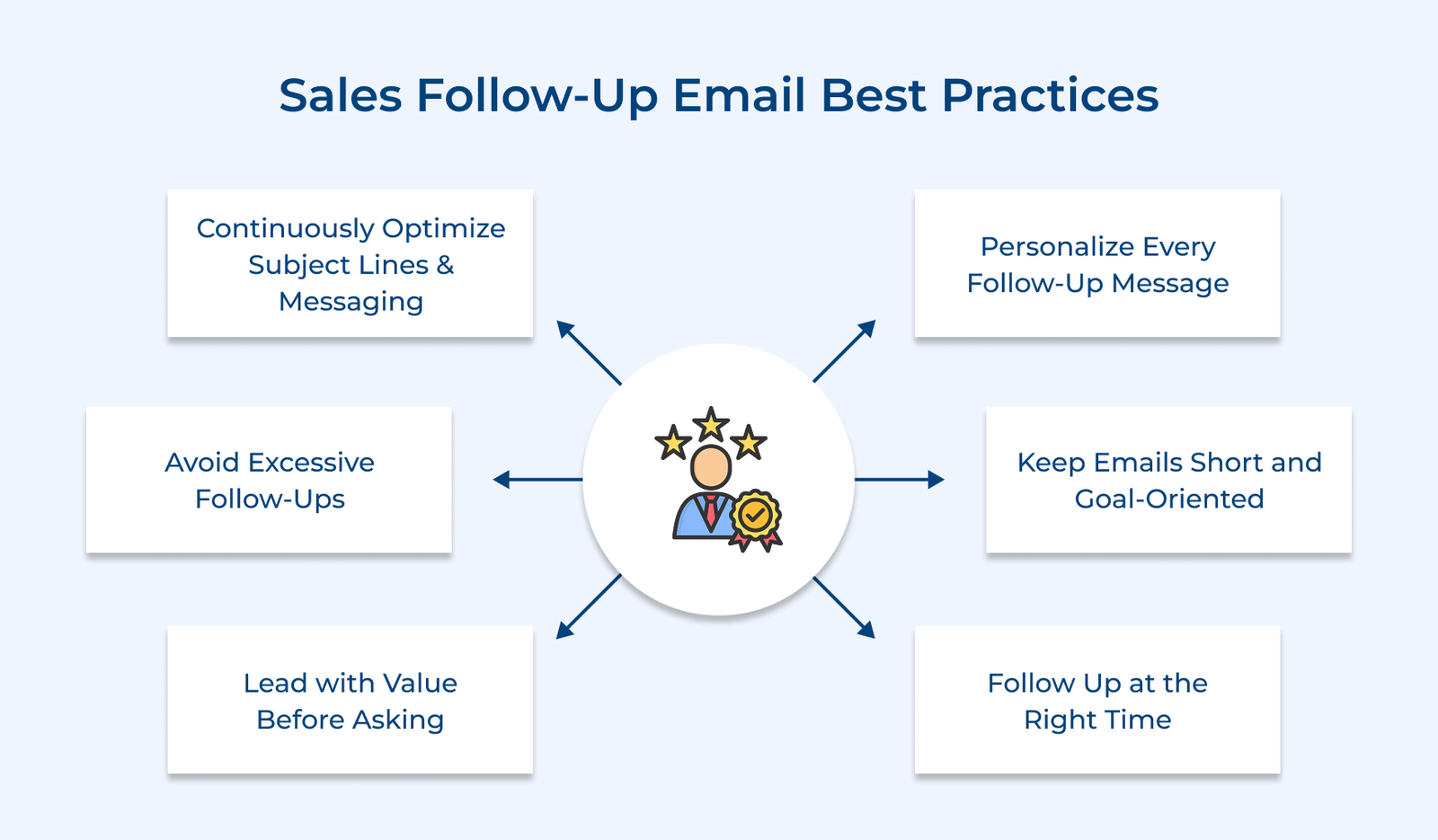
Many deals are not lost because of the product. They are lost because sales follow-up emails stop too soon. Prospects often need multiple meaningful touchpoints before they feel ready to decide.
Strong sales teams that win in the long term are not the ones with the most aggressive outreach; they are the ones who follow up with genuine relevance and perfect timing. That consistency is what turns a cold prospect into a loyal customer who trusts the brand enough to buy again.

Reference a clear pain point, recent company update or something specific from the last conversation. Real personalization shows you understood their situation and paid attention. It also makes the message feel more relevant and worth responding to.
Follow-up emails work across industries, but the tone and timing should match how each sector buys. Adjusting the approach to the audience leads to better responses. It makes the outreach feel more relevant to how decisions are actually made in that space.
Following up without adding value and ending without a clear next step are common issues. Both signal to the prospect that the outreach is more about the seller’s pipeline than solving a real problem they actually care about.
Automation helps manage timing and consistency. Messages still need to feel relevant and specific to the prospect to get replies. Personal context and clear intent make the message feel less automated.
Consistent follow-ups keep the solution top of mind during the exact window when the prospect is evaluating options internally. Research shows that most deals close between the fifth and twelfth touchpoints, meaning the conversion happens because of the follow-up and not despite it.
Grow Customer Relationships and stronger team collaboration with our range of products across the Conversational Engagement Suite.
Omnichannel Customer Support & Help Desk Software
AI Enabled Business Messaging and Chatbot Software
Sales Engagement & CRM Software
Call Center Software & Virtual Phone System
Product Marketing & Experience Platform
Customer Experience & Feedback Management Software
 Scaling Sales Team: Importance, Strategies & Challenges
Scroll to top
Scaling Sales Team: Importance, Strategies & Challenges
Scroll to top