Sales Tracking

Sales Tracking Guide: Benefits, Types & Tools

Discover the benefits and various types of sales tracking methods to find the best tools to boost your sales performance. Unlock the secrets to effective tracking and drive your business toward unparalleled growth.

No credit card required. Easy setup

Sales Tracking

Trusted by Leading Brands

Monitor Sales Performance to Optimize Strategies with Sales Tracking

Discover how to analyze key metrics, improve decision-making and maximize profitability with sales tracking. Elevate your sales effectiveness and watch your revenue soar!

Precision Insights

Experience unparalleled clarity in your sales patterns with tools designed specifically for the ever-changing market landscape. Now the teams can fine-tune their strategies, ensuring they remain aligned with shifting market dynamics and poised for success.

Strategic Boost

Empower the teams to focus on key performance metrics, giving them the agility needed to make quick pivots and capitalize on emerging opportunities. Businesses can implement effective approaches with confidence, driving sustained growth and maintaining a competitive edge.

Goal Alignment

Sales tracking serves as a compass for teams, keeping them focused with their targets. Businesses can navigate their paths efficiently, ensuring that everyone stays aligned and motivated.

Efficiency Unleashed

Boosts productivity and enhances the overall effectiveness of the sales strategy. Now see your teams close deals faster and with greater ease.

Customer Clarity

Businesses can decode buyer behavior with detailed tracking to personalize their sales approach. It enhances customer relationships and drives higher conversion rates.

Forecast Accuracy

Tracking sales helps to leverage historical data to predict future sales trends with greater precision. Teams can make informed decisions and plan proactively for sustained success.

When businesses don’t practice proper sales tracking, their teams can struggle to identify which leads deserve attention and which parts of the sales process need improvement. These gaps make it harder to allocate resources, leaving decisions to guesswork rather than reliable data.

Proper tracking of sales involves monitoring key metrics to assess performance and make informed decisions. Our guide will help you understand how to build an effective tracking system, along with the metrics that help teams understand progress and improve results.

What is Sales Tracking?

Sales tracking refers to a systematic process of monitoring, recording and analyzing sales activities within an organization. It involves collecting data on various aspects of the sales process, from initial customer interactions to closed deals. The process works by utilizing specialized software or tools to capture relevant data points throughout the sales cycle.

Tracking sales is essential for modern conversational intelligence teams as it enables them to gain deeper insights into customer interactions, optimize strategies and improve performance. Teams can identify successful patterns, refine their approach and provide targeted coaching to sales representatives by leveraging data from tracked conversations.

Key objectives:

  • Measure individual and team performance against set targets.
  • Identify bottlenecks in the sales process for improvement.
  • Forecast future sales based on historical data and current pipeline.
  • Provide actionable insights to optimize sales strategies and tactics.
  • Enable data-driven decision-making for resource allocation and goal setting.

6 Types of Sales Tracking

Let’s delve into the six key types of sales tracking methods that every sales professional should be familiar with to optimize their performance and drive results.

Types of Sales Tracking

1. Sales Performance Tracking

Sales performance tracking is a crucial aspect of managing a sales team effectively. It involves analyzing individual and team performance metrics to gauge productivity. Key performance indicators (KPIs) typically include:

  • Revenue generated
  • Number of deals closed
  • Conversion rates
  • Average deal size

Managers can identify top performers, areas for improvement and team progress.
The data-driven approach allows for targeted coaching, fair performance evaluations and informed decision-making regarding resource allocation.

2. Sales Lead Tracking

Sales lead tracking focuses on managing and monitoring potential customers throughout the buyer journey from initial contact to conversion. The process involves

  • Capturing lead information
  • Categorizing leads based on their potential value and readiness to buy
  • Tracking interactions with each lead.

Effective lead-tracking systems help sales teams prioritize their efforts, ensure timely follow-ups and prevent leads from falling through the cracks. Organizations can optimize their strategies by analyzing lead sources, conversion rates and time-to-close.

3. Sales Goal Tracking

Setting and tracking sales goals is essential for motivating sales teams.
Sales goal tracking involves establishing clear, measurable objectives for individuals, teams and the organization as a whole. The goals may include:

  • Revenue targets
  • Number of new clients acquired
  • Specific product sales quotas.

Regular monitoring of progress toward the goals allows managers to provide timely feedback, recognize achievements and address any improvement areas. Effective goal tracking also helps in aligning individual efforts with broader organizational objectives and enhancing a culture of accountability.

4. Sales Pipeline Tracking

Sales pipeline tracking provides a visual representation of the sales process, showing where potential deals are in various stages of the sales cycle. Sales teams can manage their opportunities effectively by providing valuable insights into the number of deals at each stage and conversion rates between stages.

Managers can forecast future revenue, identify bottlenecks in the sales process and make data-driven decisions by closely monitoring the pipeline. The approach ensures a healthy balance of opportunities at different stages, reducing the risk of feast-or-famine cycles.

5. Sales Activity Tracking

Sales activity tracking focuses on monitoring the day-to-day actions of sales representatives. Managers can ensure that their team is engaging in the right behaviors to drive sales success by measuring the activities. It includes tracking metrics such as

  • Number of calls made
  • Emails sent
  • Meetings scheduled
  • Proposals submitted.

Activity tracking helps identify productivity issues, provides valuable insights into time management and allows for the correlation of specific activities with sales outcomes.
The data can be used to establish best practices, set activity-based goals and provide targeted coaching to improve sales effectiveness.

6. Sales Funnel Tracking

Sales funnel tracking analyzes how potential customers move through the different stages of the buying process, from awareness to purchase. Sales teams can focus their efforts on improving weak areas and capitalizing on strengths by understanding the conversion rates between each stage of the funnel.

Funnel tracking also aids in forecasting future sales by providing insights into the number of leads needed at each stage to achieve desired revenue targets. The approach allows for more accurate resource allocation and helps in designing targeted strategies to optimize the entire customer journey.

How to Track Sales Effectively: 8 Proven Tips

Sales tracking is very important for understanding businesses to understand their performance, optimize strategies and drive growth. Let’s understand how exactly to do it:

Sales Tracking Tips

Define the Sales Objectives

Defining the sales objectives is a crucial step in effectively tracking sales. The process involves setting clear, measurable goals that align with the overall business objectives. Well-defined sales objectives provide direction, focus and motivation for the sales team, while also establishing benchmarks for performance evaluation.

When setting sales objectives, consider both quantitative metrics (e.g., revenue targets, number of new customers) and qualitative goals (e.g., improving customer satisfaction). Ensure the objectives are specific, achievable, relevant and time-bound (SMART). Aligning sales objectives with broader business goals ensures that sales efforts contribute directly to the company’s success.

Pro tips:

  • Use data-driven insights to set realistic yet challenging targets.
  • Regularly communicate objectives to all team members and stakeholders.
  • Implement a robust tracking system to monitor progress and adjust strategies as needed.

Identify Key Performance Indicators (KPIs)

Identifying Key Performance Indicators (KPIs) is crucial for tracking sales effectively. KPIs provide measurable metrics that reflect a company’s sales performance and progress toward goals. They help businesses focus on what matters most, allowing for data-driven decision-making and resource allocation.

KPIs are used to monitor various aspects of sales, such as revenue growth, customer acquisition costs and conversion rates. They enable sales teams to identify trends, spot areas for improvement and celebrate successes. Implications of well-chosen KPIs include improved team alignment, increased accountability and more accurate forecasting.

Pro tips:

  • Align KPIs with business objectives to ensure relevance and impact.
  • Limit the number of KPIs to avoid overwhelming the team and diluting focus.
  • Regularly adjust KPIs to reflect changing market conditions and business priorities.

Choose the Right Sales Tracking Tools

Choosing the right sales tracking tools is crucial for effectively monitoring and optimizing the sales process. It’s important because the tools provide valuable insights into sales performance, customer behavior and business health. They enable data-driven decision-making and help identify areas for improvement.

Use cases include tracking lead generation, conversion rates, revenue forecasting and team performance. Implications of proper tool selection include increased efficiency, better resource allocation and improved customer relationships.

Pro tips:

  • Assess the specific needs and choose tools that align with the sales process.
  • Ensure seamless integration with existing systems and provide thorough training for the team.

Establish a Standardized Data Collection Process

Establishing a standardized data collection process is crucial for effectively tracking sales. The process involves defining clear data entry protocols that all team members must follow, ensuring consistency across the organization. Businesses can minimize errors and maintain data integrity by implementing standardized procedures.

The approach enables accurate sales tracking, facilitating informed decision-making and strategy development. Organizations should implement quality control measures, such as regular audits and data validation checks to ensure data accuracy. The team can identify and correct discrepancies promptly, maintaining the reliability of sales data.

Pro tips:

  • Develop a detailed data entry manual and conduct regular training sessions.
  • Implement automated data validation tools to catch errors in real-time.
  • Establish a regular audit schedule to review and clean data periodically.

Implement a Regular Reporting Schedule

Implementing a regular reporting schedule is crucial for tracking sales effectively. Establish a structured system of daily, weekly, monthly and quarterly reports to provide a detailed view of sales performance at different intervals. Daily reports offer immediate insights, while weekly reports highlight short-term trends.

Monthly reports provide a broader perspective and quarterly reports reveal long-term patterns towards goals. Automate reporting processes where possible to save time and ensure consistency. Utilize sales tracking software or CRM systems that can generate reports automatically, reducing manual effort. Sales teams can focus on analysis and action rather than data compilation.

Pro tips:

  • Standardize report formats across all time frames for easy comparison and analysis.
  • Assign clear ownership and deadlines for each report to ensure timely completion.
  • Regularly review and refine report content to maintain relevance.

Analyze Sales Data

Analyzing sales data is crucial for tracking sales effectively. Businesses can make informed decisions, adjust strategies and optimize their sales processes by regularly analyzing sales data. Companies can capitalize on opportunities, address weaknesses and drive growth.

The analysis helps uncover seasonal fluctuations, popular products and customer preferences. Comparing performance against benchmarks allows companies to assess their progress relative to industry standards or internal goals.

Pro tips:

  • Use data visualization tools to make complex sales data more accessible and easier to interpret.
  • Implement a consistent data collection and analysis schedule to ensure timely insights.
  • Integrate customer relationship management (CRM) data with sales figures for a more comprehensive view of sales performance.

Take Action Based on Insights

Taking action based on insights is a crucial step in tracking sales effectively. It transforms data analysis into tangible results, driving business growth and performance. Companies can adapt strategies, address weaknesses and capitalize on opportunities in real time by acting on gathered insights.

The approach has various use cases, including optimizing pricing strategies, refining marketing campaigns and improving customer retention. Businesses can make data-driven decisions, enhancing sales performance and customer satisfaction. The implications are far-reaching, potentially leading to increased revenue, market share and competitive advantage.

Pro tips:

  • Establish a systematic process for reviewing and prioritizing insights regularly.
  • Create cross-functional teams to ensure diverse perspectives when interpreting and acting on data.
  • Implement a feedback loop to measure the impact of actions taken and refine strategies accordingly.

Continuously Refine the Sales Tracking Process

Continuously refining the tracking process is crucial for effective sales monitoring. The iterative approach ensures the methods remain relevant and efficient in a dynamic business environment. Regularly gather feedback from the sales team to identify pain points and areas for improvement in the current tracking system.

Their hands-on experience provides invaluable insights into what works and what doesn’t. Simultaneously, stay updated on industry best practices by attending conferences, workshops and networking events. Exposure to new ideas and technologies can help businesses adopt innovative tracking methods that enhance sales performance.

Pro tips:

  • Schedule monthly review meetings to discuss tracking processes and gather team input.
  • Implement A/B testing for new tracking methods before full-scale adoption.
  • Invest in adaptable sales tracking software that can easily incorporate changes and updates.
Sales Tracking vs. Sales Reporting: What’s the Difference?

Sales tracking and sales reporting work together but serve different functions in the sales process. Here’s how the two compare across five key areas.

Purpose

Sales tracking records calls, emails and deal progress in real time. The teams get a clear view of ongoing sales activities. Reporting turns the data into structured summaries that help sales leaders identify trends and assess performance.

Frequency

Tracking is a continuous process as it updates automatically with every rep action, call log or deal stage change across the pipeline. Reporting operates on a set cadence. So it compiles the tracked data into daily, weekly, monthly or quarterly snapshots for scheduled review.

Focus

Tracking captures raw data by recording daily activities and pipeline changes as they happen. Reporting builds on the data by identifying patterns and trends that help teams assess performance.

Users

Tracking helps the frontline teams record calls, emails and deal updates as they happen. Reporting gives managers and leadership a broader view of team performance. It helps them identify trends and assess results over a specific period.

Output

Tracking uses logs and live dashboards to show the current status of active deals along with the sales rep activities. Reporting turns the data into structured documents or slides that highlight performance trends over a set period.

Essential Sales Tracking Metrics & KPIs to Monitor

Sales tracking and sales reporting work together but serve different functions in the sales process. Here’s how the two compare across five key areas.

Sales Tracking Metrics KPIs

1. Conversion Rate

The metric measures the percentage of leads or prospects that become customers. It’s calculated by dividing the number of sales by the total number of leads and then multiplying it by 100. A high conversion rate indicates effective sales processes and strategies. Businesses need to focus on lead quality, sales team training and optimizing the sales funnel to improve the metric.

Improving conversion rates requires a closer look at three areas that directly influence how prospects move through the sales process:

  • Lead quality: Target prospects who match your ideal customer profile.
  • Sales team training: Help sales reps address objections confidently, communicate value clearly and guide prospects toward a purchase.
  • Funnel optimization: Identify friction at each stage of the buying journey and make it easier for prospects to move forward.

2. Average Deal Size

The KPI represents the typical monetary value of closed deals. Calculate it by dividing total revenue by the number of deals closed. Tracking the metric helps identify trends in customer spending and can inform pricing strategies. Businesses need to consider upselling, cross-selling, or targeting higher-value clients to increase average deal size.

Businesses looking to grow average deal size should focus on:

  • Upselling: Offering premium tiers or add-ons to existing deals.
  • Cross-selling: Introducing complementary products during the sales process.
  • Targeting higher-value clients: Prioritizing accounts with larger budgets.

3. Sales Cycle Length

The sales cycle length measures the average time it takes to close a deal, from initial contact to purchase. A shorter sales cycle often indicates more efficient processes and can lead to increased revenue. Teams must streamline their sales process, provide better training and use automation tools where appropriate to reduce cycle length.

Teams can reduce their sales cycle length through three key improvements:

Process streamlining: Remove unnecessary steps that slow down deal progression and make it easier for prospects to move toward a purchase.

Better training: Help sales reps identify buying signals, address concerns and respond to prospects at the right time.

Automation tools: Automate follow-ups and routine administrative tasks so reps can spend more time on closing deals.

4. Customer Acquisition Cost (CAC)

CAC represents the total cost of acquiring a new customer, including marketing and sales expenses. Calculate it by dividing total sales and marketing costs by the number of new customers acquired in a given period. A lower CAC relative to customer lifetime value indicates a more profitable business model. Improve CAC by optimizing marketing spend and increasing sales efficiency.

5. Sales Team Activity

The metric tracks various activities performed by sales representatives, such as the number of calls made, emails sent, or meetings scheduled. While not directly tied to revenue, the activities are leading indicators of future sales performance. Set benchmarks for different activities and use the data to identify top performers.

6. Customer Acquisition Cost (CAC)

CAC represents the total cost of acquiring a new customer, including marketing and sales expenses. Calculate it by dividing total sales and marketing costs by the number of new customers acquired in a given period. A lower CAC relative to customer lifetime value indicates a more profitable business model. Improve CAC by optimizing marketing spend and increasing sales efficiency.

Here’s how to improve CAC:

  • Optimizing marketing spend: Focusing budget on the highest-converting channels.
  • Increasing sales efficiency: Helping reps close more deals per hour worked.
  • Refining targeting: Reaching prospects more likely to convert quickly.

7. Customer Lifetime Value (CLV)

CLV estimates the total revenue a business can expect from a single customer over the entire relationship. It’s calculated by multiplying average purchase value, purchase frequency, and average customer lifespan. Tracking CLV alongside CAC helps businesses understand whether their acquisition costs are sustainable and guides decisions around retention and account growth strategies.

How Does Sales Tracking Improve Business Operations?

Let us understand how a well-executed sales engagement strategy can boost efficiency, improve customer experience and eventually enhance overall business operations.

Sales Tracking Use Cases

1. Performance Management
Sales tracking enables managers to assess individual and team performance objectively. Leaders can identify top performers, recognize improvement areas and provide targeted coaching by monitoring metrics like conversion rates.

2. Resource Allocation
Tracking sales data helps businesses allocate resources more efficiently. Let’s assume that by analyzing which products or services are selling best, companies can adjust inventory levels, marketing budgets and sales team focus.

3. Sales Forecasting
Historical sales data and current pipeline information allow for more accurate sales forecasting. It supports better financial planning, inventory management and strategic decision-making across the organization.

4. Customer Insights
Keeping track of sales provides valuable information about customer preferences, buying patterns and lifecycle. The data can help inform product development, marketing strategies and customer retention efforts.

5. Process Optimization
Businesses can identify bottlenecks in their sales process by monitoring metrics like sales cycle length and activity levels. It allows for continuous improvement and streamlining of operations, leading to increased efficiency.

What are the Benefits of Sales Tracking?

Let’s explore the numerous benefits of sales tracking to understand how it helps businesses maintain a competitive edge.

Benefits of Sales Tracking

1. Providing Real-time Information
Sales tracking systems offer up-to-the-minute data on sales activities, allowing managers and teams to stay informed about current performance. The real-time visibility enables quick responses to emerging trends or issues.

2. Enabling Better Decision Making
Leaders can make more informed decisions with comprehensive sales data at their fingertips. Tracking provides insights into which products, sales strategies, or customer segments are performing well and which aren’t.

3. Enhancing Coordination Between Departments
Tracking sales facilitates better communication and collaboration across different departments. If the sales data indicates a surge in demand for a product, the information can be quickly shared with the production team to adjust manufacturing schedules.

4. Defining Target Markets
Companies can gain a clearer picture of their most valuable customer segments by analyzing sales data. Teams can use the insight to define and refine target markets more accurately. Sales tracking learn about the patterns in customer behavior, preferences and purchasing habits.

5. Identifying Bottlenecks
Sales tracking helps pinpoint areas in the sales process where deals commonly stall or fall through. Teams can address issues more efficiently by recognizing the bottlenecks.

6. Clarifying Goal Tracking
Keeping track of sales and setting and monitoring progress towards goals becomes more straightforward. The visibility motivates sales representatives by showing their contributions to overall targets. Managers can also provide timely support or recognition as needed.

5 Sales Tracking Tools to Super-Charge the Sales Process

Let us check out the best sales tracking tools that help businesses empower their teams to make data-driven decisions and streamline the sales process

1. Veemo Sales

Best sales tracking software for better lead management

Veemo Sales Analytics Deals

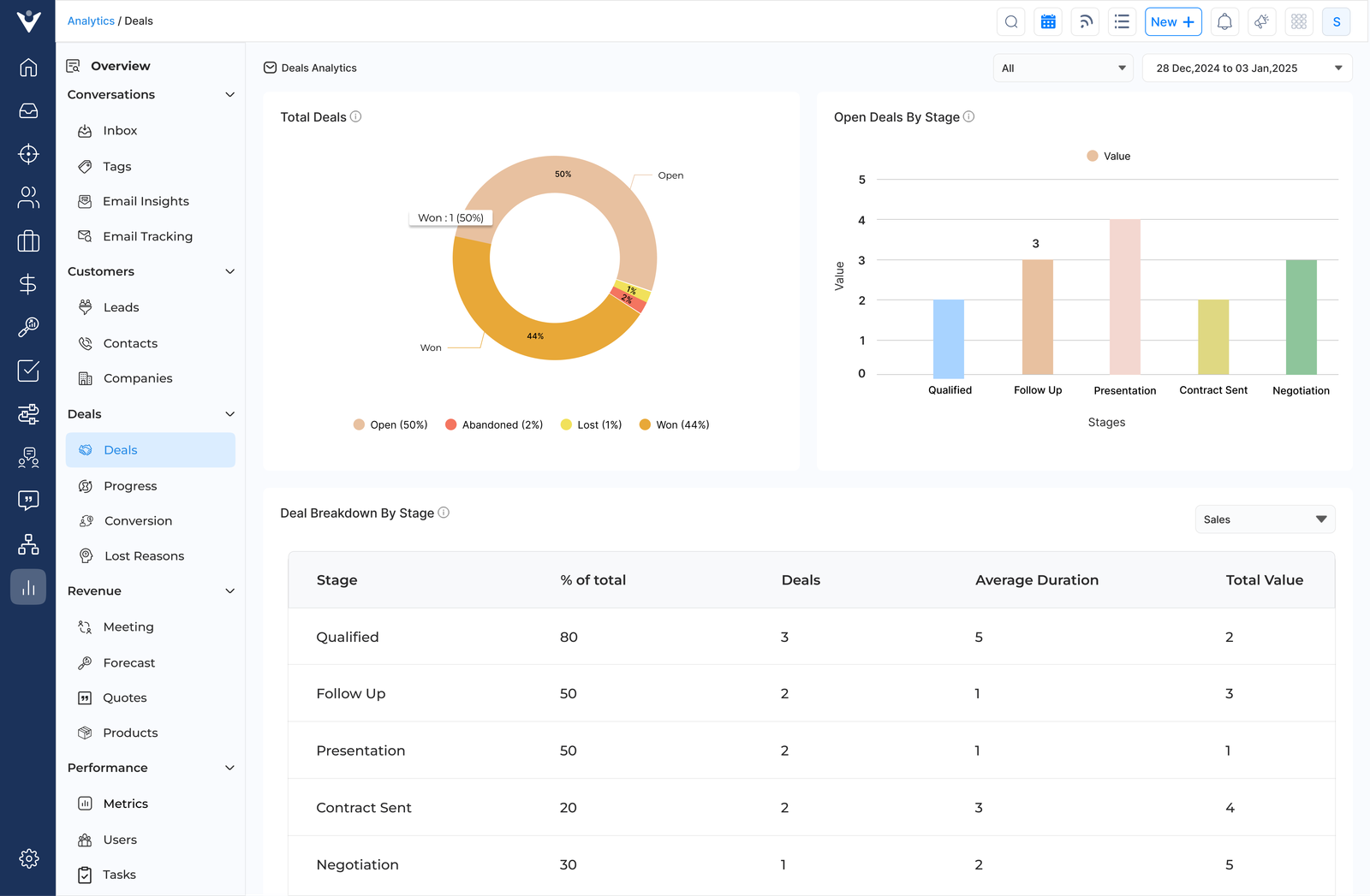
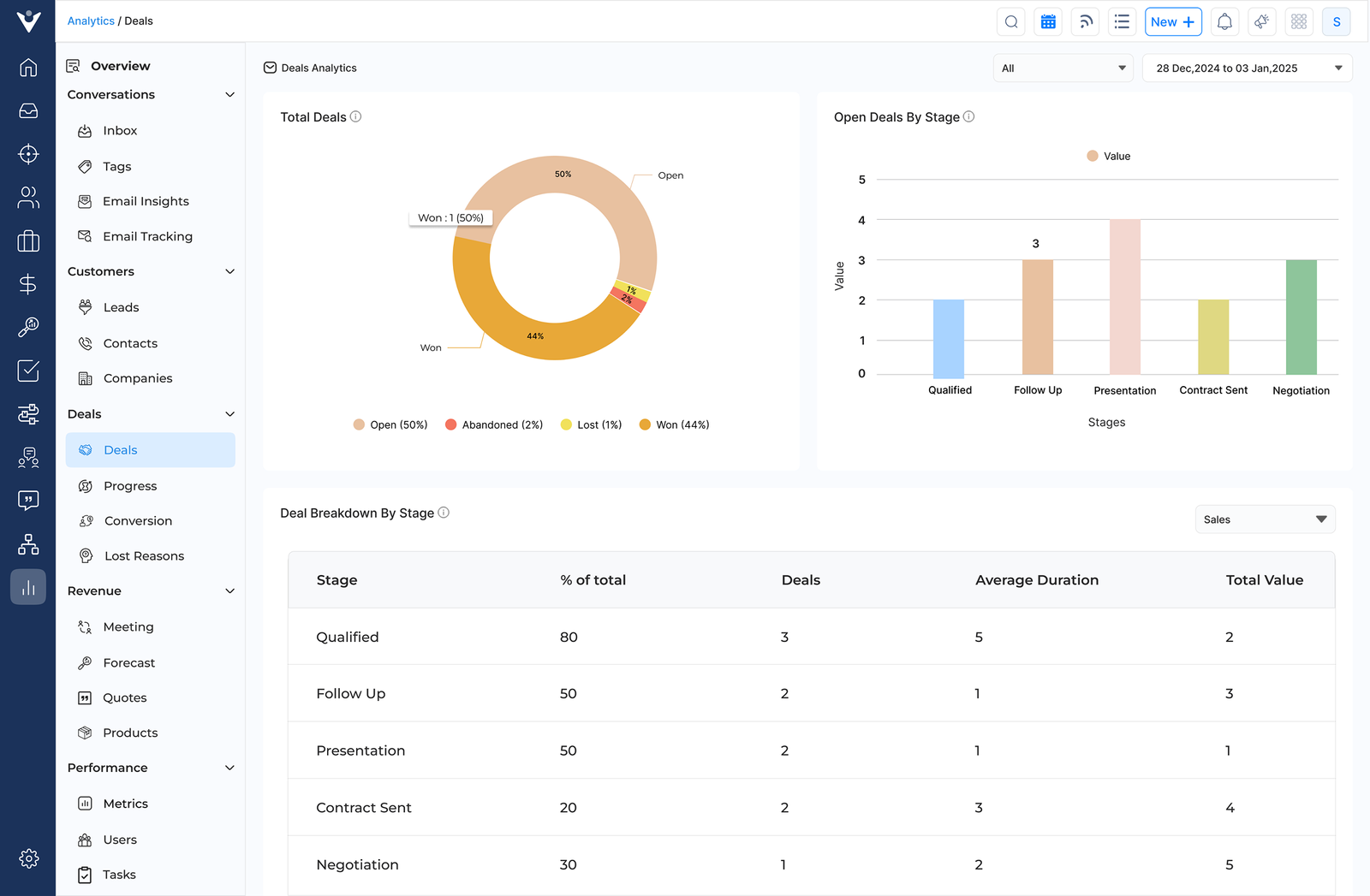
Veemo combines AI-powered sales tracking with CRM tools that help teams monitor deals, assess performance and manage their pipelines. Its detailed pipeline views, real-time analytics, and deal-level insights give managers the information they need to prioritize opportunities.

Key features:

  • Advanced pipeline visualization: Tracks deals at every sales stage, helping teams identify stalled opportunities and understand where prospects need more attention.
  • Automated lead scoring: Uses AI to score and prioritize leads based on their potential. The representatives focus their efforts on the opportunities most likely to convert.
  • Real-time performance analytics: Tracks sales metrics and KPIs as they change. The managers get a clear view of team performance.
  • Customizable sales forecasting: Uses historical sales data along with the current pipeline activity to estimate future revenue, helping managers set realistic targets and plan resources.

Pricing: The Growth plan costs $29/user/month with 3 inboxes, 1 knowledge base and omnichannel support. The Team plan is $69/user/month with 10 inboxes, 3 knowledge bases and a support widget. The Enterprise plan is $129/user/month with unlimited inboxes, a client portal and advanced asset management. Visit Veemo’s pricing page for more details.

2. Close

Close is a powerful sales tracking software designed for growing sales teams. It offers a comprehensive suite of tools for managing contacts, tracking deals and automating communication. 

Close combines built-in calling, customizable sales pipelines and detailed activity tracking to help teams manage deals. Its user-friendly interface brings calling, email and sales activities together. The reps can handle daily tasks and track deal progress without switching between multiple tools.

3. Gong

Gong is a cutting-edge sales tracking software that leverages artificial intelligence to revolutionize sales processes. The platform analyzes customer interactions across various channels, including phone calls, emails and video conferences. Gong consists of real-time conversation intelligence, deal pipeline analytics and team performance tracking.

The USP lies in its ability to automatically record, transcribe and analyze sales conversations, offering actionable insights that drive revenue growth. Gong’s AI-powered platform helps sales teams identify winning behaviors and replicate successful strategies.

4. Hubspot

HubSpot is an inbound marketing, sales and customer service platform that offers powerful sales tracking capabilities. It provides an all-in-one solution for businesses to manage their entire sales process, from lead generation to deal closure and beyond. The solution offers a customizable CRM, detailed analytics, email tracking, meeting scheduling and pipeline management.

Hubspot’s USP lies in its seamless integration across marketing, sales and service functions, providing a unified view of the customer journey. The user-friendly interface, extensive educational resources and scalability make it suitable for businesses of all sizes.

5. Pipedrive

Pipedrive is a leading sales monitoring software designed to streamline the sales process and boost team productivity. The user-friendly platform offers a visual pipeline view, making it easy for sales teams to manage leads, track deals and prioritize activities.

Pipedrive’s intuitive interface and mobile app ensure salespeople can stay organized, even in the office or on the go. Key attributes of Pipedrive include customizable pipelines, email integration and robust reporting tools.

The Best Roadmap to Revenue Growth Through Sales Tracking

Sales tracking brings performance data together to show which activities generate revenue and where deals begin to lose momentum. Without consistent tracking, businesses may overlook changes in customer behavior and market trends, making it harder to address problems before they affect sales results.

  • Data-driven decisions: Real-time insights replace guesswork with concrete evidence
  • Continuous improvement: Performance data reveals exactly where processes need refinement
  • Better customer understanding: Tracked behavior informs stronger products and service
Last update: October 20, 2026

FAQs about Sales Tracking

CRM sales tracking works by analyzing customer data, tracking interactions and surfacing sales opportunities in one place. When the business understands customer preferences and behaviors, they can tailor the strategies more precisely.

  • Personalized interactions: Tailored outreach based on tracked preferences.
  • Increased satisfaction. More relevant communication builds stronger relationships.
  • Higher conversions: Data-informed strategies close more deals.

Tracking a sales process starts with a CRM system that organizes leads, opportunities and deals across clearly defined pipeline stages. Each stage comes with specific goals, helping sales teams understand what needs to happen next and track every deal from the first contact to closing.

The insights help businesses identify where deals stall, understand which sales activities deliver results and adjust their approach based on actual performance data.

Start a sales tracker by identifying the metrics that matter most to your team. Then organize them in a tool like Excel to keep sales data structured, accessible and easy to update as new deals progress.

  • Key metrics: Total sales, conversion rates, and customer demographics.
  • Data organization: Spreadsheet software to input and structure information.
  • Visual formulas: Charts and formulas to track trends over time.
  • Regular analysis: Periodic reviews to inform sales strategy decisions.

The frequency of sales tracking depends on the nature of the business and sales cycle. Some businesses may track sales daily, weekly, monthly, or quarterly, depending on their sales volume and goals. It is essential to track sales regularly to monitor performance, identify trends and make adjustments to sales strategies promptly.

There are various sales tracking tools available in the market, ranging from simple spreadsheets to advanced CRM systems. Some popular tools include Salesforce, HubSpot CRM, Zoho CRM, Pipedrive and Insightly. It is essential to choose a sales monitoring platform that suits the business needs, budget and technical requirements to effectively track sales.