Sales Forecasting

What is Sales Forecasting? The Ultimate Guide

Discover how accurate predictions can transform your business strategy, boost revenue and enhance decision-making – all with the help of sales forecasting

No credit card required. Easy setup

Sales Forecasting

Trusted by Leading Brands

Future-Proof Your Business by Mastering the Art of Sales Forecasting

Understand the way sales forecasting has been helping businesses by empowering your decision-making, enhancing strategic planning and driving growth

Revenue Clarity

Sales forecasting acts as a crystal-clear roadmap, illuminating the path to future income for your business. Businesses can meticulously plan their budgets and allocate resources with confidence.

Resource Optimization

Let the teams strategically allocate resources, minimizing excess inventory and ensuring that investments are directed toward areas that promise the highest returns.

Strategic Agility

Get with the foresight needed to adapt quickly to market changes and seize emerging opportunities. Being proactive rather than reactive ensures businesses can capitalize on trends and maintain their edge.

Risk Mitigation

Identifying potential risks before they become significant threats has never been easier! The proactive approach to risk management not only protects the bottom line but also promotes a culture of preparedness within the organization.

Informed Decision-making

Relying on solid predictions helps businesses make informed strategic choices that align with their long-term objectives, eventually driving growth and success in a competitive market.

Performance Benchmarking

Get a reliable framework for establishing performance metrics and accurately tracking progress over time. Refine the business strategies and drive better results with ease!

Inaccurate sales forecasts can disrupt inventory planning, staffing decisions and budget allocation. These mistakes often stem from overlooking historical sales patterns, market changes or gaps in the sales pipeline. 

A reliable sales forecasting process brings these factors together to estimate future revenue more accurately. The guide explains how businesses can use sales data, market insights and pipeline analysis to create forecasts that support better planning.

What is Sales Forecasting?

Sales forecasting refers to the process of estimating future sales performance based on historical data, market trends and other relevant factors. Sales prediction crucial business practice that helps companies make informed decisions about resource allocation, budgeting and strategic planning. 

The process typically involves analyzing past sales data, current market conditions and upcoming business initiatives. Companies use various methods, including statistical models, trend analysis and expert opinions to predict future sales volumes or potential challenges.

Key components:

  • Historical data analysis: Examining past sales performance to identify patterns and trends.
  • Sales pipeline evaluation: Assessing the current status of leads and opportunities in the sales funnel.
  • Seasonality considerations: Accounting for cyclical patterns or seasonal fluctuations in demand.

Why is Sales Forecasting Important?

Sales forecasting is a critical tool for businesses, offering numerous benefits that can significantly impact overall performance.

Importance of Sales Forecasting

Reduced Costs

Accurate sales forecasts allows businesses to optimize inventory levels, preventing overstocking or understocking. The forecasts lead to reduced storage costs, minimized waste and improved cash flow. Companies can also better allocate resources, such as staffing and marketing budgets, based on projected demand.

Increased Sales

Businesses can ensure they have sufficient inventory to meet customer needs with better sales prediction. The function reduces lost sales opportunities due to stockouts. Forecasting also helps identify potential growth areas, which allows the companies to focus their efforts on high-potential products or markets.

Highlights Potential Issues

Sales forecasting acts as an early warning system. Businesses are alerted to potential problems before they escalate. The forecasting can reveal declining sales trends, seasonal fluctuations or changes in customer behavior. Companies can proactively address issues, develop contingency plans and adjust strategies accordingly.

Improved Decision-making

Accurate forecasts provide valuable data for informed decision-making across various departments. Management can make strategic choices about product development, market expansion and resource allocation based on projected sales figures. The data-driven approach reduces reliance on guesswork and intuition.

Improved Customer Satisfaction

Businesses can ensure product availability and timely delivery by better anticipating demand. It leads to improved customer experiences and increased loyalty. Forecasting also helps companies prepare for peak periods, ensuring they have adequate staff and resources to maintain service quality.

Better Investment Planning

Sales forecasts provide crucial information for long-term planning and investment decisions. Companies can more confidently plan expansion or new launches based on projected revenue. The information helps align investments with expected growth and ensures more efficient use of capital.

Factors That Can Impact Sales Forecast

Accurate sales forecasting depends on carefully considering a multitude of internal and external factors, which are explained below:

1. Hires and Fires

Personnel changes can significantly affect sales forecasts. New hires, especially in sales roles, may take time to ramp up and reach full productivity. The initial period could lead to lower-than-expected sales. Conversely, losing experienced sales staff can result in temporary dips in performance. 

2. Policy Changes

Internal policy changes can directly influence sales performance and customer purchasing decisions. Changes to commission structures, for example, may affect sales team motivation and productivity. The revised pricing policies can alter customer demand and purchase volumes. 

3. Territory Shifts

Realigning sales territories can cause significant fluctuations in forecasts. Expanding into new geographical areas may lead to initial slow growth as the market is penetrated. Conversely, reducing focus on certain territories could result in decreased sales from those regions. 

4. Economic Conditions

Factors like GDP growth, inflation rates, unemployment levels and consumer confidence can impact purchasing power. During economic downturns, businesses may see reduced demand, while periods of economic growth can lead to increased sales. 

5. Legislative Changes

Changes in tax policies, trade agreements, or industry-specific regulations can alter the business landscape. New environmental regulations, for example, might impact product design or manufacturing costs, potentially affecting pricing and demand. Forecasts should anticipate upcoming legislative changes and model their potential impacts on sales.

6. Product Changes

Modifications to existing products or the introduction of new ones can significantly influence sales forecasts. Product improvements may increase sales by attracting new customers or encouraging upgrades. The launch of new products might initially cannibalize sales of existing lines. 

7. Seasonality

Many businesses experience cyclical fluctuations in sales due to seasonal factors. The factors can include holiday shopping periods, weather-related changes in demand or industry-specific cycles. Understanding the patterns is crucial for accurate forecasting.

How to Build an Accurate Sales Forecast in 7 Steps

Let us go through the most effective steps that are known to help businesses master sales forecasting.

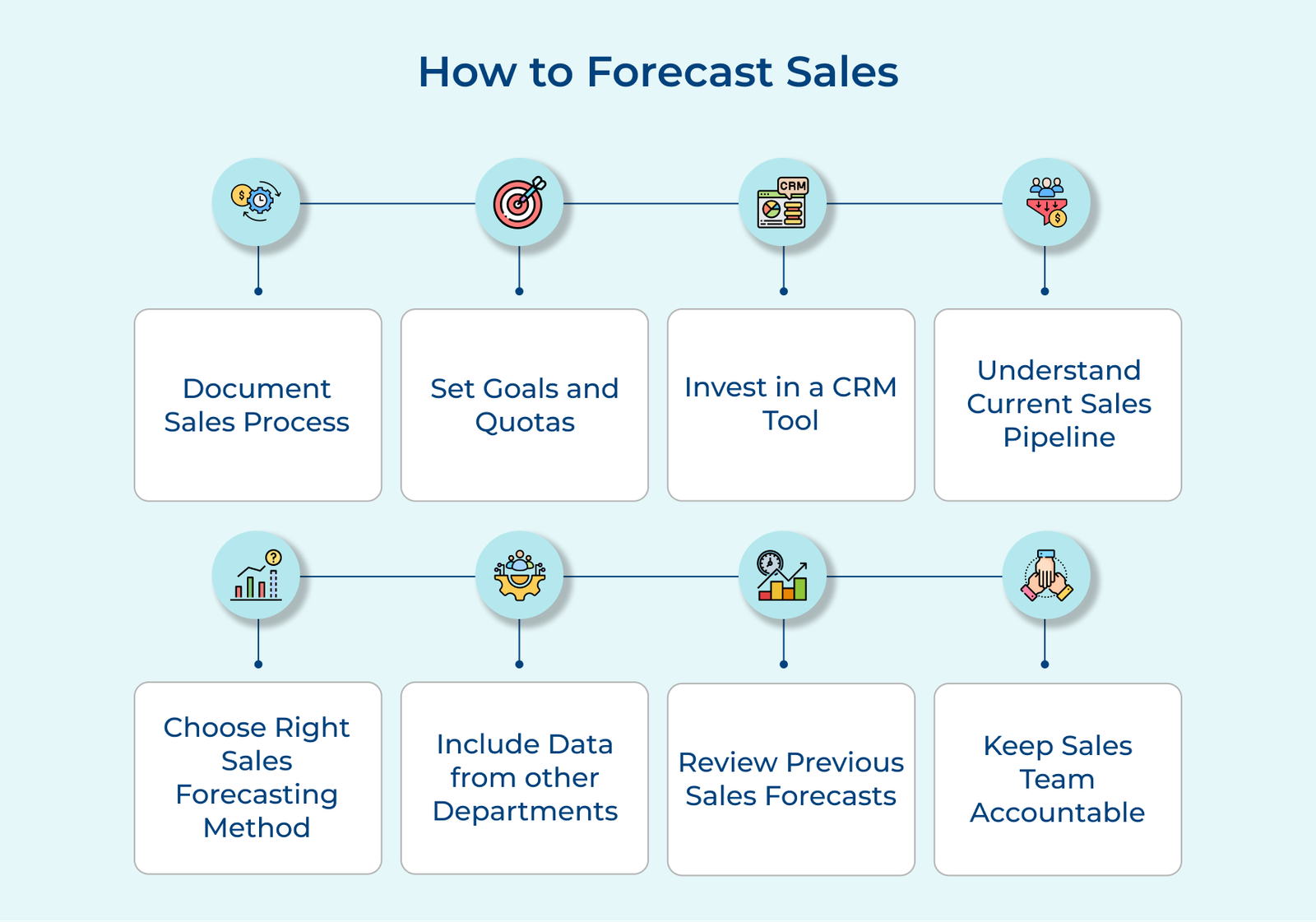
How to Forecast Sales

1. Document the Sales Process

Documenting the sales process is a crucial first step in effective sales forecasting. Businesses can gain a comprehensive understanding of the sales cycle by mapping out the entire sales journey, from initial contact to closing the deal.

The forecast allows businesses to identify key stages or milestones, such as lead qualification, proposal submission and contract negotiation. The checkpoints serve as indicators of progress and help predict the likelihood of closing deals. Standardizing the process across the organization ensures consistency in data collection and analysis, making forecasts more reliable.

Pro tips:

  • Involve the sales team in the process mapping to capture real-world insights and secure buy-in.
  • Regularly review and update the documented process to reflect changes in the market or organization.

2. Set Goals and Quotas

Setting goals and quotas is a crucial step in effective sales predictions. The process involves establishing realistic and achievable targets that motivate the team while aligning with company objectives. When setting the targets, it’s essential to consider historical data and current market conditions to ensure they are attainable yet challenging.

Aligning individual and team quotas with company objectives ensures that every member of the sales force is working towards the same overarching goals. The alignment allows for more accurate forecasting at both individual and organizational levels.

Pro tips:

  • Use SMART (Specific, Measurable, Achievable, Relevant, Time-bound) criteria when setting goals.
  • Regularly adjust quotas based on performance data and changing market dynamics.
  • Involve sales team members in the goal-setting process to increase buy-in and accountability.

3. Invest in a Customer Relationship Management (CRM) Tool

Investing in a Customer Relationship Management (CRM) tool is a crucial step in effective sales forecasting. CRMs centralize customer data, track interactions and provide real-time insights into the sales pipeline. 

When selecting a CRM, look for features like customizable reporting, pipeline visualization and integration capabilities with other business tools. The ideal CRM should also offer predictive analytics and AI-driven insights to enhance forecasting accuracy.

Actionable tips:

  • Customize the CRM to align with the specific sales process and KPIs.
  • Conduct regular training sessions to keep the team updated on best practices.
  • Integrate the CRM with other business tools to create a seamless data ecosystem.

4. Understand the Current Sales Pipeline

Understanding the current sales pipeline is a crucial step in effective sales forecasting. The process involves a deep dive into ongoing deals and potential opportunities. Businesses can gain insight into which are likely to close and when by analyzing the status of current deals.

Assessing the quality and quantity of leads helps predict future sales potential. High-quality leads are more likely to convert, while a large quantity of leads may indicate future growth. The evaluation also helps identify any gaps or loopholes in the sales process that could impact forecasts.

Pro tips:

● Implement a scoring system to objectively evaluate lead quality and deal progress.
● Regularly review and update pipeline data to ensure forecasts are based on current information.
● Use visualization tools to represent pipeline status and identify trends or areas needing attention.

5. Choose the Right Sales Forecasting Method

Choosing the right sales forecasting method is crucial for accurate predictions. There are several approaches available including historical forecasting, opportunity stage forecasting, length of sales cycle forecasting and pipeline forecasting. Each method has its strengths and is suited to different business models.

When selecting a method, consider factors such as the industry, sales cycle length, data availability and the complexity of the sales process. The size of the company and the stability of the market are also important considerations. The chosen method should align with the business goals and provide actionable insights.

Pro tips:

  • Ensure the data is clean, accurate and consistently maintained across all systems.
  • Train the sales team on the chosen method and establish clear guidelines for data input and analysis
  • Regularly adjust the forecasting method as the business evolves and market conditions change

6. Include Data from Other Departments

Collaboration with marketing provides insights into upcoming campaigns, lead-generation efforts and market positioning that can impact sales projections. Input from finance offers valuable information on budget constraints, production capacity and supply chain issues that may affect sales potential. 

Integrating market research helps align forecasts with broader economic and sector-specific factors, ensuring more accurate predictions. The interdepartmental approach creates a more comprehensive and realistic sales forecast by considering multiple perspectives. The approach helps identify potential opportunities and challenges that may not be apparent from sales data alone, leading to informed decision-making.

Pro tips:

  • Establish regular cross-departmental meetings to share relevant data and insights.
  • Develop a standardized format for data sharing to ensure consistency and ease of integration.
  • Implement a collaborative forecasting tool that allows input from various departments.

7. Review Previous Sales Forecasts

Reviewing previous sales forecasts is a crucial step in improving the accuracy and reliability of future predictions. Businesses can gain valuable insights into their forecasting process and identify areas for improvement by analyzing the accuracy of past forecasts. 

Learning from the discrepancies enables companies to refine their forecasting methods and adjust for previously unforeseen variables. The iterative process of review and adjustment leads to increasingly precise forecasts over time, supporting better decision-making.

Pro tips:

  • Establish a regular schedule for forecast reviews, such as quarterly or bi-annually.
  • Use data visualization tools to easily identify trends and discrepancies in historical forecasts.
  •  Create a feedback loop where insights from reviews are systematically incorporated into future forecasting processes.

How does Sales Forecasting Improve Business Operations?

Sales forecasting enables businesses to anticipate future demand, allowing them to align their operations with expected sales volumes. The proactive approach leads to improved efficiency, better resource allocation and enhanced performance. Companies can also identify potential challenges and opportunities in advance.

Use cases:

1. Inventory management: Accurate sales forecasts help businesses maintain optimal inventory levels, reducing carrying costs and minimizing the risk of stockouts or overstocking. The function ensures that products are available when needed while avoiding unnecessary expenses.

2. Budgeting and financial planning: Sales forecasts provide a foundation for creating realistic budgets and financial plans. Companies can make informed decisions about investments, expenses and resource allocation based on projected revenue.

3. Production planning: Manufacturers can use sales forecasts to optimize their production schedules. They can ensure they produce the right quantities of products to meet demand without wasting resources or incurring excessive storage costs.

4. Staffing and workforce management: Anticipating busy periods and slower seasons can help businesses adjust their staffing levels accordingly. They can maintain appropriate service levels while controlling labor costs.

5. Marketing and promotional strategies: Sales forecasts can inform marketing efforts by identifying trends and opportunities. Companies can tailor their promotional activities to capitalize on peak periods and boost sales during slower times.

6 Types of Sales Forecasting Methods

Let’s delve into the six types of sales forecasting methods that can revolutionize the way businesses predict and plan for sales growth of their company.

Sales Forecasting Methods

1. Opportunity Stage Forecasting Method

The method assigns probabilities to sales opportunities based on their current stage in the sales pipeline. Each stage (e.g., initial contact, proposal sent, negotiation) is associated with a likelihood of closing and the forecast is calculated by multiplying the potential deal value by its probability. 

Suitable for: B2B companies with longer sales cycles and clearly defined sales processes, such as enterprise software, consulting services or industrial equipment manufacturers.

2. Length of Sales Cycle Forecasting Method

The approach uses historical data to determine the average time it takes to close a deal. Businesses can predict when current opportunities are likely to close and forecast future revenue by analyzing the typical duration of the sales cycle. 

Suitable for: Companies with predictable and relatively stable sales cycles such as subscription-based services, real estate agencies or equipment leasing firms.

3. Intuitive Forecasting Method

Known as the qualitative method as well, intuitive forecasting relies on the experience and judgment of sales representatives to predict future sales. The method involves gathering input from the sales team about their pipelines and expectations. 

Suitable for: Small businesses, startups, or companies entering new markets where historical data is limited. It’s also useful in rapidly changing industries where past performance may not be indicative of future results.

4. Historical Forecasting Method

The quantitative approach uses past sales data to predict future performance. It analyzes historical trends, seasonality and growth patterns to project future sales. Common techniques include moving averages, exponential smoothing and trend analysis. Historical forecasting is data-driven and can be highly accurate for stable markets. 

Suitable for: Established businesses in stable industries with consistent sales patterns, such as consumer goods, utilities, or food and beverage companies.

5. Multivariable Analysis Forecasting Method

The advanced method considers multiple factors that can influence sales, such as economic indicators, market trends, competitive actions and internal variables. The method uses statistical techniques to analyze the relationships between the factors and sales performance. 

Suitable for: Large enterprises with access to extensive data and analytics resources.
The method is particularly useful for industries heavily influenced by external factors, such as automotive, tourism, or financial services.

6. Test-market Analysis Forecasting Method

The method involves launching a product or service in a limited market to gather real-world data on its performance. The results are then extrapolated to estimate potential sales in broader markets. Test-market analysis provides tangible data on product performance and customer reception. 

Suitable for: Consumer product companies, restaurant chains and retail businesses launching new products or entering new markets. It’s particularly valuable for companies with the resources to conduct comprehensive market tests.

Common Sales Forecasting Mistakes & How to Avoid

We will explore some of the most prevalent sales forecasting mistakes and how businesses can steer clear of them to achieve more accurate projections.

Common Sales Forecasting Mistakes
  1. Lack of Sales History

New businesses and companies launching unfamiliar products often struggle to forecast sales accurately because they lack historical data to support their estimates. Without a reliable sales history, identifying trends and recurring buying patterns becomes difficult.

  1. Inaccurate Data

Sales forecasts are only as reliable as the data behind them. Outdated customer records, inaccurate sales figures and inconsistent data entry across teams can distort projections. Businesses can find it harder to plan revenue, allocate resources and set realistic targets.

  1. Lack of Collaboration

Sales forecasting becomes less reliable when the sales department works in isolation from other teams. Marketing campaigns, financial changes and supply chain constraints can all influence sales performance. Excluding these factors from forecasts leaves businesses with an incomplete picture of what lies ahead.

  1. Technology Limitations

Basic spreadsheets and legacy sales systems often struggle to keep up with the complexity of modern sales operations. When teams lack tools that analyze large volumes of data and identify real-time trends, forecasting becomes less reliable.

How to avoid the sales mistakes?

  • Lack of sales history: Use industry benchmarks and comparable product data as proxies.
  • Inaccurate data: Conduct regular audits and standardize data entry practices.
  • Lack of collaboration: Involve marketing, finance and operations in the forecasting process.
  • Seller subjectivity: Combine qualitative input with objective, quantitative performance metrics.
  • Technology limitations: Invest in AI-driven forecasting tools that integrate with existing systems.

Best Practices for Sales Forecasting

We will explore the sales forecasting best practices that can elevate your game and set the business up for success.

Sales Forecasting Best Practices

1. Use Technology Like AI

Leveraging artificial intelligence and machine learning can significantly enhance sales forecasting accuracy. AI-powered tools can analyze vast amounts of data, identify complex patterns and generate predictions that account for numerous variables. Implementing AI in sales prediction allows for more sophisticated analysis and frees up sales teams to focus on customer relationships.

2. Review and Update Forecasts Regularly

Sales forecasting should be an ongoing process, not a one-time event. Regular reviews ensure that forecasts remain relevant and accurate in the face of changing market conditions, new product launches, or shifts in company strategy. Establish a consistent schedule for forecast reviews.

3. Forecast across Geographies, Products and Accounts

A detailed sales forecast should consider multiple dimensions of the business. Breaking down forecasts by geography, product lines and key accounts provides a more nuanced understanding of sales performance. The forecast also helps identify specific areas of strength or weakness within the sales pipeline, enabling more focused interventions where needed.

4. Compare Forecasts Based on Multiple Modeling Techniques

Use multiple modeling techniques and compare their results. The method might include combining quantitative methods like time series analysis with qualitative approaches like sales team input. Businesses can identify discrepancies, validate assumptions and create a more robust final forecast by cross-referencing different models.

5. Account for Internal and External Factors

Comprehensive sales forecasting should consider both internal and external factors that can impact sales performance. Internal factors might include product launches, changes in sales team structure, or new marketing initiatives. External factors could involve economic trends, competitor actions, or regulatory changes.

6. Build Sales Forecasting Calculations with Familiar Formulas

While advanced AI tools can provide sophisticated analysis, it’s important to maintain transparency and understanding in the forecasting process. Using familiar formulas as the foundation of the forecasting model ensures that team members can easily comprehend and trust the results.

Predict the Future of the Business with Sales Forecasting

Sales forecasting helps businesses understand expected revenue, changing market conditions and shifts in customer demand. Accurate forecasts allow teams to plan budgets, allocate resources and address potential shortfalls before they affect business performance.

  • Strategic planning: Accurate forecasts create a reliable roadmap for decisions.
  • Risk management: Early visibility helps businesses prepare, not just react.
  • Competitive advantage: Accurate predictions help seize opportunities faster than rivals.

FAQs about Sales Forecasting

Sales forecasting involves predicting future sales based on historical data, market trends and other factors to determine revenue goals. Demand planning focuses on predicting the amount of offerings that customers will purchase to ensure there is enough inventory available. Sales prediction is more focused on revenue projections, while demand planning is specific to inventory management.

Sales forecasting usually requires sales and marketing teams to work together. They use historical performance, market trends and customer feedback to estimate future revenue. Reliable forecasts help businesses set achievable targets and make informed decisions based on changing market conditions.

Sales forecasts help teams across an organization make informed decisions about revenue, budgets, resource allocation and future growth. Accurate, up-to-date forecasts give sales leaders and finance teams the insight they need to plan business priorities.

  • Sales teams: Set realistic targets and prioritize pipeline activity.
  • Finance departments: Allocate budgets and resources effectively.
  • Executives: Make strategic, company-wide business decisions.

Start your sales forecast by examining historical sales data and current market trends to establish a realistic revenue baseline. Next, define sales targets that reflect broader business objectives and expected revenue across departments.

Use historical performance, market conditions and pipeline data to build a detailed forecast. It must be supported by forecasting software to improve accuracy. Review actual sales results regularly and adjust your projections as deal progress change.

Sales forecasts should be updated regularly to reflect changes in the market, customer behavior and other factors. Many businesses update their sales forecast monthly or quarterly, but it depends on the specific needs of the company.