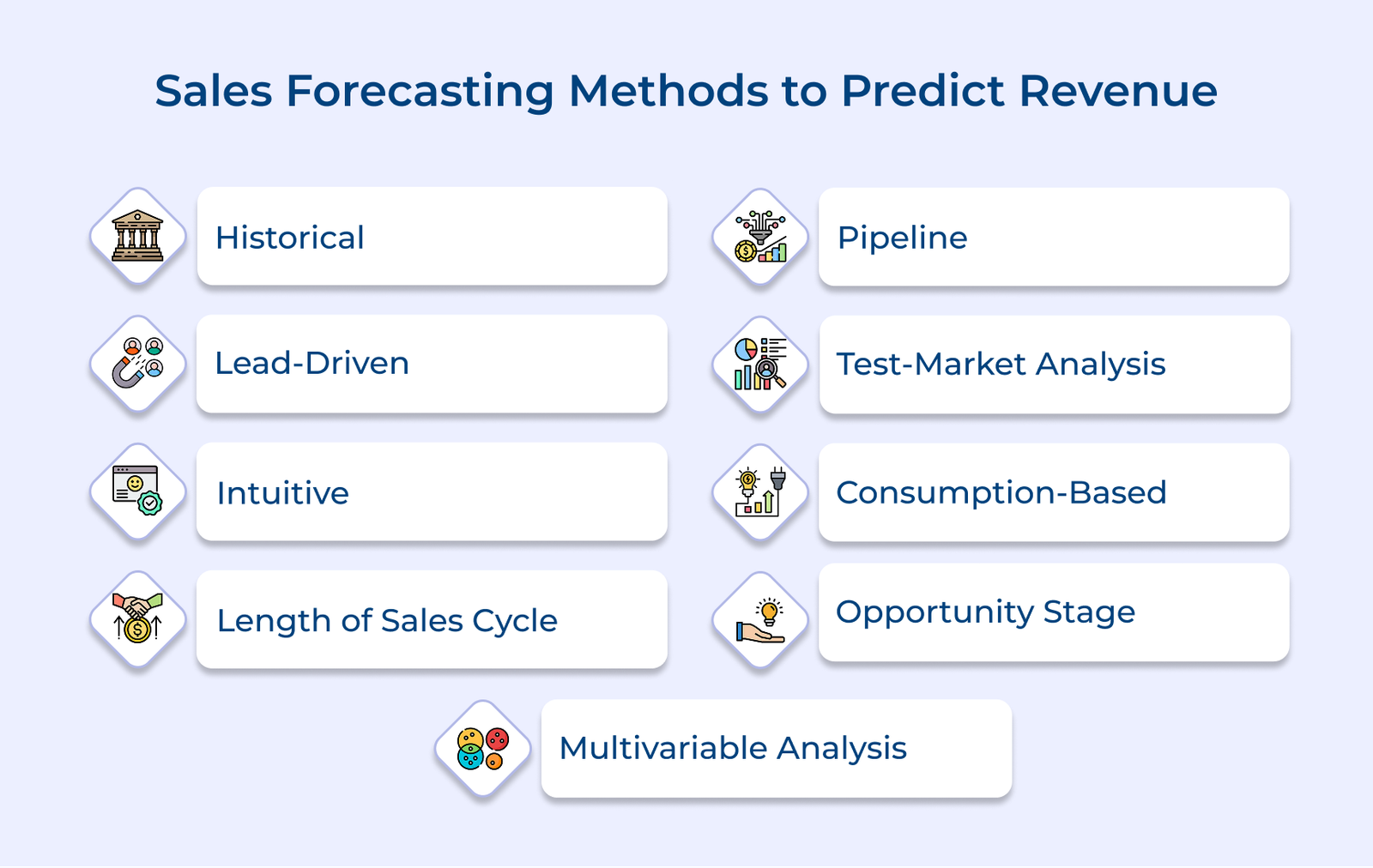
1. Historical Forecasting
Historical forecasting uses past sales data to predict future revenue, assuming that trends and patterns from previous years will continue. Businesses can estimate future sales performance with reasonable accuracy by analyzing past performance, seasonality and market behavior.
A retail store reviewing the past five years of sales data may notice a steady 10% increase in holiday season sales each year. Based on the trend analysis, they can forecast a similar rise for the upcoming season and adjust inventory to meet expected demand.
Pros:
- Easy to implement and understand, making it ideal for businesses of all sizes.
- Provides a reliable baseline for predictions, particularly in stable markets.
- Can be easily automated with spreadsheets or basic forecasting tools.
Cons:
- May overlook sudden market shifts or disruptions.
- Less effective for new businesses or products with limited historical data.
- Can perpetuate past mistakes or inefficiencies if not combined with other methods.
2. Lead-driven Forecasting
Lead-driven forecasting focuses on the volume and quality of leads in the sales pipeline. Businesses can predict future revenue with greater accuracy by analyzing lead generation rates, conversion rates and deal sizes. The approach is especially effective for companies with long sales cycles and a robust lead generation process.
A B2B software company tracks 100 new leads each month, with a 20% conversion rate and an average deal size of $10,000. Using the data, they can forecast potential revenue and adjust for market trends or seasonal fluctuations to refine their predictions.
Pros:
- Offers early visibility into future revenue based on current lead flow.
- Identifies sales funnel bottlenecks and highlights areas for improvement.
- Allows for more accurate short-term forecasts, especially in dynamic markets.
Cons:
- Relies on accurate lead scoring and qualification to avoid overestimating revenue.
- Fluctuating lead quality or conversion rates can skew predictions.
- Requires reliable CRM systems and consistent data input from sales teams.
3. Intuitive Forecasting
Intuitive forecasting taps into the experience and judgment of sales leaders to predict future revenue. It leverages expertise, often alongside data-driven methods for a well-rounded approach by gathering insights from sales teams and considering market conditions.
A startup’s sales director, relying on years of industry knowledge, forecasts a 30% sales increase for the next quarter. The prediction is informed by recent product improvements, positive customer feedback and an uptick in market demand.
Pros:
- Taps into expert insights and industry knowledge that data alone may overlook.
- Can quickly adapt to sudden market changes or unforeseen circumstances.
- Useful for new products or markets where historical data is limited.
Cons:
- Subjective and vulnerable to biases or overly optimistic projections.
- Challenging to standardize across teams or periods, leading to inconsistent forecasts.
- Might lead to inconsistent forecasts if not balanced with data-driven methods.
4. Length of Sales Cycle Forecasting
Sales cycle forecasting focuses on the average time it takes to move a lead through each stage of the sales process. Businesses can predict when deals are likely to close and estimate future revenue more accurately by understanding typical conversion timelines.
An industrial equipment manufacturer tracks its sales cycle, which averages three months from first contact to purchase. Using the data, they forecast potential revenue by identifying leads expected to close within the next quarter, factoring in deal sizes for more precise projections.
Pros:
- Offers a clear timeline for when revenue will materialize, enhancing cash flow forecasts.
- Identifies bottlenecks in the sales process.
- Enables more efficient resource allocation across the cycle.
Cons:
- May overlook variations in deal complexity or differing customer decision-making timelines.
- Requires consistent and accurate tracking of sales cycle stages.
- Can be less effective in industries with highly variable sales cycle lengths.
5. Pipeline Forecasting
Pipeline forecasting evaluates the entire sales process, from initial leads to nearly closed deals. Businesses can predict potential revenue based on the probabilities and deal sizes by assigning probability percentages to deals at different stages.
A SaaS company has 10 deals in the proposal stage (50% chance of closing) worth $100,000 each and 5 deals in contract negotiation (80% chance) worth $200,000 each. They forecast $500,000 from proposals and $800,000 from negotiations, offering a clear revenue outlook.
Pros:
- Offers a complete overview of potential revenue throughout the entire sales process.
- Allows for more accurate short-term forecasts by weighing deal probabilities.
- Empowers sales teams to focus on high-value, high-probability deals.
Cons:
- Accuracy depends on the reliability of probability assignments and deal value estimates.
- Maintaining accuracy can be time-consuming, as it requires frequent updates from the sales team.
- May not account for external factors that could influence deal closure rates.
6. Test-Market Analysis Forecasting
Test-market analysis involves launching a product in a select, controlled market to assess customer response and predict broader market success. Organizations can refine their approach before a full-scale launch by gathering real-time data from these test markets.
A fast-food chain introduces a new menu item in various locations to test different demographics. They forecast national sales potential and fine-tune their rollout strategy by analyzing sales, customer feedback or market trends from the regions.
Pros:
- Offers real-world insights into product performance before a full launch.
- Enables adjustments to product features, pricing or marketing efforts based on test market feedback.
- Reduces risk of large-scale failure by identifying issues in a controlled environment.
Cons:
- Can be costly and time-intensive to execute properly.
- Test markets might not fully represent the larger target audience.
- Competitors could gain insights into new products or strategies during the testing phase.
7. Consumption-Based Forecasting
Consumption-based forecasting predicts future sales by analyzing the rate at which customers use or consume a product. It’s especially useful for businesses offering consumables or subscription services that rely on regular replenishment or renewals.
A printer ink manufacturer tracks customer usage data, discovering that the average ink cartridge lasts two months. They can more accurately predict when customers are likely to reorder by understanding the consumption pattern, helping them optimize sales forecasting and inventory management.
Pros:
- Ideal for businesses with consistent consumption patterns.
- Ensures accurate sales predictions and enables proactive engagement for reorders or renewals.
- Helps optimize inventory management and production scheduling.
Cons:
- Depends on detailed customer usage data, which can be challenging to collect.
- Less reliable for products with fluctuating consumption rates.
- May not account for changes in customer behavior or market conditions.
8. Opportunity Stage Forecasting
Stage-based forecasting analyzes sales opportunities at each pipeline stage, assigning probability percentages based on the likelihood of closing. The method provides a more nuanced revenue projection by factoring in deal size, stage duration and historical conversion rates.
A consulting firm categorizes deals into stages: Initial Contact (10% chance), Proposal Submitted (30%), Negotiation (60%) and Contract Sent (90%). They combine the probabilities with deal values to forecast potential revenue, offering a clearer view of expected outcomes at each stage of the sales process.
Pros:
- Offers a detailed view of the sales pipeline, factoring in the maturity of each opportunity.
- Enhances forecast accuracy by incorporating historical conversion rates at each stage.
- Helps sales teams focus efforts on moving opportunities through critical stages.
Cons:
- Demands a clear, standardized sales process with defined stages.
- Can be complex to manage, particularly for businesses with diverse sales cycles.
- May overlook sudden shifts in deal momentum or external influences.
9. Multivariable Analysis Forecasting
Multivariable analysis forecasting combines multiple data sources to generate a comprehensive sales prediction. It creates a more nuanced outlook by factoring in historical sales, market trends, economic indicators and internal elements like marketing spend or sales performance.
A car dealership might use the approach to forecast sales by analyzing historical data, local employment trends, consumer confidence, upcoming model launches and planned promotions. They can generate a more accurate monthly sales forecast for the coming year by weighing the variables.
Pros:
- Offers a comprehensive view of sales drivers, resulting in more precise forecasts.
- Flexible across industries by incorporating key independent variables.
- Identifies critical factors impacting sales performance from multiple angles.
Cons:
- Can be challenging to implement and maintain, often needing specialized tools or expertise.
- May overwhelm smaller businesses with limited data analysis resources.
- Accuracy depends on the quality and relevance of data inputs across all variables.
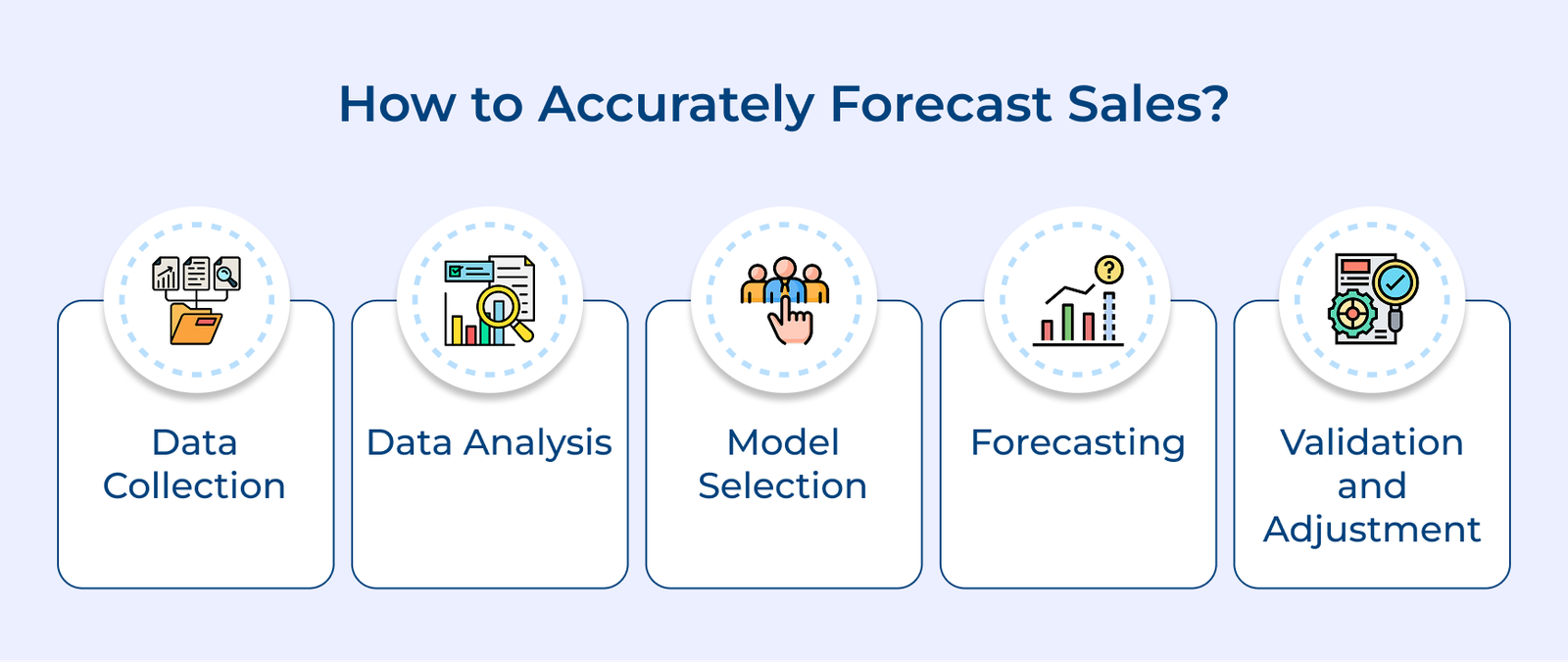
How To Accurately Forecast Sales Using Your Chosen Method?
Below are some effective techniques to accurately forecast sales, enabling you to make data-driven decisions that drive growth and profitability.