Customer Service vs Technical Support: How Do They Differ?
Explain the key differences between customer service vs technical support. It highlights their roles, goals and how both work together to enhance customer satisfaction.

Explain the key differences between customer service vs technical support. It highlights their roles, goals and how both work together to enhance customer satisfaction.
When customers reach out for help, they often don’t know whether they need customer service or technical support. The confusion leads to misdirected calls, longer resolution times and unhappy experiences for everyone involved. Misrouted inquiries waste valuable time as customers get bounced between departments. Team members feel strained handling issues beyond their expertise, causing delays and hurting customer trust.
Understanding the fundamental differences between customer service vs technical support transforms how you structure your help operations. Let’s explore what sets these two essential functions apart and how proper alignment improves outcomes.
Customer service refers to the human side of your business, the interactions that connect you with customers throughout their journey. It covers everything from answering pre-purchase questions to providing post-sale support and maintaining ongoing relationships. Think of it as your company’s voice and personality in action.
Customer service operates through multiple touchpoints where representatives address inquiries about products, policies, billing and general concerns. Representatives guide customers through processes, resolve complaints and ensure satisfaction. The focus stays on building relationships rather than fixing technical problems.
Key benefits:
Technical support refers to the specialized help for users experiencing issues with technology products or services. Think of it as having an expert guide you through software crashes, system errors or complex configurations. The experts focus specifically on fixing technical issues rather than handling general customer inquiries.
When you contact technical support, specialists follow a systematic troubleshooting process to identify your problem’s root cause. They gather information about your issue and guide you through step-by-step solutions or escalate complex problems to higher-tier engineers. The structured approach ensures consistent problem-solving across different support interactions.
Key benefits:
Below are the key differences between tech support vs customer support to help you to navigate your next customer service or technical support interaction with confidence.
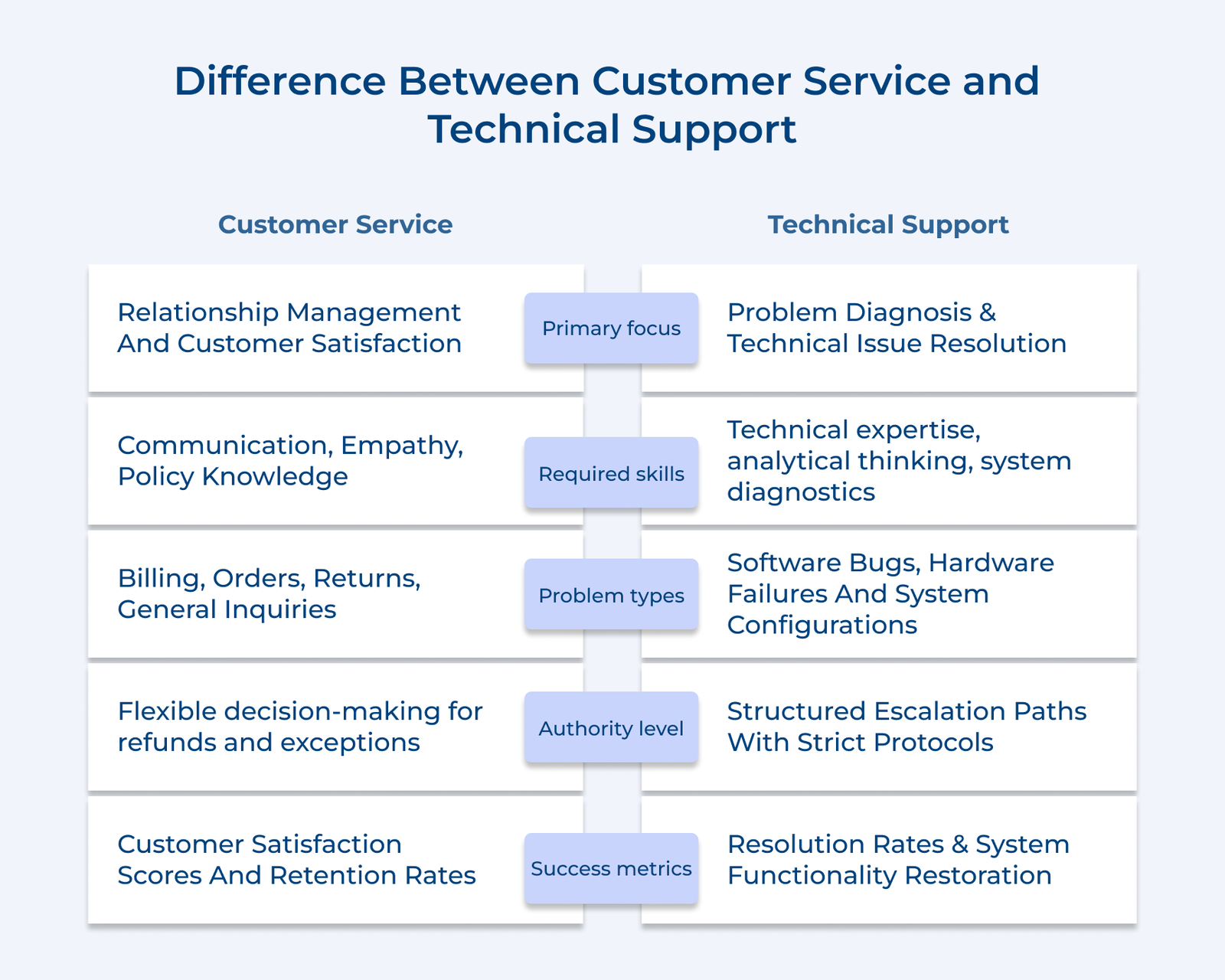
Customer service handles a wide range of inquiries, including billing, order status, returns and account management. The focus is on maintaining positive relationships and ensuring satisfaction across every interaction.
Technical support concentrates solely on resolving technology-related issues, such as software bugs, hardware malfunctions or system configurations. Specialists have deep technical knowledge to diagnose problems and guide users through solutions.
Pro tips:
Customer service and technical support require very different skill sets because they handle distinct types of problems. Think of customer service as the friendly face of your company, while technical support serves as the problem-solving brain.
Key capabilities:
Key competencies:
The key difference lies in emotional intelligence versus technical expertise. Customer service prioritizes human connection, while technical support emphasizes analytical thinking and systematic problem resolution to restore functionality.
Customer service representatives use empathy-driven approaches to understand customer frustrations and find solutions within company guidelines. They can offer compensation, discounts or alternatives to resolve issues and maintain relationships.
Technical support uses structured troubleshooting to find the root cause of technical issues. They rely on technical documentation, error logs and testing procedures rather than emotional considerations when determining the best solution path.
Actionable tips:
Customer service reps use a warm, empathetic style focused on connection and relationship rather than technical details. They use accessible language and focus on making customers feel heard and valued throughout every interaction.
Key differences:
Technical support specialists communicate using precise technical language and structured methodologies that prioritize accuracy over emotional considerations. They guide users step-by-step while clearly communicating limits and realistic timelines.
Customer service often prioritizes immediate acknowledgment and emotional support, even when resolving complex billing or policy issues takes time. Technical support emphasizes accurate problem identification and consistent communication throughout longer resolution processes.
Key differences:
Technical support follows diagnostic timelines, often requiring multiple troubleshooting steps or escalation to specialists. Users typically accept longer resolution times when they understand the technical investigation process and receive regular progress updates.
Customer service and technical support departments measure success differently because they serve distinct purposes in your organization’s overall support strategy. Customer service success is measured by satisfaction, retention and relationship quality, reflecting loyalty. The team’s focus is on creating experiences that encourage customers to continue doing business with the company.
Key metrics:
Key metrics:
Technical support effectiveness is measured by resolution rates, response times, and accuracy in restoring functionality and preventing repeat issues. Success means solving the technical issue completely rather than just making customers feel better about ongoing problems. The key difference: customer service measures satisfaction, technical support measures problem resolution.
Customer service representatives have broader authority to handle relationship issues, such as issuing refunds, discounts or policy exceptions within set limits. They provide immediate solutions using account tools and guidelines that prioritize customer satisfaction over strict procedures.
Technical support follows structured escalation, sending complex issues to higher-tier specialists. They follow protocols to ensure accuracy and documentation, avoiding independent decisions that risk system integrity. Let’s assume that when a customer demands a refund for a malfunctioning product, customer service often approves it immediately. When that product has a software bug, technical support must document the issue and escalate it to the development teams.
Best practices:
Check out how the two teams collaborate to tackle challenges head-on and deliver a superior customer experience.
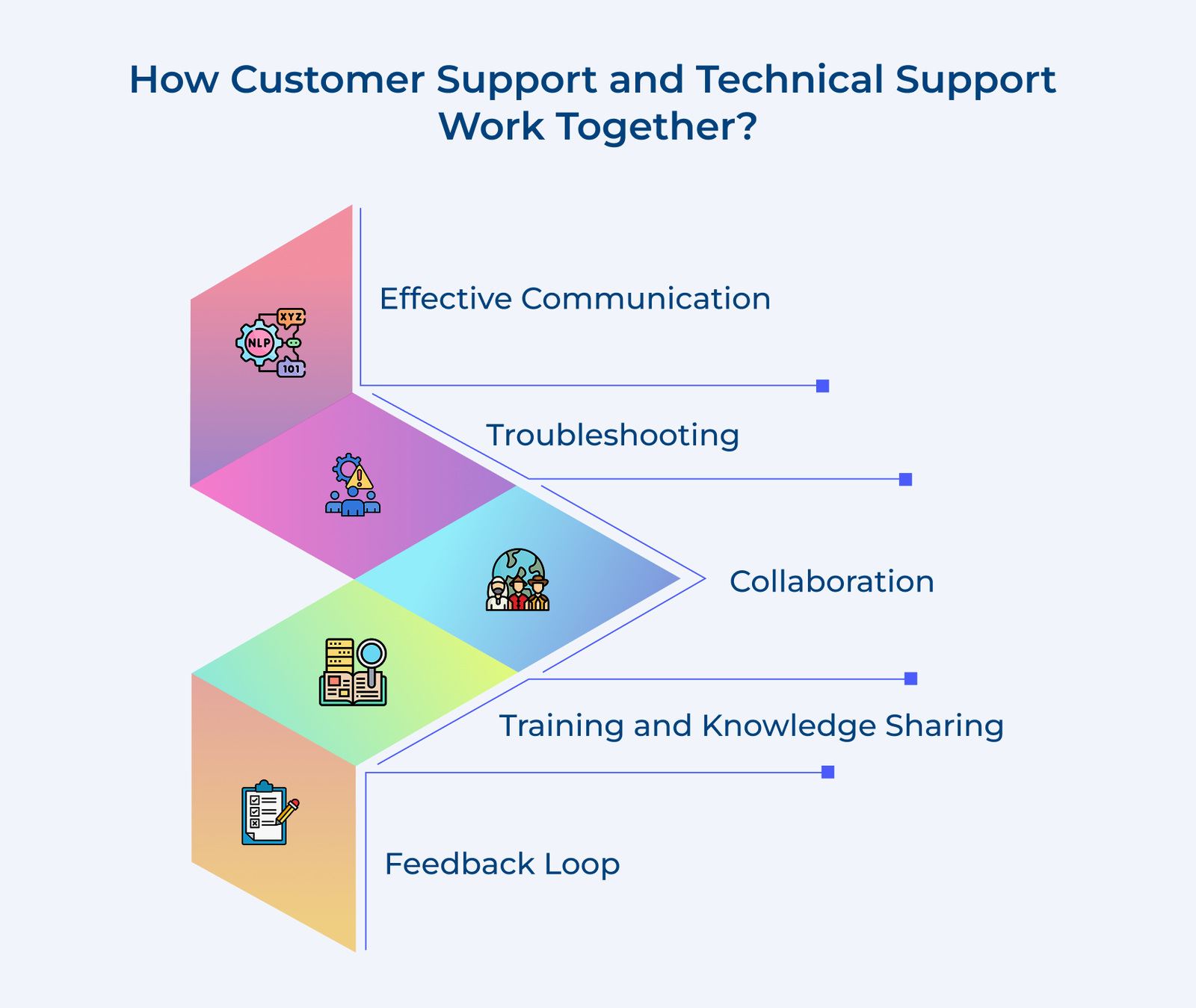
Customer service and technical support must maintain open communication to resolve issues efficiently. Customer service reps act as the first point of contact, listening to customer concerns and gathering details. They then pass the information to technical support, ensuring specialists have the context needed to address the problem.
Technical support teams are responsible for resolving technical issues that customers may encounter. Customer service reps can guide customers through basic troubleshooting for technical issues. If the issue persists, the representative can transfer the customer to a technical support specialist who has deeper knowledge and expertise in resolving technical issues.
Customer service and technical support teams often need to collaborate to solve complex problems. Customer service reps provide customer history and preferences to help technical support understand their needs. Such collaboration ensures that technical support specialists can provide personalized solutions and empathetic assistance.
Customer service reps need a foundational understanding of technical products or services to handle initial inquiries. Technical support can train them on technical topics, ensuring they are prepared to assist customers effectively.
Customer service collects feedback on technical issues, product features or user experience and passes it to technical support. The exchange helps identify recurring issues, strengthening both problem-solving and overall service quality.
Below are some key strategies to ensure you are delivering excellent customer service. Let’s check them out in more detail.
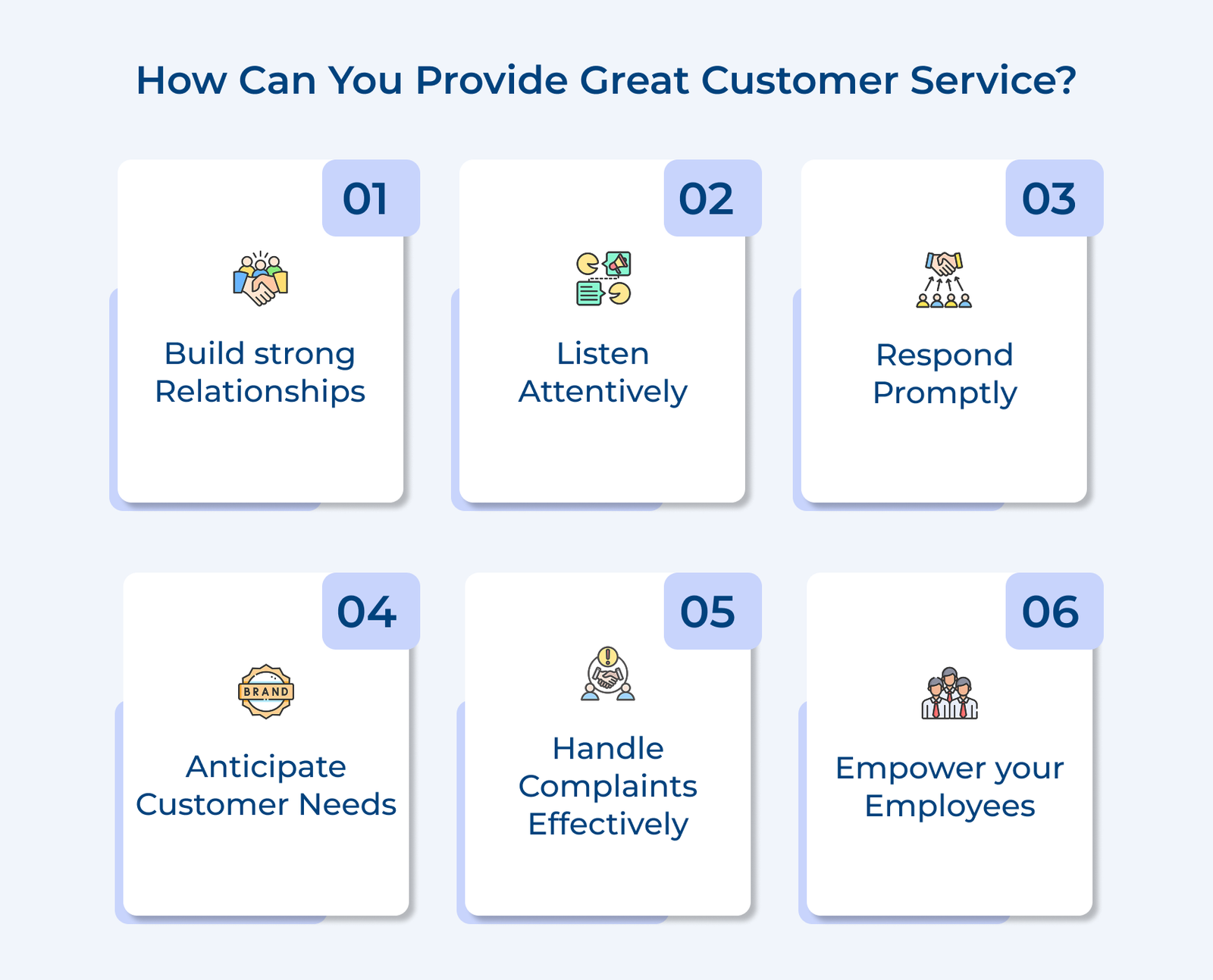
1. Build strong relationships: Good customer service starts with genuine relationships. Take time to understand your customers’ preferences and concerns. Trust grows when people feel heard and valued.
2. Listen attentively: Give customers your full attention. Listen carefully to what they say and ask questions to clarify their concerns. Clear, attentive listening leads to better understanding and more accurate solutions.
3. Respond promptly: Quick responses show respect for your customers’ time. Address questions or complaints as soon as possible to prevent frustration and keep communication smooth.
4. Anticipate customer needs: Great customer service involves being proactive and anticipating your customers’ needs. Identify patterns or common issues and provide solutions before they arise.
5. Handle complaints effectively: No business is perfect and handling customer complaints professionally is crucial for maintaining customer satisfaction. Apologize sincerely, take ownership of the issue and work towards finding a suitable resolution.
6. Empower your team: Equip employees with the training, tools and authority they need to help customers. When staff feel supported, they deliver better service and take ownership of each interaction.
Check out the key practices that help deliver great technical support, from clear communication to building proactive problem-solving.
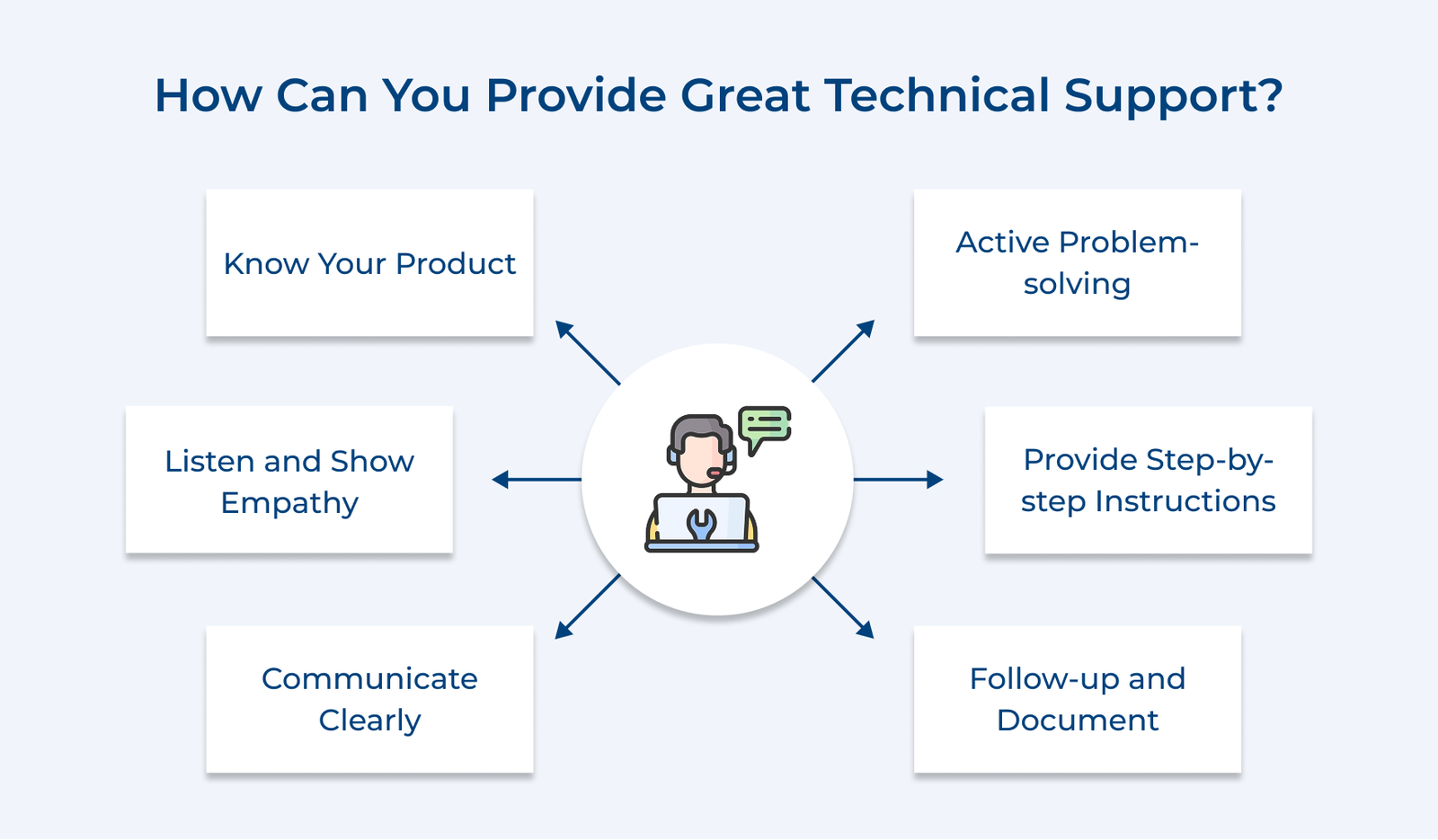
1. Know Your Product
Good technical support starts with deep product knowledge. You should understand its features, functions or limitations, along with common bugs or errors and their troubleshooting steps. The better you know your product, the faster you can solve customer issues.
2. Listen and Show Empathy
Customers often reach out when they’re frustrated. Be patient, listen carefully and acknowledge their feelings. A simple reassurance that you’re there to help can make the situation less stressful and build trust.
3. Communicate Clearly
Communication is key when it comes to providing technical support. Listen carefully, ask relevant questions and keep communication clear and concise. Avoid using technical jargon and use language that is easily understandable to the person seeking assistance.
4. Active Problem-solving
Approach every issue with curiosity and persistence. Identify the root cause, research if needed and guide the customer through each step. Involve them in the process so they feel informed and confident in the solution.
5. Provide Step-by-step Instructions
Break down the troubleshooting process into simple, step-by-step instructions. It is essential to be detailed, without overwhelming the person with unnecessary information. Use visuals if possible, such as screenshots or diagrams, to help clarify the steps.
6. Follow-up and Document
Once the issue is resolved, check back to confirm everything works properly. Encourage feedback and keep a record of the problem along its solution. Good documentation saves time and improves future support.
Exceptional customer service and technical support can shape the success of any business. When customers feel heard, they stay loyal and share their positive experiences with others. Clear communication, attentiveness and prompt problem-solving are essential in delivering exceptional customer service.
A skilled technical support team ensures customers get reliable help when technical issues arise. Prioritizing customer satisfaction and investing in exceptional customer service will undoubtedly contribute to the success of any business.

Reach out to customer service for general questions about products or services, help with orders, returns, policies or account-related issues. They’re trained to handle a wide range of inquiries and can guide you to the right solution.
Contact technical support when you encounter specific technical issues with a product or service. It can include software or hardware malfunctions, connectivity problems, error messages or any other technical complexities. Customer service agents possess the expertise to diagnose and troubleshoot such issues, to provide effective solutions.
Yes. Customer service and technical support often work together to ensure problems are fully resolved. Customer service may escalate technical problems to support specialists, while technical teams may involve customer service for non-technical concerns.
Customer service representatives should possess excellent communication skills, empathy, patience and the ability to handle difficult customers. They should also have product knowledge & be well-versed in company policies. Customer support agents require strong technical expertise, problem-solving skills and the ability to explain complex concepts in a simplified manner.
Customer service can help with simple troubleshooting and general guidance, but complex technical problems are usually handled by specialized support teams. When needed, they transfer or escalate the issue to ensure it’s properly resolved.

Grow Customer Relationships and stronger team collaboration with our range of products across the Conversational Engagement Suite.
Omnichannel Customer Support & Help Desk Software
AI Enabled Business Messaging and Chatbot Software
Sales Engagement & CRM Software
Call Center Software & Virtual Phone System
Product Marketing & Experience Platform
Customer Experience & Feedback Management Software

 Customer Experience Future: 8 CX Predictions to Know in 2026
Scroll to top
Customer Experience Future: 8 CX Predictions to Know in 2026
Scroll to top