What Is Outbound Lead Generation? The Complete Guide
Check out how outbound lead generation helps businesses proactively reach potential customers. Explore the key strategies, tools and best practices to drive consistent sales growth.
Check out how outbound lead generation helps businesses proactively reach potential customers. Explore the key strategies, tools and best practices to drive consistent sales growth.
Does it feel like your pipeline has suddenly gone quiet? You’re waiting on inbound leads, refreshing your dashboard, while competitors seem to be booking meetings nonstop. The truth is, your potential customers are out there and many of them likely need exactly what you offer. They’re just not finding you on their own.
Outbound lead generation is the approach that can change it all, if done right, of course! 32% of marketers say that the outbound approach is effective in generating more leads. You stop waiting and start reaching out to the exact people who fit your ideal customer profile.
So without further ado, let’s dive in to understand how to identify the right prospects, reach out with messages that get replies and turn cold conversations into real opportunities.
Outbound lead generation refers to when your sales team takes the initiative to find potential customers instead of waiting for them to come to you. It starts by identifying companies that fit your ideal customer profile, then reaching out to decision-makers through channels like email, phone or LinkedIn.
Unlike inbound, where you rely on organic discovery, outbound lets you decide who to contact and when. You can focus on specific industries or company sizes that align closely with your product, creating faster and more meaningful sales conversations.
Key objectives:
The following are the benefits that make the outbound sales lead generation worth considering for your business. Let’s check them out briefly below.
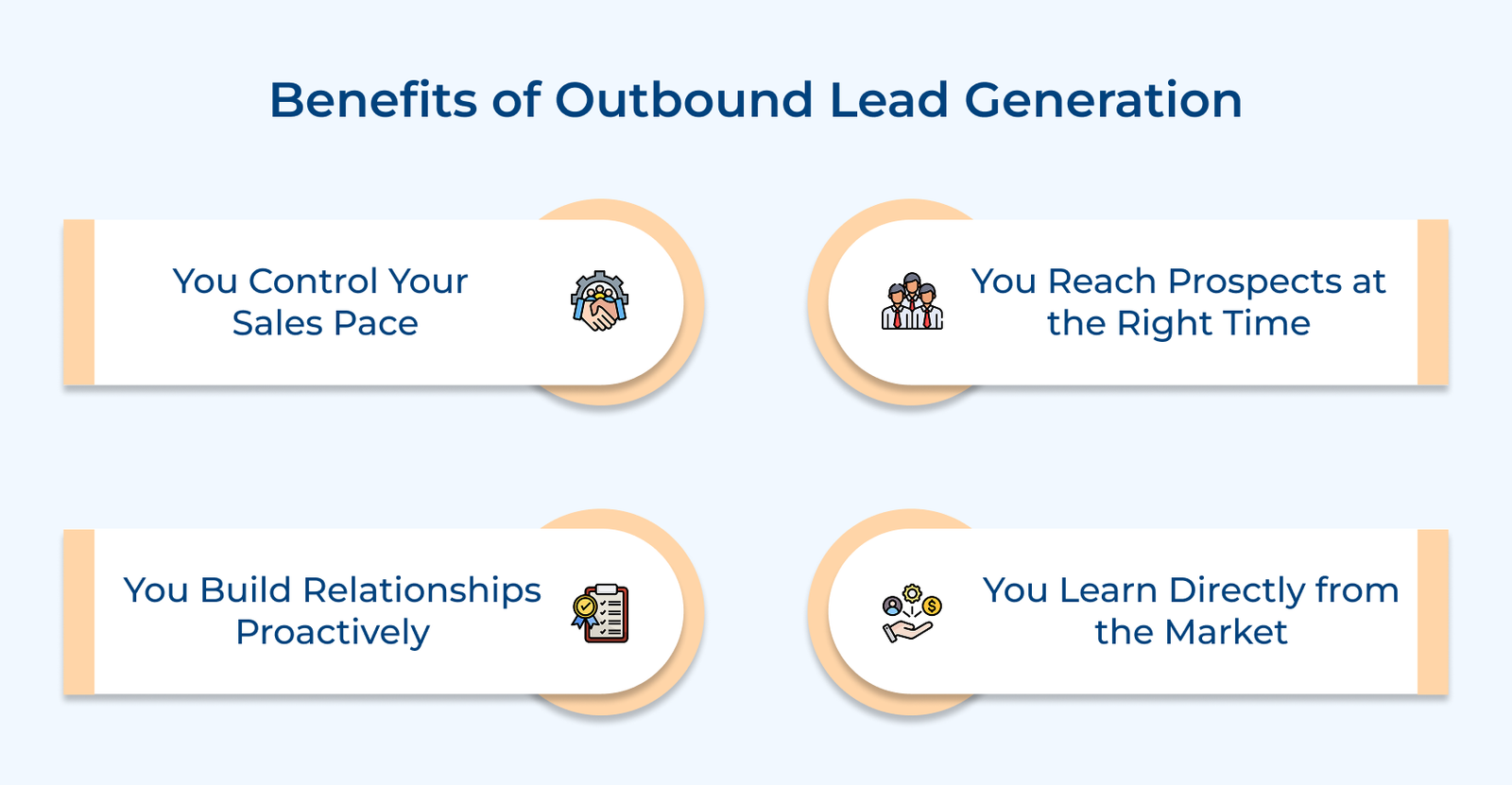
1. You Control Your Sales Pace
Outbound gives you the ability to decide how many conversations to start each week. You can ramp up outreach when you need more opportunities or slow down when your team is focused on closing deals. You’re not dependent on search algorithms or fluctuating inbound traffic to keep your pipeline moving.
2. You Reach Prospects at the Right Time
Your team can research which companies are expanding or hiring in relevant departments before reaching out. The timing advantage means you’re often catching prospects right when they’re evaluating solutions. You’re not waiting for them to realize they have a problem and then search for answers.
3. You Build Relationships Proactively
Thoughtful, well-researched outreach starts conversations with people who might never visit your website. Even if they’re not ready to buy, they remember the helpful interaction. When the need arises, you’re already on their radar.
4. You Learn Directly from The Market
Every call or email response teaches you something about how prospects perceive your value proposition. You hear objections in real-time and can adjust your messaging immediately. The feedback loop helps you refine your positioning faster than relying on analytics alone.
Let’s go through the step-by-step process of how outbound lead generation works in B2B, from identifying ideal prospects to turning cold outreach into qualified sales opportunities.
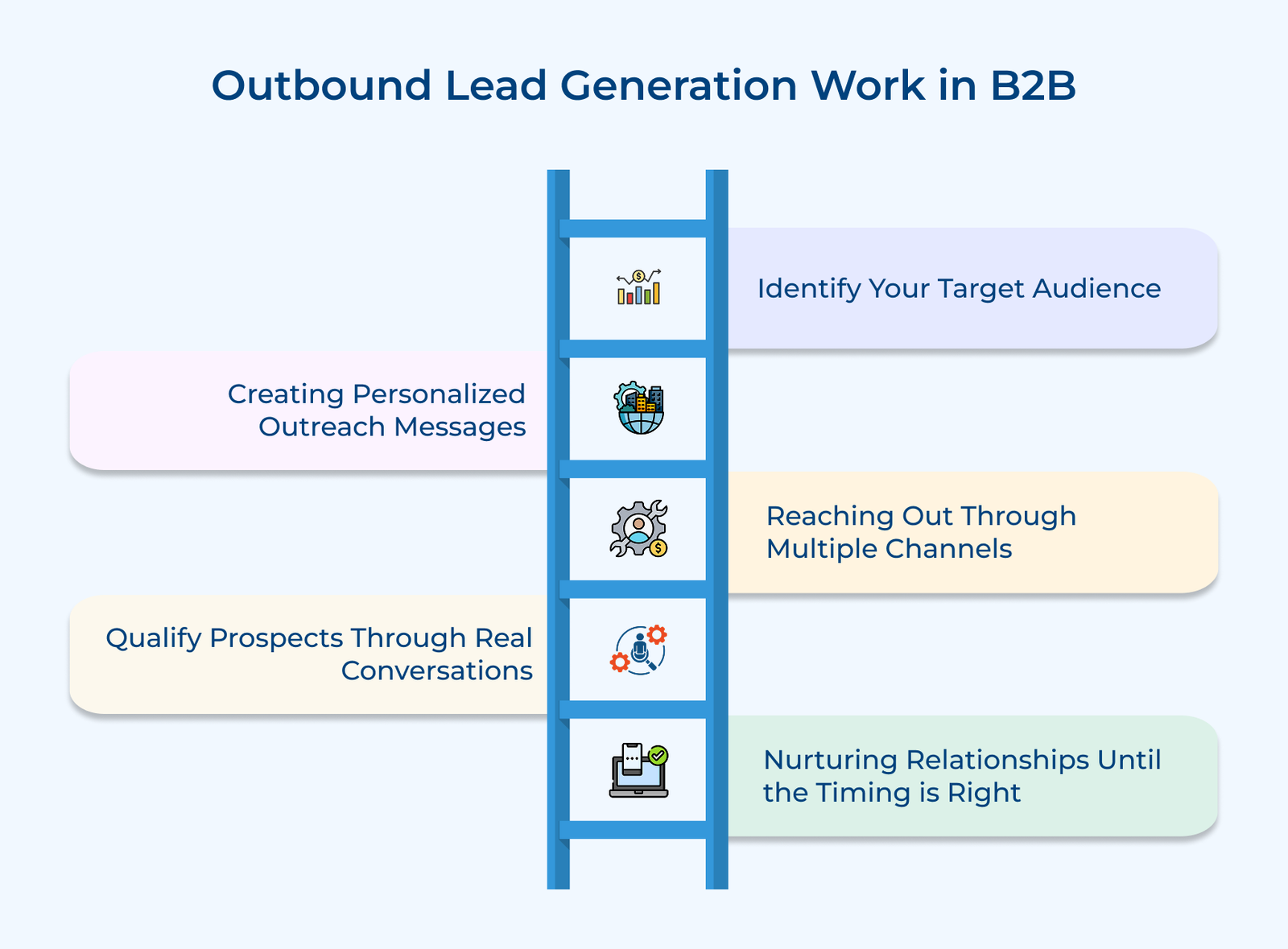
Start by defining who’s most likely to buy based on your best existing customers, such as their size, industry and common pain points. It helps you focus on prospects worth your time instead of chasing random leads.
You then use databases to build lists of companies that match your criteria and identify decision-makers within them. Reaching the wrong person at the right company is just as ineffective as reaching the right person at the wrong company.
Your sales team researches each prospect to understand their business challenges and crafts messages that speak directly to their specific situation. The personalization might reference recent company news or connect your solution to an industry challenge they’re facing.
The goal of your first message is to start a conversation or book a discovery call rather than close a deal immediately. You offer value upfront by sharing insights rather than immediately pitching your product to respect the prospect’s time.
Email works well for scale, but it shouldn’t be your only tool. Combine it with phone calls and LinkedIn messages to increase your chances of connecting.
Phone calls add a personal touch that breaks through when emails go unanswered and LinkedIn works well for reaching protective executives. Smart strategies combine the channels so a prospect receives an email and then a LinkedIn message referencing it days later.
When a prospect shows interest, your team asks questions to confirm if their needs align with your solution. You assess if they have the budget and timeline that match your sales process to avoid pursuing dead-end opportunities.
Discovery calls dig deeper into pain points and decision-making processes to evaluate if you should invest more time with them. The conversation should feel like a joint evaluation of if working together makes sense or not.
Some prospects simply aren’t ready and that’s fine. Stay in touch with helpful updates, quick check-ins or new ideas that might matter to them later.
Keep an eye on small signals like clicks or replies that show renewed interest. When the timing changes, you’ll already have the relationship, which makes restarting the conversation much easier.
Check out the proven B2B outbound sales lead generation tactics that will help you increase your sales and build meaningful relationships with prospects who are ready to engage.
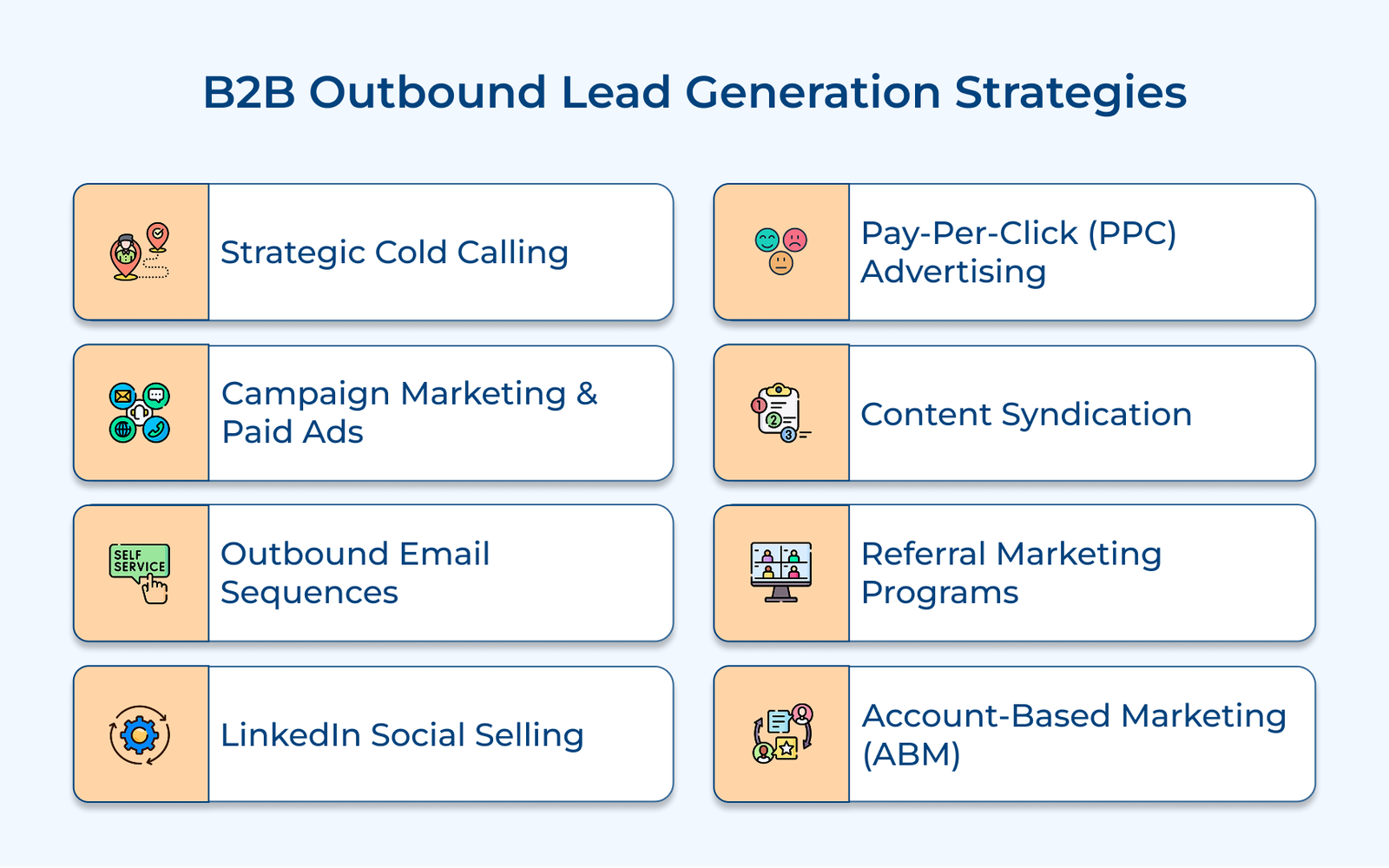
Cold calling means reaching out to people who haven’t shown interest yet but could genuinely benefit from what you offer. It remains necessary for outbound lead generation because it creates an immediate human connection and lets you have real-time discussions that email simply cannot replicate.
More than 70% of executives are willing to make an appointment or attend an event based on a cold call alone. The key is to approach every call with respect and preparation. You’re interrupting someone’s day, so you need to show quickly that you understand their world and have something worth hearing.
Key ways:
Campaign marketing means putting your message directly in front of the people you want to reach at the right time, on the right platform. It’s a way to create visibility and spark interest rather than waiting for prospects to find you.
Key questions:
The questions help you avoid wasted ad spend and ensure your campaigns target the right people with clear goals on appropriate platforms. Answering them upfront establishes measurable success criteria and prevents you from launching campaigns based on guesswork rather than strategy.
Once you’re ready, set up ads on channels like LinkedIn or Google using precise targeting. Write a simple, relevant copy that addresses real problems your audience faces and start with a small budget to test what works.
Key formats:
Outbound email sequences are a series of timed messages designed to start real conversations, not spam inboxes. One email rarely does the job, but a thoughtful sequence keeps you visible and relevant without crossing into annoyance.
The challenge is keeping things personal when you’re reaching out at scale. Research each company and personalize the first line with something specific that shows you’ve done your homework. Then keep the rest simple and consistent.
Example:
Most prospects get dozens of sales emails daily and ignore them without reading past the subject line. Your carefully crafted sequence might never get a fair chance, no matter how well you’ve personalized it or how valuable your solution actually is.
Social selling means building relationships with prospects by engaging with their content and sharing useful insights before pitching. It works because decision-makers on LinkedIn are more likely to engage with familiar names in their feed.
You can use the approach by commenting thoughtfully on your prospect’s posts and sharing content that positions you as knowledgeable in their industry. When you reach out, they already know your name and see you as helpful, not just another salesperson.
Pro tips:
Pay-per-click advertising means paying only when someone clicks your ad to visit your website or landing page. It’s quite useful for outbound lead generation because it reaches prospects already searching for solutions like yours. PPC generates twice the visitors that SEO does, with the average conversion rate being between 3.1% and 6%.
Key ways:
Content syndication means republishing your existing content on trusted third-party sites to reach new audiences beyond your usual traffic. It’s especially useful in B2B because decision-makers often read industry publications rather than discovering your website directly.
Content syndication means partnering with industry sites that share your articles or whitepapers with their audience. You typically gate the content behind a form to capture contact information from readers who download your material.
Key formats:
When it is perfectly done, it becomes a cost-effective way of reaching more of your audience because you’re leveraging someone else’s traffic. You gain visibility with qualified prospects without building your own audience from scratch, which can take years of consistent content marketing effort.
The main drawback is that syndicated leads are often of lower quality since many people download content without real interest. You might pay for contacts who only want the content, not your solution.
Key factors:
Referral marketing works by asking happy customers to introduce your company to people in their network who could also benefit from your product. It’s a very effective outbound lead generation strategy because a trusted recommendation carries far more weight than a cold email.
Create simple reward programs that offer discounts or gifts when customer referrals turn into paying clients. Make it easy with ready-to-use email and social post templates that customers can share.
Key takeaways:
Below are the key factors that distinguish inbound from outbound lead generation and help guide you in deciding which might be right for your business objectives.
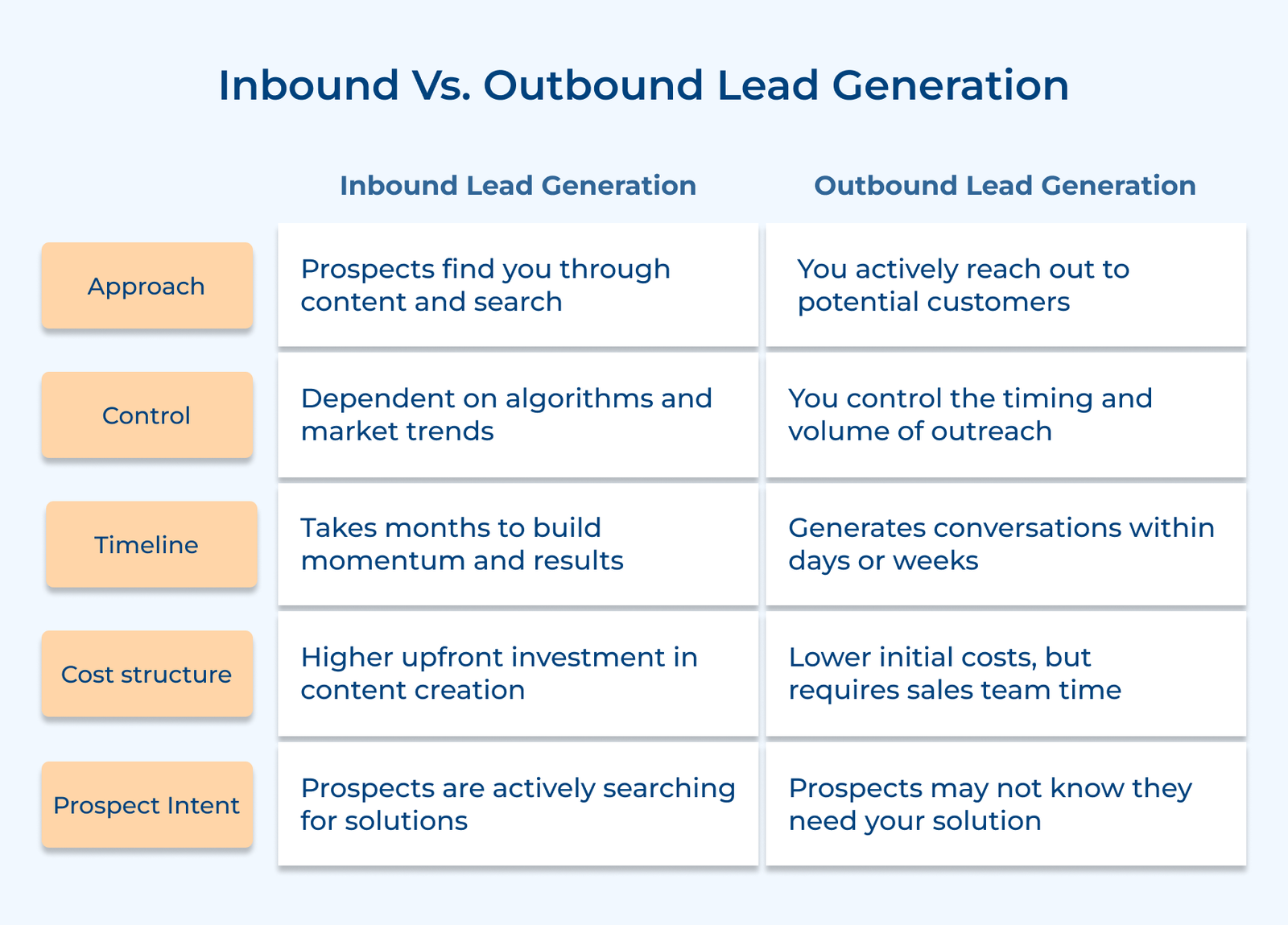
Who Starts the Conversation?
Inbound happens when prospects find you while searching for answers to problems they already know they have. Your website and content act as magnets that pull interested buyers toward you when they’re ready to explore options.
Outbound flips this dynamic because your sales team identifies target companies and reaches out before prospects start their buying journey. You’re introducing your solution to people who might not even realize there’s a better way to handle their current challenge.
Control Over the Pipeline
Inbound lead flow depends heavily on search engine rankings and social media algorithms that you can’t directly control or predict. A Google update or content trend shift can cut your lead volume overnight.
Outbound puts you in the driver’s seat because you decide exactly how many prospects to contact each week based on capacity. If you need more pipeline you simply increase outreach activity and if you need less, you dial it back immediately.
Speed of Results
Inbound takes time. You need months of steady publishing and SEO before results start to show. The payoff grows over time, but early progress can feel slow.
Outbound gives feedback within days since you reach decision-makers directly. The speed lets you test messaging and iterate on your value proposition much faster than waiting for organic traffic to build.
Resources and Costs
Inbound needs upfront investment in content, SEO, and tools before leads start coming in. The costs are heavily front-loaded and you’re essentially betting that future lead flow will justify the initial spending on content infrastructure.
Outbound needs fewer tools but relies on sales reps to research and send personalized outreach. Your main costs are personnel rather than content creation, which means you can start smaller and scale as you prove results.
Prospect Awareness
Inbound attracts prospects already aware of their problems and looking for solutions. The leads often arrive partially educated about your category, which can shorten sales cycles but also means they’re comparing multiple vendors simultaneously.
Outbound often reaches prospects who haven’t identified the problem yet or don’t know solutions like yours exist in the market. You must educate early, but face less competition since you’re first to engage.
The following are the practical ways to automate your outbound sales lead efforts without losing the personal touch.
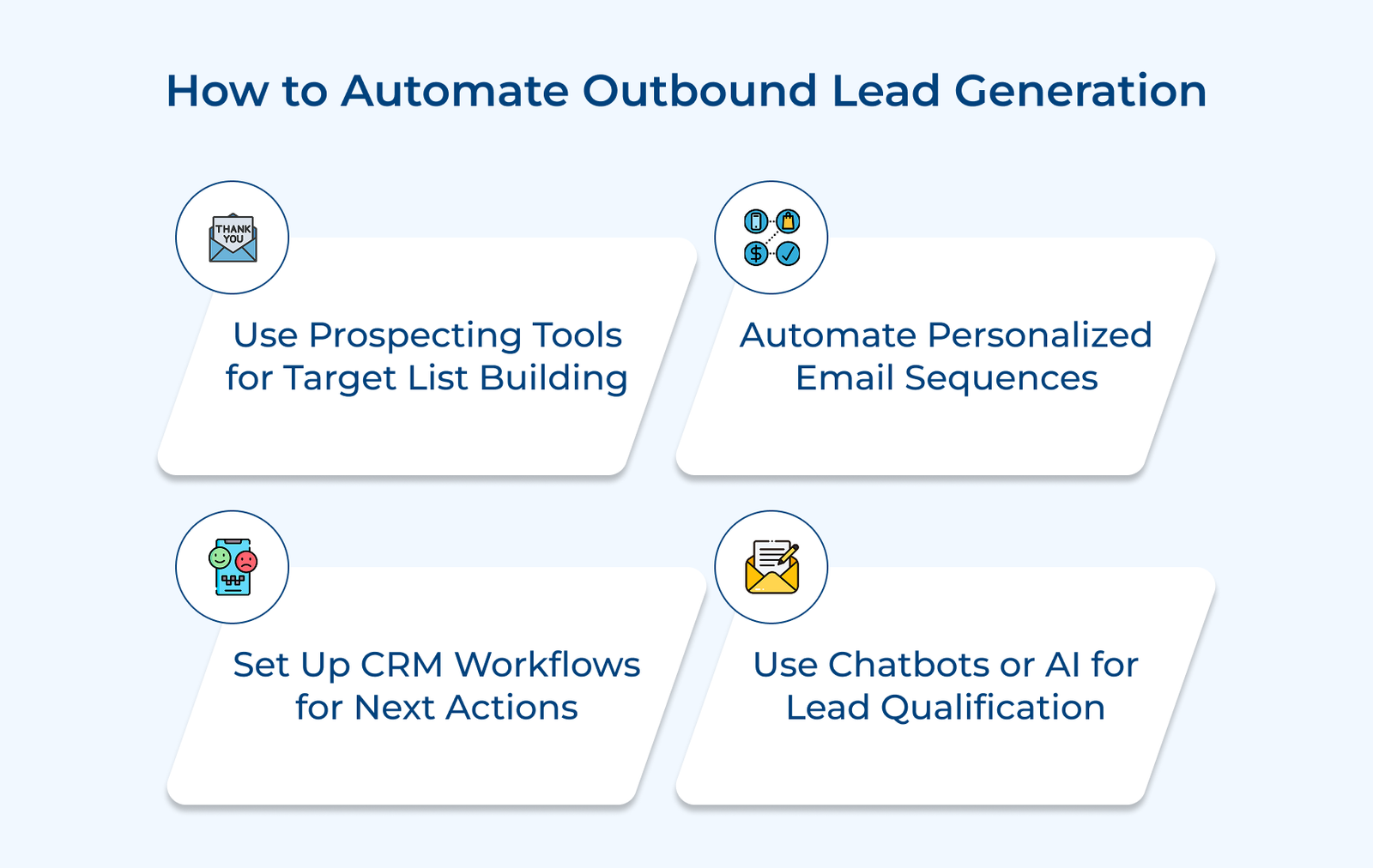
1. Use Prospecting Tools to Automate Target List Building
Tools like Apollo or ZoomInfo find companies and decision-makers that fit your target criteria. You simply define parameters like industry and company size then the system generates a fresh list of qualified prospects ready for outreach.
2. Automate Email Sequences Using Personalization Tokens
Email tools send personalized follow-ups automatically based on opens or clicks. You write your sequence once with personalization tokens that automatically insert the prospect’s name or company details, then the system handles sending and follow-ups.
3. Set Up CRM Workflows to Trigger Next Actions Automatically
Your CRM can auto-assign tasks and update pipeline stages based on prospect actions. You’re essentially creating rules that say “when it happens, then do that,” so your outreach process runs constantly even when team members are busy.
4. Deploy Chatbots or AI Assistants for Initial Qualification
AI chatbots engage visitors instantly and qualify leads before sending them to sales. The tools work around the clock to capture prospect information and schedule meetings without requiring a human to monitor incoming traffic constantly.
B2B outbound lead generation gives you control over your sales pipeline, letting you decide who to contact and when. The strategies help you reach decision-makers who might never find you on their own.
Success comes from blending personalization with automation to scale outreach while keeping the human touch that builds trust. Begin with one or two approaches that fit your team, then refine based on real prospect feedback to improve results steadily.

Accurate data guides who you contact and what you say, preventing wasted outreach to the wrong companies or decision-makers. Quality data lets you personalize messages effectively, while poor data means you’re calling the wrong people or sending emails to outdated addresses.
The main activities include cold calling prospects, sending personalized email sequences, reaching out through LinkedIn messages and engaging on social platforms. Your team also researches target accounts, qualifies leads through discovery calls and follows up persistently until prospects respond or explicitly opt out.
Score leads by factors like company size, role, and engagement level to focus on the most promising prospects. Use a CRM to track interactions and schedule follow-ups so no lead slips through the cracks.
Common mistakes include sending generic messages, quitting after a few attempts and targeting prospects who don’t fit your ideal profile. You also want to avoid aggressive pitching before understanding the prospect’s actual needs or failing to research their company before reaching out.
Outbound works for both B2B and B2C, but it’s more common in B2B because business purchasing decisions involve longer cycles and higher values. B2C purchases are quicker and lower-cost, making inbound marketing as well as paid ads more effective for the customers.
Both approaches aim to start conversations with potential customers and drive revenue growth by filling your sales pipeline with qualified opportunities. They both require understanding your ideal customer and crafting compelling messages, though outbound pushes your message out while inbound pulls prospects in.
Grow Customer Relationships and stronger team collaboration with our range of products across the Conversational Engagement Suite.
Omnichannel Customer Support & Help Desk Software
AI Enabled Business Messaging and Chatbot Software
Sales Engagement & CRM Software
Call Center Software & Virtual Phone System
Product Marketing & Experience Platform
Customer Experience & Feedback Management Software
 Scroll to top