Swarming vs Tiering Support: Which One’s Right For Your Business?
The blog compares swarming vs tiering support models. It explains how each works, their advantages, limitations and how to choose the right structure for faster resolutions.
The blog compares swarming vs tiering support models. It explains how each works, their advantages, limitations and how to choose the right structure for faster resolutions.
A customer calls in, explains their problem in full, gets transferred and explains it again. Then again. Somewhere in that third retelling, they stop being frustrated with the problem and start being frustrated with you.
Support teams have operated on tiered structures for decades. That design did make sense when products were simpler and customer expectations were lower. Neither of those is true anymore.
Two models now compete for how modern support should be structured: tiering, where cases climb a predefined escalation ladder and swarming, where one agent owns the case end-to-end and pulls in expertise without transferring ownership. If your support org is rethinking how tickets move, how ownership is assigned, and how expertise reaches customers without burning through their patience, the swarming vs tiering support debate is exactly the right place to start.
Tiered customer support refers to a structured system that organizes incoming requests by complexity and routes them to different levels of expertise. Simple queries get handled by frontline agents while more technical issues escalate to specialized teams. The system ensures customers reach the right expertise for their specific problem.
Similarly, tiered support directs simple requests to frontline agents and complex issues to specialists, so customers avoid unnecessary delays. The approach creates clear pathways for problem resolution. Each tier has defined responsibilities and expertise levels. When an agent can’t resolve an issue, they hand it to the next tier with context already documented.
Key objectives:
Swarming customer support refers to a collaborative approach where a team works together on a single customer issue in real time. One agent owns the conversation from start to finish and pulls in colleagues with the right expertise when the situation demands it.
Customers interact with one consistent point of contact while the team solves the problem behind the scenes. A difficult case does not move through layers of escalation. The assigned agent invites subject matter experts into the discussion and coordinates input as the solution takes shape. Shared visibility and active collaboration replace traditional handoffs.
Key objectives:
Let’s check out how the swarming vs tiering support approaches stack up against each other by looking at their respective strengths and weaknesses.
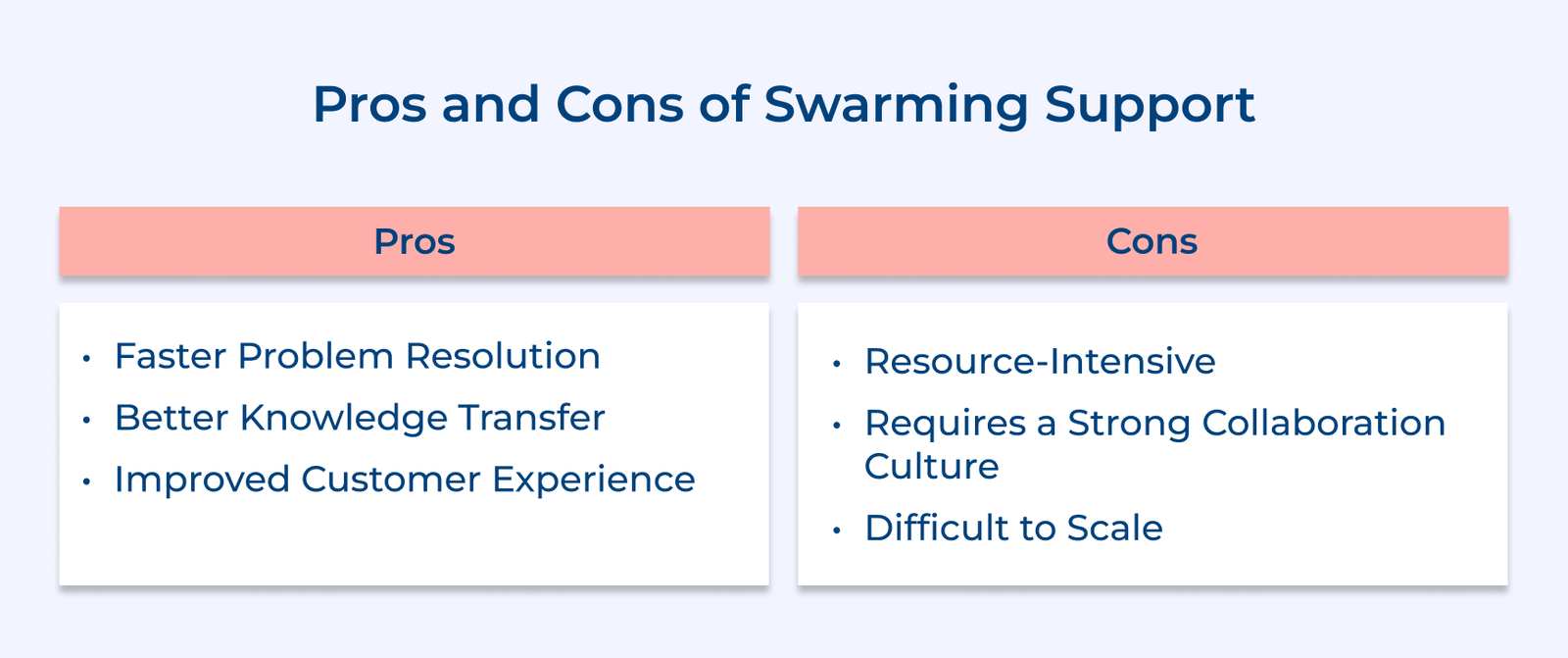
Faster problem resolution: Experts contribute at the same time instead of passing the case from one department to another. Shared input speeds up diagnosis and shortens the path to a clear solution.
Better knowledge transfer: Junior agents observe experienced specialists handling real cases. Live collaboration exposes practical thinking, structured troubleshooting and communication techniques that training manuals cannot fully capture.
Improved customer experience: Customers speak with one primary agent throughout their journey instead of repeating their story to multiple people. The continuity builds trust and reduces the frustration that comes from feeling passed around.
Resource-intensive: Involving several team members in one case increases time demands on specialists. Expert availability can shrink quickly when multiple complex issues arise at the same time, leading to capacity strain
Requires a strong collaboration culture: Effective swarming depends on open communication and willingness to assist across roles. Teams that operate in isolation or hesitate to share knowledge will face friction when adopting this model.
Difficult to scale: As your customer base grows, coordinating multiple experts for numerous issues becomes chaotic without sophisticated tools. Small teams can manage this informally, but larger operations need robust systems to track who’s helping with what.
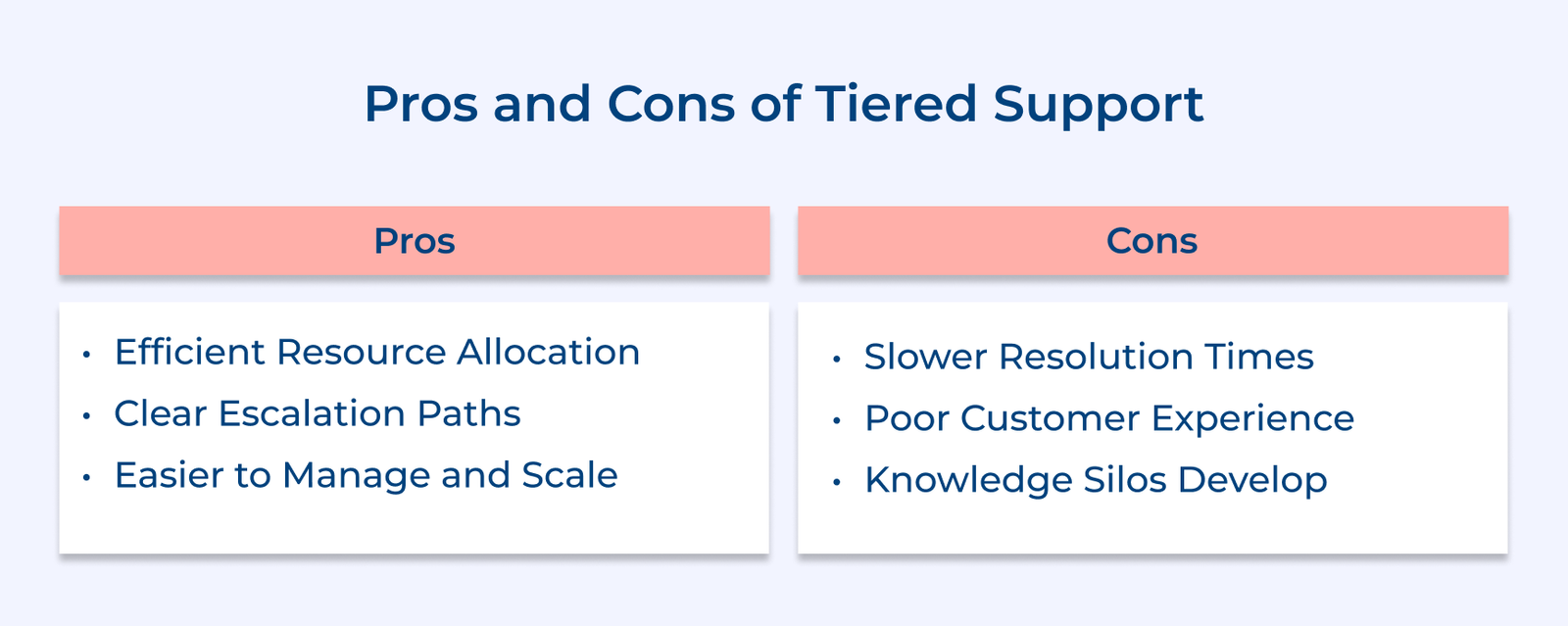
Efficient resource allocation: Senior specialists focus on advanced technical issues that require deep expertise. Frontline agents handle routine requests, allowing skilled resources to spend time where they add the most value.
Clear escalation paths: Defined criteria determine when a case moves to the next level. Teams understand their responsibilities and new hires can follow established workflows without confusion.
Easier to manage and scale: Structure tiers create clear reporting relationships and performance benchmarks. Growth becomes more manageable because additional agents can be added at specific levels based on demand and case complexity.
Slower resolution times: Cases move step by step through different levels and each transfer adds delay. A fix that takes minutes can sit in queues for days before reaching the right specialist.
Poor customer experience: Customers often repeat the same details as their issue moves across tiers. Repetition creates frustration and weakens confidence in the support process.
Knowledge silos develop: Frontline agents rarely gain exposure to complex cases, while senior specialists stay removed from everyday customer concerns. Separation limits shared learning and can disconnect solutions from practical user challenges.
Check out the key difference between swarming vs tiering support to understand how each approach handles customer issues.
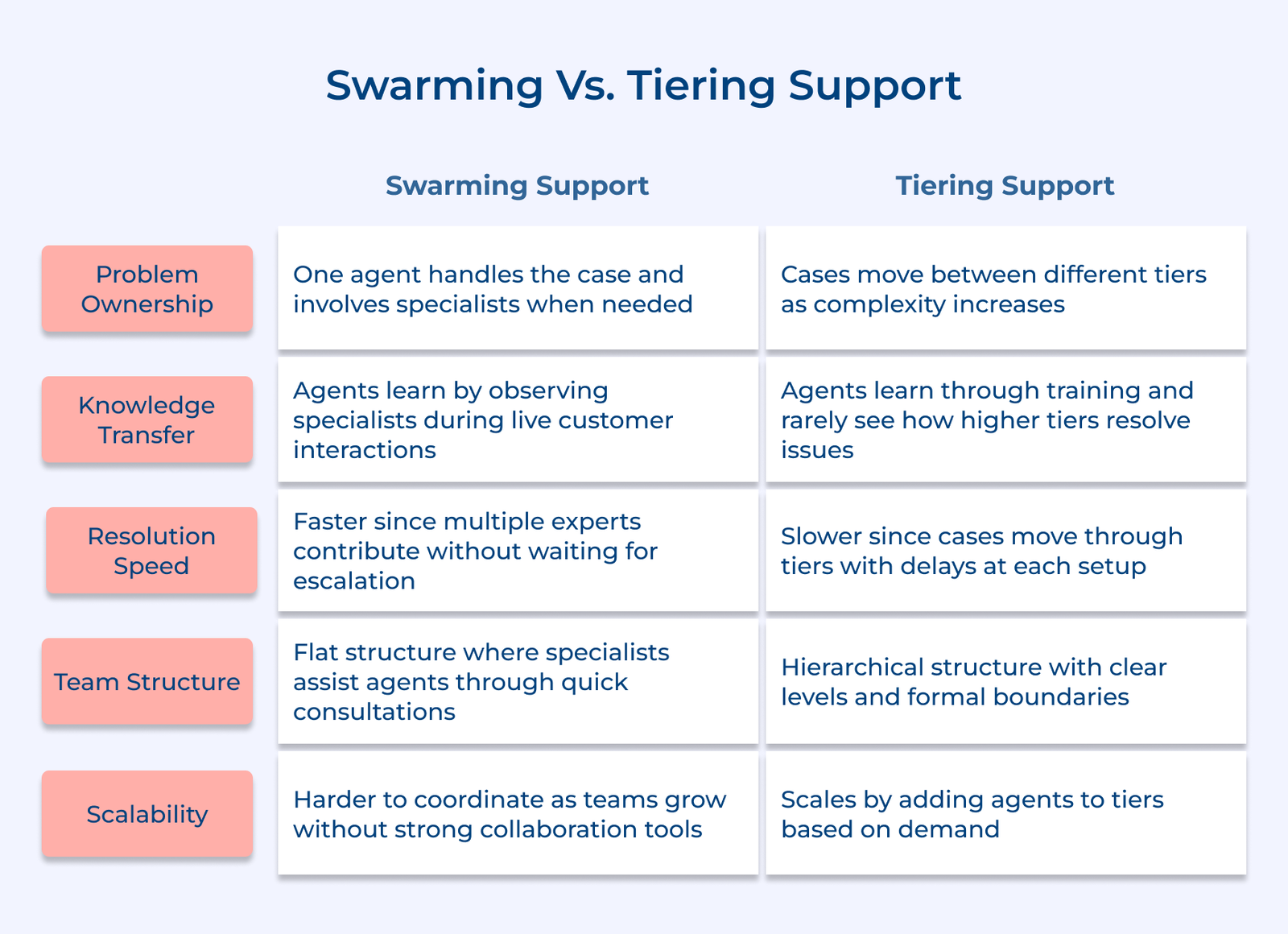
Swarming customer support keeps one agent responsible for the issue from beginning to resolution. The agent remains the main contact for the customer and brings in specialists when deeper expertise is required. Customers continue speaking with the same person while experts assist in the background.
The first agent who answers the call or ticket stays accountable for solving the problem. Specialists join through internal communication tools such as Slack or Teams while the agent keeps the customer informed about progress updates.
Pro tips:
Tiered customer support follows a different approach to ownership. A tier one agent documents the issue and transfers the case to tier two when it becomes too complex. The customer then interacts with a new agent who reviews the case details and continues the support process.
Swarming creates natural learning moments because agents see how specialists solve complex issues in real time. A junior agent who brings in a senior engineer for a database problem can observe the troubleshooting process and understand how the expert approaches the situation.
Repeated collaboration like this gradually builds stronger skills across the team. The junior agent begins to recognize similar issues in future cases and may solve them independently. Each interaction becomes a practical learning experience that strengthens the team’s knowledge.
Key mechanisms:
The tiered model handles learning differently. Agents within each tier develop strong expertise in their specific responsibilities but rarely see how higher tiers resolve escalated issues. A tier one agent may pass many cases to tier two without fully understanding how the problems are eventually solved.
The difference in speed becomes clear when looking at how quickly the right expertise reaches a problem. Swarming allows specialists to step in almost immediately when deeper knowledge is needed. The main agent can contact an expert and continue assisting the customer while support arrives.
Key questions:
Swarming reduces the gap between identifying the need for expertise and getting expert help. The agent simply messages the right person and that person can join immediately if available. Multiple experts can even contribute at the same time if the problem touches several domains.
The tiered support model introduces waiting periods at each escalation point. When tier one escalates to tier two, the case enters a queue where it waits for the next available tier two agent. That agent must then read through all the documentation from tier one before even beginning their own troubleshooting.
Swarming uses specialist time in short and focused moments instead of assigning them full ownership of a case. A senior database expert might spend fifteen minutes guiding a frontline agent through a difficult query problem. The same expert could assist several agents within the same hour.
The frontline agent continues handling the conversation with the customer and manages routine troubleshooting. Specialists step in only when deeper technical knowledge is required. The approach allows experts to focus on the part of the problem where their skills matter most.
Key scenarios:
The approach maximizes the impact of your most skilled people. Your specialists can touch many more cases in a day because they’re contributing expertise rather than managing entire workflows. Tiered support allocates resources by segregating work into distinct complexity levels. Each tier has dedicated staff who work exclusively on cases that reach their level.
Swarming works best in teams with a flexible and open structure. Specialists communicate easily across roles and share knowledge when a problem requires deeper expertise.
Accessibility and willingness to help each other play a major role in making this model effective. The collaborative model only works when your company culture genuinely supports it. Senior specialists must view assisting colleagues as part of their core job rather than an interruption.
Key questions:
Swarming keeps the entire customer conversation in one place because the original agent continues handling the case. Specialists join the discussion with full visibility of the interaction history inside the shared workspace.
Clear context improves the overall customer experience. Customers usually explain their issue with effort and detail. Repeating the same explanation to multiple agents can quickly lead to frustration and a feeling that the company is not paying attention.
Key ways:
Tiered support relies heavily on documentation during every handoff. A tier one agent records notes before transferring the case to tier two. Important details can still be missed during these transitions, which may require the customer to repeat information.
Swarming spreads specialist expertise across many customer cases instead of assigning them full ownership of each one. A senior engineer who might handle a few complex cases in a day can now assist many more by offering focused guidance when needed.
Actionable tips:
Swarming can also introduce new expenses that teams should plan for. Collaboration tools and communication platforms are becoming more important. Training investment may increase as agents develop broader skills across different areas. Technology spending increases to support collaboration platforms.
Tiered support offers more predictable cost structures that make financial planning straightforward. You know exactly how many tier one agents you need based on incoming ticket volume. Each tier has clear salary bands and you can forecast headcount needs with reasonable accuracy.
Choosing between swarming vs tiering support shapes how your team handles customer issues and shares knowledge. Swarming suits teams that rely on quick collaboration and value learning through real problem-solving with specialists.
Tiering works best when you need predictable scaling and clear specialization across your growing support organization. Your decision should align with your company culture and the complexity of problems your customers typically face daily.

Yes, many organizations combine both approaches. Tiering for basic issue categorization while implementing swarming within each tier. The hybrid model lets you maintain structure for scaling purposes while enabling collaborative problem-solving when agents need specialist input for complex cases.
Swarming often suits smaller teams because it allows specialists to support several agents at the same time. Shared expertise helps small teams solve a wider range of problems without needing a large support staff.
Tiering support usually tracks metrics such as escalation rates and resolution times within each tier. Swarming focuses more on first-contact resolution and collaboration between agents. Teams may also track how often agents solve issues independently after learning from specialists.
Swarming often leads to faster resolutions since specialists can assist as soon as a problem appears. Delays may happen when too many requests reach the same experts at once. Good coordination and availability help maintain faster response times.
Tiering works well when issues fall into clearly defined categories with predictable complexity levels, like password resets versus database migrations. Swarming excels with unpredictable problems that cross multiple domains, like when a customer’s issue involves billing, technical configuration plus account permissions all at once.
Switching often requires new collaboration tools, team training and time to adjust workflows. Teams may also update performance metrics and internal processes. Many organizations take several months to fully transition, depending on team size and existing systems.
Grow Customer Relationships and stronger team collaboration with our range of products across the Conversational Engagement Suite.
Omnichannel Customer Support & Help Desk Software
AI Enabled Business Messaging and Chatbot Software
Sales Engagement & CRM Software
Call Center Software & Virtual Phone System
Product Marketing & Experience Platform
Customer Experience & Feedback Management Software

 What is Customer Service Philosophy? Benefits, Tips & Examples
Scroll to top
What is Customer Service Philosophy? Benefits, Tips & Examples
Scroll to top