9 Best Sales Tactics for Businesses in 2026
Learn about the best sales tactics that help businesses communicate better and build customer trust. See how to handle objections confidently and close more deals through clear conversations.

Learn about the best sales tactics that help businesses communicate better and build customer trust. See how to handle objections confidently and close more deals through clear conversations.
Do you know what common sales pipelines that don’t end up working well? Problems usually start when sales teams apply the wrong approach at the wrong stage of the conversation. That disconnect quietly slows deals down, weakens relationships and causes opportunities to slip away.
A survey found that 91% of the businesses failed to achieve 80% or more of their quota target. That number highlights a larger issue. Many teams are putting in consistent effort but still struggling to turn activity into reliable results.
Below we’ll go through the best sales tactics that help teams improve prospecting, strengthen conversations, handle objections more effectively and close deals with greater consistency. Each tactic focuses on real sales situations that directly influence pipeline quality and long-term customer relationships.
Sales tactics refer to the specific actions sales teams use throughout the sales process to move conversations forward and help prospects make decisions. They are the practical steps used during outreach, discovery calls, follow-ups, demos and negotiations where deals are often won or lost.
B2B sales look very different from what most people expect. You are rarely selling to one person; you are navigating buying committees, building consensus and managing long decision cycles where trust matters more than a pitch.
The approach in SaaS sales shifts toward speed and value demonstration. Tactics here revolve around reducing time-to-value, getting the prospect into a trial or a live demo fast before their attention moves elsewhere. Not every tactic works the same way across different business models. A tactic like “urgency creation” works in SaaS through trial expiry or seat limits. When it comes to enterprise B2B, the same tactic needs to be anchored in business impact, like quarterly targets or competitive risk.
Key objectives:
Let’s understand why sales tactics matter for your business and how the right approach can help your team close deals more consistently.
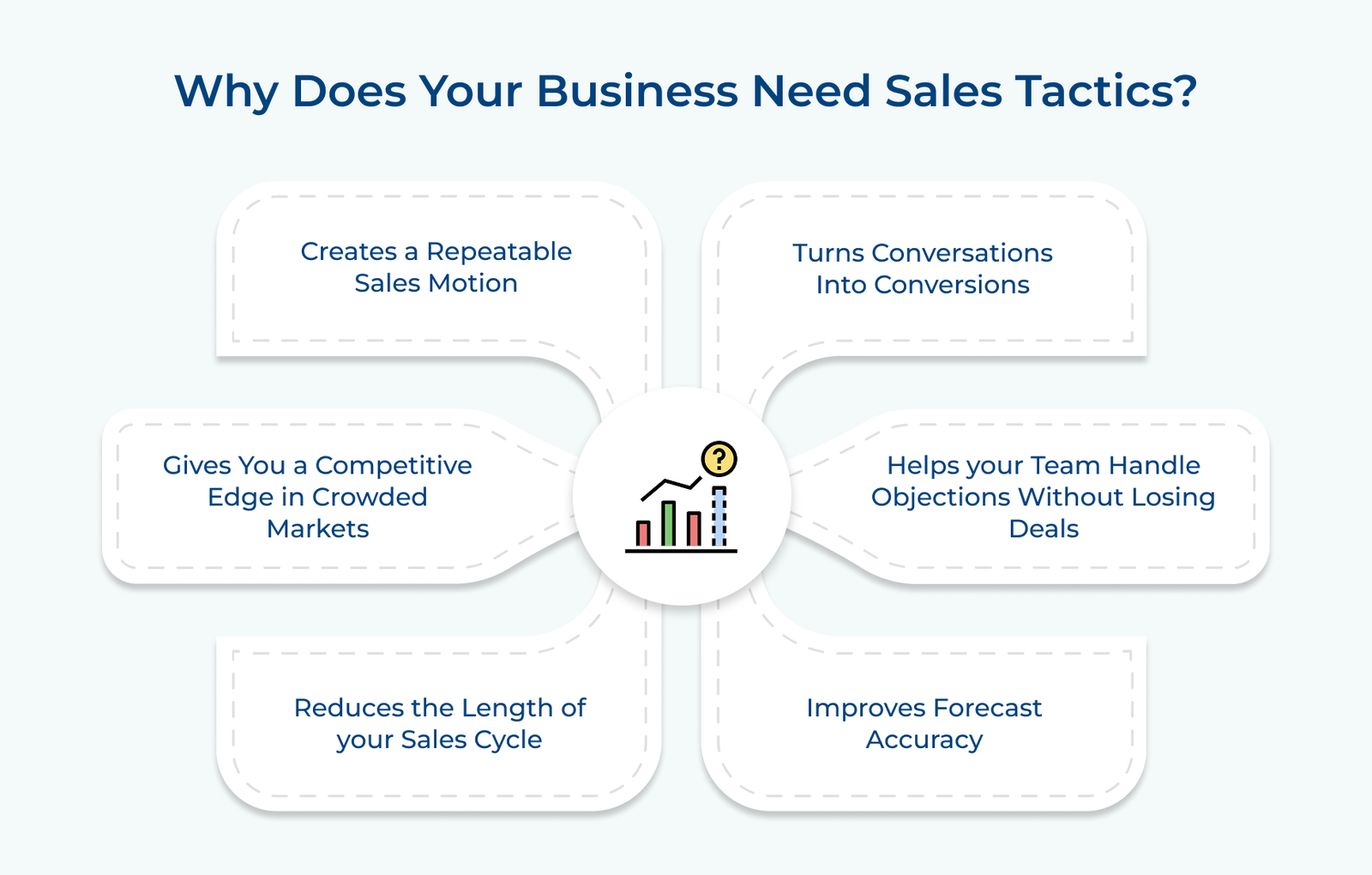
1. Turns Conversations into Conversions
Many deals fall apart because conversations lose direction. A prospect may show interest at the beginning, but without the right approach, the discussion slows down and momentum disappears. Strong sales tactics help reps guide conversations clearly and move opportunities toward real decisions.
2. Creates a Repeatable Sales Motion
When your sales tactics are defined and tested, any rep on your team can execute them consistently. You stop being dependent on one or two “natural closers” and start building a process that scales across your entire sales floor.
3. Reduces the Length of Your Sales Cycle
Long sales cycles drain time, resources and energy. Deals that stay inactive in the pipeline too long often lose momentum completely. Proven sales tactics like multi-threading or ROI anchoring push prospects to decisions faster without making them feel rushed.
4. Helps Your Team Handle Objections Without Losing Deals
Objections are usually signs that a prospect needs more clarity or reassurance before moving forward. Sales tactics give your reps a structured way to address concerns like pricing or timing without going off-script and killing momentum.
5. Improves Forecast Accuracy
When every rep follows a defined tactical playbook, deal stages actually mean something. You can predict which deals will close and when because the actions driving them forward are consistent.
The following are proven sales tactics that help businesses attract better prospects and close deals more consistently without relying on guesswork.
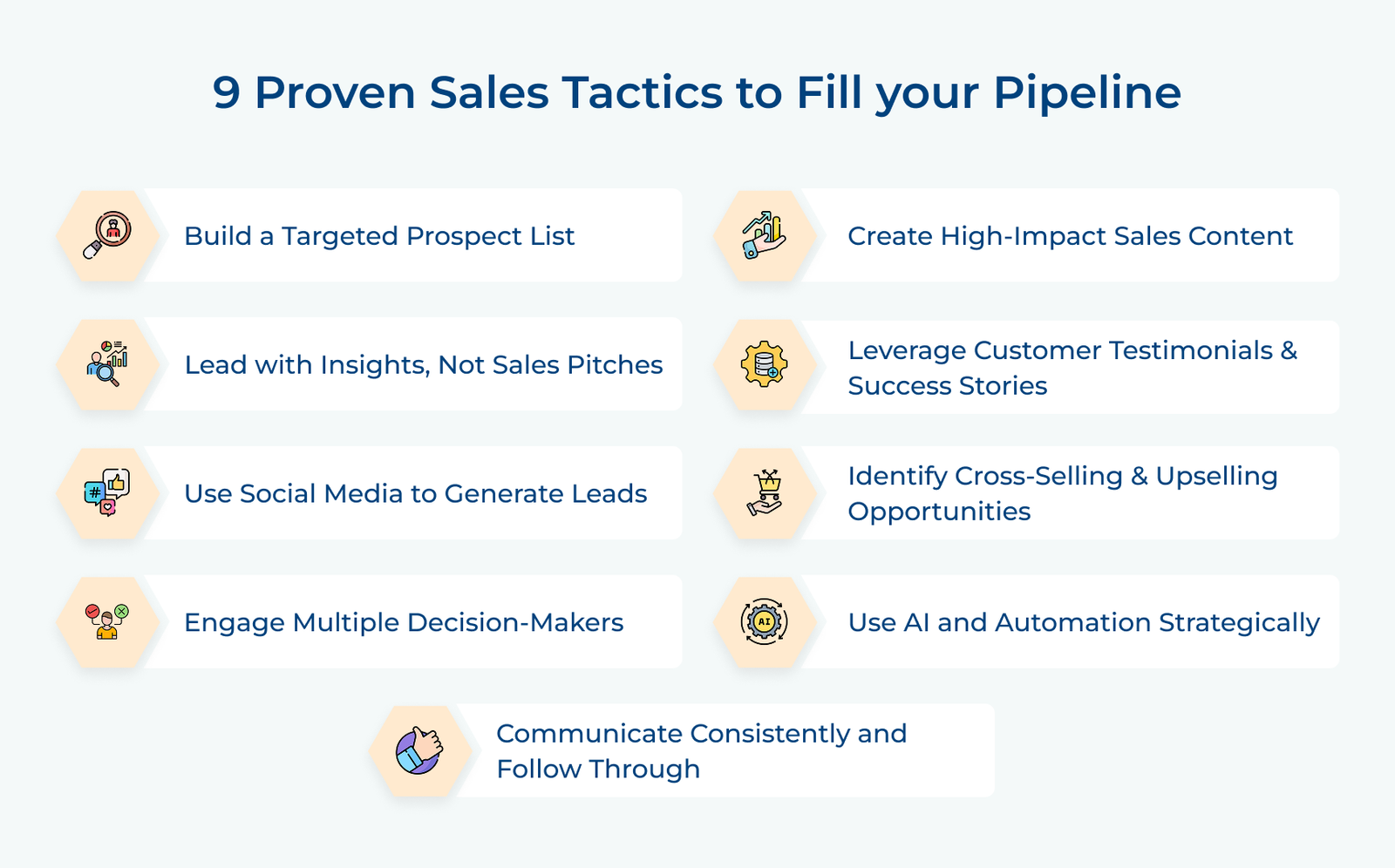
A strong sales process starts long before the first pitch. Sales teams waste enormous amounts of time reaching out to companies that were never likely to buy in the first place. Pitching without a targeted prospect list means your reps are burning time on accounts that will never convert. The quality of your pipeline is always determined before your first outreach, not during it.
Pro tips:
Leading with insight is one of the most underused sales tactics to fill your pipeline with prospects already leaning toward a conversation. When you open with something that challenges how a prospect thinks, you earn attention that a standard pitch never will.
Key questions:
The questions force a shift from product-first thinking to buyer-first thinking. When you can answer all five honestly, your outreach stops feeling like a pitch and starts feeling like a valuable conversation.
A practical approach is to research one visible challenge the company may currently be dealing with. Hiring growth, leadership changes, expansion into new markets or recent product launches often create pressure points worth discussing. Connecting the situations to results you helped similar businesses achieve makes the outreach feel far more relevant and credible.
Actionable tips:
Social media has become one of the most direct sales tactics to find and warm up leads before you ever send a cold message. Reps who consistently fill their pipeline treat platforms like LinkedIn as a live database of buying signals.
Engage with Prospects Before Sending Cold Outreach
Cold messages become more effective when some level of familiarity already exists. Thoughtful comments on a prospect’s posts or useful engagement with their content help create recognition naturally.
Share Content That Pulls Inbound Interest Toward You
When you consistently share content that speaks to your buyer’s challenges, the right prospects start coming to you. A single post that reframes a common industry problem can generate more qualified conversations than a full week of cold outreach.
Use LinkedIn Signals to Time Your Outreach Perfectly
LinkedIn gives you real-time buying signals, like profile views, post engagement and job change alerts. When a prospect engages with your content, that is your window to reach out while you are still top of mind.
Relying on a single contact inside an account is one of the most common reasons deals stall without warning. Multi-threading means building relationships across multiple stakeholders, so no single departure or disinterest can kill your deal.
How do you multi-thread without creating tension with your main contact? Present additional conversations as a way to keep the right stakeholders informed and aligned throughout the buying process rather than as an attempt to work around them.
Key points:
Once you have mapped the buying committee, engage each stakeholder with messaging tied to their specific priorities. A CFO cares about ROI, whereas an end-user cares about daily workflow impact.
Sales conversations become much harder when reps do not have the right material to support what they are saying. Strong sales enablement content gives teams clearer answers, more confidence and better ways to handle objections during important conversations.
Key ways:
Prospects trust real customer experiences far more than polished sales claims. People want evidence that a product or service has already helped businesses facing similar challenges. Strong testimonials and measurable results help remove uncertainty and make decisions feel safer.
Best practices:
Most revenue growth opportunities are already sitting inside your existing customer base. You just need a system to find and act on them at the right time. Cross-selling and upselling are not aggressive sales tactics; they are a natural extension of delivering consistent value to customers who already trust you.
How do you identify the right moment to introduce an upsell without damaging the relationship? The timing has to be anchored in their success, not your quota. When a customer has hit a clear milestone or outgrown their current setup, that is your signal to have the expansion conversation.
Key points:
Once you identify a strong expansion signal, tie your upsell directly to a measurable business outcome they care about. Saying “the feature will cut your team’s reporting time by half” lands far better than “you should consider upgrading your plan.”
AI and automation work best when they remove repetitive tasks and give sales teams more time for meaningful conversations. The goal is not to replace human interaction. The goal is to help reps spend less time on manual work and more time speaking with qualified prospects.
Key factors:
The sales teams winning right now are not using AI to spray more outreach into the market. They are using it to make sharper decisions about where their reps invest time and which accounts deserve priority attention this week.
Use cases:
Inconsistent communication is one of the quietest deal killers in any pipeline. Buyers are actively evaluating your reliability long before they sign anything. The way you handle small commitments during the sales process tells a prospect exactly what kind of partner you will be after the contract is signed.
How you follow through on every touchpoint is a direct reflection of your professionalism and the trust your prospect places in you. Reps who communicate with consistency and genuine purpose will consistently outsell those who rely on product strength alone to carry their deals home.
Best practices:
Check out the most common sales tactic mistakes that slow deals down, weaken customer trust and prevent sales teams from turning strong opportunities into closed business.
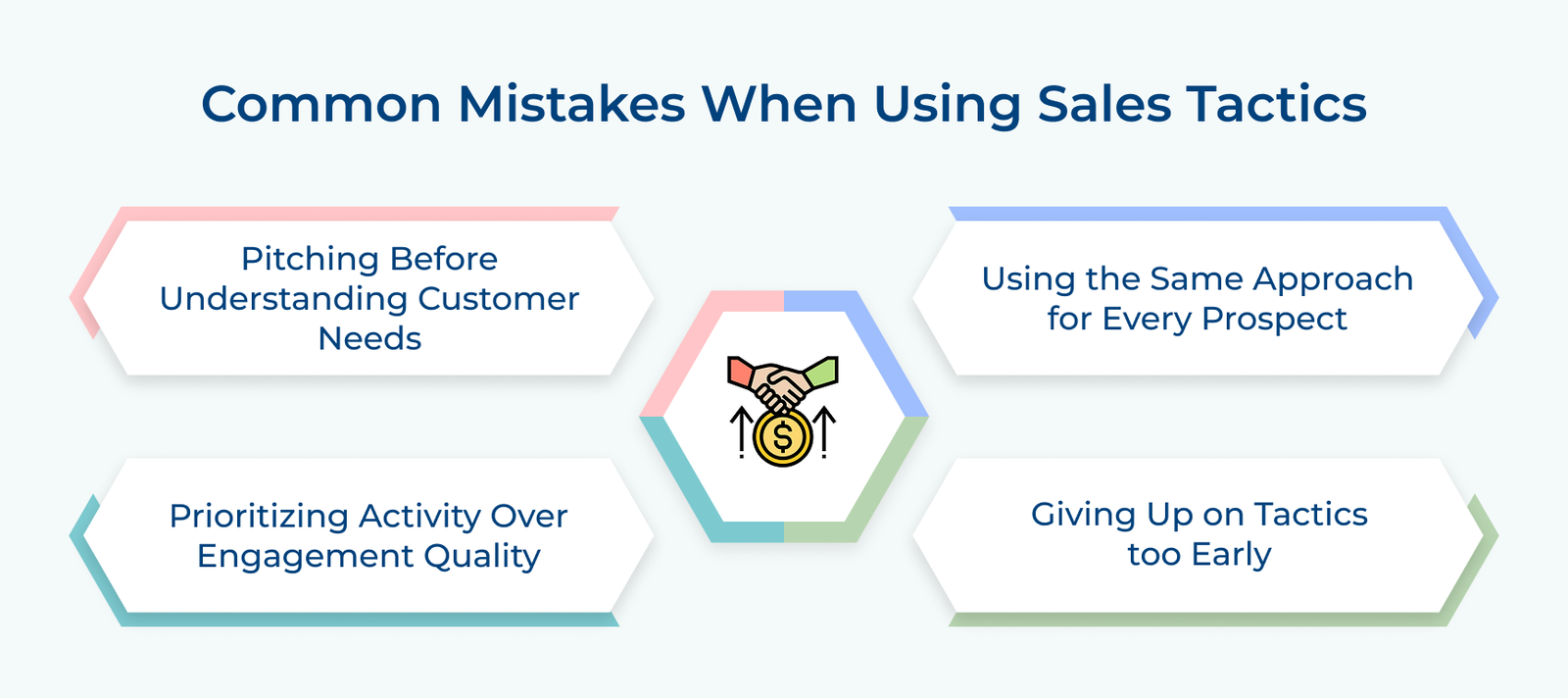
1. Pitching Before Understanding the Buyer’s Problem
Many sales conversations fail because the rep starts talking about the product too early. Prospects lose interest quickly when they feel the conversation is focused more on selling than on understanding their situation. Strong sales conversations begin with active listening. Buyers are far more likely to engage when they feel their challenges, priorities and goals are being understood first.
2. Using the Same Sales Tactic for Every Prospect
Sales tactics that work perfectly for a mid-size SaaS buyer will fall completely flat with an enterprise procurement team. Treating every prospect the same way shows a lack of research and kills trust before the conversation even gets started.
3. Focusing on Activity Volume Over Quality of Engagement
Sending 100 generic outreach messages will never outperform 20 highly personalized and well-researched ones. High activity numbers look good on a dashboard but they consistently produce shallow pipelines filled with unqualified and uninterested prospects.
4. Abandoning Tactics Before Giving them Time to Work
The best sales tactics usually need consistency before meaningful results appear. Many teams test a new approach briefly, see limited immediate success and move on before the tactic has enough time to work properly. Approaches such as multi-threading, insight-driven outreach or relationship building often improve gradually through repetition and refinement.
Implementation steps:
Sales tactics are not a shortcut to closing deals. They are the disciplined execution layer that separates consistent revenue from unpredictable results. The teams that win are the ones who treat every tactic as a repeatable system rather than a one-time experiment.
Key takeaways:
If you are ready to stop relying on gut instinct and start building a pipeline that performs consistently, now is the time to put these tactics into a real playbook. Start with a few sales techniques from the guide and measure the impact before expanding your approach across the full team. The best sales tactics are not about pressure or persuasion tricks. They are about showing up with the right message, for the right buyer, at exactly the right moment in their journey.

Without defined sales tactics, your team has no repeatable way to move prospects toward a decision consistently. These sales techniques give every rep a proven execution framework that removes guesswork and drives predictable revenue results.
B2C sales usually move quickly, so the most effective tactics focus on building trust fast and making decisions easier for the buyer. Social proof, personalized follow-ups, limited time offers and simple communication often work well because buyers typically make decisions within shorter timeframes.
Start by understanding your buyer’s decision-making process and where deals most commonly stall in your pipeline. The right tactics are always the ones that directly address your specific conversion gaps rather than what worked for someone else.
Today’s buyers are more informed and more resistant to traditional pressure-based approaches than ever before. Modern sales strategies adapt to that shift through more personalized communication, useful insights and better timing throughout the buyer journey. Conversations become more effective when sales teams focus on relevance and clarity instead of pressure-based selling.
Grow Customer Relationships and stronger team collaboration with our range of products across the Conversational Engagement Suite.
Omnichannel Customer Support & Help Desk Software
AI Enabled Business Messaging and Chatbot Software
Sales Engagement & CRM Software
Call Center Software & Virtual Phone System
Product Marketing & Experience Platform
Customer Experience & Feedback Management Software

 Outage Communication: Benefits, Steps & Best Practices
Scroll to top
Outage Communication: Benefits, Steps & Best Practices
Scroll to top