What is Campaign Management? Components, Steps & Types
Learn what campaign management involves, from planning and execution to tracking performance. Explore key components and campaign types that help drive consistent marketing success.

Learn what campaign management involves, from planning and execution to tracking performance. Explore key components and campaign types that help drive consistent marketing success.
Every stakeholder in the room nodded when the campaign plan was presented. Fast forward to the next six weeks: half the deliverables were late, the budget had quietly crept 20% over and the post-mortem conversation circled back to the same question: who was supposed to own it?
That question rarely has a clear answer, because the problem was never about effort or intent. It was about the absence of a system that kept ownership, timelines and decisions visible to everyone running the campaign.
More than 80% of marketing campaigns miss their targets. It is why it’s important to have a comprehensive view of campaign management because the teams that consistently hit their campaign targets are not running harder, they are running a better process to manage their campaigns.
Campaign management refers to the process of planning, running, tracking and improving marketing campaigns. It brings together marketing strategy, content and data so campaigns reach the right audience at the right time.
Marketing campaign management software brings all your campaign activities into one place. It eliminates the chaos of managing multiple spreadsheets and disconnected tools by giving your team a single source of truth.
A good platform does more than store data. It helps teams understand what is working and what needs attention. Everything from channels to team workflows stays connected and easier to manage.
Key features:
Let’s go through the key reasons marketing campaign management matters, from improving coordination to helping teams track performance clearly.
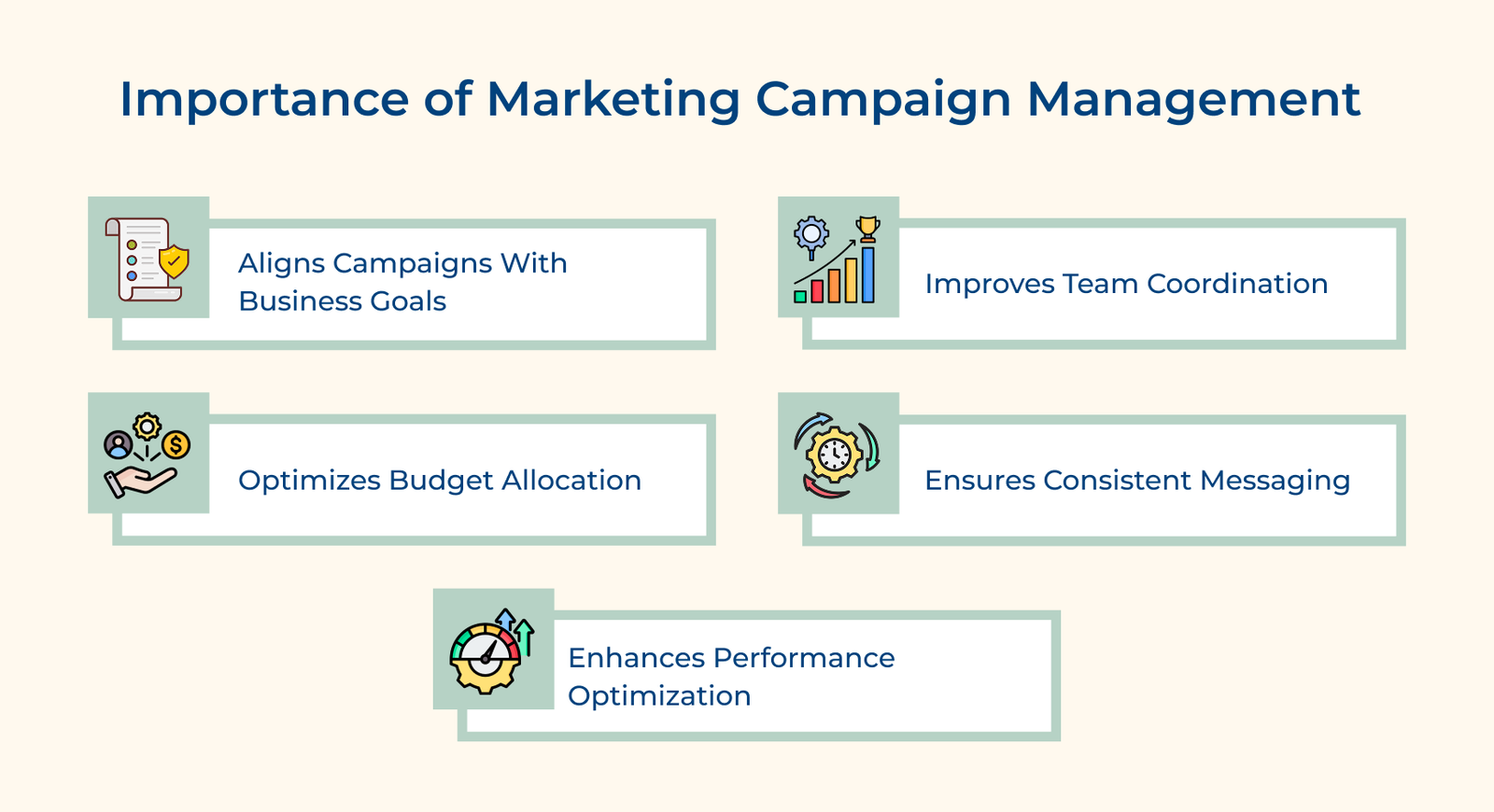
1. Keeps Every Campaign Aligned with Business Goals
Campaigns often lose direction when execution moves away from the original goal. A clear management process keeps every decision tied to a measurable outcome and prevents unnecessary drift.
2. Improves Team Coordination and Reduces Execution Gaps
Breakdowns usually happen during handoffs between creative, media and analytics teams. Clear roles and responsibilities at each stage help work move smoothly without delays or confusion.
3. Enables Smarter Budget Allocation
Experienced marketers know that budgets rarely perform equally across channels and campaign management gives you the data to act on that reality quickly. Tracking performance early helps shift spend toward what is working and avoid wasting money on underperforming areas.
4. Delivers Consistent Messaging Across All Channels
A customer who sees your LinkedIn ad and then lands on a mismatched email sequence immediately loses trust in your brand. Campaign management ensures every touchpoint tells the same story in the same tone, regardless of the channel.
5. Makes Performance Optimization Faster and More Accurate
Waiting until the end of a campaign to review results limits your ability to improve. Tracking performance during the campaign helps make timely changes while there is still room to adjust. Small improvements made early often lead to significantly better outcomes.
The following are the components that hold the entire process together. Let’s check them out in more detail.
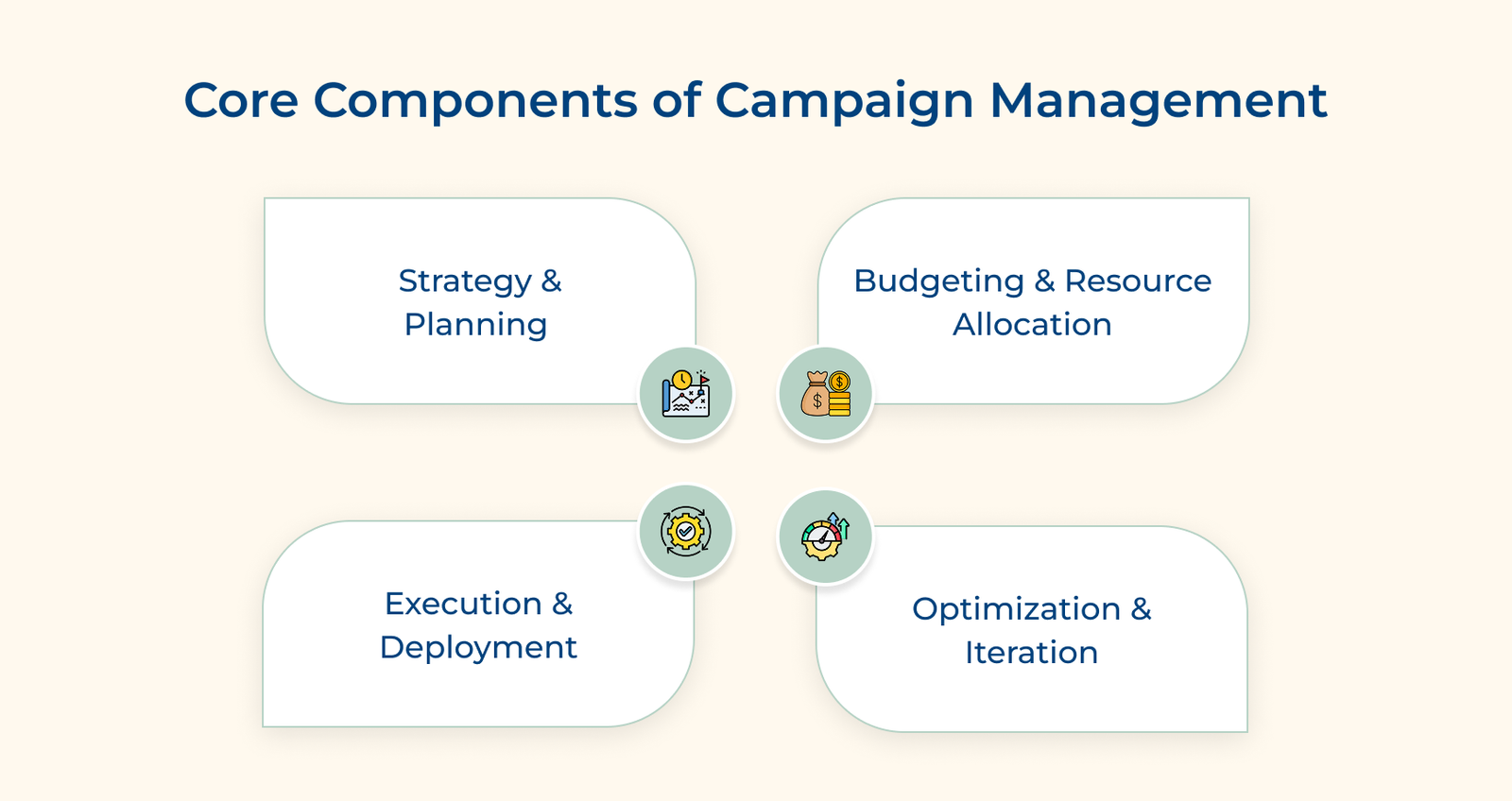
A campaign without a clear plan turns into scattered activity that drains the budget quickly. Define the audience, campaign objective and the specific metrics that will tell you whether you have succeeded.
Key questions:
Skipping this stage leads to confusion later, even when the creative looks strong. A well-built strategy keeps decisions consistent when challenges come up during execution. It also helps the team move faster since everyone is aligned on the same priorities from the start.
Budget decisions made before a campaign launches determine the ceiling of what that campaign can realistically achieve. Allocating spend without looking at past performance often leads to wasted effort.
Keep part of the budget flexible, reserving 15 to 20 percent for reallocation once early performance data starts coming in. The approach allows you to double down on what is working rather than staying locked into a plan that the data is already disproving.
Execution is where plans are tested in real conditions and small gaps quickly become visible. The difference between a smooth launch and a chaotic one almost always comes down to how well the pre-execution checklist was followed.
Key scenario in a SaaS company:
Even with a strong campaign management strategy and budget in place, poor deployment can kill a campaign’s performance in the first 48 hours. Building a structured launch process with clear sign-offs at every step is what separates teams that execute consistently from those that are always firefighting.
Optimization is not an end-of-campaign activity. It is a continuous process that begins the moment your first data points come in. Waiting until a campaign ends to make changes means you have already spent the majority of your budget on underperforming variables.
Pro tips:
Below is a step-by-step process to help you manage your marketing campaign efficiently and achieve your desired goals.
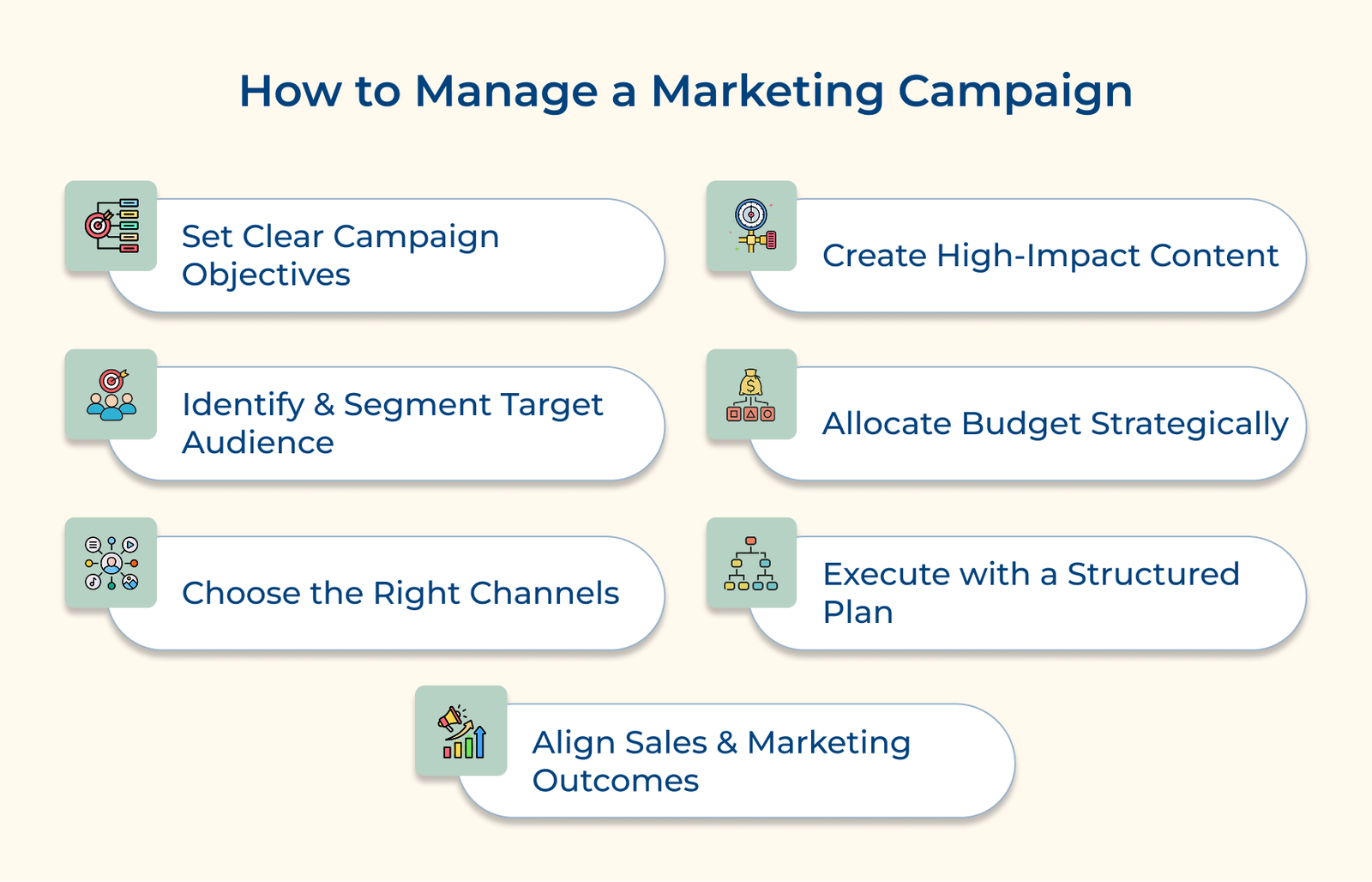
Campaigns fail when goals are set loosely and not tied to real business numbers. Vague targets lead to unclear results and make improvement difficult. Teams also end up focusing on activities instead of outcomes that actually matter.
Clear objectives define what needs to be achieved, how much and within what timeline. This gives every decision a clear direction and removes guesswork during execution. It also helps teams evaluate performance quickly and make adjustments without losing focus.
Key objectives in a SaaS company:
Specific objectives remove confusion and help the team focus on what actually moves results. Clear objectives are not just a planning tool; they are the management system your entire campaign runs on.
Knowing your audience decides if your message connects or gets ignored. Without clarity, decisions around channel, content and budget turn into guesswork. It often leads to wasted effort on people who were never likely to convert in the first place.
Key questions:
The answers shape how your message should be framed. A clear understanding moves your targeting beyond basic demographics and into real intent as well as behavior. It makes your messaging more relevant and increases the chances of meaningful engagement.
Key segments:
Choosing the wrong channels is one of the most expensive mistakes in campaign management because you do not discover the error until a significant budget has already been spent. The right channel is never the most popular one; it is the one where your specific audience is most receptive to your message.
Key factors:
Teams that get it right pay close attention to audience behavior. Decisions come from data, not habits or past wins from unrelated campaigns. They constantly test and adjust instead of assuming what worked once will keep working.
Key channels:
Content carries your entire campaign to the audience. Weak content fails even when targeting and channels are right. Every piece you create has one job. Grab attention fast and guide the reader toward a clear next step.
Key ways:
The most common challenge is producing content that feels consistent across multiple channels when different teams are creating assets in parallel. The fix is a campaign content brief that every team works from, one document that defines the core message, the audience pain point, the tone and the single call to action before a single word gets written.
Most campaign budgets fail before the campaign even starts. The teams that consistently extract more from their budget treat allocation as an active decision, not a one-time planning exercise.
Key questions:
Without clear answers, your budget becomes rigid at the exact moment it needs to be flexible. Financial clarity before launch is what separates campaigns that optimize well from ones that burn through spend waiting for results that never come.
Key takeaways:
A strong strategy means very little if execution is messy. Most campaigns lose momentum on day one because small mistakes slip through and affect performance. Early data shapes every decision that follows, so errors at this stage create misleading signals that are hard to recover from.
A structured launch protects you from wasting budget on avoidable issues. Tracking gaps, broken links or unclear ownership can quietly damage results while everything looks live on the surface. The first 48 hours set the direction for the entire campaign, so they need to be clean.
Pro tips:
The teams that execute cleanly are not the ones with the most resources. They are the ones who treated preparation as seriously as strategy and built a launch process that removes human error from the equation before it gets the chance to cost them.
A campaign can hit every top-level metric and still fail to bring real results. Leads mean nothing if sales do not know how to handle them. The handoff is where effort turns into revenue or gets lost without notice.
Key questions:
Late alignment creates confusion. Leads lose interest while teams figure things out. Clarity before leads start coming in keeps momentum intact. It also ensures faster follow-up when interest is at its peak.
Actionable tips:
The campaigns that drive real revenue are not owned by one team. They are revenue campaigns where sales and marketing operate around one shared outcome from the first planning meeting to the final closed deal.
Best practices:
Check out the role of AI in campaign management as it helps teams analyze data faster, improve targeting and make smarter decisions without relying on guesswork.
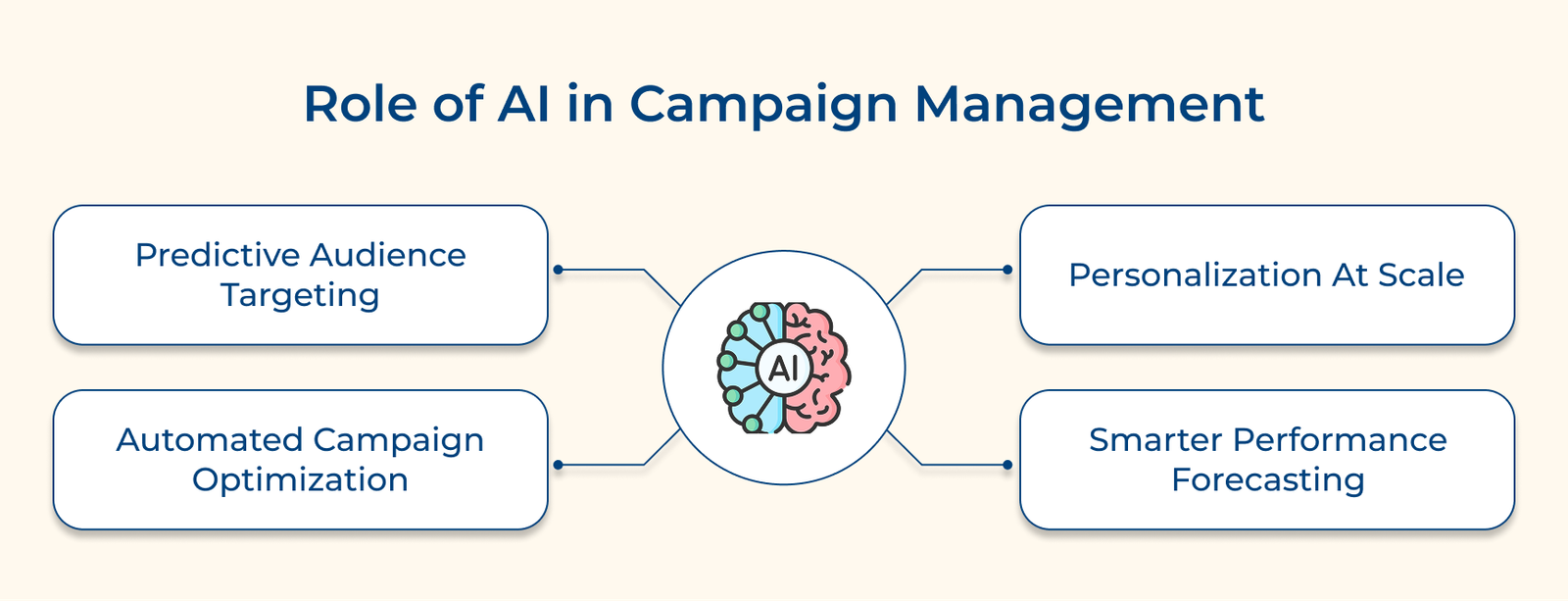
1. Predictive Audience Targeting
AI studies behavior across large sets of data to spot patterns humans would miss. It helps you focus on people who are more likely to take action, so your budget is spent on the right audience from the start.
2. Automated Campaign Optimization
AI keeps track of performance as the campaign runs and adjusts based on what is actually working. What used to take a skilled media buyer hours of analysis now happens automatically without human intervention.
3. Personalization at Scale
Reaching different audience groups with relevant messaging becomes difficult as campaigns grow. AI makes it manageable by adjusting content, offers and timing based on how people interact, without adding extra workload.
4. Smarter Performance Forecasting
AI uses past campaign data to estimate future outcomes with better accuracy. Targets and budget decisions become more grounded since they are based on patterns across large data sets instead of assumptions.
Let’s go through the different types of campaign management and understand how each one works, so you can choose the right approach based on your goals.
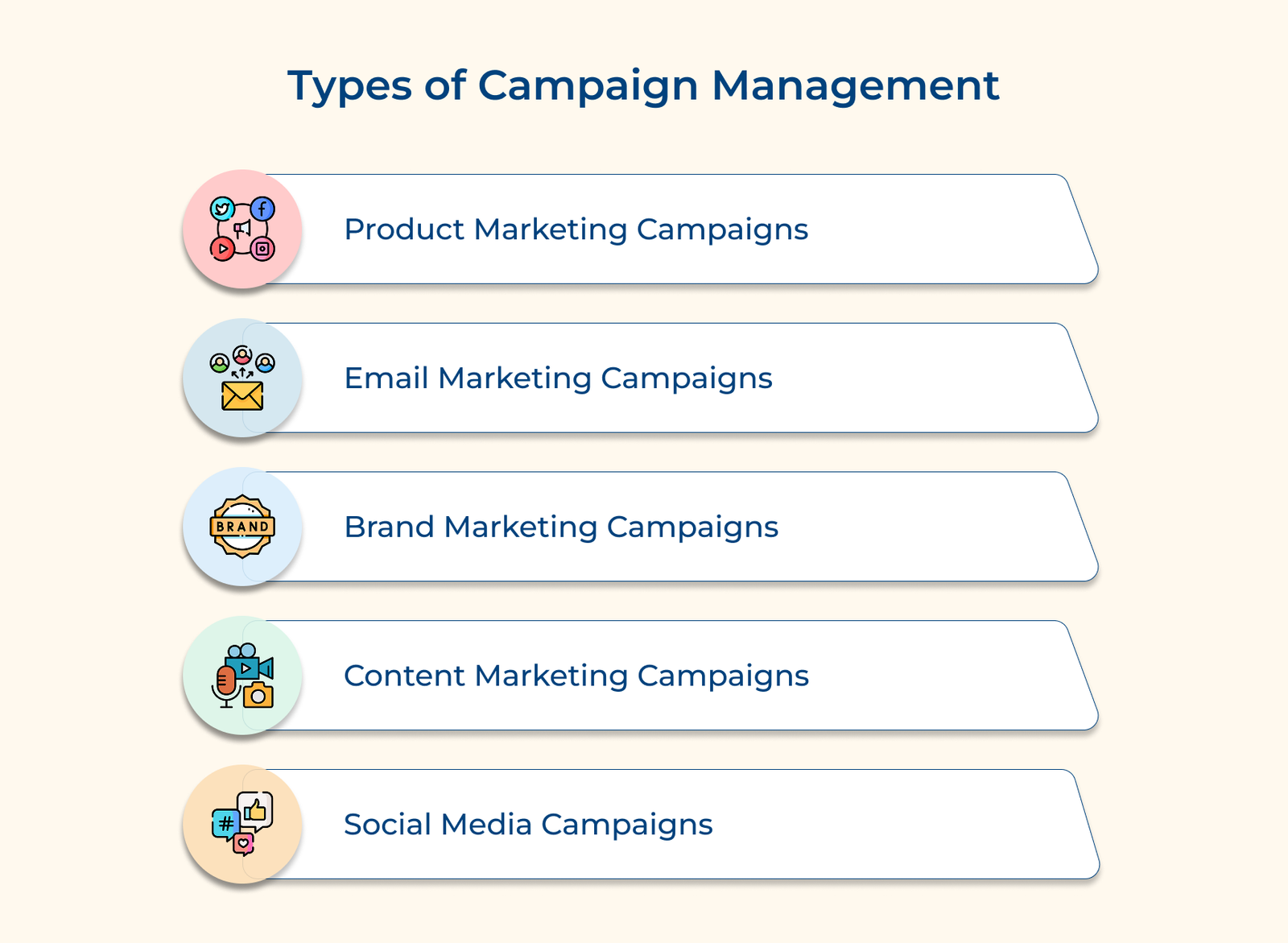
Most teams start with features because it feels easier. Buyers care more about their problem than your product. Shift the focus to what they are dealing with and your message becomes easier to connect with.
Opening with the customer’s pain makes people pay attention. Once they feel understood, your product naturally becomes the solution instead of something you have to push. The approach builds trust early and makes the decision feel easier.
Email works because people have already permitted you to reach them. Treating everyone the same ignores that trust and reduces engagement over time. Relevant messages keep that permission valuable and make people more likely to respond.
Brand campaigns are hard to get approved because their impact never shows up in the month’s numbers. But what they build, which is recognition and preference, is what makes every other campaign perform better over time.
Companies that cut brand investment during tough quarters find their paid acquisition costs climbing shortly after. Audiences buy from names they already recognize and brand campaigns are what keep you on that shortlist.
Content marketing works on a different timeline than every other campaign type and that is where teams lose patience. The work you put in today keeps bringing value long after the campaign ends.
Strong content builds trust with people who are already researching a purchase decision. When your content answers their questions best, your brand becomes the default choice before sales even begin.
Social campaigns often run without a clear goal, which leads to weak results. Posting without a defined outcome turns effort into noise instead of impact. Clear goals help you measure what is working and improve faster.
Clarity on what you want people to do changes how you create and measure content. Understanding how your audience behaves on each platform is what makes social campaigns actually work.
Below are the campaign management metrics that help you understand how effectively your efforts are driving meaningful results.
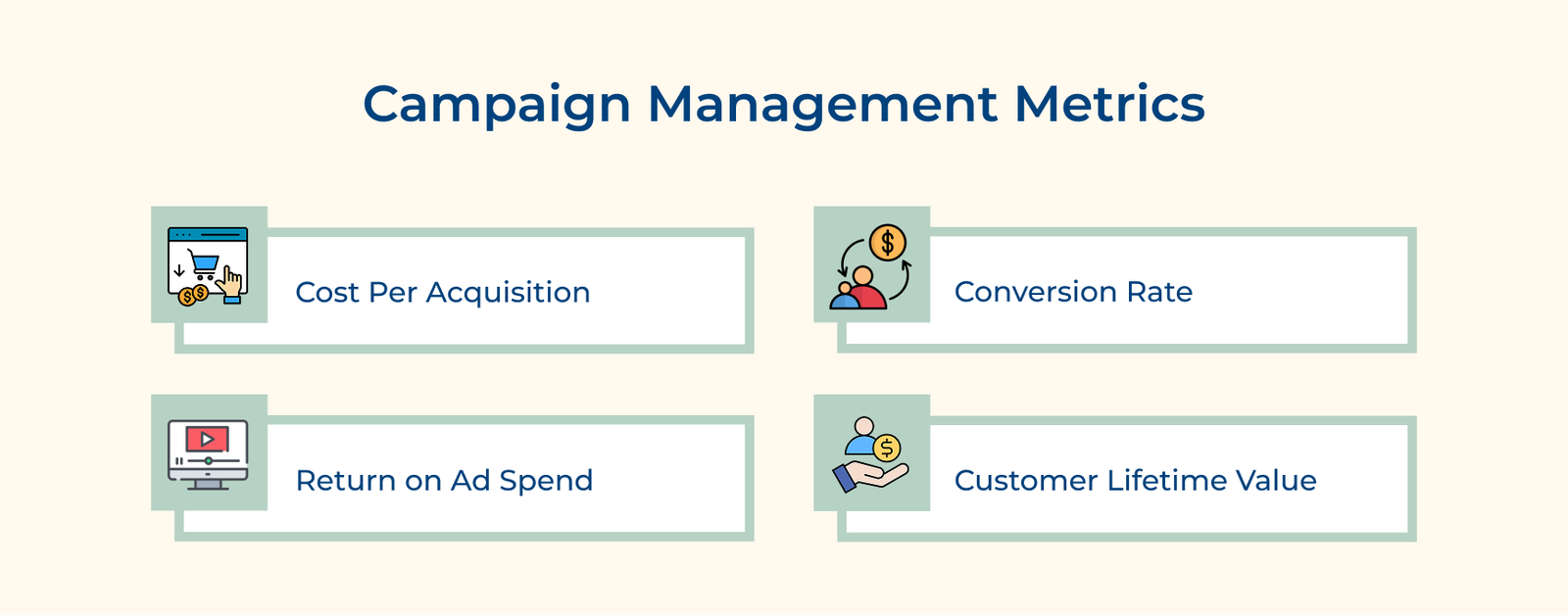
1. Cost Per Acquisition (CPA)
CPA shows how much you are spending to get an actual customer, not just attention. A sudden increase usually points to the wrong audience or issues in your conversion flow that need fixing. Tracking it closely helps you catch problems early before they drain your budget.
2. Conversion Rate
Conversion rate shows how many people take action after engaging with your campaign. A low rate often means your message attracts interest but fails to convince people to move forward. Improving this usually comes from fixing clarity, trust, or the ease of taking the next step.
3. Return on Ad Spend (ROAS)
ROAS helps you understand if your campaign is bringing in more revenue than it costs. Scaling only makes sense when this number is strong; you end up increasing losses. Keeping a close eye on it helps you decide when to scale and when to fix the campaign first.
4. Customer Lifetime Value (CLV)
CLV shows how much value a customer brings over time, not just in the first purchase. Looking at it helps you make smarter decisions about how much you can afford to spend to acquire customers.
The following are the three examples that show what campaign management looks like in practice.
McDonald’s
McDonald’s runs campaigns with a strong focus on local behavior. Global messaging stays consistent, but offers and creatives shift based on what people actually buy in each location. The precision targeting directly reduced promotional waste and pushed offers toward audiences most likely to act. Higher redemption rates and stronger same-store sales performance followed naturally from that discipline.
Spotify
Spotify builds campaigns using its own listener data. Campaigns are shaped around what people actually listen to, not assumptions about their preferences. Wrapped turns that data into something people want to share. It brings in massive organic reach, brings back inactive users and keeps existing users engaged without extra spend.
Apple
Apple keeps its campaigns simple and focused. Each campaign revolves around one clear idea that stays consistent across every channel and market. The clarity builds curiosity and anticipation. People are ready to buy even before detailed information or reviews are available, which shortens the time it takes to convert interest into sales.
The brands that win consistently are not the ones with the biggest budgets. They are the ones who run campaigns with discipline and clarity at every step. Each part of the process exists to turn effort into results you can track and improve over time.
Campaign management is not a one-time task. It is how your entire marketing function operates day to day. Teams that treat it that way stop chasing short-term wins and start building results that grow with every campaign they run.

Campaign analytics is the process of measuring every meaningful action your audience takes in response to your campaign. It turns raw performance data into decisions that tell you exactly where to invest more and where to stop spending immediately.
Managing multiple campaigns works best with a central view of status, budget and performance. Without that visibility, campaigns compete for attention and resources, which weakens overall results.
The most damaging challenges are inconsistent messaging across channels and the inability to act on performance data fast enough. Both usually come from a lack of clear structure and planning.
A strong setup includes a planning tool, a marketing automation platform, an analytics dashboard and tools for each channel you use. Many teams struggle not because they lack tools, but because they do not fully use the ones they already have.
Cross-channel campaigns help B2B companies stay visible throughout a long buying journey. Consistent messaging across platforms keeps the brand familiar and makes decision-making easier for the buyer.
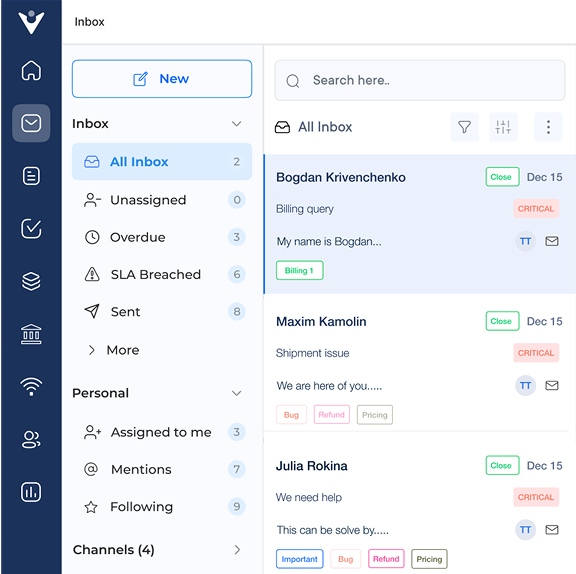
Grow Customer Relationships and stronger team collaboration with our range of products across the Conversational Engagement Suite.
Omnichannel Customer Support & Help Desk Software
AI Enabled Business Messaging and Chatbot Software
Sales Engagement & CRM Software
Call Center Software & Virtual Phone System
Product Marketing & Experience Platform
Customer Experience & Feedback Management Software

 Agent Experience (AX) Guide: Importance, Best Practices & Challenges
Scroll to top
Agent Experience (AX) Guide: Importance, Best Practices & Challenges
Scroll to top