How to Improve Email Collaboration? 8 Key Tips (2026)
Email collaboration improves team efficiency by streamlining communication, organizing threads and reducing confusion. Learn how to manage shared inboxes, assign tasks and boost clarity.
Email collaboration improves team efficiency by streamlining communication, organizing threads and reducing confusion. Learn how to manage shared inboxes, assign tasks and boost clarity.
Most collaboration emails get ignored because they feel generic or try too hard. The message sounds like it was copied, pasted and sent to a hundred people, doesn’t it? When there’s no clear reason to respond or no sign of real effort, potential partners move on without a second thought.
Missed replies just keep on adding up. While your outreach sits unopened, others are building partnerships that open doors to new audiences, shared credibility and steady growth. Weak email collaboration can shrink your network and leave you leaning on costly marketing tactics instead of smart, relationship-driven opportunities.
The guide will teach you how to write emails that people actually reply to. The goal is simple – turn cold outreach into real conversations that lead to meaningful partnerships.
Email collaboration refers to a professional message that initiates or manages a partnership between two or more parties working toward a shared goal. The emails lay the groundwork for relationships, be it with the influencers or team members.
The key lies in creating clear communication that establishes mutual benefits and expectations from the start. Collaboration emails start a structured dialogue, outlining opportunities and what each side brings to the table.
Imagine a skincare brand reaching out to a beauty blogger: “Hi Sarah! I love your honest reviews of sensitive skin products. We’d like to send you our new gentle cleanser for an authentic review. In exchange, we’ll feature your content on our social channels and provide affiliate commission opportunities.” The approach shows genuine interest while offering clear mutual benefits.
Key principles:
Below are the key benefits of email collaboration, helping you communicate, stay organized and achieve shared goals efficiently.
Key questions:
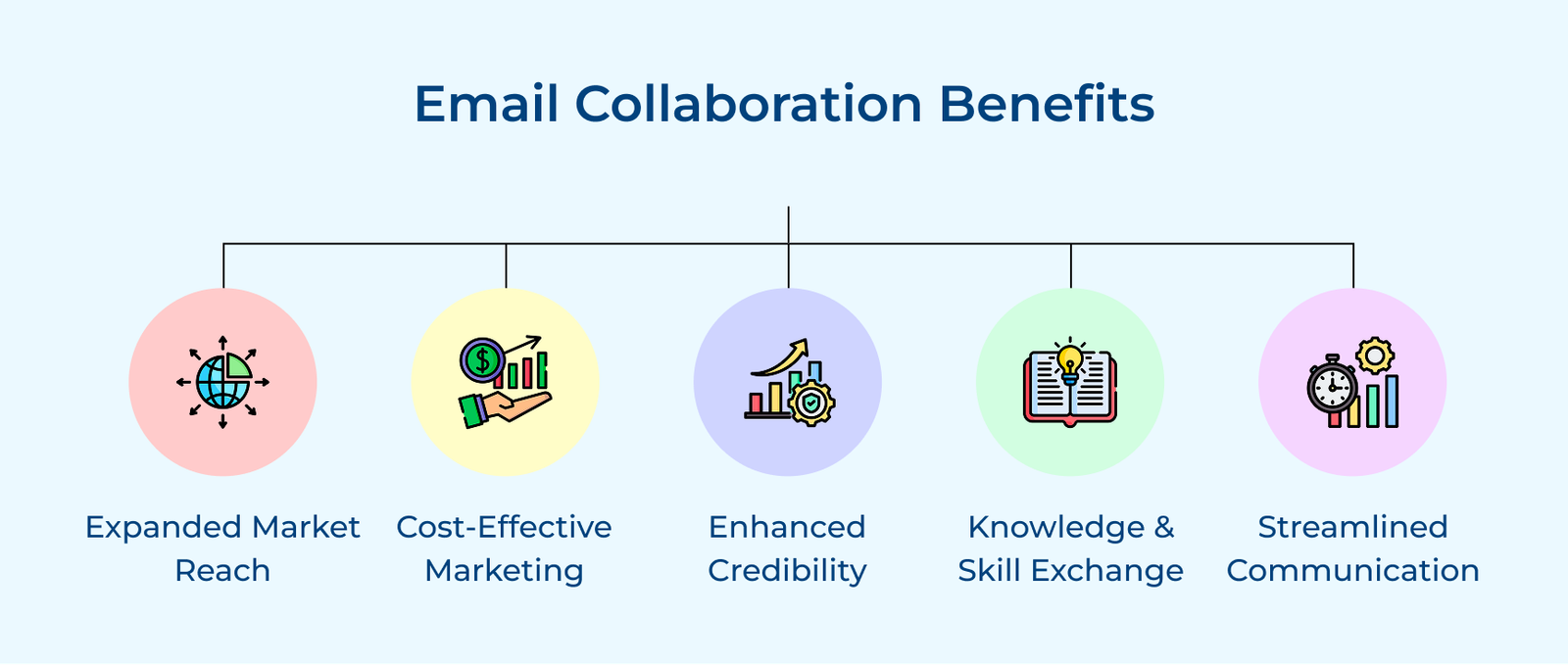
Expanded Market Reach
Email collaboration lets you tap into your partner’s audience. When a trusted brand introduces you, people are more likely to listen and act than with a cold pitch.
Cost-effective Marketing
Collaborative emails reduce your marketing expenses by sharing promotional costs and leveraging each other’s existing audiences. Instead of building brand awareness from scratch, you benefit from your partner’s established credibility. The approach delivers higher ROI than traditional advertising methods.
Enhanced Credibility
When respected businesses align with you, it sends a signal of trust. Their support makes it easier for new customers to take you seriously.
Knowledge and Skill Exchange
Collaboration gives you a chance to learn from others. Be it the industry tips or technical skills, email conversations often lead to useful insights you wouldn’t get on your own.
Streamlined Communication
Collaboration email creates organized communication channels that keep all stakeholders informed and aligned on project goals. Clear email trails ensure accountability and reduce misunderstandings that can derail partnerships.
Below are the top tips that will transform your email writing process and increase your chances of a successful collaboration.
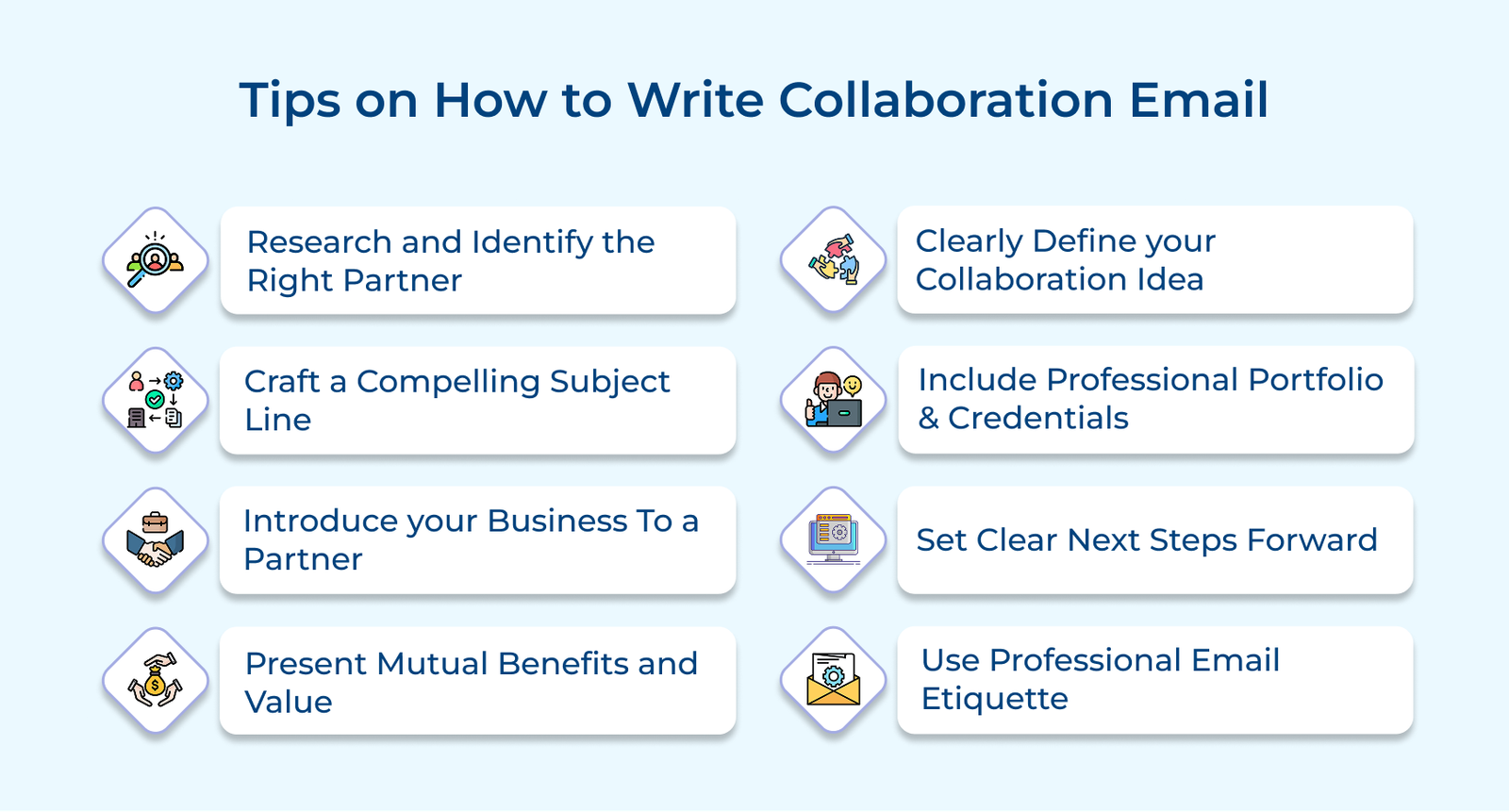
Before you reach out to a potential partner, take time to really understand who they are and how they work. Skipping the step often leads to mismatched expectations and ignored emails. Understanding your target partner before reaching out creates the foundation for meaningful collaboration opportunities:
Let’s assume that a fitness brand looking to partner with a wellness blogger discovers her followers are mostly busy professionals looking for quick, effective workouts. The insight shapes a pitch around home gym solutions that save time, making it far more likely to land.
Subject lines determine if your collaboration email gets opened or ignored by busy professionals managing overflowing inboxes. A well-crafted subject line communicates professionalism while indicating your partnership intentions and expected mutual benefits.
Common subject lines:
The generic subject lines get lost among hundreds of similar emails because they fail to communicate specific value or differentiate your proposal from competitors. Instead, use the approaches:
Why do the subject lines work better for team collaborations and brand partnerships? They immediately communicate who you are and what specific value you bring to the table. Recipients can quickly understand the partnership scope and decide if the opportunity aligns with their current business priorities.
A good business introduction sets the stage for your collaboration email. It gives the recipient a quick snapshot of who you are, what you do and why you’re worth their attention without wasting their time.
Long, vague intros often backfire. Busy people don’t want to read a full company bio before understanding your actual proposal. Keep it short, relevant and focused on what matters to them.
Key questions:
Let’s consider that a digital marketing agency might introduce itself like: “We’re a five-year-old agency specializing in e-commerce growth for sustainable brands. Our clients typically see 40% revenue increases within six months of working with us.”
If you want someone to collaborate with you, they need to see what’s in it for them, honestly. Presenting mutual benefits shows that you understand their time and effort matter, too. It shifts the conversation from what you want to what you can build together.
Key outcomes:
The main drawback involves overselling benefits without delivering realistic expectations, which damages long-term partnership potential. Overcome the issue by providing specific examples and measurable outcomes from previous collaborations to build trust.
Clearly defining collaboration ideas eliminates confusion and helps partners understand exactly what you’re proposing, including timelines and expected outcomes. The clarity prevents misunderstandings that could derail partnerships before they begin.
Use the approach by outlining specific deliverables and responsibilities for each party while establishing clear success metrics. Include realistic timelines and budget considerations to ensure both parties can commit appropriately.
Best practice:
Including professional credentials establishes your expertise and track record while providing evidence that you can deliver on collaboration promises. The documentation builds confidence and separates you from less experienced competitors.
Key questions:
The questions help you select the most relevant credentials that directly address your potential partner’s concerns about working with you. Consider the professional credentials that strengthen your collaboration email credibility:
How should you implement the strategy effectively? Think about it like this: would you hire someone without seeing their previous work? Your potential partners want proof that you can deliver results before committing their time and resources to your collaboration proposal.
Setting clear next steps turns your email from a general inquiry into a focused proposal with specific timelines. The approach demonstrates professionalism and makes it easier for potential partners to respond positively to your outreach. Start by suggesting a few specific times and dates for a call or meeting within the next week or two.
Moving beyond just scheduling, you’ll want to provide multiple contact methods to ensure seamless communication throughout the partnership development process. Different people prefer different communication channels based on their work style and current availability. Having various options removes barriers that might prevent a quick response.
Key methods:
Establishing reasonable response time expectations prevents partnerships from stalling due to unclear communication protocols. What happens if you don’t set the expectations? Without urgency, your partner may question your intent or delay their response indefinitely. An ideal deadline for collaboration email responses is typically 5-7 business days.
Following basic email etiquette helps your message stand out for the right reasons. Sloppy writing or an unprofessional tone can cause your proposal to be dismissed, no matter how good the idea is.
Key elements:
Consider the example phrase that demonstrates proper collaboration email etiquette: “I’d appreciate the chance to discuss how our strengths could benefit both our customers. Please let me know if you’d like to schedule a brief call this week.”
Below are the templates that provide structured frameworks for different email collaboration scenarios while maintaining professional communication standards.
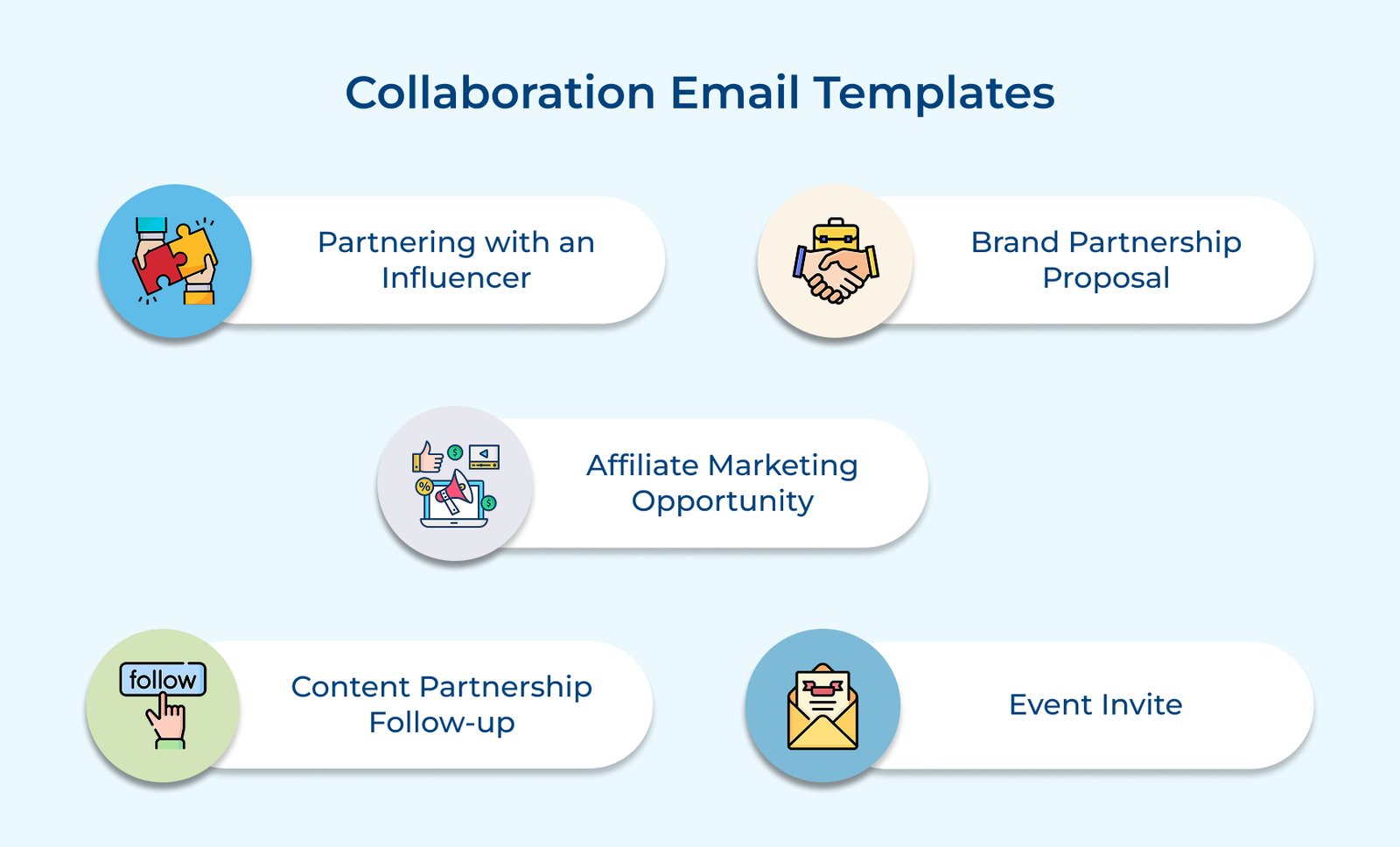
Influencer partnerships require personalized outreach that demonstrates genuine appreciation while clearly outlining mutual benefits. The template balances authenticity with professional terms.
Email Template:
Subject: Collaboration Idea – [Your Brand] x [Influencer Name]
Hi [Influencer Name],
I enjoy your work on [platform], especially your recent post on [specific topic]. Your recent post about [specific example] resonated with our brand values.
We’d like to collaborate on [specific project type]. We can offer [compensation/products] in exchange for [specific deliverables] that fit your style.
Would you be open to a short call this week to discuss?
Best,
[Your name]
[Contact information]
The template builds genuine connections through personalized research while presenting clear value propositions.
Brand partnership proposals require strategic positioning that highlights complementary strengths and shared audiences. The template focuses on mutual growth opportunities while establishing credibility.
Email Template:
Subject: Subject Partnership Proposal – [Your Brand] + [Their Brand]
Hi [Decision Maker Name],
I’m with [Your Company] and I think our brands could work well together. We focus on [your expertise] and you’re known for [their strength].
I have an idea for [specific collaboration idea] that could benefit both sides. I’ve attached a case study from a similar partnership we ran with [similar brand].
Could we set up a 15-minute call next week?
Best regards,
[Your name]
[Contact information]
The template demonstrates strategic thinking while providing concrete evidence of past success to build confidence.
Affiliate marketing proposals must clearly explain commission structures while emphasizing the low-risk nature of the partnership. The template addresses common concerns about affiliate programs.
Email Template:
Subject: Affiliate Partnership – Earn [Commission Rate]% Commission
Hi [Partner Name],
Your audience’s interest in [relevant product category] caught my attention. We’d like to invite you to our affiliate program offering [commission rate]% on every sale you refer.
We provide ready-to-use marketing materials and direct support. Partners usually earn between [realistic range] monthly, depending on engagement.
Would you like to see the full details?
Best regards,
[Your name]
[Contact information]
The template removes barriers to entry while communicating earning potential and support systems.
Content partnership follow-ups require gentle persistence while adding new value to previous conversations. The template acknowledges their busy schedule while presenting additional benefits.
Email Template:
Subject: Follow Up – Content Partnership
Hello [Partner Name],
I’m following up on my earlier note about a possible content partnership. Since then, I’ve developed a [new benefit/resource] that could make the collaboration even stronger.
I’ve attached [relevant resource] showing examples of how it has worked elsewhere. It requires little time but offers solid results.
Would you have 10 minutes for a quick call?
Best regards,
[Your name] [
Contact information]
The template maintains professional persistence while adding value and flexibility to overcome common objections.
Event invitations require clear value propositions that explain why attendance benefits the recipient beyond just supporting your event. The template emphasizes networking opportunities and exclusive content.
Email Template:
Subject: Invitation – [Event Name], [Date]
Hi [Partner Name],
We’re hosting [Event Name] on [Date] and I’d like to invite you as our guest. The event brings together [target audience] to [specific purpose].
You’ll have the chance to connect with [type of attendees] and take part in [exclusive activity or content]. Your perspective in [their field] would be a valuable addition.
Could you let me know by [date] if you can attend?
Best regards,
[Your name]
[Contact information]
The template positions event attendance as valuable networking while offering exclusive benefits that justify time investment.
Below are the partnerships that demonstrate how strategic collaboration emails can transform business relationships and create mutually beneficial marketing opportunities.
The Publicity Stunt – GoPro and Red Bull
GoPro and Red Bull connected over a shared love of extreme sports. Their email exchanges focused on a simple idea: combine GoPro’s high-performance cameras with Red Bull’s expertise in staging jaw-dropping stunts.
The result was a long-term partnership that gave GoPro access to Red Bull’s global events and athlete network. Red Bull’s event coverage leveled up with GoPro’s filming technology. Together, they reached bigger audiences and deepened their reputations in the extreme sports world.
The Giveaway – McDonald’s and Nintendo
McDonald’s pitched Nintendo on using Happy Meal promotions to reach families and gaming fans. Their proposal showed how Nintendo’s popular characters could enhance McDonald’s family dining experience. It also aimed to introduce Nintendo products to new demographics.
The collaboration boosted both brands’ visibility among target audiences while creating authentic excitement around their products rather than traditional advertising approaches. McDonald’s boosted its family entertainment appeal, while Nintendo reached beyond gaming retail into mainstream family dining.
The Content Partnership – Spotify and Uber
Spotify and Uber saw an overlap in their audiences: people on the go who value personal experiences. Their email conversations explored a straightforward concept: let riders control the music during their Uber trips using Spotify.
The integration gave Uber rides a personal touch and kept customers coming back, while Spotify reached millions of commuters in a setting where music naturally fit. Both brands solved a small but real customer pain point and stood out from competitors.
Email collaboration turns routine messages into clear, purposeful steps toward building partnerships. Done well, it opens doors to new opportunities by connecting you with the right people instead of competing for the same space alone.
The examples we’ve covered show how a well-crafted email can spark relationships that grow over time, leading to more than just one-off deals. Treat each collaboration email as planting seeds that can grow into lasting, mutually beneficial relationships.

Anyone who works with partners, clients, or teams inside or outside their organization can benefit. It includes agencies contacting influencers, B2B companies seeking partnerships, project managers coordinating with stakeholders and entrepreneurs building new relationships.
Email collaboration creates structured communication channels that reduce the back-and-forth messages that waste time in remote environments. When team members follow consistent collaboration protocols, they can coordinate projects more efficiently and share resources effectively. It also helps maintain accountability without constant video calls or meetings.
Use dedicated folders for each project, write clear subject lines and agree on when email should be used instead of chat or calls. Filters can sort messages automatically and a regular cleanup schedule keeps things manageable.
Successful project email collaboration requires clear communication roles, consistent terminology and thorough documentation of decisions. Project managers should create email templates for common scenarios and set clear response time expectations. They can also use project management tools that integrate with email systems to streamline workflows.
Grow Customer Relationships and stronger team collaboration with our range of products across the Conversational Engagement Suite.
Omnichannel Customer Support & Help Desk Software
AI Enabled Business Messaging and Chatbot Software
Sales Engagement & CRM Software
Call Center Software & Virtual Phone System
Product Marketing & Experience Platform
Customer Experience & Feedback Management Software

 A Comprehensive Guide on Ecommerce Loyalty Program
Scroll to top
A Comprehensive Guide on Ecommerce Loyalty Program
Scroll to top