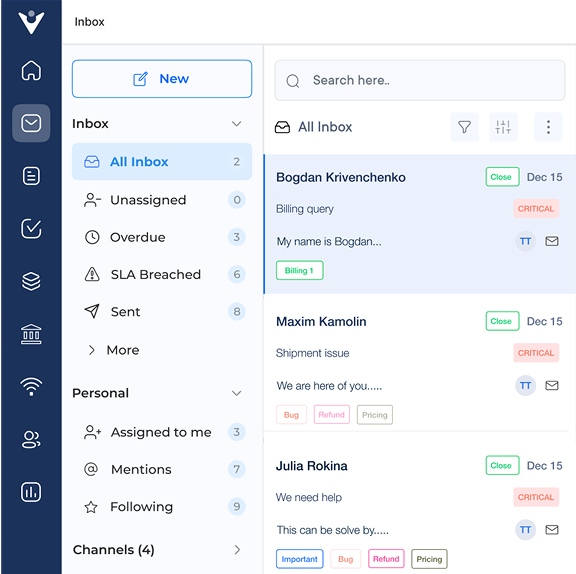
1. Auto-Generating Personalized Customer Replies
The use case focuses on AI drafting responses that fit each customer’s specific situation and communication style. Personalized replies solve issues faster and feel more thoughtful than generic templates. Customers notice when their exact concern is addressed instead of receiving a standard answer.
Key capabilities:
- Analyzes previous interactions to understand preferences and history
- Pulls accurate information from knowledge bases to provide accurate solutions instantly
- Adjusts language complexity based on the customer’s technical expertise level
- Includes relevant order details, product information and account data in the response
2. Unearthing and Organizing Customer FAQs
The use case centers on AI reviewing large volumes of support conversations to spot questions customers ask repeatedly. FAQ pages often reflect what teams assume people want to know. AI highlights what customers are actually asking in their own words.
The system scans tickets, chats and emails to detect repeating themes and phrases. Similar questions are grouped, even when phrased differently. Topics are then ranked based on how often they appear. The result is an FAQ section built from real customer concerns.
Actionable tips:
- Run FAQ analysis every quarter to capture new trends as products change or features are introduced.
- Use AI-suggested FAQ titles that mirror customer language instead of internal jargon.
3. Seamless Agent-to-Agent Support Team Handoff
The use case focuses on transferring conversations between agents without losing context or asking customers to repeat their story. Repetition frustrates people and slows down resolution. Generative AI keeps everyone aligned during transitions.
Instant conversation history summaries for agents
When a new agent joins the case, AI generates a summary of the main issue. Previous troubleshooting steps and promises made to the customer are clearly listed. The agent can step in with full awareness instead of scrolling through long transcripts.
Highlighting unresolved customer issues and concerns
AI pinpoints what still needs attention after earlier exchanges. Emotional cues such as frustration or urgency are surfaced so the next agent knows the tone of the situation. Important details stay visible during shift changes or department transfers.
Providing complete context without reading entire transcripts
Key facts such as product details, account status and recent actions are pulled into a clear overview. Agents receive the information they need within seconds. Customers experience smoother conversations because context follows them, not the other way around.
4. Generating Comprehensive Knowledge Base Articles
The step focuses on using AI to draft clear and detailed help articles that guide customers through common questions. Strong documentation allows customers to solve issues on their own and gives agents a reliable reference during conversations. Clear articles reduce confusion and lower incoming ticket volume.
Key benefits:
- Agents avoid repeating the same explanations to multiple customers
- Customers fix simple problems without waiting for agent availability
- New hires learn faster with structured and accessible reference material
Knowledge base creation also requires regular updates as products change. AI can spot gaps between current articles and recurring support questions. When customers keep asking about the same issue, the system can suggest edits or new articles to close that gap.
Key tasks:
- Content structuring: Organizes information into clear sections with step-by-step guidance.
- Technical translation: Rewrites complex concepts into simple language that customers can understand.
- Visual recommendations: Suggests where screenshots or diagrams would improve comprehension of complicated processes.
- Version tracking: Flags articles that may be outdated based on product updates or recurring confusion.
B2B and SaaS companies should maintain a review process where subject matter experts check AI-drafted content before it goes live. Accuracy carries more weight than speed. Automation works best when paired with careful human review to maintain trust and clarity.
5. Detecting Customer Service Automation Opportunities
The use case focuses on spotting support tasks that can be automated to reduce workload and save time. Many teams overlook simple automation wins hidden in everyday conversations and repetitive tickets.
The system reviews ticket volume, response patterns and resolution steps to identify requests that follow clear processes. It highlights workflows that require little human judgment and suggests where AI can step in based on real interaction data.
Pro tips:
- Begin with the three most common repetitive customer queries before moving into more detailed scenarios.
- Monitor automation success rates monthly and adjust when customer satisfaction scores drop below acceptable levels.
6. Building Targeted and Effective Surveys
AI can help you design surveys that feel relevant instead of repetitive. Thoughtful surveys collect useful customer feedback without overwhelming them. Generic questionnaires often lead to low response rates and vague answers that teams cannot use.
Key approaches:
- Personalized questions based on interaction history: The system tailors questions to each customer’s actual experience. Relevance dramatically increases completion rates compared to one-size-fits-all surveys.
- Dynamic follow-up questions: AI adjusts the next questions based on the previous answer. Detailed responses trigger deeper follow-ups, while simple ratings keep the survey short. The experience feels more natural and focused.
- Touchpoint-specific surveys: Different stages of the customer journey require different questions. Post-purchase surveys focus on the buying experience. Post support surveys focus on resolution quality. Each survey matches the moment.
The main challenge is survey fatigue, where customers ignore requests after receiving too many questionnaires from different departments. Overcome it by using artificial intelligence to consolidate feedback requests and limit each customer to one survey per month.
7. Simplifying and Enhancing Self-Service Options
Many customers prefer to solve simple issues on their own rather than wait for an agent. Clear or reliable self-service tools reduce wait times and improve overall experience.
AI powers intelligent help systems that understand natural language questions and guide customers through solutions step by step. The interaction feels more like a conversation and less like scrolling through endless help articles.
Best practices:
- Track which self-service attempts fail and lead to agent contact to improve those specific flows.
- Design self-service options that seamlessly escalate to human agents when AI detects customer frustration building.
8. Adding Context to Automated Quality Scoring
AI can review support conversations and provide consistent quality insights at scale. Manual reviews take time and often vary from one evaluator to another. Automated scoring adds structure while saving hours of review work.
Evaluating agent responses for accuracy
The system compares agent replies with your knowledge base and company guidelines. Incorrect or incomplete information gets flagged quickly. Agents receive timely corrections and customers receive more reliable answers.
Identifying areas where agents need training
The system detects patterns in agent performance that reveal knowledge gaps or skill deficiencies across the team. The insights guide targeted training programs that address specific weaknesses rather than generic skill-development sessions.
Providing feedback on communication style
AI reviews tone, empathy markers and communication clarity in each interaction. Feedback highlights strong responses and suggests improvements in wording or structure. Clear examples help agents refine how they communicate with customers.
Challenges of Generative AI in Customer Support
The following are the obstacles that help businesses implement AI solutions more effectively and avoid common pitfalls.