1. Identify Knowledge Needs and Gaps
The first step in managing knowledge is knowing where the gaps are. Before you can improve how information flows in your organization, you need to figure out what’s missing. The early discovery phase helps avoid situations where teams waste time or repeat mistakes simply because key information wasn’t available when they needed it.
- Audit what you already have and what’s still needed. Start by comparing your current knowledge assets to what’s needed to meet your goals. It helps identify important gaps where missing information could slow down progress or decision-making.
- Conducting interviews to uncover tacit knowledge means sitting down with experienced team members to draw out the invaluable expertise that exists only in their heads, the kind that never makes it into manuals or documentation without deliberate extraction.
- When the same mistakes or inefficiencies keep popping up, it’s often a sign that something important hasn’t been documented or shared. The patterns are clues pointing to where knowledge is lacking.
The stage is all about clarity. If you don’t know where your knowledge gaps are, you risk organizing information that no one needs, while the stuff that could help your team goes uncollected and unused.
2. Discover Sources of Valuable Knowledge
Before you can manage knowledge, you need to know where it lives. The most valuable information in your organization is often scattered across conversations, documents and individual employees’ heads. Finding it takes curiosity, observation and a few smart systems.
- Internal expertise in employees: The most valuable knowledge is often what people carry with them. Long-time employees know how things really get done, what’s been tried before and what to avoid.
- Historical projects and decisions: Old project files, meeting notes and internal reports hold lessons that are easy to overlook. The records show what worked, what didn’t, and why.
- Customer interactions and feedback: Support tickets, user reviews and sales calls aren’t just feedback; they’re full of real-world insights. They demonstrate how your product integrates into people’s lives, where it falls short and where there’s potential for improvement.
3. Capture and Document Key Insights
Capturing knowledge turns one person’s experience into something the whole team can use. If important know-how stays stuck in someone’s head, it disappears the moment they leave, get promoted or simply forget the details. The stage makes valuable information visible, usable and ready to grow.
Best practices:
- Document knowledge as it’s created rather than trying to reconstruct it after the fact when details have faded from memory.
- Use templates and structured formats to ensure consistency in knowledge capture across different types of information.
4. Evaluate Knowledge Quality and Relevance
Not everything that gets written down deserves a place in your knowledge base. It’s where evaluation comes in, it’s the checkpoint that helps you separate useful insights from outdated or misleading ones. If you skip this step, your knowledge system can quickly fill with clutter.
Let’s assume that a manufacturing team shares a new process improvement that seems promising. But, during evaluation, they found it only worked under very specific conditions. The detail was added to the documentation, saving other teams from copying a method that wouldn’t work for them.
5. Organize Knowledge for Easy Retrieval
The organization stage is where scattered notes, ideas and insights become usable knowledge. It’s what turns your database into a resource people actually use, not just a dumping ground. Without structure, even the best insights remain buried. Proper organization ensures the right people can quickly access what they need, when they need it, without digging through clutter or guessing search terms.
Key elements:
- Knowledge categorization and taxonomy development create the foundational structure for your knowledge ecosystem.
- Metadata tagging and attribute assignment add descriptive information to knowledge assets, making them discoverable through multiple pathways.
- Link related content so users can easily jump from one helpful piece of information to the next. It creates a network of knowledge, helping people discover answers they didn’t even know they needed.
- Findability engineering and search optimization ensure knowledge can be located through intuitive navigation and effective search functionality.
A significant challenge in knowledge organization is balancing standardization with flexibility. Too rigid a system fails to accommodate emerging types of knowledge, while too loose a system creates inconsistency. Finding the balance requires ongoing collaboration between information architects and actual users of the knowledge system.
6. Store Knowledge in Accessible Systems
The storage stage of the knowledge management process is where all the organized content is placed into systems that people can access when needed. Without the right setup, valuable knowledge ends up gathering dust in forgotten folders or buried drives. The stage is less about where the information sits and more about how easily people can get to it when it matters most.
Key questions:
- Accessibility and ease of use: How easily can users with different technical abilities find and retrieve information from the system?
- Scalability and performance: Can the system grow with your organization’s needs and maintain performance as knowledge volume increases?
- Security and permission controls: Does the system allow appropriate protection of sensitive information while still enabling necessary sharing?
- Integration capabilities: How well does the system connect with other tools and platforms your organization already uses?
- Search functionality: Does the system offer robust search options, including keyword filters and semantic search capabilities?
- Maintenance requirements: What ongoing resources will be needed to keep the system functional and up-to-date?
7. Share Knowledge Throughout the Organization
The sharing stage of the knowledge management process turns knowledge from static resources into active organizational capabilities. Without deliberate sharing, even the best-organized knowledge remains underutilized and isolated. The critical stage ensures that valuable insights reach the people who need them, breaking down silos that typically prevent information flow across teams.
Build Communities of Practice and Peer Forums
Communities of practice bring together people with shared interests to exchange ideas, collaborate on challenges and develop collective expertise. The formal or informal groups create spaces where knowledge naturally flows through discussions, problem-solving sessions and relationship-building activities.
Implement Mentorship and Knowledge Transfer Programs
Pair experienced team members with newer or less experienced ones in a structured way. Rather than waiting for informal conversations to happen, schedule sessions where people walk through real work together. It makes it easier to pass along hard-earned knowledge that’s often never written down.
Develop Incentives for Knowledge-sharing Behaviors
Incentive systems recognize and reward people who actively contribute to organizational knowledge. It might include formal acknowledgments in performance reviews, promotion considerations or simple recognition during team meetings.
8. Apply Knowledge to Solve Problems
The application stage transforms theoretical knowledge into tangible value for your organization. Without practical application, even the most comprehensive knowledge base remains an untapped resource collecting dust. The essential stage validates your knowledge management efforts by demonstrating how captured insights directly contribute to better outcomes.
Integrate Knowledge into Decision-making Processes
Decision frameworks that incorporate knowledge assets help teams avoid relying solely on intuition or limited personal experience. Organizations ensure relevant insights are consulted before key choices are made by embedding knowledge checkpoints into decision protocols.
Use knowledge bases during project planning
Before launching any new project, take time to look at what’s been done before. Dig into records of similar work, like what went well, what didn’t and why. Make it a standard part of project kickoffs so teams start with their eyes open, not by reinventing the wheel.
9. Maintain and Update Knowledge Base
The maintenance stage of the knowledge management process is where your system stays sharp, accurate and trustworthy. Without regular care, people stop relying on it and all your hard work slowly fades into irrelevance.
- Schedule regular reviews: Set a timeline like monthly, quarterly or annually, depending on the type of knowledge. Review for accuracy, relevance and usefulness. Check if the procedures are still followed, data is still valid and goals still align with what’s documented.
- Remove outdated or invalidated information: Old or incorrect information can do more harm than good. Outdated content creates confusion, leads to mistakes and wastes time. Deleting or archiving it keeps your system lean and useful.
- Incorporate new learning into existing knowledge: Transforms isolated insights into connected wisdom. Rather than simply adding new documents, the integration process enriches existing knowledge, creating a deeper understanding by connecting fresh discoveries with established concepts.
- Assign clear ownership: Every knowledge area should have someone responsible for keeping it clean and current, like a subject expert who treats their section like a garden. When everyone knows who to go to, nothing slips through the cracks.
A software company set up quarterly knowledge reviews where dev teams sit together and compare their documentation with the actual code. During one of these sessions, the team spotted outdated installation steps pointing to components that no longer existed.
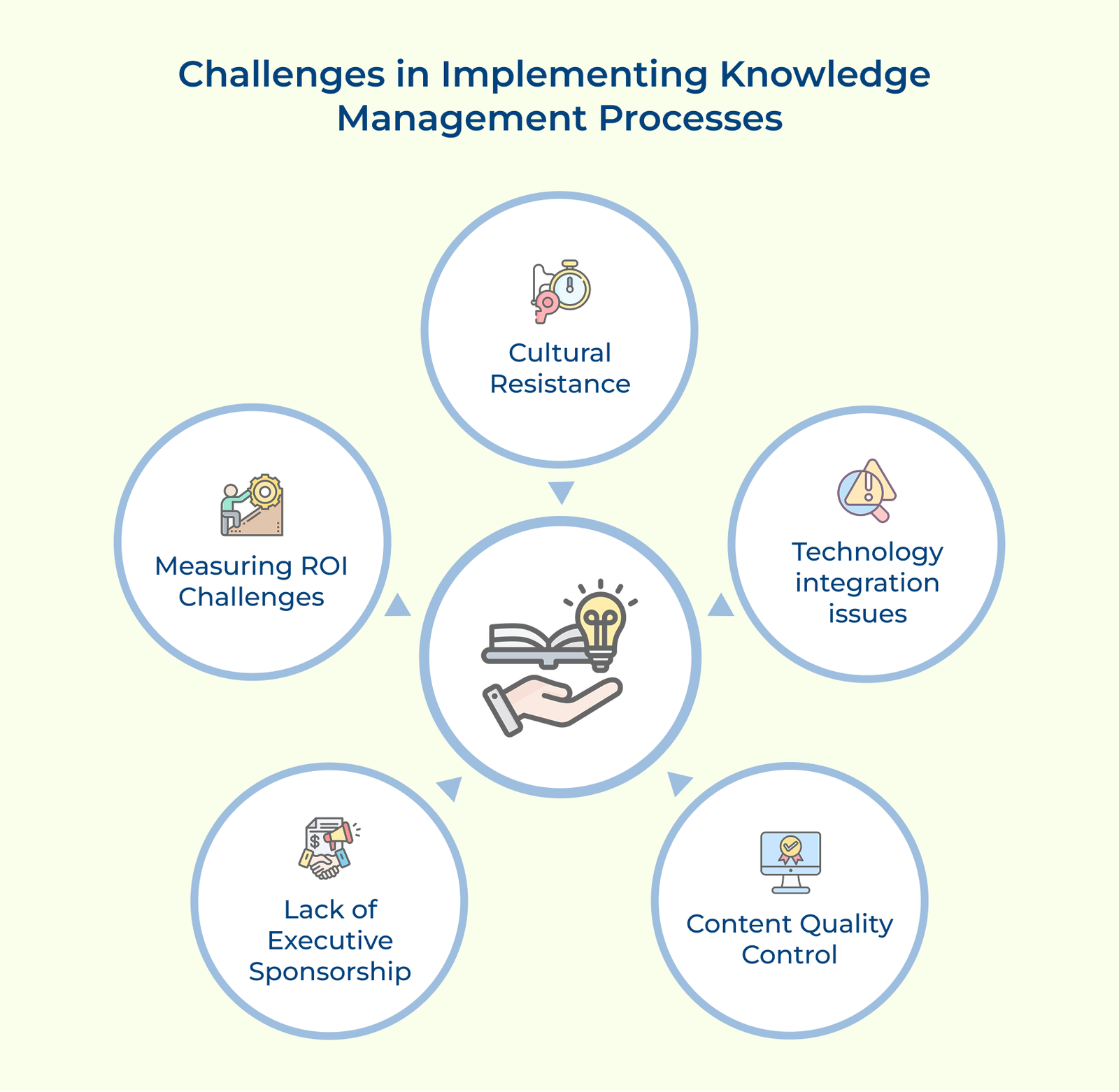
Challenges in Implementing Knowledge Management Processes
Check out the challenges organizations face when implementing knowledge management processes and understand what can stand in the way of turning information into action.