How to Write Lead Nurturing Emails?: Tips, Examples & Mistakes
Lead nurturing emails help you stay relevant and build trust over time. It guides prospects toward buying through timely, helpful messages tailored to their needs and behavior.
Lead nurturing emails help you stay relevant and build trust over time. It guides prospects toward buying through timely, helpful messages tailored to their needs and behavior.
You invest time and budget into attracting leads, yet most drop off before they ever become customers. They download a resource or browse your pricing page, then disappear without a trace, leaving a clear gap between initial interest and final purchase that directly impacts revenue.
Most prospects are not ready to buy the moment they discover your brand. A lack of consistent communication during their decision process makes it easy to forget you or move toward a competitor who stays present.
Lead nurturing emails address this gap through timely and relevant communication that guides prospects toward a decision at a pace that feels natural. They get up to 10x the response rate compared to standalone emails. Let’s understand how to convert cold leads into paying and loyal customers.
Lead nurturing emails refer to a series of targeted messages sent to potential buyers over time. The emails guide prospects through their buying journey by providing relevant information at each stage. The aim isn’t to push a sale, but to stay useful and relevant until they’re ready to buy.
Key factors:
Think of lead nurturing like tending a garden. You wouldn’t expect a seed to become a flower overnight. Similarly, most prospects need time and attention before they’re ready to buy. The emails provide consistent care by addressing questions and concerns as they naturally arise during the decision-making process.
Key elements:
The following are the benefits of lead nurturing emails. Let’s check them out in more detail for a better understanding.
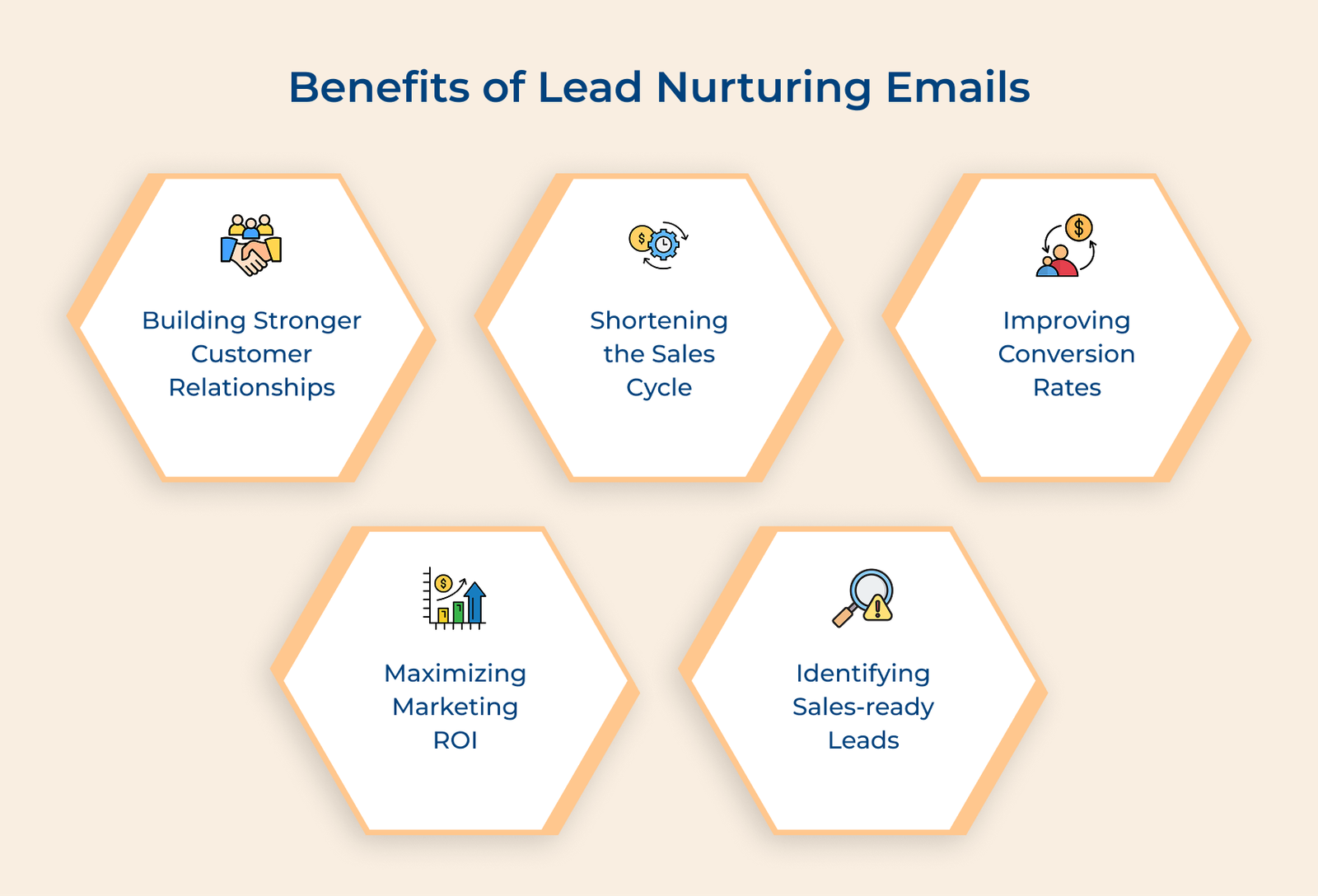
Building Stronger Customer Relationships
Lead nurturing builds trust by sharing helpful, relevant information over time. Prospects feel supported, not pushed and reach out when they’re ready.
Shortening the Sales Cycle
The emails educate prospects about your offerings and address common objections before sales conversations even begin. The preparation reduces back-and-forth communication and helps deals close faster than they would with cold prospects.
Improving Conversion Rates
Nurtured leads convert at significantly higher rates because they receive relevant information matched to their specific stage in the buying journey. The targeted approach means more prospects eventually become paying customers instead of abandoning their interest midway.
Maximizing Marketing ROI
Nurturing makes better use of the leads you already have. You spend less on acquiring new ones while getting more value from existing interests.
Identifying Sales-ready Leads
Email engagement metrics reveal which prospects are actively interested and moving closer to purchase decisions. The insight helps your sales team prioritize their outreach efforts toward the leads most likely to convert right now.
Lead nurturing emails adapt to each stage by delivering the right message at precisely the right moment in the funnel. Let’s check them out in detail.
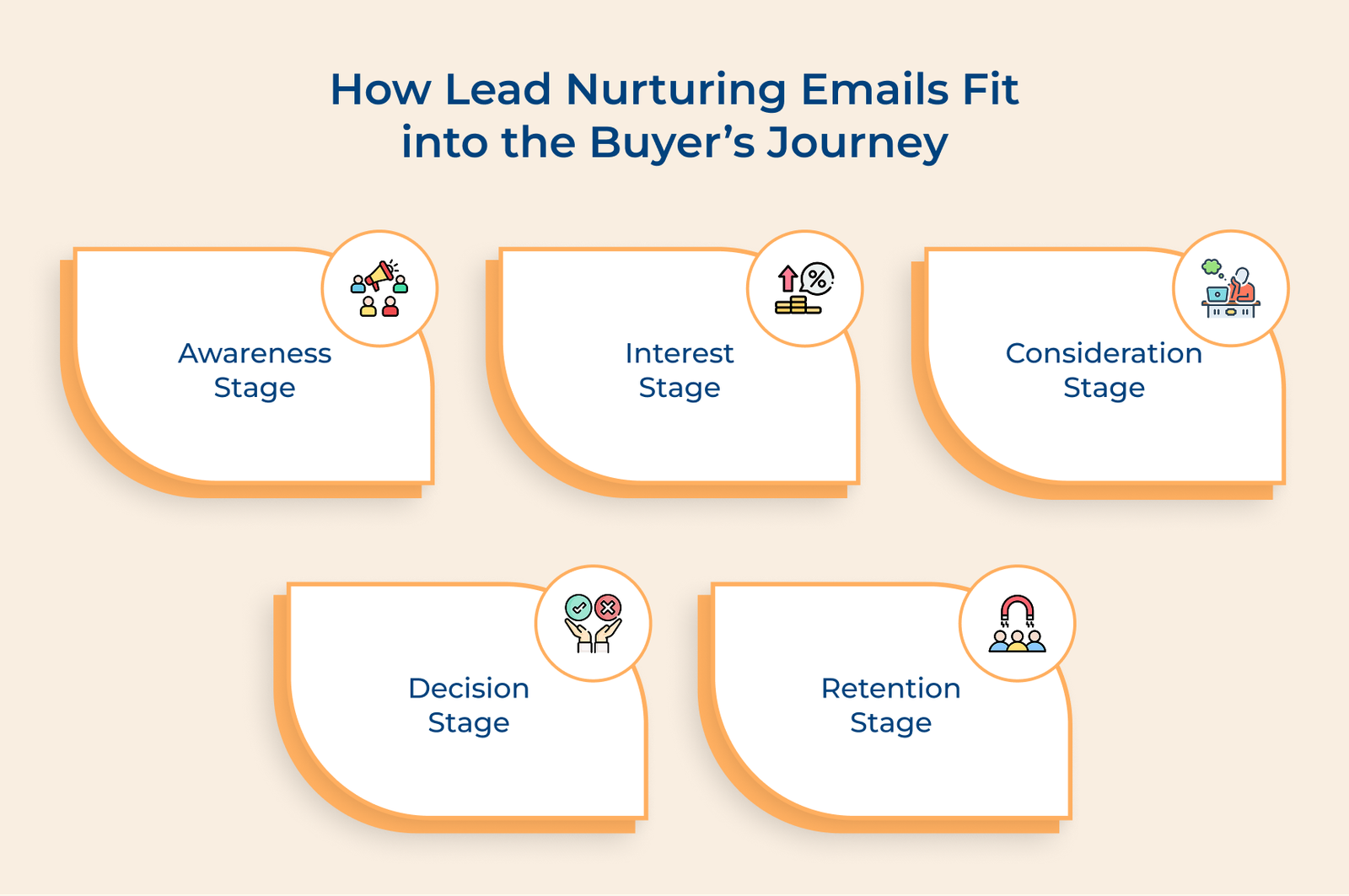
Prospects realize they have a problem but don’t yet know about potential solutions or your business. Your lead nurturing emails introduce educational content that helps them understand their challenge better without pushing any product. Focus on building credibility by sharing insights that demonstrate your expertise in their problem area.
Key ways:
Prospects begin viewing your company as a knowledgeable resource they can trust for guidance and information moving forward.
Leads start researching different approaches and actively seek information about available solutions in the market. Your emails explain different solution approaches without pushing your product. Present comparisons that help them evaluate options objectively while subtly positioning your approach as effective.
Key areas:
Leads develop a framework for evaluating solutions and naturally begin considering your company as a viable option.
Prospects are comparing a short list of options and deciding who can realistically solve their problem. The lead nurture emails should help them make that choice with clarity, not pressure. Focus on showing how your solution fits their needs better than alternatives, using clear facts and real outcomes.
Key ways:
Qualified leads feel confident enough to take the next step of engaging directly with your sales team.
Leads are ready to make a purchase but need final reassurance or clarity on specific details. Using the emails helps you to remove any remaining obstacles by addressing pricing questions and implementation concerns. Provide urgency through limited-time offers or highlight potential risks of delaying the decision to encourage action.
Key touchpoints:
Prospects convert into customers with clear expectations and confidence in their choice to work with you.
Once someone becomes a customer, your focus shifts to helping them get real, lasting value. Retention emails support day-to-day use, solve problems early and introduce relevant add-ons only when they make sense.
Key ways:
Satisfied customers become repeat buyers and enthusiastic advocates who refer others to your business organically.
Below are the top strategies to elevate your email campaigns and ensure they’re not just sent, but truly resonate with your audience.
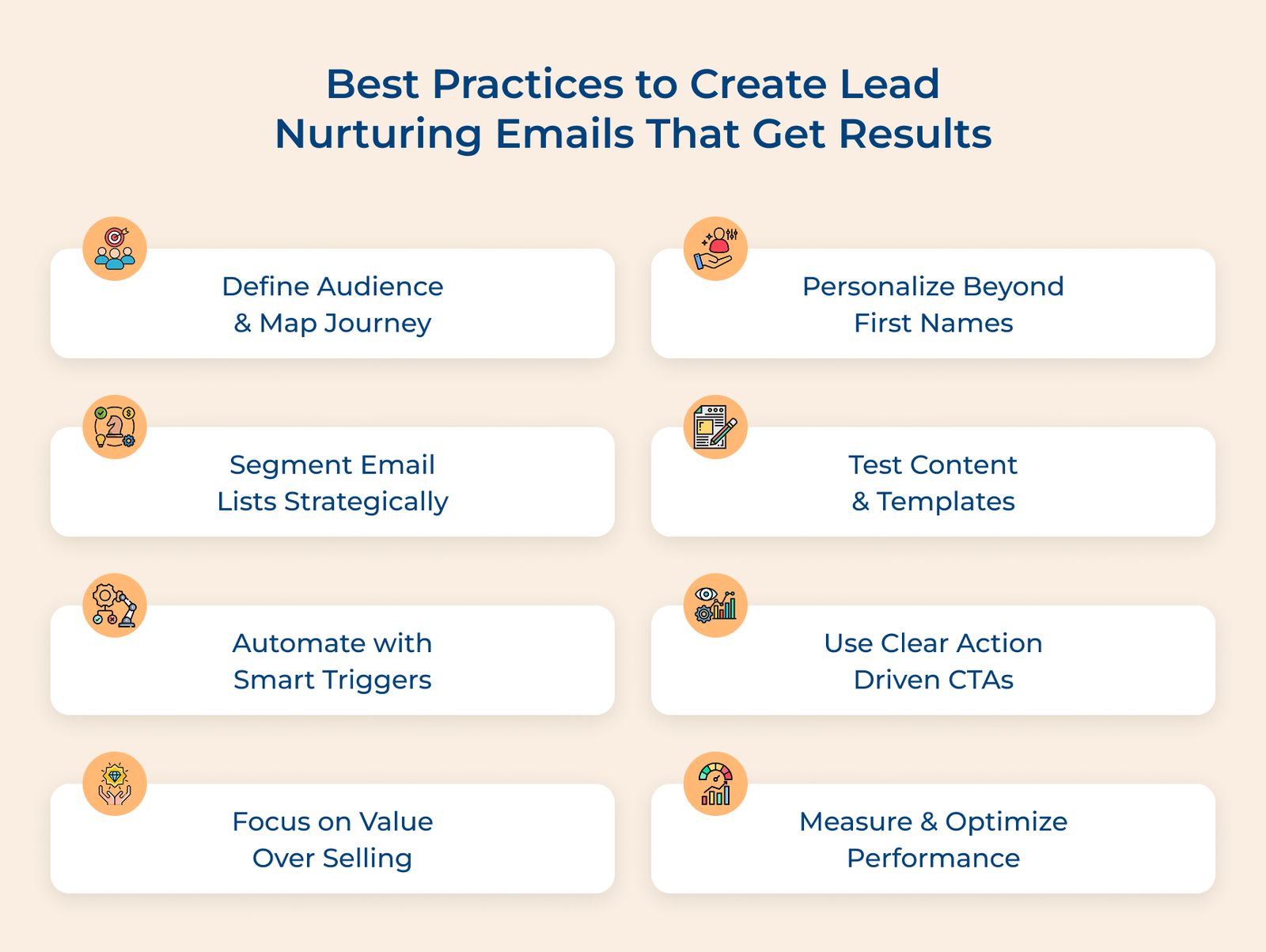
Your emails won’t land if you don’t clearly understand who you’re writing to and what they’re trying to figure out at each step. Defining your audience and mapping their journey creates a foundation that makes every subsequent email more relevant.
Key ways:
People ignore generic emails because they can tell when a message wasn’t written with them in mind. Real personalized emails show you understand their situation and turn an email into a direct conversation, not a mass send. It improves open rates by 29% and click-through rates by 41%.
Start by tracking what pages someone visits on your website and what content they download. Then reference the interests directly in your emails. If someone downloaded a pricing guide, your next email should acknowledge they’re evaluating costs and provide ROI examples.
Key factors:
The level of personalization requires more effort upfront, but transforms your emails from forgettable noise into valuable conversations. Recipients feel seen and understood, which naturally builds the trust necessary for eventual purchase decisions.
Sending the same email to everyone wastes attention and goodwill. Some readers get bored by basics, while others feel lost when messages jump too far ahead. Effective segmentation means grouping people by shared characteristics so each group receives content matched to their specific situation. Someone who’s been opening emails for months and downloading resources needs deeper, more specific help.
Pro tips:
What resonates with one audience may fall flat with another. Testing removes guesswork, showing what truly drives opens and clicks with your specific audience rather than relying on generic best practices.
Key factors:
Implement testing by creating two versions of each email and sending them to equal portions of a segment. Let the test run long enough to gather meaningful data, then use the winner for your remaining contacts and future campaigns.
Key types:
Automation keeps leads engaged without manual effort and prevents prospects from slipping through the cracks. Smart workflows send emails based on specific actions, ensuring timely, relevant follow-up.
Key use cases:
Start small with one or two workflows rather than trying to automate everything at once. Most email platforms let you create visual workflows where you define what action starts the sequence and what happens next based on engagement.
Every nurturing email should have one clear next step that moves recipients forward in their journey. CTAs without a clear purpose confuse people and waste the attention you’ve earned by getting them to open your message.
Match CTAs to the stage
Early-stage prospects aren’t ready for sales calls, so asking them to schedule demos will feel pushy and premature. Instead, your CTA should match their readiness level. Later-stage prospects who’ve engaged multiple times need stronger CTAs like booking consultations or starting free trials.
Make next steps clear and easy
Vague CTAs like “Learn More” leave people wondering what they’ll actually get if they click through. Be specific about what happens next, such as “Download the 5-Step Implementation Checklist” or “Watch the 3-Minute Product Demo.” Remove friction by ensuring the click leads directly to the promised resource.
Use a single focused CTA per email
Multiple CTAs split attention and reduce the likelihood that someone takes any action because choice paralysis sets in. Pick the one action that matters most for the particular email and audience segment. If you must include a secondary option, make it visually subtle so the primary CTA dominates.
Recipients can instantly tell when an email exists solely to push a sale and they’ll disengage quickly from overly promotional content. Value-first emails build trust by solving problems, creating goodwill that leads to purchases when the timing is right.
Share genuinely useful insights like industry trends or tactical how-to advice that improves their work, regardless of whether they buy from you. The approach builds trust and keeps your audience engaged throughout the nurturing process.
Pro tips:
Running lead nurture emails without tracking results is like flying blind. Measuring performance reveals what works, so you can refine campaigns and focus on strategies that actually drive conversions.
Key metrics:
The metrics tell the complete story of how your emails perform from initial curiosity to final conversion. Open rates show if the subject lines are capturing attention, while click-through rates reveal if the content delivers on that promise. Conversion rates demonstrate if the CTAs move people toward purchase.
Key ways:
Check out the most effective lead nurturing email examples that guide prospects through their buying journey.
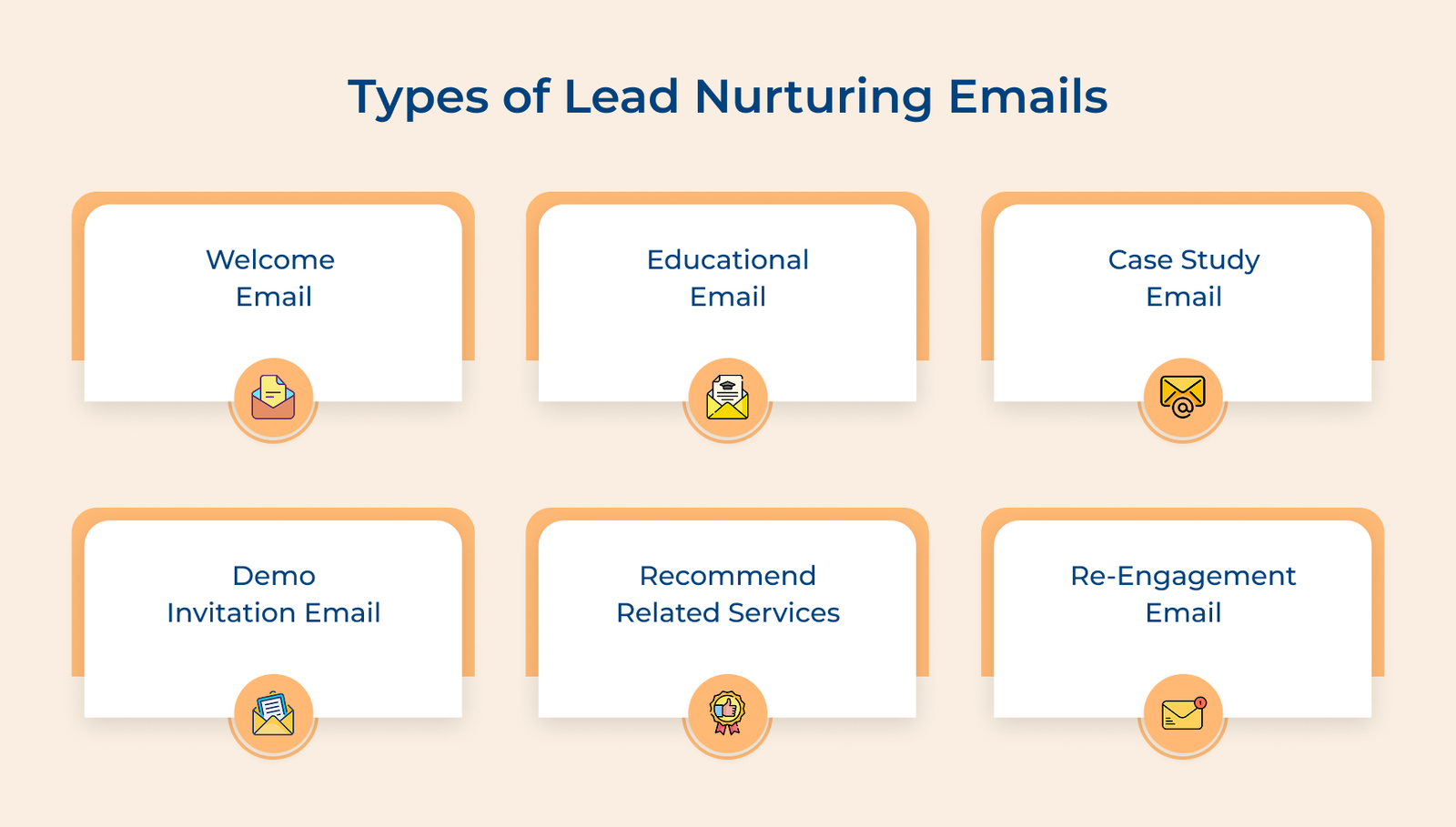
Send it immediately after someone subscribes to your list or downloads their first resource. Every business benefits from welcome emails because first impressions set the tone for your entire relationship. It works at the awareness stage when prospects are just getting to know you.
Example Template:
Subject: Welcome! Here’s how we can help
Hi [First Name],
Thanks for joining us!
You signed up because you’re interested in [specific topic]. Over the next few weeks, we’ll send you practical tips to help you [achieve specific outcome].
Expect one email every Tuesday with actionable advice. No fluff and no constant sales pitches.
Here’s our most popular guide to get started: [Link]
[Your Name]
Send educational emails early to help prospects understand their problem before exploring solutions. SaaS companies and B2B service providers particularly benefit because their offerings require explanation. Use it when someone has engaged with content but hasn’t requested product information.
Example Template:
Subject: 3 mistakes that slow down [specific process]
Hi [First Name],
Most teams struggle with [specific challenge] because they’re making preventable mistakes.
Here are the three biggest ones: [Brief description of each mistake and its impact]
We’ve created a guide that walks through solutions for each. [Link]
[Your Name]
Send use case studies during the consideration stage to show how your solution works in real situations. B2B companies selling complex products benefit most because buyers need reassurance. Send it after someone has engaged with educational pieces and downloaded comparison content.
Example template:
Subject: How [Company] increased [metric] by [percentage]
Hi [First Name],
[Company Name] faced the same challenge: [specific problem]. They were losing [impact] every month.
Here’s what they did: [Key actions taken]
The results after 90 days: [Specific outcome]
Read their complete story: [Link]
[Your Name]
Send demo invitations during the late consideration or early decision stage when prospects are ready to see solutions in action. Software companies and service providers benefit most. Use it after someone has engaged with product content or visited your pricing page.
Example template:
Subject: See [product] in action (15 minutes)
Hi [First Name],
Want to see how [specific feature] actually works?
I’d love to show you a quick demo tailored to [their industry].
We’ll cover how it solves [their problem] with real examples. Book a 15-minute slot: [Calendar link]
[Your Name]
Send recommendations during the retention stage after someone has made an initial purchase and experienced success. E-commerce and SaaS companies use this to increase customer lifetime value. Send these 30-60 days after the initial purchase.
Example template:
Subject: You might also like these
Hi [First Name],
Customers who love [product purchased] often find these helpful:
[Product 1]: [How it complements their purchase]
[Product 2]: [How this solves a related problem]
Here’s 15% off: [Code]
[Your Name]
Use re-engagement emails for subscribers inactive for 30-60 days. They help clean your list and give disengaged prospects one last chance to stay connected.
Example template:
Subject: Are we still on?
Hi [First Name],
I noticed you haven’t opened our emails lately.
If you’d like to keep receiving updates, click here: [Link]
If I don’t hear from you in a week, I’ll remove you from our list. No hard feelings.
[Your Name]
The following are the common mistakes that affect your lead nurturing campaigns. Let’s examine the most damaging ones and how to fix them.
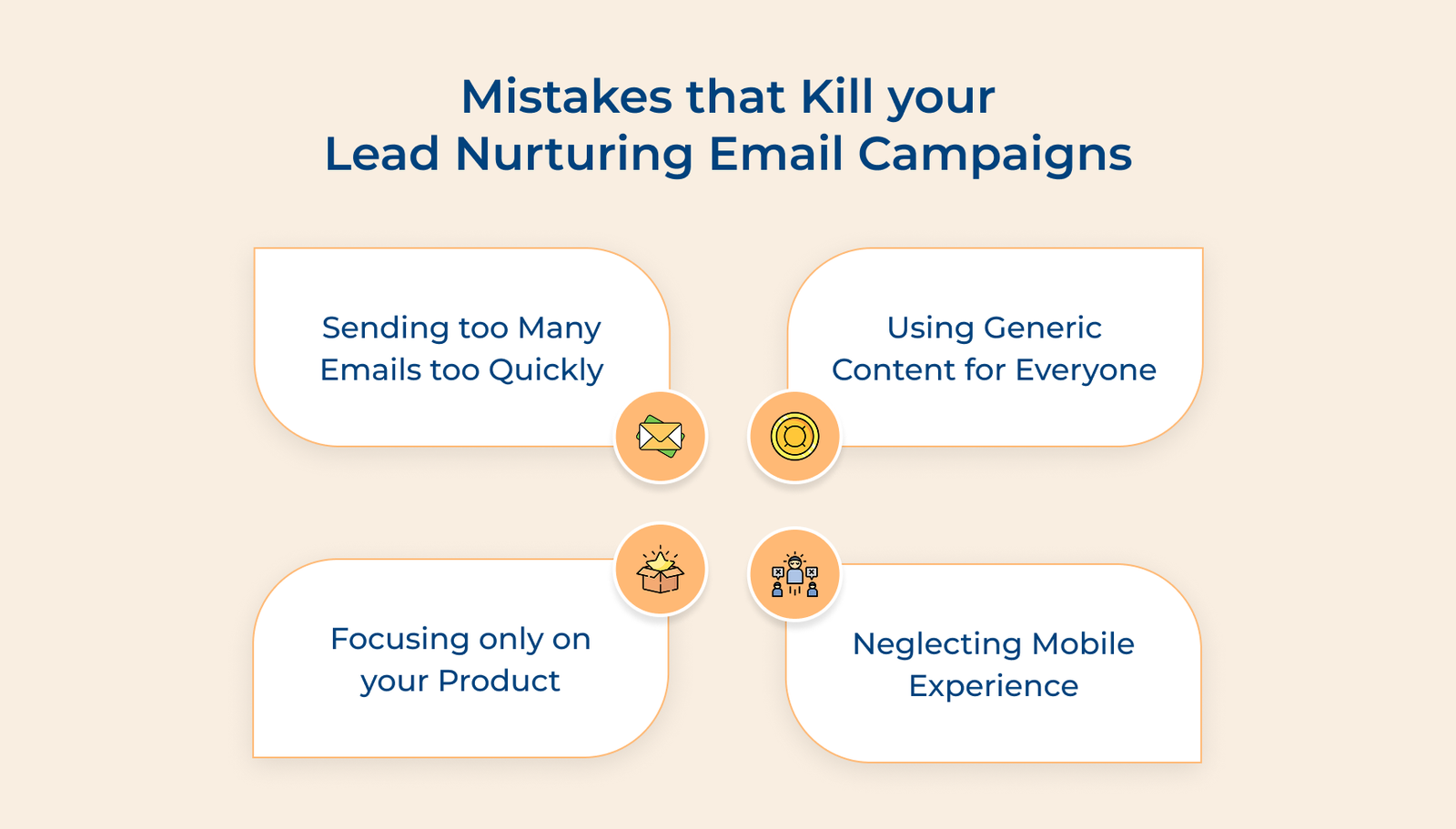
Sending Too Many Emails Too Quickly
Daily or overly frequent emails overwhelm prospects, causing them to ignore your messages or unsubscribe. Consistent but measured pacing keeps your audience engaged without fatigue.
Using Generic Content for Everyone
One-size-fits-all emails fail because they don’t address individual needs. Tailoring content to specific interests or behaviors ensures your message resonates and keeps attention.
Focusing Only on Your Product
Every email that talks exclusively about your features without addressing actual customer problems feels like a sales pitch. Product-obsessed emails ignore what prospects actually care about and create the impression you’re self-interested rather than helpful.
Neglecting Mobile Experience
Most people check emails on phones. Tiny text, crowded layouts or desktop-only formatting make messages hard to read and reduce engagement. Make sure to test if your designs are mobile-friendly for each email you are pushing out.
Implementation steps:
Lead nurturing emails work best when they align with where prospects are in their buying journey. Messages that feel relevant turn generic emails into meaningful conversations, gradually building trust and guiding people toward confident purchase decisions.
Start by implementing just two or three best practices from the guide rather than attempting everything at once. Test your approaches and pay attention to what your specific audience responds to best. Effective nurturing takes patience, building relationships through consistent value rather than pushy sales tactics.

Lead nurturing works by sending a strategic sequence of emails that guide prospects through their buying journey at their own pace. You provide relevant information that matches each stage from awareness to decision. Automated workflows trigger emails based on specific actions, so every lead receives appropriate attention without manual intervention.
A lead nurture email marketing campaign is an organized series of messages designed to move prospects closer to purchase over weeks or months. Each email serves a specific purpose, like educating about problems or demonstrating solutions. The systematic approach turns cold leads into warm prospects who eventually become ready-to-buy customers.
Write emails that convert by focusing on the recipient’s needs rather than your product features throughout most of the sequence. Start with helpful education, then introduce your solution when it naturally fits. Include one clear call-to-action per email and personalize beyond first names by referencing their specific behaviors.
Campaign length depends on how long buyers usually take to decide. Simple purchases may need a few emails over two weeks, while complex B2B deals often need months. Let engagement guide the length.
Send nurturing emails every three to five days for most audiences to maintain presence without overwhelming inboxes. Higher frequency works only if every message delivers exceptional value. Test different schedules with your specific audience to find the balance between staying relevant and becoming annoying.
Grow Customer Relationships and stronger team collaboration with our range of products across the Conversational Engagement Suite.
Omnichannel Customer Support & Help Desk Software
AI Enabled Business Messaging and Chatbot Software
Sales Engagement & CRM Software
Call Center Software & Virtual Phone System
Product Marketing & Experience Platform
Customer Experience & Feedback Management Software
 What is Real Time Customer Service? A Detailed Guide
Scroll to top
What is Real Time Customer Service? A Detailed Guide
Scroll to top