Lead Scoring Template: Benefits, Elements and Tips in 2026
A lead scoring template helps businesses rank prospects by fit and engagement. The blog explains its benefits, key elements and tips to build a reliable model that improves sales focus.
A lead scoring template helps businesses rank prospects by fit and engagement. The blog explains its benefits, key elements and tips to build a reliable model that improves sales focus.
Your sales team spends hours chasing leads that were never going to convert, while real buyers quietly move on. If there’s a lack of a clear way to qualify prospects, it becomes hard to tell casual interest apart from serious buying intent.
Each poorly qualified lead drains time, energy and focus that should go into closing real opportunities. Conversion rates take a hit when sales reps reach out too early, too late, or miss high-intent prospects altogether.
Lead scoring templates bring structure to this chaos. They help assess prospect quality using clear qualification criteria, so sales teams can focus on opportunities that actually deserve attention and let low-value leads fall away naturally.
Lead scoring templates refer to simple frameworks that assign points to potential customers based on their actions and traits. They give sales teams a clear way to see which prospects are most likely to buy. Think of them as a report card that shows how close someone is to making a purchase.
The system tracks behaviors as email opens, downloads, or website visits and adds points for each. Once a prospect hits a set score, they’re flagged as ready for sales outreach. It helps teams spend less time chasing cold leads and more time on genuinely interested people.
Key objectives:
Let’s go through the lead scoring templates to transform how B2B companies identify and nurture their most promising prospects.
Key statistics:
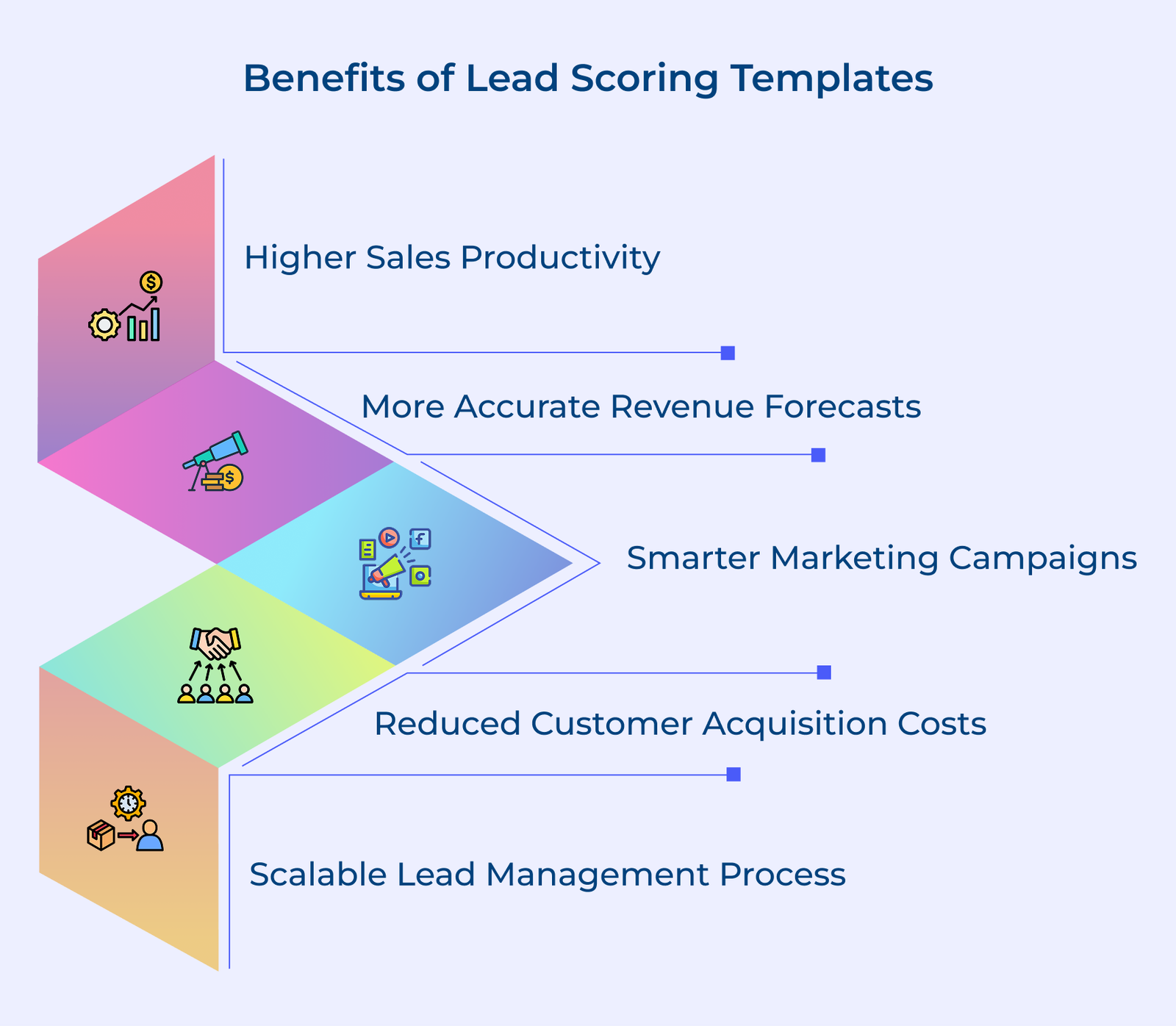
1. Higher Sales Productivity
Sales reps spend less time chasing dead ends and more time talking to people who actually want to buy. It means fewer wasted calls and more meaningful conversations.
2. Smarter Marketing Campaigns
Marketing teams can send the right message at the right time. High-scoring leads get direct outreach, while lower-scoring ones receive nurturing content until they’re ready.
3. More Accurate Revenue Forecasts
Sales managers gain clearer visibility into their pipeline quality by understanding how many high-scoring leads are moving through each stage. The data makes revenue projections more reliable and helps leaders allocate resources wisely.
4. Reduced Customer Acquisition Costs
When your team focuses on qualified prospects, the entire sales process becomes more efficient and cost-effective. You save on wasted outreach and close deals faster, boosting profitability.
5. Scalable Lead Management Process
As lead volume grows, templates keep the process consistent. Even at scale, your team can evaluate prospects fairly without getting overwhelmed.
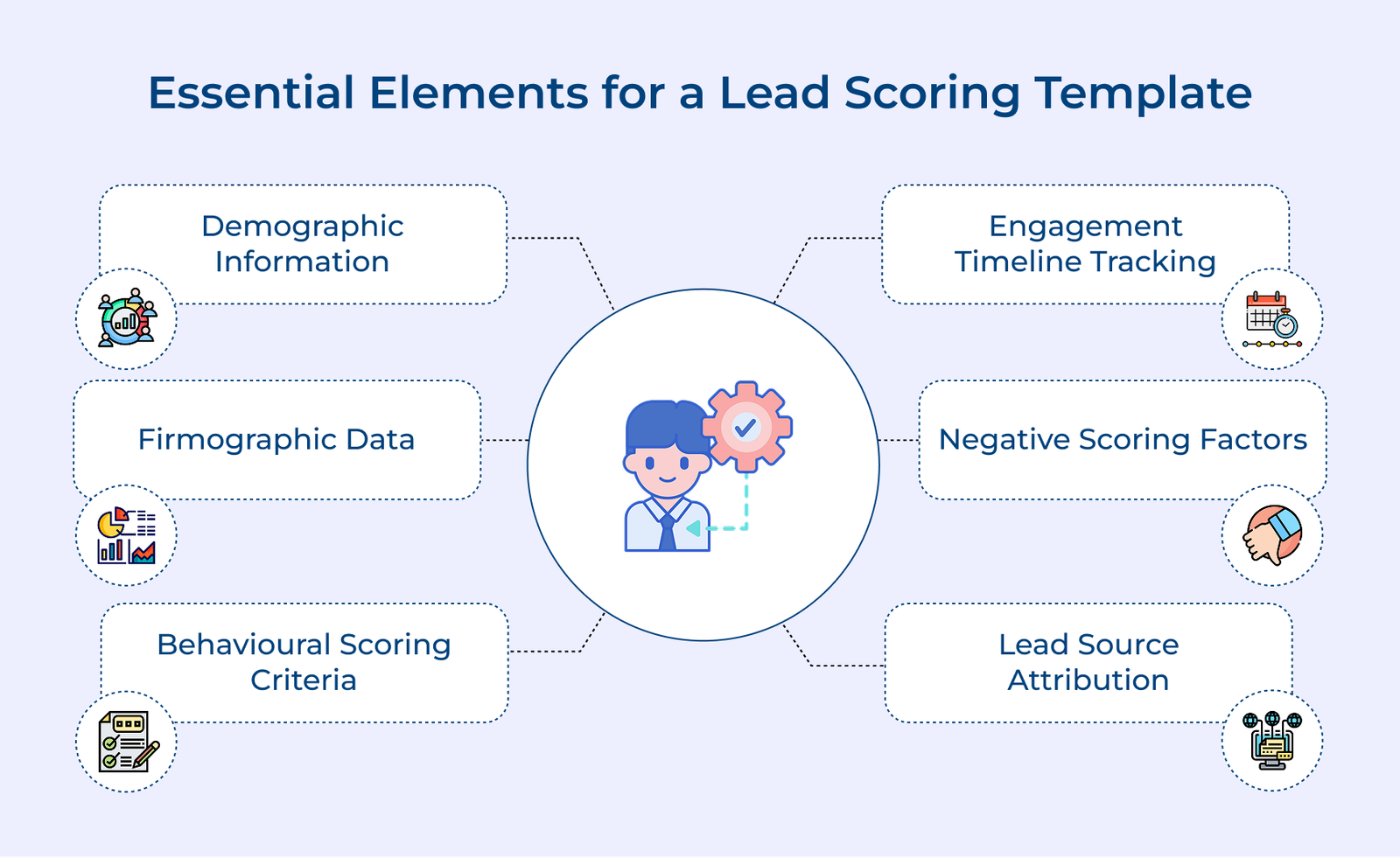
Check out the essential elements every lead scoring template should include to ensure better alignment between sales and marketing.
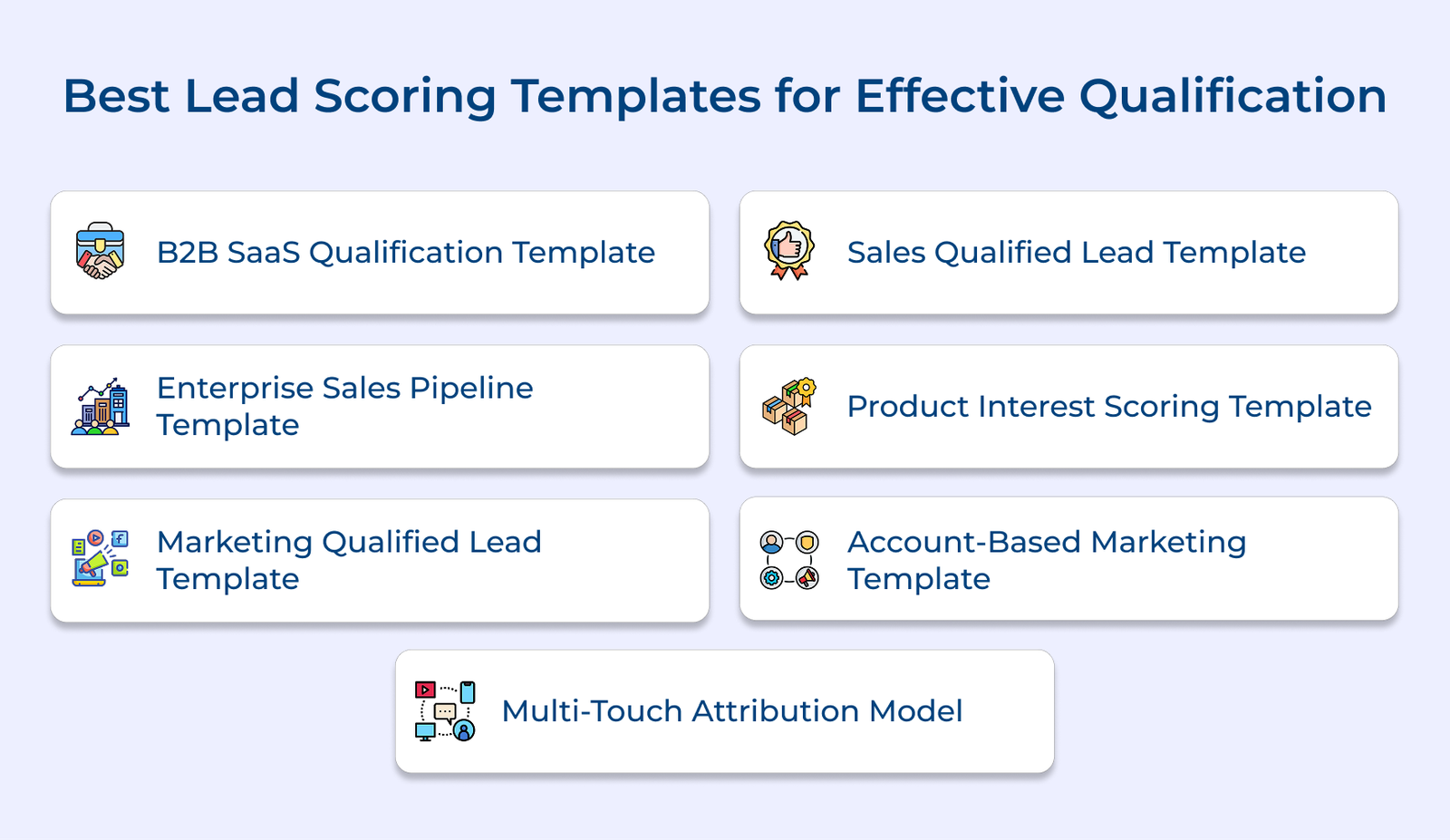
The following are the best lead scoring templates that will transform your approach to lead qualification.
The basic point-based template is a simple way to qualify leads by assigning total scores to their actions and characteristics. It helps businesses spot promising prospects without relying on complex systems.
Key elements:
Start with simple scoring rules, then adjust point values based on actual conversion data from your sales team. Track which activities correlate with closed deals to refine your scoring accuracy over time.
The BANT model evaluates prospects based on Budget, Authority, Need and Timeline criteria. It helps sales teams concentrate on leads with both the ability and intent to buy.
Key components:
A software company assigns 25 points for confirmed budget, 20 points for decision-maker status and 15 points for urgent timeline needs. Leads scoring above 60 points receive immediate sales attention and personalized outreach campaigns. Regularly update your BANT criteria based on changing market conditions and customer feedback to maintain scoring accuracy.
An industry-specific scoring model adapts lead qualification to the buying habits and decision-making processes of different sectors. The approach recognizes that healthcare and manufacturing firms make purchasing decisions in very different ways.
Key industries:
The template works by identifying sector-specific pain points that trigger buying decisions, then weighting behavioral signals according to industry purchasing patterns. Compliance affects scoring because regulated industries have stricter evaluation processes before approving investments.
Challenge: Different industries require extensive research to understand unique buying behaviors and decision-making processes within each sector. Solution: Partner with industry experts and analyze historical customer data to build accurate scoring models for each target market.
The product interest template scores leads based on how they interact with specific features or solutions. It helps separate casual browsers from prospects who show real curiosity about your products.
The template tracks feature page visits, demo requests and specific content downloads to gauge genuine product curiosity levels. Sales teams can then tailor their outreach messages to address the exact solutions that captured each prospect’s attention.
Best practice:
The predictive analytics lead scoring system uses machine learning and past customer data to estimate how likely a lead is to convert. Instead of relying on assumptions, it uncovers patterns hidden in thousands of interactions.
A SaaS company’s predictive lead scoring model analyzes 50 behavioral signals and assigns probability scores from 1-100. Leads scoring above 75 show an 85% conversion likelihood based on historical data patterns and receive immediate sales attention.
Implementation steps:
The account-based marketing lead scoring template looks at companies as a whole rather than scoring individual leads. It is especially useful in B2B sales where decisions involve several people across departments.
Key questions:
Account-based scoring reveals which companies show enterprise-level interest signals across multiple touchpoints and stakeholder groups. They track all contacts in a target account and assign a combined score based on overall engagement. When multiple stakeholders from the same company engage with content, the account score increases significantly, indicating serious organizational interest.
Key elements:
The multi-touch attribution lead scoring template scores leads by looking at their entire journey across channels instead of isolated actions. Since most buyers interact through several touchpoints before making a decision, the approach gives a more accurate picture of intent.
Use cases:
An enterprise software company tracks prospects across LinkedIn ads, webinars, email campaigns and website visits. When someone attends a webinar after clicking a LinkedIn ad and then downloads a case study, they receive compound scoring reflecting this high-intent sequence.
Below are the tips for creating an effective lead scoring template that requires strategic thinking and careful consideration of your unique business context.
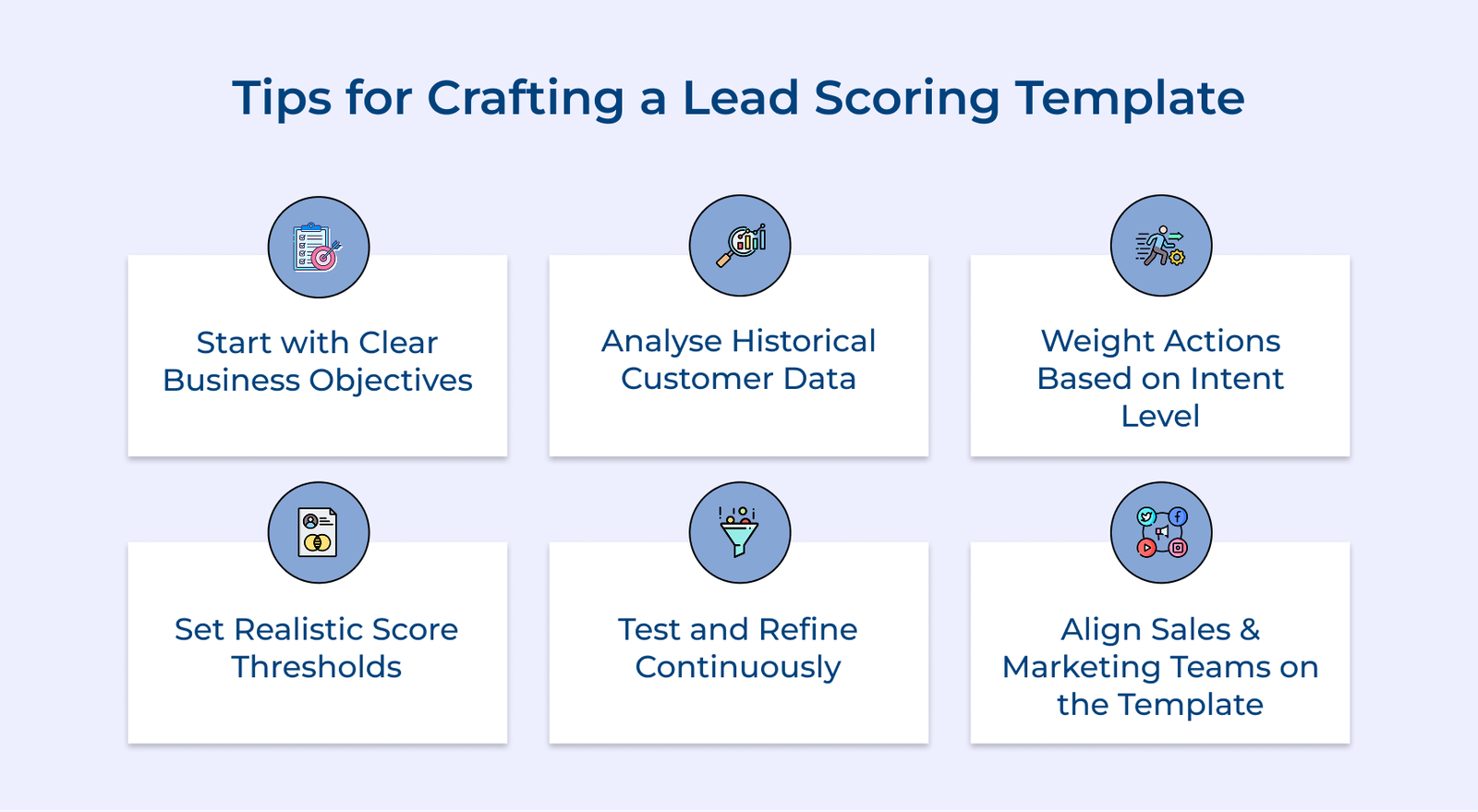
Before assigning points or building rules, define what your sales team is actually working toward. A scoring system without clear goals just produces numbers that don’t help anyone.
Key elements:
Remember that your scoring template should serve your business objectives rather than creating an elaborate system that impresses but doesn’t deliver results. The most sophisticated template means nothing if it doesn’t help your sales team close more deals consistently.
The best scoring models are built on evidence, not guesses. Look at your past sales to see what real customers had in common before they signed a deal.
Key questions:
Look beyond surface-level metrics to understand the deeper patterns that indicate genuine buying intent versus casual interest. Your historical data contains the blueprint for identifying future customers if you analyze it thoughtfully and systematically.
Not all actions carry the same meaning. A demo request signals far more interest than downloading a general industry guide, so your scoring should reflect that difference appropriately.
Give stronger weight to high-intent actions like visiting the pricing page, requesting a trial or comparing you with competitors. Lower-value actions, such as opening a newsletter, should add only a small bump.
Your thresholds should match what your sales team can handle. If too many leads score “hot”, your rep gets overwhelmed. If the bar is too high, good prospects slip through.
Key factors:
Test different threshold levels and adjust based on actual results rather than sticking rigidly to initial assumptions. Your ideal scoring cutoffs will emerge through experimentation and continuous refinement based on real-world performance data.
Your first scoring setup won’t be perfect and that’s fine. Start with simple rules, then adjust based on what actually drives conversions. Real sales data should shape your model, not assumptions.
Implementation steps:
Track your template’s performance metrics just like any other marketing campaign to ensure it continues delivering value. The best scoring systems evolve continuously based on new data and changing market conditions.
A lead scoring template only works if sales and marketing agree on what a qualified lead looks like. Misalignment happens when marketing sends leads that sales see as unqualified or sales overlook high-scoring prospects due to differing criteria.
Hold regular meetings to review scoring performance and gather feedback from both teams about template effectiveness. Reps provide valuable insights about lead quality while marketing teams understand which campaigns generate the highest-scoring prospects consistently.
Key questions:
Success requires ongoing collaboration between sales and marketing rather than treating lead scoring as a one-time setup project. Regular communication ensures your template serves both teams’ needs and contributes to overall revenue growth objectives.
Lead scoring templates turn disorganized prospect handling into a structured system that highlights your best opportunities. The scoring frameworks eliminate guesswork by assigning numerical values to prospect behaviors and characteristics based on historical conversion data.
Implementing the right template helps your sales team focus energy on qualified prospects while marketing nurtures lower-scored leads toward readiness. The precision approach increases conversion rates and reduces customer acquisition costs significantly.

Lead scoring templates bring structure to chaos. They help assess prospect quality using clear qualification criteria, so sales teams can focus on opportunities that actually deserve attention and move faster on deals that show real buying signals, while low-value leads fade out on their own.
Begin with basic demographic scoring, then layer behavioral tracking based on your specific sales process and customer journey stages. Build flexibility into your template by allowing point value adjustments as you gather conversion data and refine qualification accuracy.
Templates automate prospect evaluation by consistently applying the same criteria to every lead, eliminating subjective judgment calls from your qualification process. Sales teams receive pre-ranked prospects instead of spending time sorting through unqualified lists.
Study each market’s buying habits and timelines, then adapt your criteria to reflect the patterns. Weight different actions and characteristics based on what drives conversions within each particular market segment you’re targeting.
Grow Customer Relationships and stronger team collaboration with our range of products across the Conversational Engagement Suite.
Omnichannel Customer Support & Help Desk Software
AI Enabled Business Messaging and Chatbot Software
Sales Engagement & CRM Software
Call Center Software & Virtual Phone System
Product Marketing & Experience Platform
Customer Experience & Feedback Management Software
 Scroll to top