10+ B2B Sales KPIs & Metrics Every Business Should Track
Explore the essential B2B sales KPIs, their benefits and practical examples. It helps businesses measure performance, optimize sales strategies and drive sustainable revenue growth.
Explore the essential B2B sales KPIs, their benefits and practical examples. It helps businesses measure performance, optimize sales strategies and drive sustainable revenue growth.
Most businesses track dozens of sales numbers but understand very few of them. The dashboards look impressive, yet the insights often fall flat. When teams can’t tell which metrics actually drive growth, they end up chasing vanity numbers and missing what really moves the needle.
Clarity drives real progress. The key is to track B2B sales KPIs that actually reflect performance, not vanity numbers. The metrics below cover everything from daily actions to pipeline strength and revenue impact, so you can see exactly what’s working and what needs attention.
B2B sales KPIs refer to specific, measurable indicators that help businesses evaluate how effectively their sales teams are performing when selling to other businesses. The metrics are essential for tracking progress, spotting weak points and making informed decisions to improve sales outcomes.
The process starts by monitoring sales activities at every stage, from the first contact with a lead to closing the deal. The data is then compared against set goals or benchmarks to see what’s working and what’s not. Most modern B2B companies use CRM systems to track the metrics in real time, allowing sales teams to respond quickly when strategies need adjusting.
Key principles:
Let’s go through the invaluable benefits of measuring B2B sales KPIs and why embracing the practice can lead to transformative results for your business.
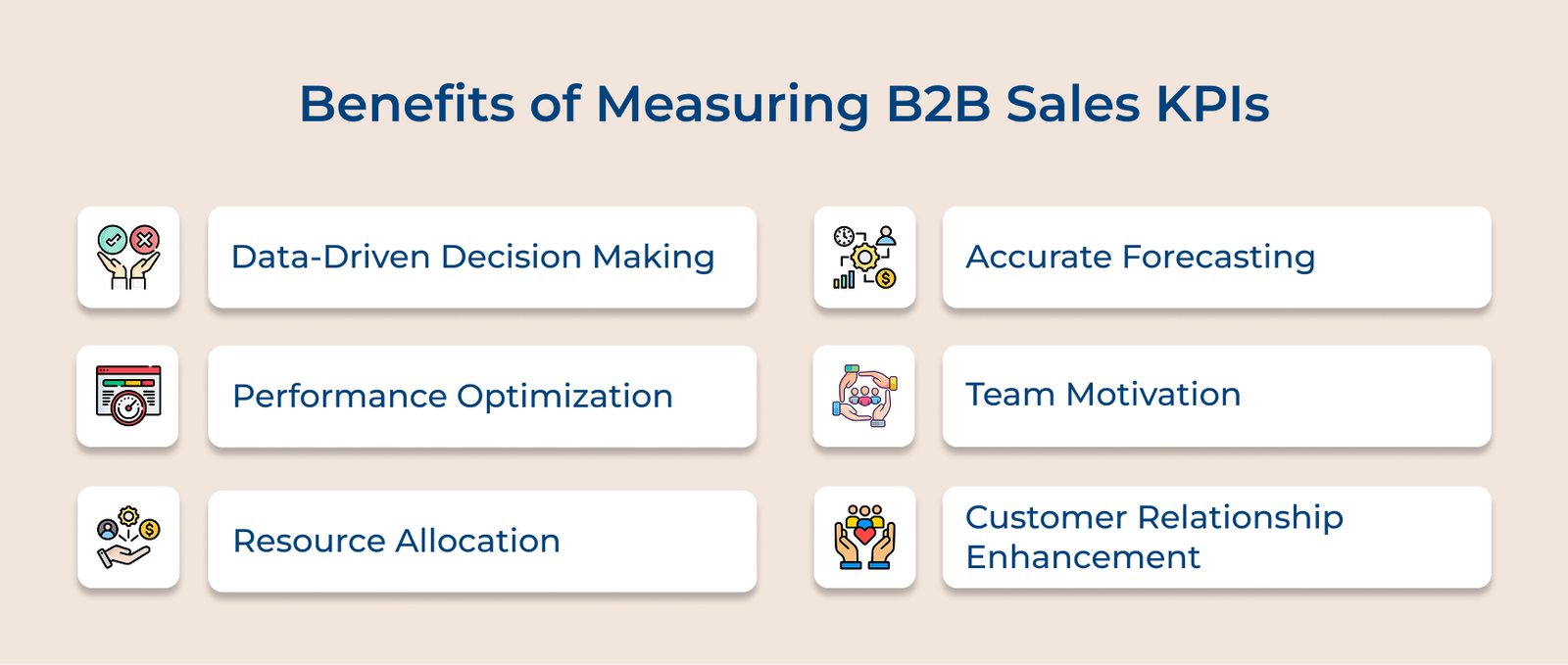
Data-driven Decision Making
Tracking KPIs takes the guesswork out of your sales strategy. You see what’s working, what’s not and where to focus. Instead of relying on hunches, your team uses real data to guide every move, whether adjusting a pitch or refining a campaign.
Performance Optimization
Regular KPI reviews reveal where your sales process slows down, maybe leads aren’t converting or deals are getting stuck. The insights help you fix problems early and offer targeted support to team members who need it.
Resource Allocation
Not all efforts bring equal results. KPIs show which customer segments and sales activities deliver the best results. The knowledge enables you to shift your time, money and team energy to where they’ll have the most impact.
Accurate Forecasting
KPI trends help you predict what’s ahead. Be it anticipating a slow season or planning for growth, having data-backed forecasts makes it easier to prepare—across sales, inventory, hiring and more.
Team Motivation
Clear metrics give your sales team something to aim for. When people understand how their work ties into the bigger picture and see their progress, it boosts motivation. You can also build rewards around real, measurable achievements.
Customer Relationship Enhancement
Tracking customer engagement KPIs shows where relationships grow or fade. You’ll see which touchpoints need improvement and where to focus your efforts to deliver better service.
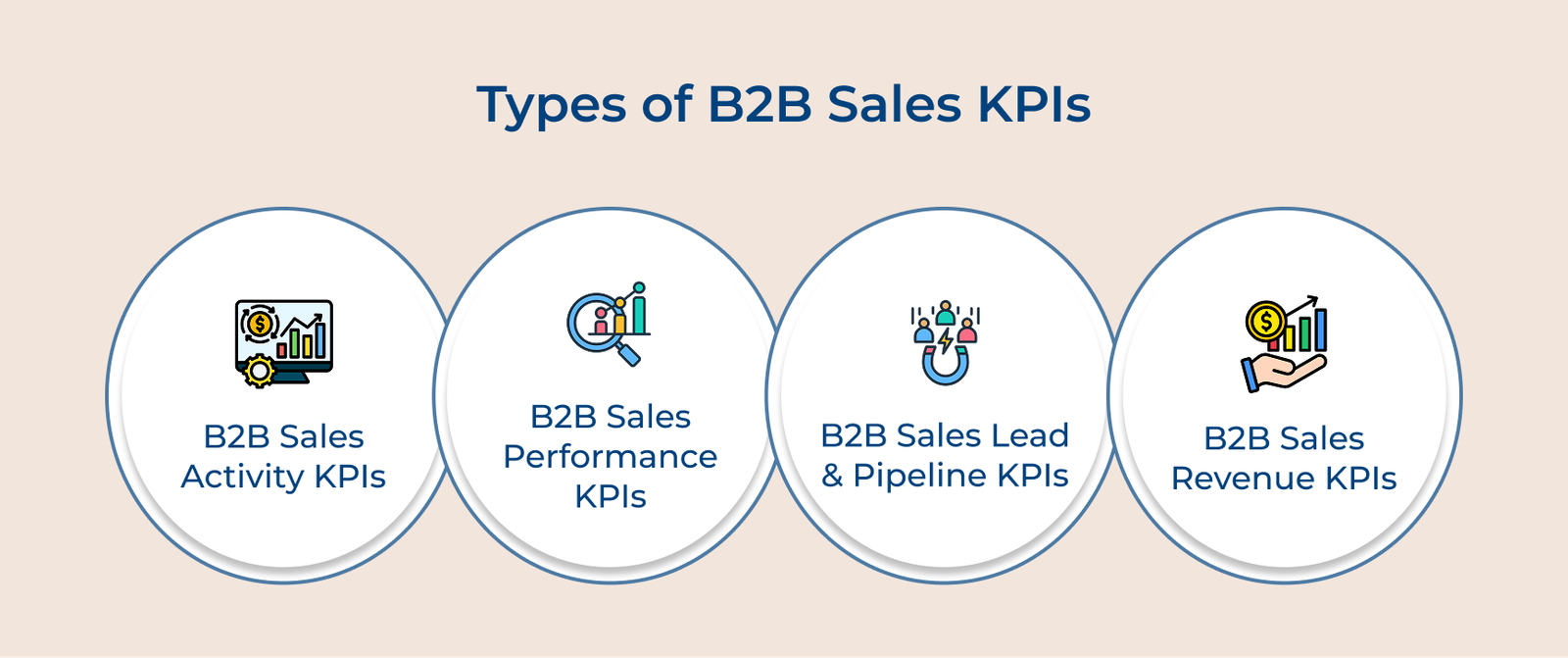
Below are a few critical B2B sales KPIs you must track to enhance your performance, optimize your team’s efforts and elevate your bottom line.
The KPI tracks how many calls your sales team makes over a set period. It’s a simple yet powerful way to measure how actively your team is reaching out to prospects and following up with existing leads.
Total Number of Sales Calls = Successful Connections + Attempted Calls + Scheduled Calls in [Period]
While the right number varies by industry, most B2B sales teams benefit from focusing on quality conversations over raw volume. Let’s assume that a software sales rep makes 25 calls in a day. They speak directly with 8 leads and leave voicemails for 17. The numbers give the manager a quick look at the rep’s pace and if the activity level supports broader sales goals.
Pro tips:
The KPI tracks how many sales emails your team sends and what percentage of them receive replies. It helps gauge whether your outreach is connecting with the right people and if the message is hitting the mark.
Formula:
Response Rate = (Number of Responses Received / Total Number of Emails Sent) × 100
Success in email outreach depends on personalization and targeting. High-performing B2B sales teams aim for response rates that indicate meaningful engagement rather than focusing solely on email volume. Let’s consider that a sales team sends 100 tailored emails to qualified leads. They received 15 replies and 8 of those led to follow-up calls. The 15% response rate shows your message is working and your targeting is on point.
Actionable tips:
The KPI shows how consistently your sales team follows through on planned activities—calls, emails and meetings. Timely follow-ups often make the difference between a closed deal and a missed opportunity.
Follow-up Completion Rate = (Completed Follow-up Activities / Planned Follow-up Activities) × 100
A high completion rate means your team is staying on track and giving each prospect the attention needed to move deals forward. It’s not just about doing more, it’s about doing what you said you would. A rep plans 15 follow-ups for the week. They completed 12, including 5 calls, 4 emails and 3 meetings. It gives them an 80% completion rate, which helps evaluate their follow-up discipline.
Best practices:
Win rate shows how many of your sales opportunities turn into actual deals. It’s a simple but powerful way to measure how effective your sales process is.
Win Rate = (Number of Won Opportunities / Total Number of Closed Opportunities) × 100
The average win rate ranges between 20% to 40% for B2B sales teams. Enterprise software companies typically see lower rates due to complex sales cycles, while simpler B2B products might achieve higher rates. The key is maintaining consistency and showing improvement over time.
Sales cycle length tracks the average time it takes to turn a lead into a paying customer. It’s a useful way to gauge how efficiently your sales process is running and helps set realistic expectations for forecasting revenue. It also highlights where prospects tend to stall, so you can address the points directly.
Formula:
Average Sales Cycle Length = Total Days for All Won Deals / Number of Won Deals
Let’s assume that your company tracks three recently closed deals. One took 45 days, another took 60 days and the third took 75 days. Your average sales cycle length would be 60 days. The baseline helps you plan resources and set expectations for future deals.
Key takeaways:
Deal closing efficiency measures how well your sales team turns proposals into actual sales. It shows if you’re focusing your efforts on the right opportunities and how effective your closing process is.
Deal Closing Efficiency = (Number of Deals Closed / Number of Proposals Sent) × 100
A good benchmark for B2B sales is closing 30% to 50% of proposals, though it can vary depending on your industry and how complex your offering is. The key is to watch your trends over time and aim for steady improvement.
The KPI tracks how many leads meet your specific qualification standards. It helps you gauge how well your marketing is attracting the right prospects and if your sales team is being handed leads worth pursuing. Start with a clear definition of what a “qualified” lead looks like, based on factors like budget, authority, need and timeline. Apply it to all incoming leads using a lead scoring system or manual checks.
Formula:
Qualified Lead Rate = (Number of Qualified Leads / Total Number of Leads) × 100
A common benchmark for B2B companies is a 25-30% qualification rate. It will vary depending on how strict your criteria are and the channels you’re using to attract leads. The goal is to improve lead quality while slowly increasing volume.
Pro tips:
Pipeline velocity measures how quickly leads move through your sales pipeline. The metric helps identify bottlenecks and forecast revenue more accurately. It’s crucial for understanding the health and efficiency of your sales process.
Measure the average time leads spend in each pipeline stage. Track the number of opportunities, the conversion rates between stages and the average deal size. Multiply the factors together to determine your pipeline velocity in terms of potential revenue movement.
Formula:
Pipeline Velocity = (Number of Opportunities × Deal Value × Win Rate) / Length of Sales Cycle
Pipeline velocity will look different depending on your industry and how complex your sales process is. The main thing to watch is if it’s improving over time and where it slows down.
Actionable tips:
Lead conversion rate shows the percentage of leads that ultimately become customers. The metric helps evaluate the effectiveness of your entire sales process from initial contact to close. It’s essential for understanding your sales funnel efficiency.
Formula:
Lead Conversion Rate = (Number of Converted Leads / Total Number of Leads) × 100
B2B companies generally see conversion rates between 5%-10%, though it depends on your industry and how qualified your leads are. The goal is to spot where leads drop off and make improvements at those points.
Best practices:
The KPI tracks the total potential revenue sitting in your active sales pipeline. It gives you a snapshot of future income potential and helps gauge if your team is on pace to meet sales goals. Knowing your pipeline value also supports smarter decisions around staffing, budgeting and goal setting.
Total up the potential value of all active deals. Apply a probability to each deal based on its stage in the pipeline. Use historical data to guide how you weigh each stage. Review and update this regularly to reflect current progress.
Weighted Pipeline Value = Σ (Opportunity Value × Probability of Closing)
Aim for a pipeline that’s 3–5× your revenue goal. It gives you a strong buffer to account for deals that fall through. Adjust the multiplier based on your usual win rate and sales cycle length.
Best practices:
Monthly recurring revenue (MRR) tracks the reliable revenue income your business earns each month from active subscriptions. It’s a key metric for B2B companies, especially in SaaS, because it reflects predictable cash flow and long-term sustainability.
MRR = Sum of (Number of Customers per Plan × Monthly Revenue per Plan)
Net MRR Growth = New MRR + Expansion MRR – Churned MRR – Contraction MRR
Many B2B companies aim for monthly MRR growth between 10%-20% in early growth stages. As you scale, that percentage may level off, but the focus should shift to consistency and reducing churn.
Key takeaways:
CAC measures how much you spend to bring in a new customer. It includes all related costs and helps assess how efficiently you’re growing. A clear view of CAC helps control spending, prioritize high-performing channels and maintain long-term financial health.
Formula:
CAC = Total Sales and Marketing Costs / Number of New Customers Acquired
[Measured over a specific period, typically monthly or quarterly]
Tracking CAC helps ensure you’re not overspending to gain customers who won’t deliver enough value over time. Most B2B companies aim to recover CAC within 12 months for sustainable growth. The payback period can vary, but shorter is generally better.
Actionable tips:
The KPI tracks how much revenue each sales rep generates on average. It helps you gauge individual contribution and overall team efficiency. It’s especially useful for spotting high performers, identifying training needs and planning future team capacity.
Revenue per Rep = Total Revenue Generated / Number of Sales Representatives
There’s no universal benchmark; targets vary by industry, product pricing and sales cycle length. The focus should be on setting goals that reflect your business reality and encouraging steady improvement over time.
Key takeaways:
Let’s go through the major companies that use specific metrics to drive their B2B success and what impact the measurements have had on their business growth.
Amazon
Amazon tracks pipeline velocity and conversion rates closely in its B2B marketplace. Key metrics include time-to-first-order, average order value and reorder frequency. They also monitor supplier performance and buyer satisfaction to ensure marketplace consistency.
The attention to data has helped Amazon Business grow quickly. They’ve improved customer retention, attracted more suppliers and scaled their B2B footprint across industries by acting on the metrics.
Puma
Puma focuses its B2B strategy on wholesale performance. They monitor sell-through rates, inventory turnover, seasonal pre-orders and retailer satisfaction. Product category performance and time-to-market for new launches are also key areas of measurement.
Tracking the metrics has helped Puma streamline inventory, reduce stockouts and improve coordination with retail partners. The result is a more efficient and predictable wholesale operation.
Nike
Nike prioritizes digital tools in its B2B operations. They measure engagement with their online wholesale portal, acquisition costs and order processing times. Other key metrics include how often partners use their digital tools, response time to inquiries and supply chain efficiency.
The data helps Nike improve accuracy, speed up communication and better support retail partners around the world, all while simplifying the B2B ordering process.
Apple
Apple’s B2B focus is on long-term enterprise relationships. They track deployment time, customer satisfaction, solution adoption, account growth, support resolution times and retention rates.
Apple has deepened its presence in the business world by keeping close watch on these areas. Their metrics help ensure smooth rollouts, strong customer support and steady account expansion over time.
Check out how to choose metrics that align with your business goals and provide meaningful insights for decision-making.
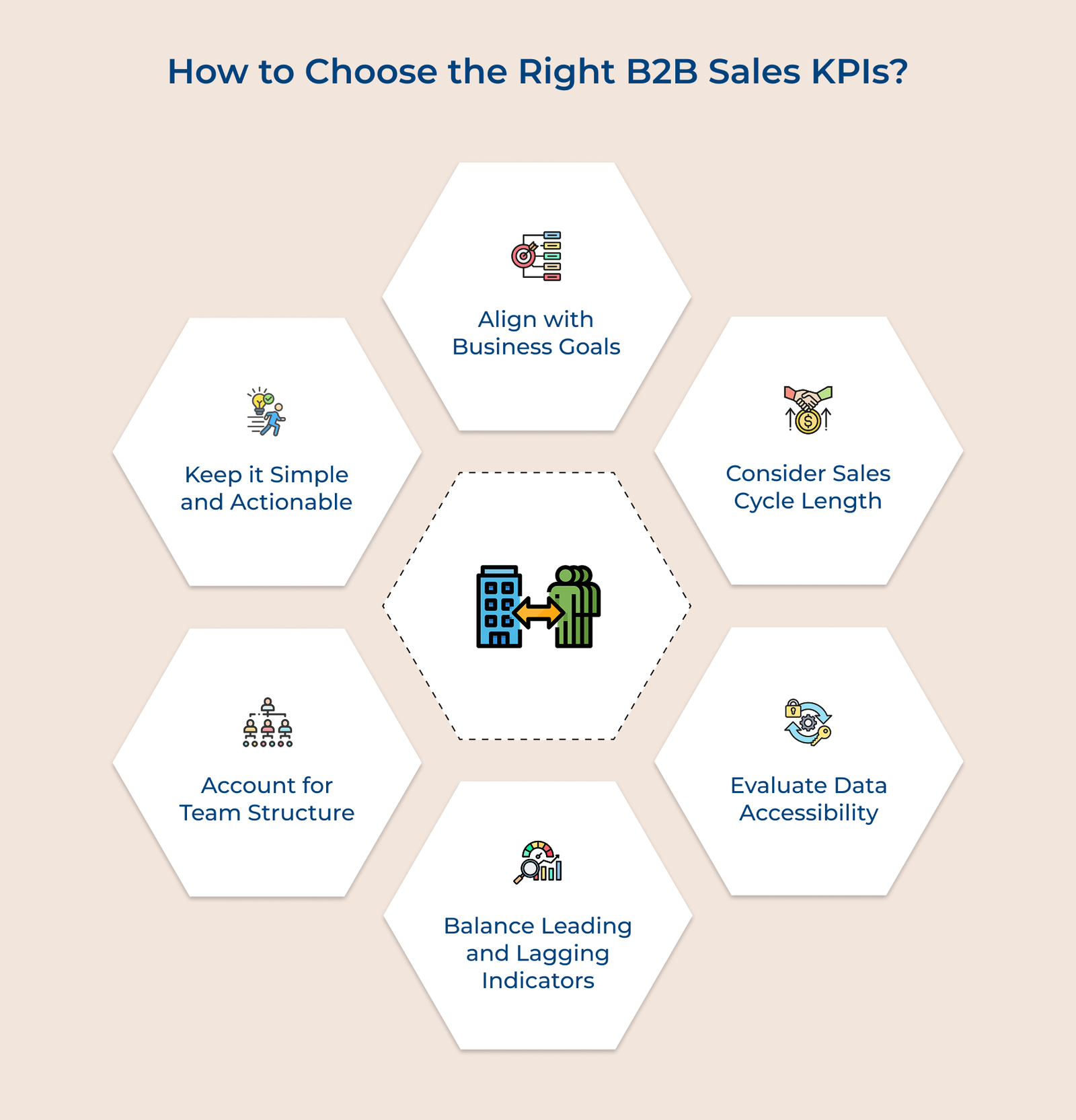
Start by being clear about what you’re trying to achieve. If you’re expanding into new markets, track metrics like how many new customers you’re gaining in those areas. Every KPI should have a direct link to a business objective, if it doesn’t, it’s just a distraction.
The pace of your sales process should shape what you measure. If your deals take months to close, focus on metrics like pipeline movement and deal stage progression. If your cycle is short, zero in on daily activity and conversion rates. It keeps your tracking relevant.
Only choose KPIs you can measure consistently with the systems you already use, like your CRM or reporting tools. If you can’t track it accurately or regularly, it won’t help you make better decisions.
Don’t just look at outcomes like revenue. Also track what leads to those results—calls made, demos booked, follow-ups sent. Having both types of metrics helps you spot issues early and manage both today’s work as well as tomorrow’s outcomes.
When you define sales metrics, start by looking at your team structure. A small team where everyone handles multiple stages of the sales cycle can’t be measured the same way as a large team with dedicated prospectors and closers. The way your team is built should shape the numbers you track and the goals you set.
Focus on KPIs your team can actually act on and understand. When salespeople see how their everyday actions affect a measurable goal, they take ownership, stay motivated and make smarter decisions. They don’t have to wait for a manager to explain what matters.
Successfully using B2B sales metrics starts with choosing the right metrics and making sure they’re used in day-to-day decisions. The goal isn’t just to measure performance, it’s to help your team make better choices that lead to more sales, stronger customer relationships and smoother operations.
The most effective KPIs are tied to real business goals and give your team insight they can act on. Regular check-ins and adjustments keep your metrics relevant. The best B2B teams don’t treat KPIs as a reporting task. They use them to steer strategy and shape the way they grow.
Key takeaways:

The core sales KPIs often include conversion rate, pipeline velocity and customer acquisition cost (CAC). The metrics directly reflect how well your sales process works and how efficiently you’re growing revenue. While each business is different, most B2B teams prioritize KPIs that show both how fast and how effectively deals are moving. Choose based on your sales cycle length and specific goals.
Developing effective sales KPIs starts with clearly defining your business objectives. Start by identifying what success looks like for your specific situation, then work backward to determine which metrics will measure progress toward that goal. Create detailed documentation that explains how each KPI is calculated, what data sources are needed and who’s responsible for tracking it. Include specific formulas, measurement frequencies and desired benchmarks in your documentation.
Make sure your CRM and sales tools are set up to collect the right data. Use dashboards or reports that update automatically and schedule regular reviews. Check the data quality often—bad inputs lead to bad insights. Break your KPIs down by team, region, product or customer segment.
While all KPIs are metrics, not all metrics are KPIs. Key performance indicators specifically measure progress toward strategic business objectives, while metrics might track any measurable aspect of your business. Think of KPIs as your most important metrics that directly indicate success or failure in achieving your goals. Let’s assume that while email open rate is a metric, conversion rate from email campaigns might be a KPI if email is a key sales channel.
The measurement frequency depends on your sales cycle and the nature of each KPI. Leading indicators like activity metrics might need daily or weekly monitoring, while lagging indicators like quarterly revenue could be reviewed monthly or quarterly. Create a balanced schedule that allows for timely course corrections without creating unnecessary administrative burden.
Start with your past results. Add industry benchmarks and factor in your current goals. Your targets should push the team, but still be achievable. Consider market trends, team capacity and seasonal shifts. Check in regularly about what was realistic six months ago might need to change.
Grow Customer Relationships and stronger team collaboration with our range of products across the Conversational Engagement Suite.
Omnichannel Customer Support & Help Desk Software
AI Enabled Business Messaging and Chatbot Software
Sales Engagement & CRM Software
Call Center Software & Virtual Phone System
Product Marketing & Experience Platform
Customer Experience & Feedback Management Software
 A Detailed Guide on B2C Customer Experience in 2026
Scroll to top
A Detailed Guide on B2C Customer Experience in 2026
Scroll to top