Cold Email Sequence: Steps, Examples & Tools in 2026
The blog explains what a cold email sequence is, how it works and how to create step-by-step emails. It helps to start conversations, earn replies and build new business relationships.
The blog explains what a cold email sequence is, how it works and how to create step-by-step emails. It helps to start conversations, earn replies and build new business relationships.
Cold outreach fails most of the time and the reason is rarely the email itself. Decision-makers receive dozens of messages daily. A single touchpoint from an unfamiliar sender gets skimmed, mentally filed under “maybe later” and forgotten before the day ends. It is why 95% of cold emails end up getting no replies.
The instinct most people follow is to either give up after one attempt or flood the inbox with increasingly desperate check-ins and both approaches destroy the opportunity. Unplanned follow-ups without a clear progression read as noise, erode trust and train spam filters to catch your domain before it even reaches a human.
A cold email sequence built around timing and value builds enough familiarity that a cold prospect starts to see you as a credible option worth engaging.
A cold email sequence refers to a short series of planned emails sent to people who do not know your business yet. Think of it as a calm conversation that unfolds over time instead of a single message that asks too much, too soon. Each email builds on the last and moves the reader one small step closer to replying.
The sequence works because people rarely respond to the first email they receive from a stranger. You’re giving prospects multiple chances to engage while providing different angles of value. Each touchpoint serves as a gentle reminder that you exist and can solve a problem they’re facing.
Key objectives:
Let’s go through the reasons most businesses need a cold email sequence to consistently reach prospects and turn initial outreach into meaningful conversations that drive results.
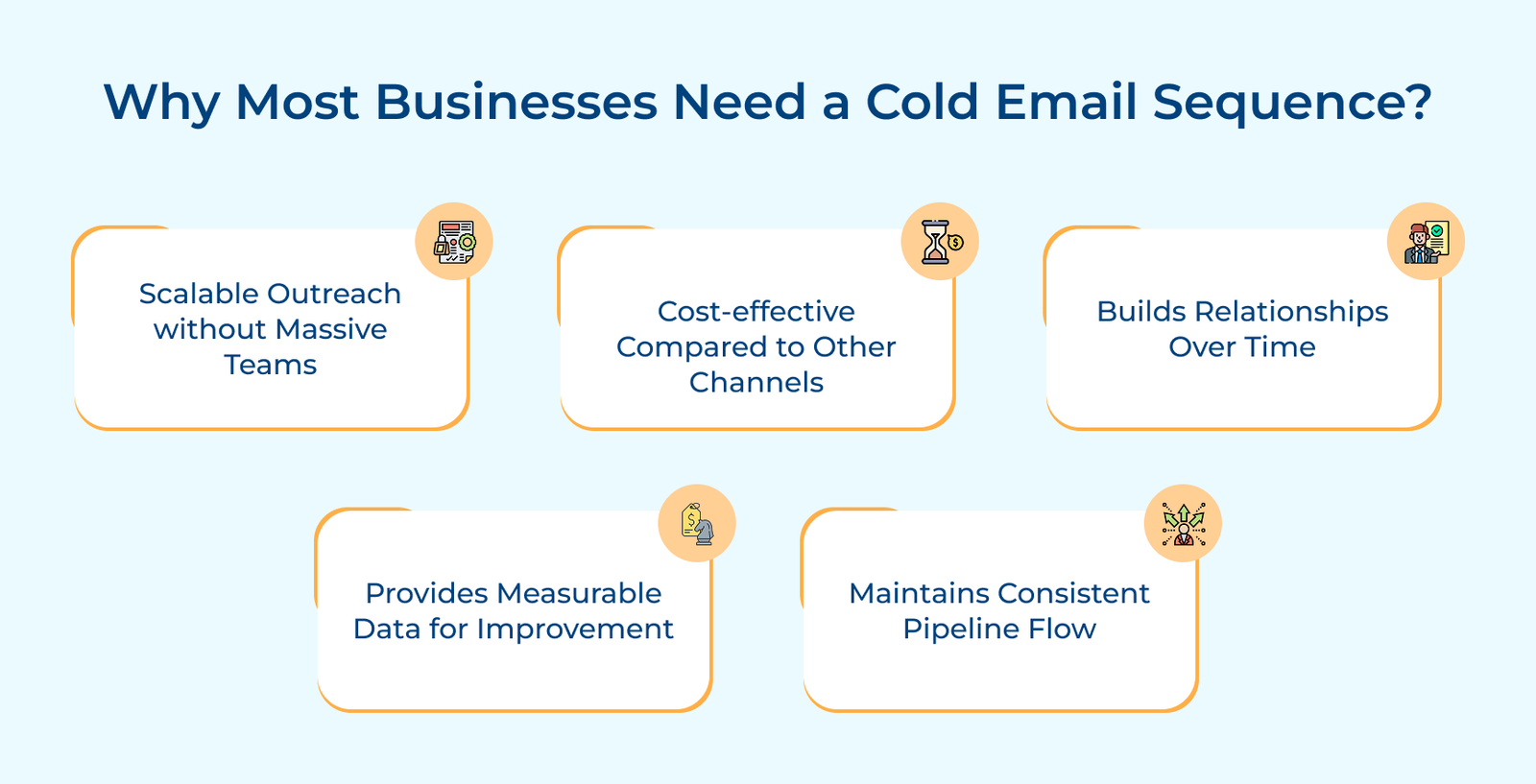
Scalable Outreach with Minimal Effort
Reach hundreds of potential customers at once while keeping each message personal. Automation handles timing and follow-ups, leaving you free to craft messages that address your ideal customer’s challenges.
Cost-effective Lead Generation
Cold email sequences require minimal investment beyond your time and an email tool. You’re not paying per click like ads or per call like telemarketing. One well-crafted sequence can generate leads for months at essentially zero marginal cost.
Relationships Grow Over Time
Prospects need multiple touches before trusting you enough to respond. Each email adds credibility and shows persistence without pressuring strangers for instant results.
Insights You can Add On
Open and response rates show what works. Testing subject lines, messaging or value propositions helps you fine-tune your approach and understand what motivates your audience.
Consistent Pipeline Flow
A running sequence sparks new conversations weekly without manual effort. It keeps your pipeline steady, avoiding feast-or-famine cycles and filling your calendar with qualified opportunities consistently.
Check out the actionable steps and discover how you can transform your cold email sequence strategy, getting the responses you desire.
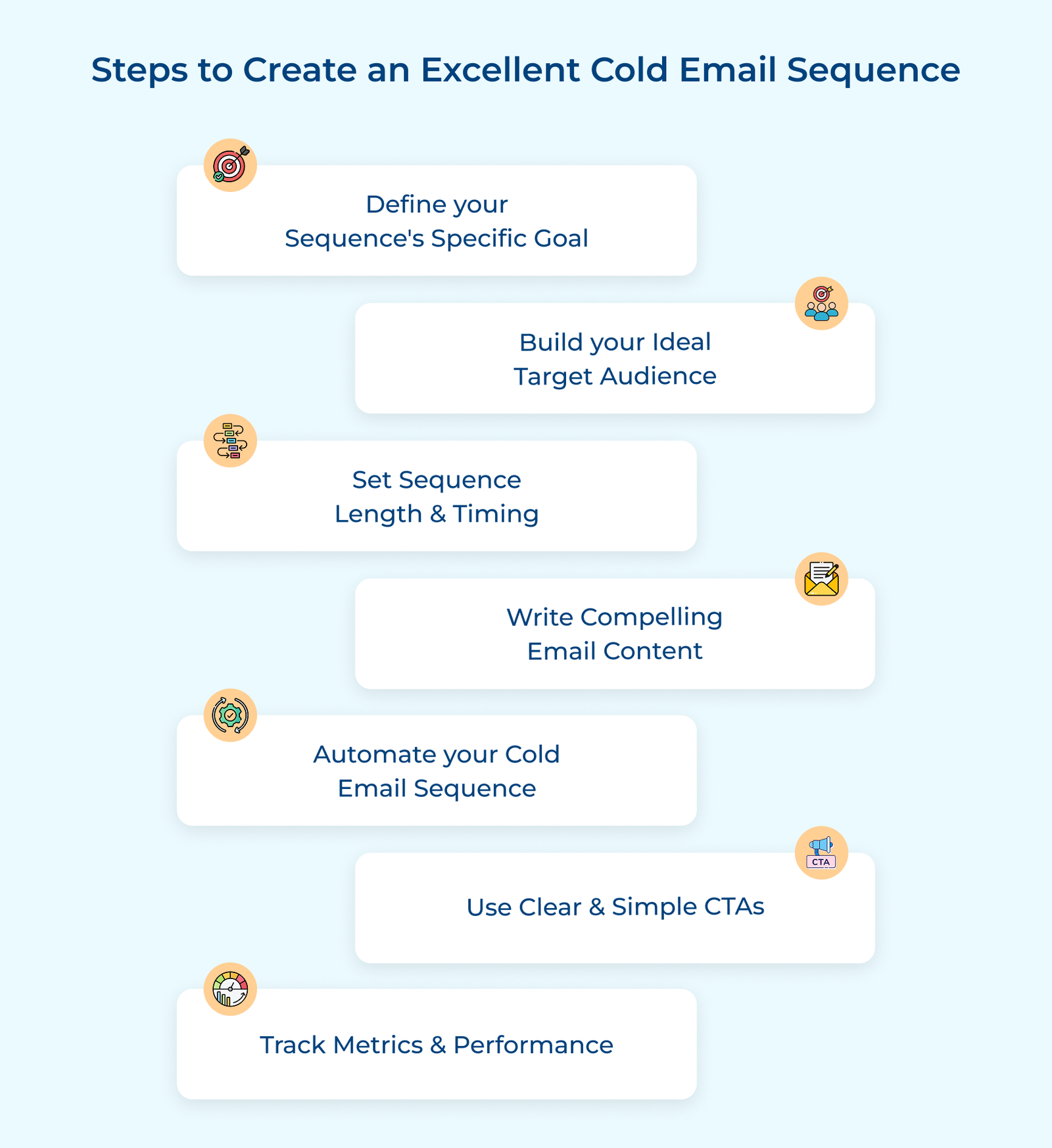
Your goal shapes everything in your sequence, from messaging to the number of emails you send. Otherwise, the sales cold email sequence mails feel generic and fail to move prospects toward meaningful action.
A goal could be booking discovery calls or prompting the download of a case study. Ask yourself what happens after someone responds. The clearer the endpoint, the easier it becomes to design each email as a step toward that outcome.
Pro tips:
A well-defined audience turns ordinary emails into messages that feel personal and relevant. Your target should include people who genuinely need what you offer and have the authority to act on it.
Actionable tips:
Sequence length and timing decide how much attention you ask from prospects before moving on. Complex B2B offerings usually need more touchpoints, while shorter sales cycles work better with fewer emails.
Key questions:
Most successful sales cold email sequences run between five and seven emails. Space your first three emails two to three days apart to build momentum. Then stretch the gaps to four or five days as you give prospects more breathing room.
Key sequence:
Email content decides the success of your entire sequence. Strong timing and targeting mean nothing if the message feels generic or irrelevant. Every email should give the reader a reason to keep reading.
Before writing, you need to understand what keeps your prospects up at night. Research their industry challenges and read recent news about their company. It ensures your emails reference real situations they recognize.
Key types:
Start with a subject line that sparks curiosity without being clickbait. Your opening sentence should acknowledge something specific about their business. The body presents one clear idea tied to a problem they’re experiencing. End with a soft call to action that asks for a small commitment.
Key ways:
The magic happens when prospects feel like you’re speaking directly to them about their specific situation. Each email should feel like the next logical step in a conversation rather than a disconnected pitch.
Automation allows you to run thoughtful outreach at scale without sending every email manually or tracking follow-ups in your head. The sequence works quietly while you focus on real conversations with people who reply. Nothing slips through the cracks and every prospect gets the same level of attention.
Key areas:
Engagement-based paths: Email flow changes based on how people interact. Opens and clicks signal interest and trigger more detailed follow-ups. Low engagement leads to lighter touch messages with a new angle.
A call to action shows prospects what to do next. Many emails fail because they never ask for a next step or ask for too much at once. Clear CTAs remove guesswork and make it easy to respond.
Key questions:
Add a signup button with “Start your free 14-day trial today.” Implementation comes down to positioning your CTA where prospects can’t miss it. Place it at the end after you’ve delivered value. Use action verbs that create urgency without pressure, like “grab” or “explore” instead of passive language. Make the task so simple that saying yes takes less effort than saying no.
Best practices:
Metrics show you what people actually do with your emails, not what you hope they do. Tracking performance helps you spot problems early and improve results instead of repeating the same mistakes.
Review your dashboard weekly to spot patterns in open rates and reply rates across different emails. Compare performance between prospect segments to understand if certain industries respond better than others. Use the information to double down on what works and cut underperforming elements.
Pro tips:
Below are the best cold email sequence examples that show how structured follow-ups turn cold prospects into replies and qualified meetings when done with clarity.
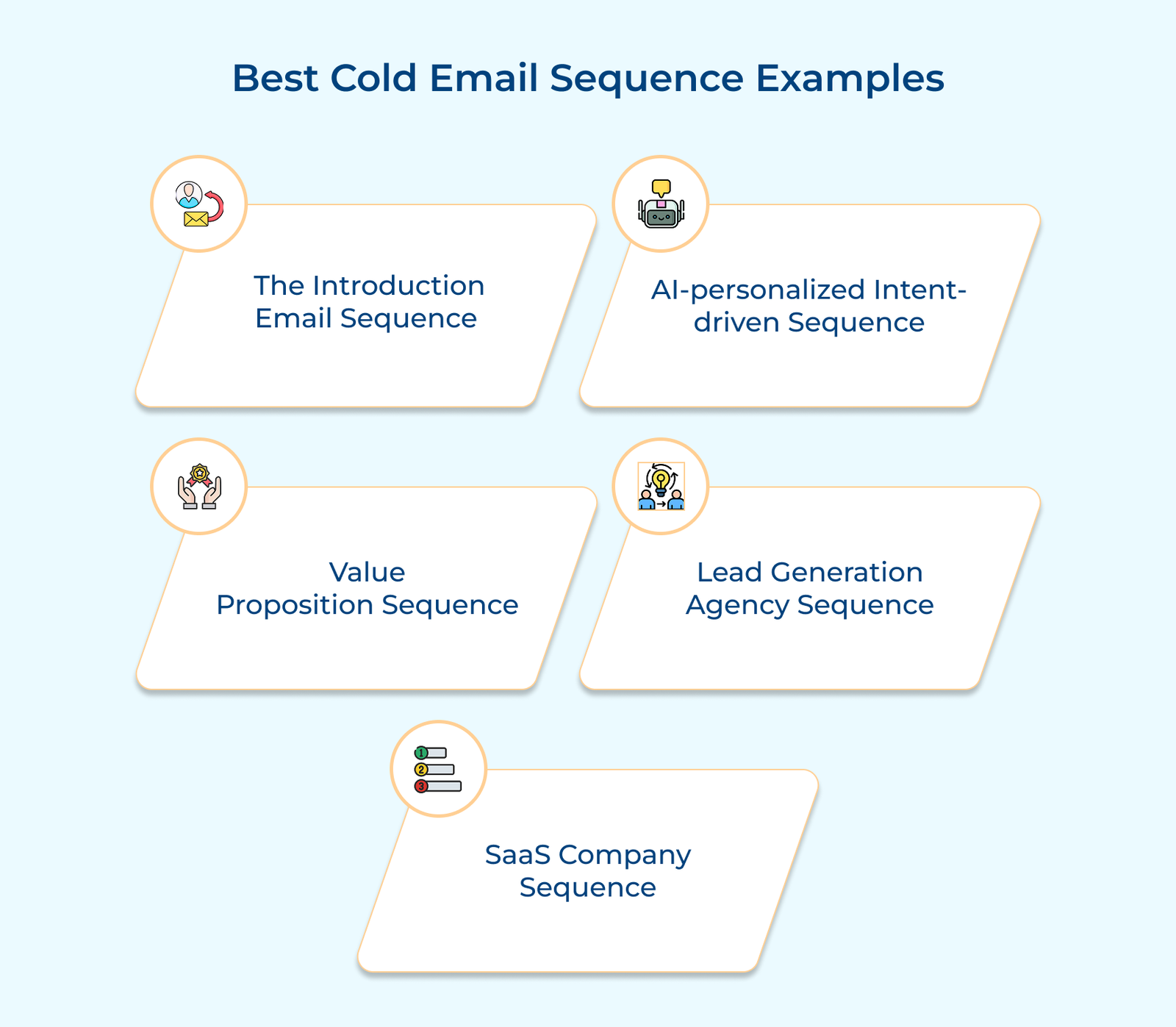
The simple sequence suits consultants and service providers who need to make a strong first impression without overloading prospects. The goal is clarity, relevance and respect for their time.
Email 1: Initial Introduction (Day 1)
Subject: Quick question about [Company]’s [specific challenge]
Hi [First Name],
I noticed [Company] recently [specific trigger event]. Teams in similar situations often run into [specific pain point].
I work with [industry] teams to fix it by [brief solution]. Does it make sense to see if it is relevant for you?
Best,
[Your Name]
Email 2: Value Focused Follow-Up (Day 4)
Subject: Thought it might be useful
Hi [First Name],
I came across [relevant resource] and thought of [pain point]. The key insight that applies to [Company] is [specific takeaway].
Have you considered the approach?
Best,
[Your Name]
Email 3: Final Check-In (Day 8)
Subject: Should I pause outreach?
Hi [First Name],
I haven’t heard back, so I’m guessing this isn’t a priority right now. Should I close your file or is there a better time to reconnect?
Best,
[Your Name]
The sequence works because it respects the prospect’s time while demonstrating you’ve researched their specific situation. The final email creates urgency without being pushy by giving prospects an easy out.
Tech companies use the sequence when they have access to prospect behavior data. The strategy targets people who’ve shown interest through website visits but haven’t converted yet.
Email 1: Intent Acknowledgment (Day 1)
Subject: Notice your interest in [specific feature]
Hi [First Name],
I noticed you were looking at our [specific page] on [topic]. Most people exploring this are trying to solve [specific problems].
Is that what brought you there?
Best,
[Your Name]
Email 2: Relevant Case Study (Day 3)
Subject: How [Similar Company] solved it
Hi [First Name],
Since you’re interested in [topic], [Similar Company] tackled [specific challenge] and achieved [specific result] in [timeframe].
Want to know if something similar could work for you?
Best,
[Your Name]
Email 3: Direct Offer (Day 7)
Subject: Let’s solve [specific problem]
Hi [First Name],
You’ve been researching [topic] and I can show you exactly how to [achieve specific outcome].
Are you free for 15 minutes this week?
Best,
[Your Name]
The personalization based on actual behavior makes the sequence incredibly effective because prospects know you’re not sending generic blasts. The approach typically generates response rates 40% higher than generic sequences.
The sequence suits B2B teams selling outcomes with clear financial impact. Each email keeps the focus on the results leaders care about and removes uncertainty step by step.
Email 1: Clear Value Statement (Day 1)
Subject: Unlock $50K this quarter
Hi [First Name],
Companies like [Their Company] typically leave $50K on the table each quarter because of [specific inefficiency]. We help fix that in 30 days.
Interested in seeing how?
Best,
[Your Name]
Email 2: Proof Point (Day 4)
Subject: The $50K isn’t theoretical
Hi [First Name],
Here’s proof: [Similar Company] added $73K in their first quarter using our approach. The difference maker was [specific change].
Does it apply to your situation?
Best,
[Your Name]
Email 3: Risk Reversal (Day 9)
Subject: No risk way to test this
Hi [First Name],
If you’re skeptical about the $50K opportunity, we can start with a pilot. Zero commitment beyond the first 30 days.
Should we explore it?
Best,
[Your Name]
The sales cold email sequence cuts through noise by speaking the language of business outcomes that executives care about. Starting with a specific dollar amount gets attention because it’s concrete rather than vague promises.
—
Marketing agencies use the sequence to demonstrate their understanding of client acquisition challenges. The approach showcases expertise by offering insights before asking for anything.
Email 1: Industry Insight (Day 1)
Subject: [Industry] companies are missing this
Hi [First Name],
I’ve been analyzing [Industry] companies and most are struggling with [specific lead gen challenge]. The solution is simpler than you’d think.
Want me to share what’s working?
Best,
[Your Name]
Email 2: Free Audit Offer (Day 5)
Subject: Quick audit of [Company]’s funnel
Hi [First Name],
I can do a 10-minute review of your lead generation approach and point out the biggest opportunity I see. No pitch.
Are you?
Best,
[Your Name]
Email 3: Competitor Reference (Day 10)
Subject: What [Competitor] is doing differently
Hi [First Name],
Your competitor [Competitor Name] recently changed their lead gen approach and I’m seeing interesting results.
Happy to share if you’re interested.
Best,
[Your Name]
Agencies benefit from this sequence because it positions them as advisors rather than vendors. The free audit offer works particularly well because prospects get immediate value.
—
The cold email sequence works well when your product offers a free trial and speaks for itself. The goal is simple. Get prospects to try the product instead of pushing them into a call.
Email 1: Problem Agitation (Day 1)
Subject: Still dealing with [outdated method]?
Hi [First Name],
Most [job titles] are frustrated with [current solution] because it [specific pain point]. We built [Product] specifically to eliminate that problem.
Want to see it in action?
Best,
[Your Name]
Email 2: Demo Video (Day 3)
Subject: 2-minute demo of [Product]
Hi [First Name],
I recorded a quick walkthrough showing how [Product] solves [specific pain point] in minutes instead of hours.
Watch it here: [link]
Best,
[Your Name]
Email 3: Trial Invitation (Day 7)
Subject: Try it yourself
Hi [First Name],
Rather than more emails, test [Product] free for 14 days. Sign up here: [link]
No credit card needed.
Best,
[Your Name]
SaaS companies succeed with this sequence because it removes friction from the evaluation process. Prospects learn by doing and decide on their own timeline without pressure.
Below are the cold email sequence software tools that help you automate follow ups, personalize outreach and track responses without losing the human touch.
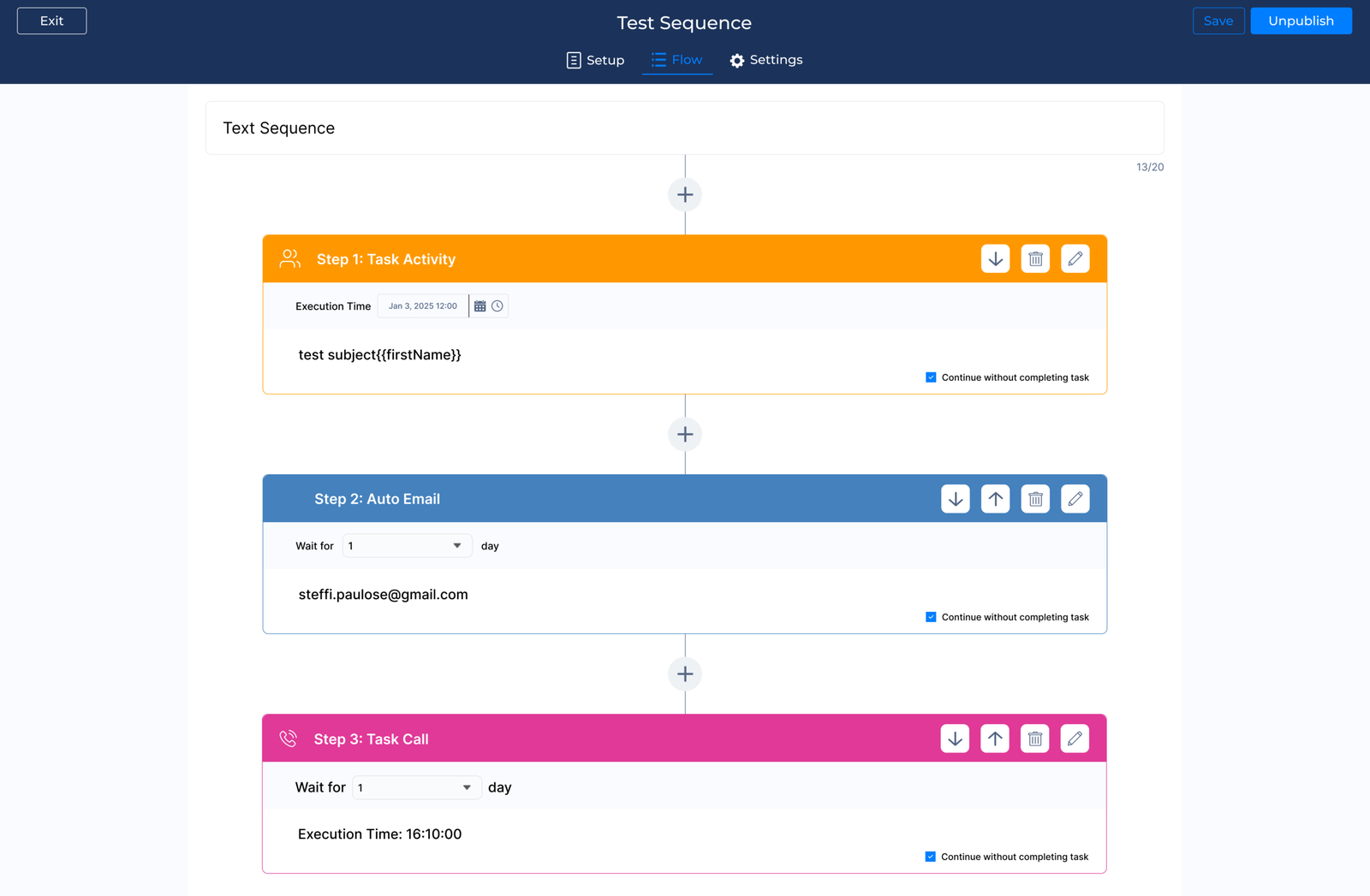
Pipedrive combines visual pipeline management with a built-in automated sequences feature so you can nurture prospects from the same platform. The CRM eliminates the need to jump between separate tools by handling contact management and automated outreach in one centralized system designed specifically for sales teams.
Key Features:
Smartlead focuses on deliverability by rotating multiple email accounts to keep your sender reputation healthy and inbox placement rates high. The tool includes built-in email warmup and unlimited mailbox connections so you can send higher volumes without triggering spam filters or getting blacklisted.
Instantly.ai combines cold email automation with a lead database of over 160 million contacts so you can build lists inside the platform. The software shows which emails get replies and supports team collaboration for agencies managing multiple client campaigns.
Apollo.io brings prospecting and outreach into one place. You can find leads, run email sequences or track engagement across email and LinkedIn while getting smart suggestions on when to follow up.
A strong sales cold email sequence helps you start real conversations with people who matter. Each message builds on the last, guiding prospects from curiosity to reply without sounding pushy or scripted.
Success requires more than just sending emails on a schedule. You need clear goals and personalized messaging combined with smart automation that respects your prospect’s time. Start implementing the strategies today and watch your response rates climb as you build genuine connections that drive real business growth.

Most cold email sequences work best over two to three weeks. It gives prospects enough reminders to notice you without feeling chased. Shorter sequences work for urgent problems or lower-priced offerings, while complex B2B sales benefit from extended sequences that build trust gradually over multiple weeks.
Start with a subject line that references something specific about their business to earn the open. Your first sentence should acknowledge a challenge they likely face based on research you’ve done. Present one clear value point and end with a simple question or low-commitment call to action.
Five to seven emails hit the sweet spot for most businesses because you get multiple chances to connect without overwhelming prospects. The first email rarely gets responses, so subsequent touches catch people when timing is better. More than seven emails risks annoying people, while fewer than five leave opportunities on the table.
Sales sequences should span 10 to 15 days for most B2B situations because it allows proper spacing between touchpoints. High-ticket items or enterprise deals might stretch to three or four weeks since buying committees need more time. Fast-moving industries or lower-priced products can compress sequences into one week without seeming too aggressive.
Tuesday to Thursday mornings between 8 AM and 10 AM get the best results. Mondays get buried under weekend email backlogs while Fridays compete with people wrapping up their week. Mid-morning hits that productive window after people clear urgent items but before meetings fill their calendar.
Grow Customer Relationships and stronger team collaboration with our range of products across the Conversational Engagement Suite.
Omnichannel Customer Support & Help Desk Software
AI Enabled Business Messaging and Chatbot Software
Sales Engagement & CRM Software
Call Center Software & Virtual Phone System
Product Marketing & Experience Platform
Customer Experience & Feedback Management Software
 What is Canned Response? Benefits, Examples and Best Practices
Scroll to top
What is Canned Response? Benefits, Examples and Best Practices
Scroll to top