What is CRM Analytics? Benefits, Types and Challenges
CRM analytics transforms raw customer data into meaningful insights. Understand how you can use data not just to track customers, but to truly understand and grow with them.

CRM analytics transforms raw customer data into meaningful insights. Understand how you can use data not just to track customers, but to truly understand and grow with them.
Most businesses sit on mountains of customer data like the sales calls, support tickets, website clicks, social posts – you name it! Yet most of it gathers dust while teams keep guessing.
The real issue isn’t collecting information, it’s knowing what to do with it. That’s where CRM analytics changes the game. It cuts through the noise and brings clarity to the chaos. Knowing which analytics to use and how to use them changes everything.
You start spotting patterns, understanding what drives different customers and even anticipating what they’ll need next. It’s less about crunching numbers and more about turning data into smarter choices, quicker responses and decisions your whole team can stand behind.
CRM analytics can be defined as the process of examining customer data from CRM systems to understand how people interact with your business. It helps reveal patterns in customer behavior, sales trends and day-to-day operations, so teams can make clearer, more informed decisions. It transforms raw data into meaningful intelligence that drives decision-making and improves relationships.
CRM analytics looks at data from every point in the customer journey, like website visits, purchases, support calls and social media activity. It analyzes patterns in the data to show what’s working, what’s not and where to focus. Advanced systems use statistical methods, machine learning algorithms and predictive modeling to process data.
Insights are displayed through dashboards, charts and reports that reveal customer preferences along with the trends. It helps businesses predict future behavior and quickly identify opportunities or issues.
Key Principles:
Let’s explore the key benefits and challenges of CRM analytics, equipping you with the knowledge needed to harness its full potential for your organization
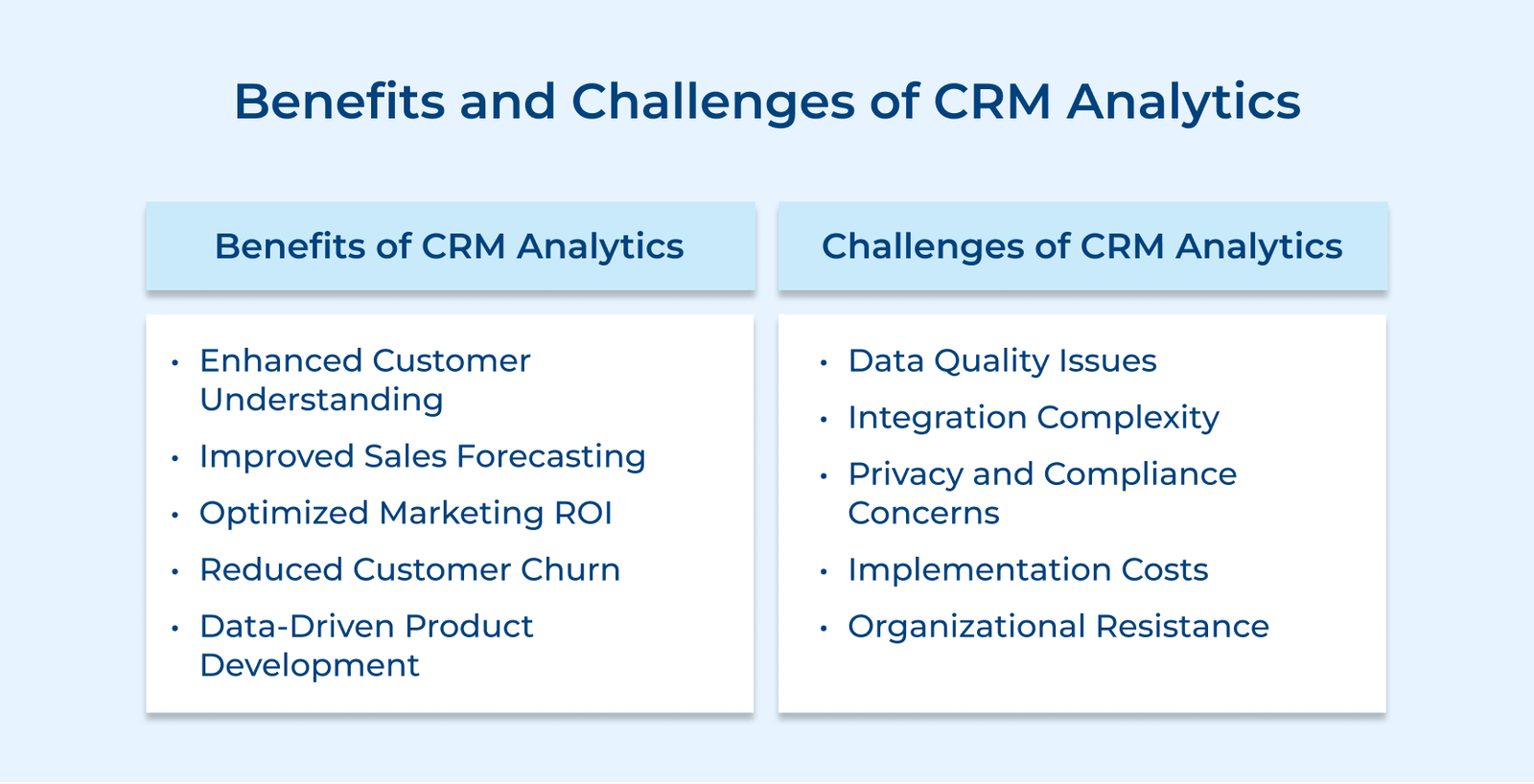
Enhanced customer understanding
CRM analytics provides deep insights into customer preferences, behaviors and needs by analyzing interaction history across multiple touchpoints. A clear view of client data helps create personalized experiences, engage at the right moments and predict needs before they arise. It helps build stronger relationships and loyalty.
Improved sales forecasting
CRM analytics studies past sales trends, seasonal shifts and buying habits to predict future sales with precision. These forecasts help teams plan smarter, keep inventory in check, set realistic targets and identify revenue opportunities before they surface. It turns guesswork into confident decision-making.
Optimized marketing ROI
CRM analytics enables precise measurement of marketing campaign performance across channels, identifying which initiatives deliver the best returns. Organizations can better group customers, tailor messages, focus budgets and adjust strategies quickly using up-to-date performance data.
Reduced customer churn
CRM analytics helps you notice the early signs that a customer might leave before it actually happens. When you catch those signals in time, you can step in, solve problems, and give people a reason to stay. Over time, this approach sharpens your loyalty efforts and strengthens the parts of your service that matter most.
Data-driven product development
CRM analytics reveals how customers use the solutions, highlighting features they value most and identifying pain points. The insights steer product development toward what customers need and not guesses. It leads to more useful products that stand out in the market.
Data quality issues
Poor-quality, fragmented or outdated customer data undermines analytics accuracy. Organizations often face duplicate records, missing details and inconsistent formats across systems. Cleaning, organizing data takes time and effort before it’s ready for useful analysis.
Integration complexity
Many businesses operate multiple systems that contain customer data, from legacy platforms to specialized tools. Building a clear, unified view means linking different systems, matching up mismatched data and keeping everything flowing smoothly. It has to be done without breaking what already works.
Privacy and compliance concerns
Increasingly stringent regulations restrict how customer data can be collected, stored and analyzed. Organizations need to manage consent, protect identities and follow local laws, all while still making sense of the data.
Implementation costs
Establishing robust CRM analytics capabilities requires significant investment in technology, talent and organizational change. Beyond software costs, companies also need skilled staff, training and system upgrades. These expenses can be especially tough for smaller organizations.
Organizational resistance
Many employees resist data-driven approaches that challenge traditional decision-making processes. Getting past the resistance takes a shift in mindset that requires showing the value of analytics. It can be done with small early successes, offering clear training and making sure data supports, not replaces, human judgment.
Let’s delve into the vital metrics you should be tracking to optimize your customer engagement and facilitate lasting loyalty.
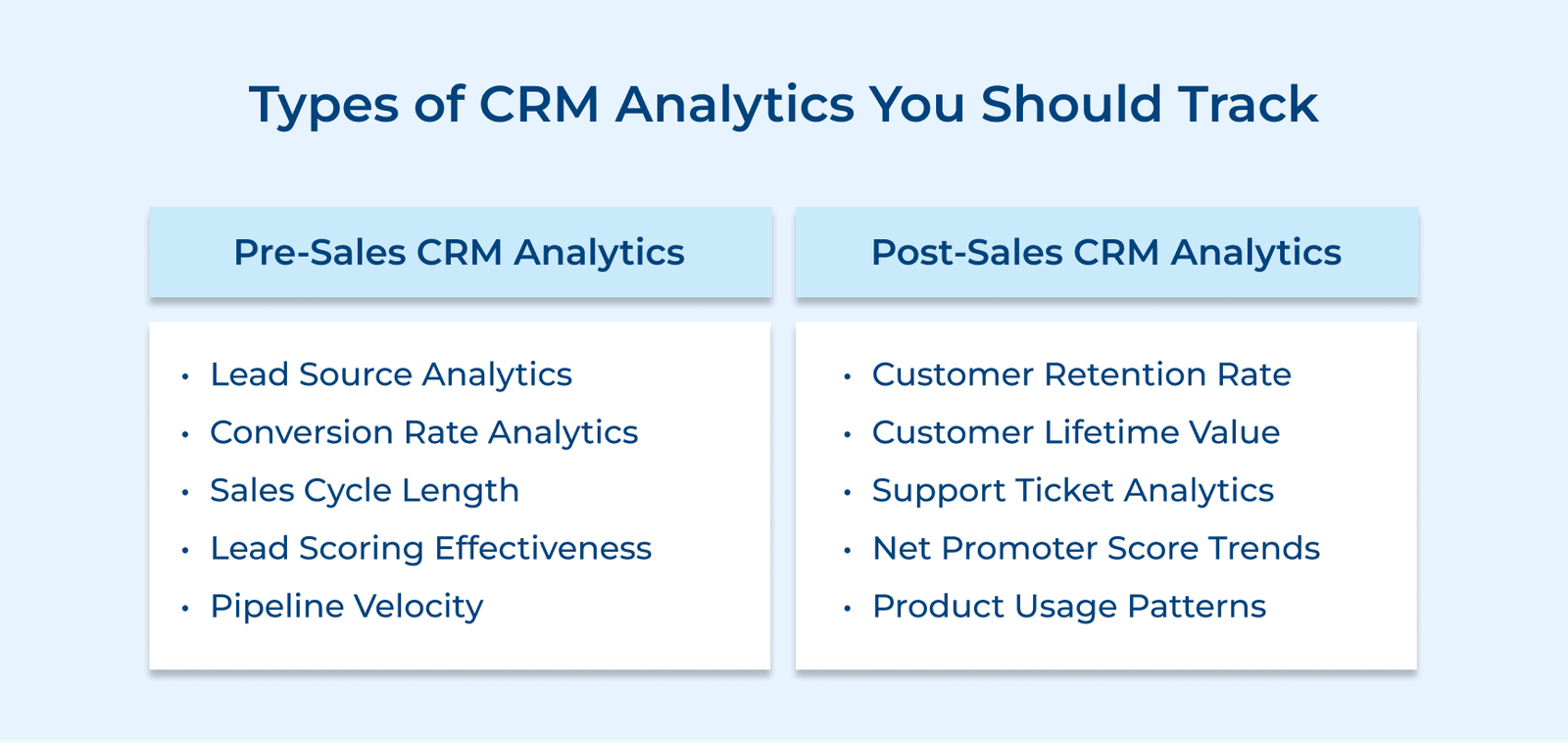
Lead source analytics: Businesses can track where your leads come from and which sources generate the highest quality prospects. You can see which marketing channels work best and put resources where they’ll have the most impact. Understanding lead origins helps you optimize advertising spend and focus on platforms that attract your ideal customers.
Conversion rate analytics: The conversion rate measures the percentage of leads that become paying customers. You can track how prospects move through your sales funnel to spot where they drop off. It shows which sales tactics are working and where things need to improve.
Sales cycle length: Measuring the sales cycle length will give you an understanding of how long it takes to convert a prospect from initial contact to closed deal. You can spot opportunities to streamline your sales process and remove unnecessary delays. Short sales cycles often mean things are running smoothly. Longer ones can point to spots where prospects get stuck or need more help to move forward.
Lead scoring effectiveness: When businesses measure lead scoring effectiveness, they can understand how accurately their scoring system predicts which leads will convert. You can refine your criteria based on actual outcomes rather than assumptions. Effective lead scoring lets sales focus on prospects ready to buy and helps marketing send over leads that fit your ideal customer.
Pipeline velocity: The pipeline velocity measures how quickly leads move through each stage of your sales process. You can identify stages where prospects frequently stall and develop strategies to maintain momentum. Tracking sales speed helps you predict future sales more reliably and build steadier revenue for your business.
Customer retention rate: Customer retention rate tracks the percentage of customers who continue doing business with you over time. You can identify patterns that lead to long-term relationships versus one-time purchases. High retention shows your product fits well with customers. If retention drops, it’s a sign to look into problems with the product or customer experience.
Customer lifetime value: Customer lifetime value calculates the total revenue you can expect from a typical customer relationship. You can determine how much you should invest in acquiring and retaining different customer segments. Knowing a customer’s lifetime value helps you decide how much time to invest and which relationships are worth going the extra mile for.
Support ticket analytics: The support ticket analysis examines patterns in customer support interactions, including frequency and resolution time. You can identify common issues that frustrate customers and opportunities to improve your product. Tracking support metrics helps you respond faster, spot issues early, so you can fix problems before they grow and keep customers happier.
Net promoter score trends: The net promoter score trend measures customer loyalty and likelihood to recommend your product or service. You can track how changes to your offering impact customer sentiment over time. Falling scores are early warning signs, while rising ones show your changes are working and reveal what keeps customers coming back.
Product usage patterns: Product usage patterns analyze how customers interact with your product or service after purchase. You can identify which features deliver the most value and which ones go unused. Knowing how customers use your product helps you improve it in the right places and offer clearer guidance, so people get more out of it.
Below are the essential techniques for effectively tracking CRM analytics that can turn your data into actionable insights, ensuring you’re always one step ahead in the competitive market.
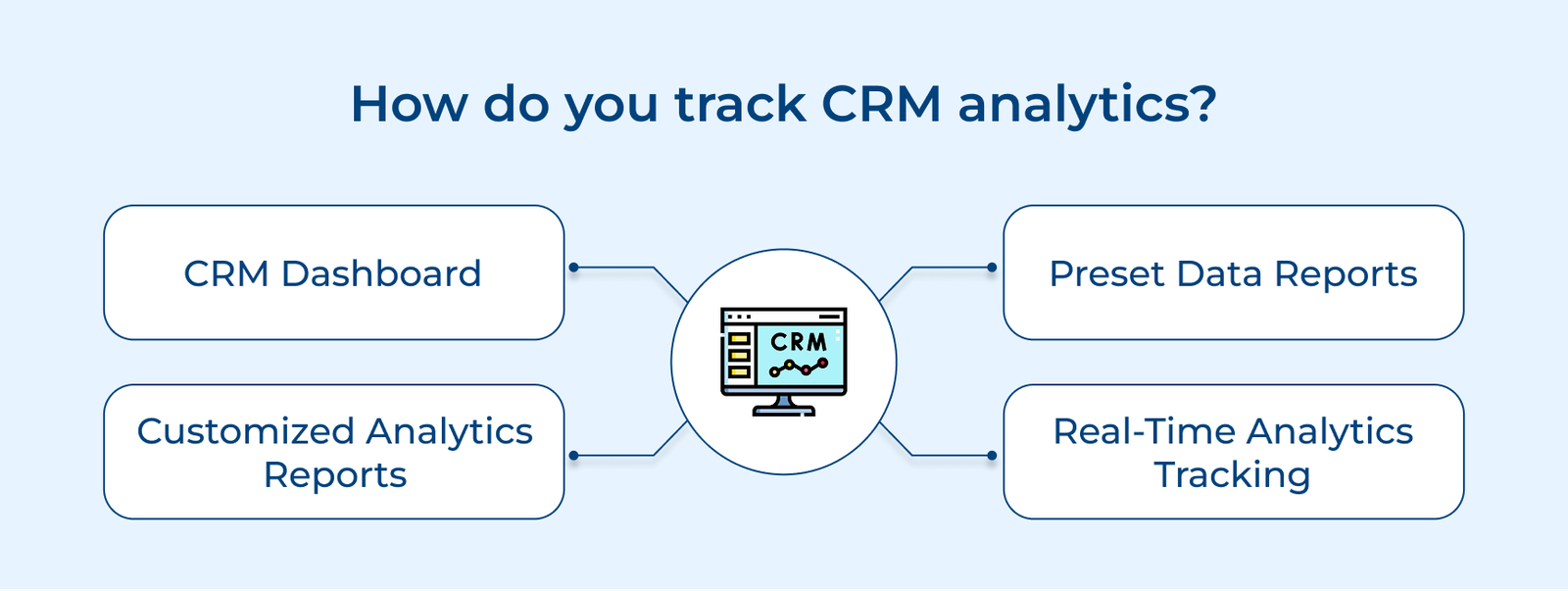
A CRM dashboard provides a visual overview of your key metrics in one centralized location. You can customize these dashboards to display the specific KPIs most relevant to your business goals. Dashboards turn complex data into clear visuals, making it easy to spot trends and catch problems without wading through long reports, which is a key function of sales reporting tools.
Preset data reports offer standardized analytics on common metrics that most businesses need to track. You can run these reports with minimal setup to get quick insights on sales performance and customer behavior. Templated reports save time by giving teams the same clear snapshot at regular intervals, helping everyone stay on the same page when making informed decisions.
Customized reports allow you to track specific metrics tailored to your unique business needs and goals. You can design these reports to answer particular questions about customer segments or sales processes that preset reports might not address. Custom analytics let you dig into specific problems and uncover insights that standard reports might miss.
Real-time analytics tracking provides immediate visibility into customer interactions as they happen. You can monitor sales activities and customer engagement without waiting for end-of-period reports. Quick feedback helps teams spot new opportunities or issues and adjust their approach based on what customers are doing right now, not just what they did in the past.
Below are the effective ways to use CRM analytics data that can elevate your business operations and customer engagements to new heights.
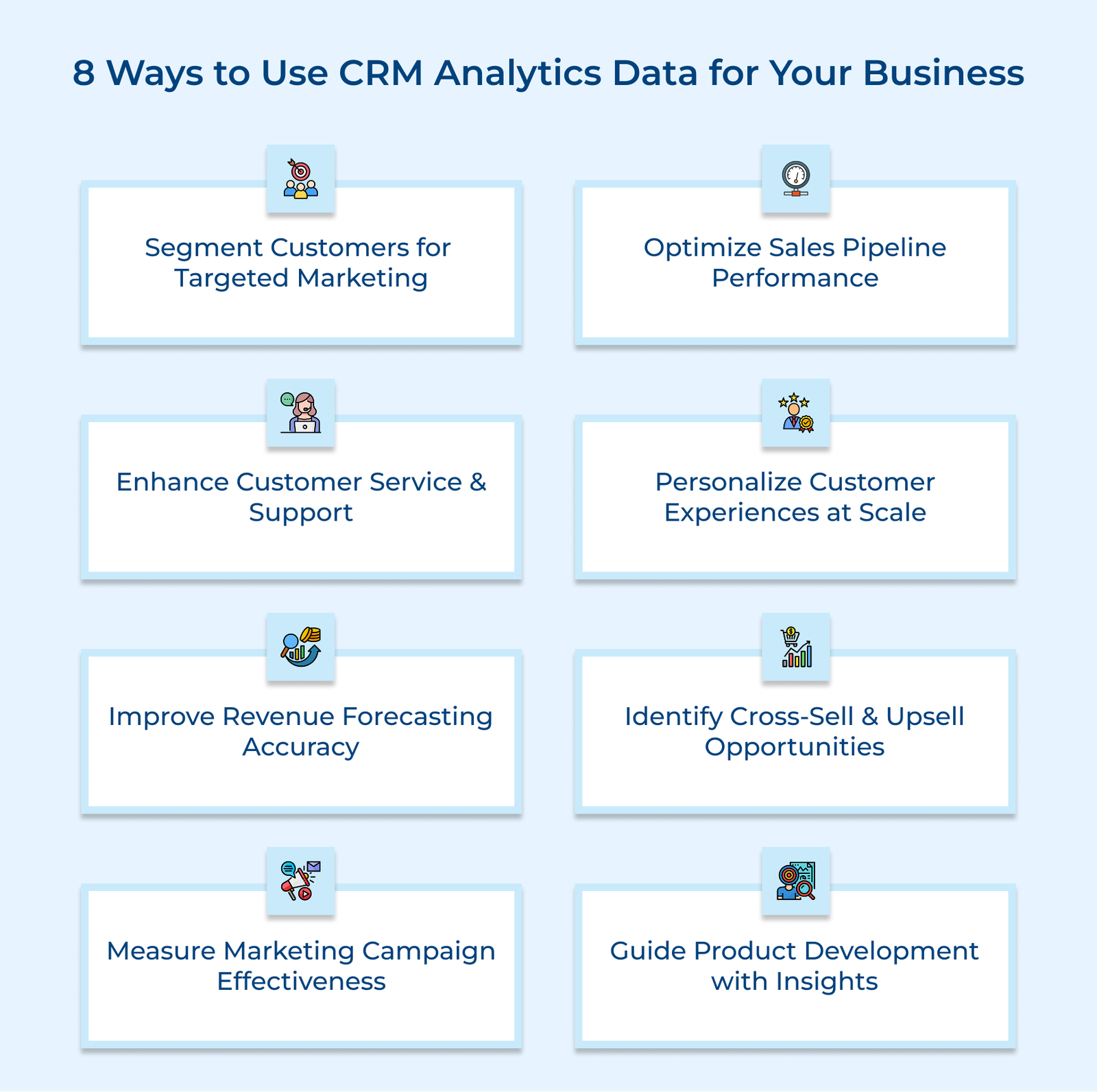
Customer segmentation divides your customer base into distinct groups based on shared characteristics. The approach is essential because not all customers have the same needs or behaviors, isn’t it? Treating everyone identically wastes resources and reduces effectiveness. Segmentation helps you speak to the right people with the right message, making it more likely they’ll pay attention and take action.
CRM analytics identifies patterns across demographics and behaviors to create meaningful segments. You can group customers by purchase history and frequency or engagement levels across channels. Advanced CRM systems can automate the process and recommend optimal segment divisions. These insights let you customize messages and offers to match what each group really needs.
Best practices:
Sales pipeline optimization means reviewing and improving each step of your sales process to close more deals, faster. The sales pipeline performance approach is critical because inefficient pipelines lead to lost opportunities and extended sales cycles. CRM analytics shows exactly where prospects stall or drop off, helping your team fix the spots that hold up sales.
Identify bottlenecks in the sales process
CRM analytics data reveals where prospects spend excessive time or frequently abandon the sales process. You can pinpoint specific stages that have lower-than-expected conversion rates or longer durations. The insight helps you figure out if the problem is a complicated process or a sales rep needing support.
Track velocity across sales stages
Measuring how quickly leads move through each pipeline stage provides crucial timing insights. CRM analytics data calculates average days spent in each phase and flags deals that exceed normal timeframes. You can establish benchmark velocities for different product lines or customer segments. Knowing sales speed patterns helps you predict outcomes more accurately and set realistic timelines.
Implement data-driven sales coaching
CRM analytics data identifies which sales behaviors correlate with successful outcomes. You can compare performance metrics between top performers and struggling team members. Comparison highlights specific activities and approaches that drive results. Coaching becomes clear and focused when performance data drives your conversations instead of guesswork.
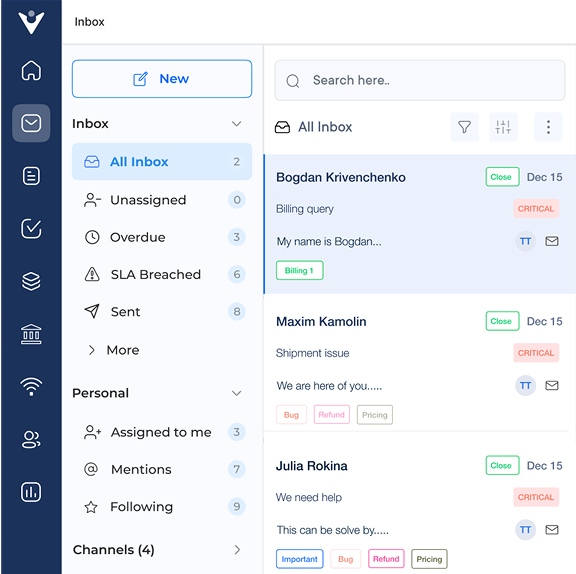
Enhanced customer service uses data insights to deliver faster and more effective support. The capability is essential because service quality directly impacts customer satisfaction and retention. CRM analytics turns reactive support into proactive action by spotting customer issues early, preventing problems before they hurt relationships.
Predict issues before they occur
CRM analytics data identifies warning signs that typically precede customer problems. You can monitor usage patterns that historically lead to service requests. Predictive capability enables support teams to intervene before customers experience difficulties. Reaching out early shows you care and can turn problems into positive experiences with your company’s service.
Analyze resolution time patterns
CRM analytics data breaks down resolution times by issue type and support representative. You can identify which problems consistently take longer to solve. Resolution time patterns analysis helps you develop specialized training or create knowledge base resources for complex issues. Faster issue resolution boosts customer satisfaction and cuts the cost of long support cases.
Personalization at scale adjusts interactions to each person’s preferences without slowing down your whole operation. The approach has become essential as customers increasingly expect experiences designed specifically for them. 81% of customers prefer companies that offer a personalized experience.
CRM analytics turns generic interactions into personalized moments that build stronger relationships, without extra work for your team. Let’s understand the uses of these analytics in personalizing customer experience:
Personalization at scale represents the perfect balance between efficiency and customer-centricity. CRM analytics data provides the intelligence needed to treat thousands of customers as individuals. Personalizing the customer experience approach builds stronger customer relationships without slowing you down, leading to better retention and steady growth.
Revenue forecasting uses CRM analytics data to predict future sales performance based on historical patterns and current pipeline health. The capability is essential because accurate projections inform critical business decisions about hiring and resource allocation. Accurate forecasts give you the clarity to plan and spot cash flow problems before they hit.
A software company used these analytics data to identify that enterprise deals’ closing rates dropped significantly during the fourth quarter. They updated their forecast to reflect the seasonal trend and focused more marketing on mid-market deals during that time. The data-informed approach resulted in more accurate projections and better resource allocation throughout the year.
Best practices:
Cross-selling and upselling identification leverages CRM analytics data to uncover additional revenue opportunities within your existing customer base. Cross-selling and upselling approaches are valuable because selling to current customers costs significantly less than acquiring new ones. Helpful suggestions that truly fit what customers need to build trust. It often leads to longer relationships and more sales.
CRM analytics data reveals which products are frequently purchased together and identifies customers with similar profiles who made different purchases. You can analyze usage patterns to determine when customers might benefit from premium features. The system can send alerts when customers show signs they’re ready to buy or are using a product enough to need more support or features.
Best practices:
Marketing campaign measurement looks at how well your efforts are working by using data from your CRM. Marketing campaign capability is essential because it helps marketers understand which campaigns generate real results and deserve additional investment.
Good measurement makes sure your marketing budget goes to what works and not just what keeps people busy. Let’s explore uses of CRM analytics data to measure marketing campaign effectiveness:
Just having CRM analytics isn’t enough and you need a clear strategy to get accurate insights that improve your business. These best practices help organizations get the most from their CRM data and build lasting advantages.
Create strict protocols for data entry and maintenance across all departments that touch your CRM system. Regularly clean duplicate records, standardize formats and validate information accuracy. Using automated data checks cuts down on human mistakes and keeps your analytics running on solid, trustworthy data.
Connect your CRM with other business platforms, including marketing automation, ERP, support desk and ecommerce systems. The full integration gives a complete view of customer interactions across their journey. Connecting data from all sources gets you deeper insights than CRM data alone.
Create regular training that helps teams grasp how to use your analytics tools and apply insights to real business challenges. Demonstrate how insights directly improve daily workflows and decision-making processes. Users who understand analytics value contribute higher-quality data and utilize insights more effectively.
Begin with basic metrics that answer your key business questions, then move on to more complex analyses. A progressive analytics approach builds organizational confidence in data-driven decisions through early wins. Gradually introducing more complex analytics prevents overwhelm and ensures thorough implementation at each stage.
Define specific roles and responsibilities for data management within your organization, including ownership of different data elements. Create transparent processes for accessing, sharing and acting upon analytics insights. Good governance protects data while making sure the right people get the insights they need.
Hold quarterly reviews to check if your analytics are solving real business problems and driving results. See which reports get regular use and which don’t, then adjust to keep your efforts focused on what matters most.
Let’s explore the best CRM analytics software available, highlighting key features and benefits that can elevate your business’s performance while driving long-term success.
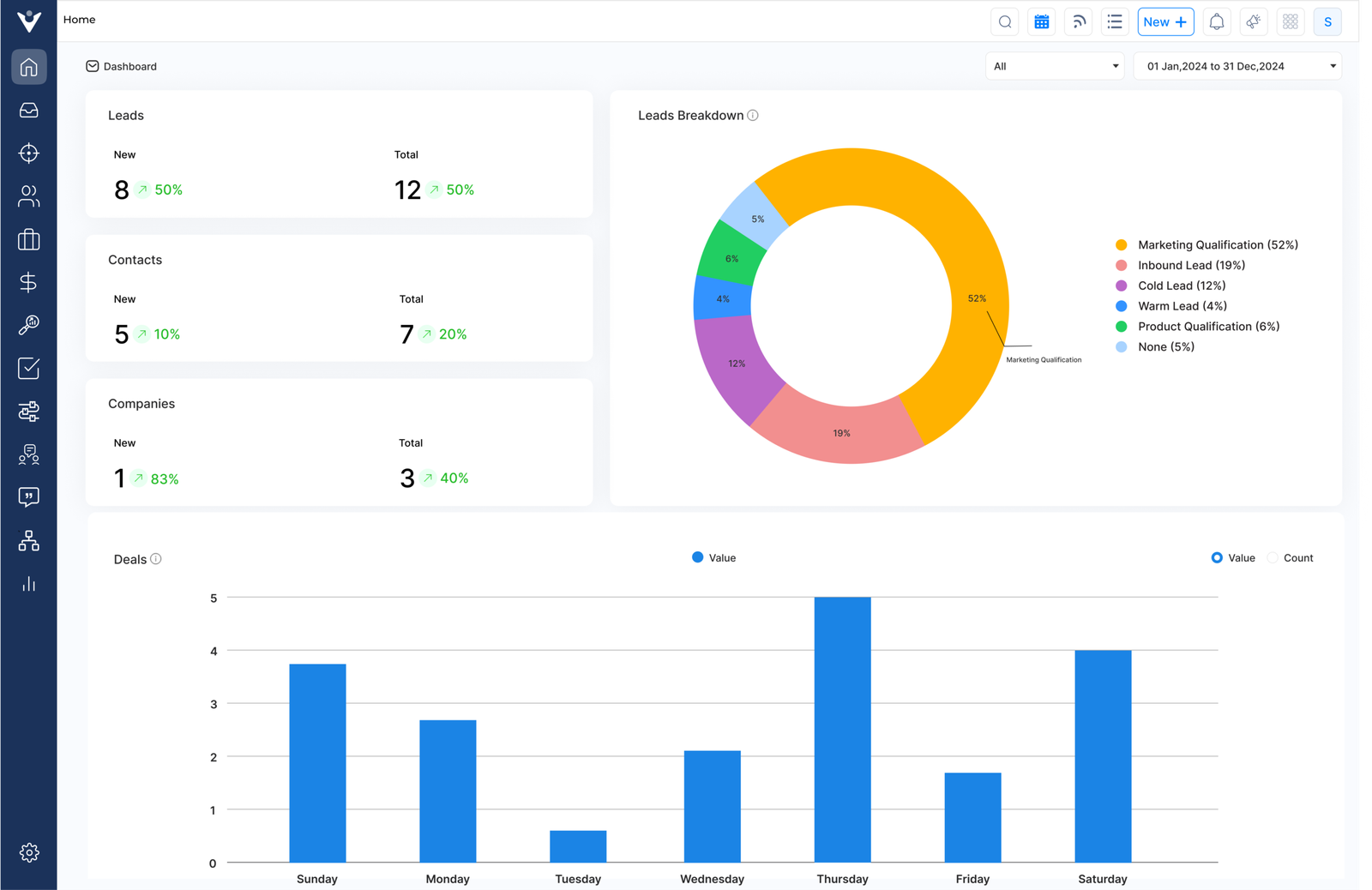
Salesmate offers a cloud-based CRM built for small to mid-sized businesses, blending easy contact management with clear data visuals. It turns customer interactions into practical insights and makes complex sales data easy to understand for better decisions.
Key Features:
HubSpot offers an integrated CRM with robust analytics capabilities designed for businesses of all sizes. The platform combines sales and marketing analytics in one unified dashboard with a user-friendly interface. HubSpot’s analytics focuses on clear visual reports and lets you customize dashboards, making complex data easy to understand for everyone.
HubSpot addresses the challenge of disconnected marketing and sales data through its comprehensive integration capabilities. The platform excels at providing clear visibility into the complete customer journey from first contact to closed deal. Key features include customizable reports, dashboards that track performance throughout the customer lifecycle and show which marketing efforts lead to real revenue, not just activity.
Pipedrive delivers sales-focused CRM analytics with an intuitive visual pipeline interface that prioritizes simplicity. The system was built by salespeople for salespeople with a strong emphasis on activity-based selling. Pipedrive’s analytics help teams see where deals are and identify the next best steps to keep them moving forward.
Pipedrive solves the common problem of sales teams lacking visibility into their pipeline health and activity effectiveness. The platform provides clear insights about which activities lead to successful deals and where prospects typically get stuck. Key features include customizable dashboards and reports that help reps focus on the best opportunities based on past data.
Zoho CRM provides comprehensive analytics capabilities within an affordable and highly customizable platform. The system offers advanced reporting tools that can be tailored to businesses of various sizes and industries. Zoho’s analytics covers sales forecasts, performance tracking and customer behavior across various touchpoints.
Zoho CRM addresses the challenge of scattered customer data through its unified approach to information gathering and analysis. The platform helps businesses struggling with fragmented views of customer interactions by centralizing data from multiple channels. Key features include Zia, an AI analytics assistant and flexible customization that lets businesses build industry-specific reports without needing technical skills.
CRM analytics turns large stores of customer data into clear insights that guide smarter business decisions. Spotting patterns in behavior helps organizations anticipate needs and improve every step of the customer journey. With strong analytics, teams can base actions on real data instead of guesswork. It leads to better customer experiences and more efficient operations, driving revenue by focusing on what customers truly need.
Increasing competition pushes organizations to use CRM analytics for deeper customer understanding and faster responses to changing behaviors. Data-driven approach doesn’t just improve immediate outcomes; it creates sustainable competitive differentiation through continuously evolving customer intelligence.

Look for intuitive dashboards with customizable reports that match your specific business needs. Prioritize systems with strong data visualization capabilities and pre-built templates for common metrics. Choose a platform that fits smoothly with your current tools and can grow with your business. Look for features like AI that spot hidden patterns and mobile access so decisions can be made anytime, anywhere.
Operational CRMs focus on streamlining customer-facing processes like sales automation and service management. Analytical CRMs specialize in data processing to uncover patterns and insights from customer interactions. Collaborative CRMs emphasize information sharing across departments to create seamless customer experiences. Strategic CRMs focus on building lasting customer relationships and keeping them engaged over time. Today’s platforms usually blend features from all four types, adjusting focus based on who they serve.
The right CRM depends on your business size, needs and industry. Salesforce covers large enterprises with robust analytics, while HubSpot excels in marketing tools and ease of use. Zoho offers deep customization at a budget-friendly price. Sales-focused teams might prefer Pipedrive or Salesmate for their pipeline and reporting features. Think about your budget, must-have tools, team skills and future growth when choosing.
CRM (Customer Relationship Management) is the overall system for managing customer interactions and relationships.CRM analytics takes the data collected by CRM systems. It turns them into clear insights using statistics and visual tools. While basic CRM shows what happened with customers, analytics reveals why, predicts what’s next and suggests the best steps to take.
Most businesses begin seeing initial ROI from CRM analytics within 3-6 months after proper implementation. Early returns typically come from efficiency improvements like reduced data entry time and better lead prioritization. More substantial benefits emerge around 6-12 months as predictive insights begin influencing strategic decisions. It typically takes 12 to 18 months to fully realize ROI, once analytics are woven into daily operations and the team has embraced their use.
Grow Customer Relationships and stronger team collaboration with our range of products across the Conversational Engagement Suite.
Omnichannel Customer Support & Help Desk Software
AI Enabled Business Messaging and Chatbot Software
Sales Engagement & CRM Software
Call Center Software & Virtual Phone System
Product Marketing & Experience Platform
Customer Experience & Feedback Management Software
 The Future of Knowledge Management: Trends & Predictions for 2026
Scroll to top
The Future of Knowledge Management: Trends & Predictions for 2026
Scroll to top