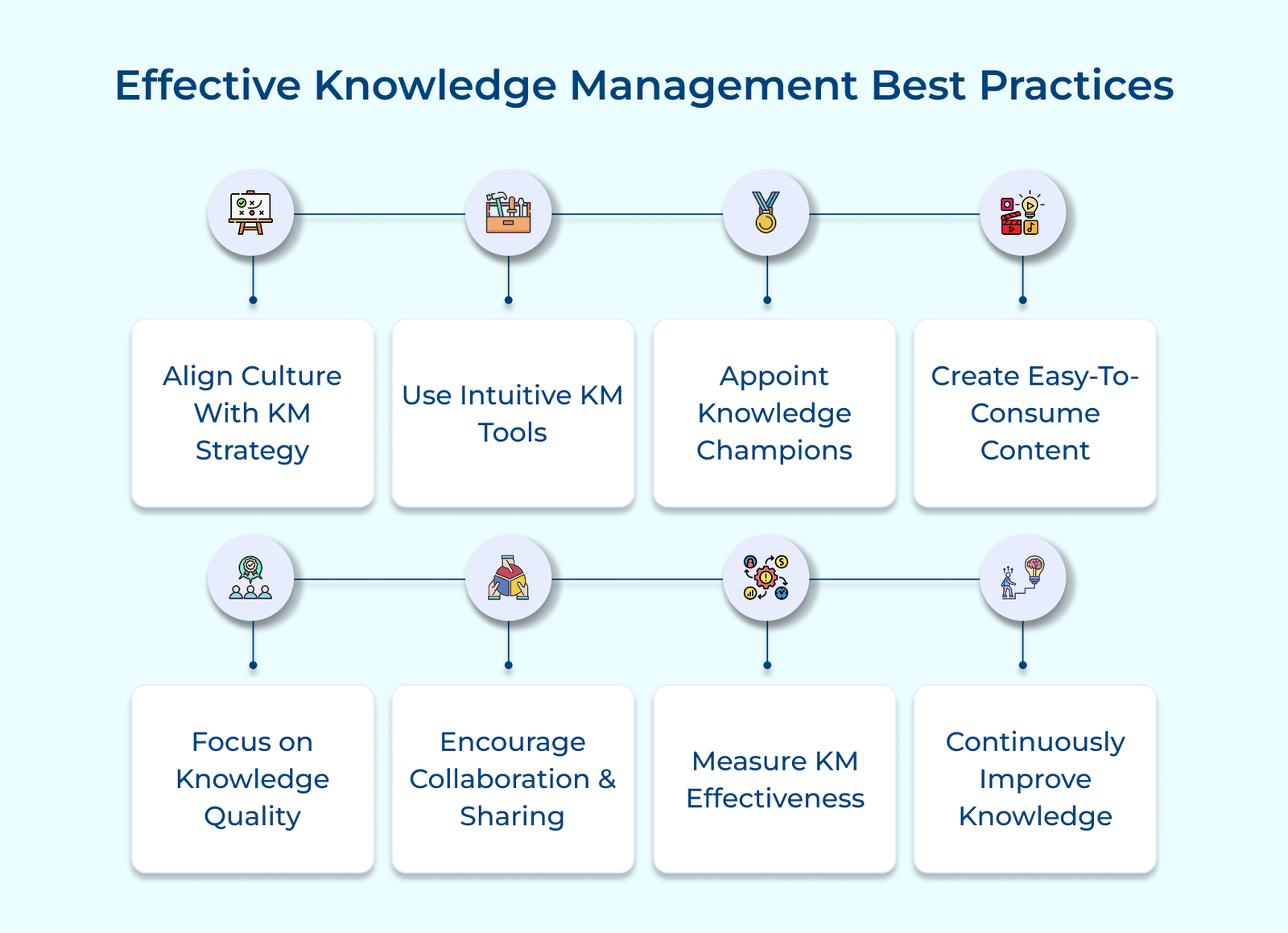
1. Align Organization Culture With KM Strategy
Aligning organizational culture with knowledge management strategy means creating an environment where knowledge sharing becomes a natural part of how people work. The integration ensures that KM practices support existing values and workflows rather than competing with them.
Organizations need alignment because imposed knowledge systems that conflict with cultural norms will be rejected. When it reinforces what people already value, adoption happens naturally and resistance diminishes.
Key idea:
- Begin with an honest cultural assessment to understand current knowledge flows and bottlenecks, then design KM initiatives that address actual pain points employees experience daily.
- Connect knowledge sharing to mission fulfillment by regularly sharing stories about how proper knowledge management directly contributed to meaningful organizational outcomes and successes.
- Modify reward structures to recognize knowledge contributions as valuable work by incorporating sharing metrics into performance evaluations and celebrating employees who excel at documentation.
- Don’t launch company-wide systems right away. Begin with a team or department that’s open to the idea. When others see KM working in one place, they’re more likely to get on board.
2. Deploy Intuitive Knowledge Management Tools
Deploying intuitive knowledge management tools means selecting and implementing platforms that feel natural to integrate seamlessly with existing workflows. The systems should reduce friction in storing and retrieving information rather than creating additional work for employees. When knowledge tools are intuitive, they become invisible infrastructure that supports work rather than distracting from it.
Key factors:
- Simple, familiar design: Choose a system with a clean interface that doesn’t need a manual. If people can figure it out without training, they’re more likely to use it.
- Integration capabilities: Prioritize tools that connect with existing software ecosystems, including email, project management platforms and communication channels, so knowledge capture happens within the flow of work rather than requiring separate steps.
- Strong search functionality: A knowledge base is only useful if people can find what they need. Look for tools with fast, smart search features, like filters, keyword suggestions and the ability to understand plain-language queries.
- Scalability and performance: Consider how the platform will perform as your knowledge base grows and user numbers increase.
- Mobile and remote accessibility: Your team needs access from anywhere, be it in an office, on the road or at home. Make sure the platform works well on mobile and in low-connectivity environments.
3. Designate Knowledge Management Champions
Even the best knowledge management system can fall flat without people who actively encourage others to use it. It’s where knowledge champions come in. They are team members who help bring your KM strategy to life by keeping it relevant, useful and rooted in daily work.
A knowledge champion is a practical problem solver who helps their team make sense of shared knowledge systems. They answer questions, guide updates or connect the dots between the company’s big-picture knowledge goals and the everyday needs of their coworkers.
- They translate high-level knowledge management strategies into practical applications that make sense within their specific departmental context.
- They identify critical knowledge that should be documented and help subject matter experts capture their insights in accessible formats.
- They troubleshoot knowledge barriers by recognizing when team members struggle to find or contribute information.
- They evangelize successful knowledge-sharing outcomes by highlighting specific examples where proper documentation saved time or improved results.
- They provide feedback to knowledge management leaders about what’s working and what needs improvement from the frontline perspective.
Look for individuals who already informally fulfill this role, the colleagues naturally turn to with questions or who maintain unofficial resource collections. The best champions combine technical understanding with strong interpersonal skills and demonstrate genuine enthusiasm for helping others access knowledge.
4. Promote Easy-to-Consume Knowledge Formats
Valuable information isn’t helpful if no one reads or understands it. That’s why making knowledge easy to consume is a core part of any effective knowledge management strategy. It’s not just what you share, it’s how you present it. Long documents, unclear structures or overly technical language often keep people from using the information they need.
- Match the format to what people actually need. Technical teams want the full breakdown so they can work with the details. The frontline teams usually just need a simple, fast guide that helps them act on the same information without digging through layers of text.
- Well-designed visuals, like flowcharts, infographics, or decision trees, can explain complex ideas faster than blocks of text. They help users see the structure of a process or decision at a glance, which improves both speed and retention.
- Use clear headings, bullet points and summaries to let people find what they need without reading everything. Think of it like a road map, people should be able to navigate quickly, not get lost in the fine print.
- Microlearning works best when big topics are sliced into small, clear lessons people can finish in a few minutes. These quick modules fit easily into natural pauses during the day, so employees pick up new skills bit by bit without interrupting their flow.
Picture a hospital that tosses out its bulky emergency manuals and switches to clear decision trees and quick video explainers. ER teams suddenly find what they need much faster. The result is fewer treatment delays, better patient outcomes, and a crew that feels more confident when the pressure spikes.
5. Prioritize Knowledge Quality Over Quantity
When it comes to knowledge management, more isn’t always better. A large library of outdated, unclear or irrelevant content can do more harm than good. It slows people down, causes confusion and undermines trust in the system. That is why prioritizing quality over quantity is essential.
A smaller set of reliable, well-maintained resources is far more valuable than a bloated knowledge base full of outdated material. The goal is to make sure that when someone searches for an answer, they find information they can trust, quickly.
Pro tips:
- Implement a systematic review schedule where content owners verify and update their materials quarterly rather than allowing documentation to age indefinitely without oversight.
- Create clear criteria for what constitutes “documentation-worthy” information to prevent unnecessary documentation that clutters your knowledge base with low-value content.
6. Cultivate a Culture Of Collaboration
Creating a collaborative workplace means making knowledge sharing feel like a natural part of daily work rather than an extra task. The approach turns information from personal property to a communal resource. Organizations need collaborative cultures because siloed knowledge creates bottlenecks, redundant work, and vulnerability when key employees leave or become unavailable.
The collaborative approach can be enhanced by designing both physical and digital spaces that encourage interaction, establishing cross-functional teams that bring diverse perspectives together and recognizing employees who actively contribute to the collective knowledge base.
Actionable tips:
- Create psychological safety by celebrating when employees share lessons from failures rather than only acknowledging successes, as it encourages honest documentation of valuable learning experiences.
- Design collaboration into physical workspaces with dedicated areas for spontaneous discussion and visual displays of current projects that invite curiosity from colleagues passing by.
7. Measure Knowledge Management Effectiveness
You can’t improve what you don’t measure. You need practical ways to track usage, spot gaps and connect knowledge-sharing habits to real business results. Without the visibility, KM stays abstract, easy to ignore and hard to justify.
Track Knowledge Utilization Through Analytics
Use built-in analytics to see how often people access certain resources, what they search for and if they use what they find. The patterns show which materials are helpful and which need updates or retirement. They also highlight if the content is organized in a way that makes sense.
Monitor Time Saved Through Knowledge Reuse
Tracking time savings focuses on quantifying how knowledge management impacts operational efficiency across the organization. The metric captures the cumulative effect of employees finding answers quickly rather than recreating solutions or searching extensively.
Assess Impact on Business Key Metrics
Look at how your knowledge practices affect bigger goals like faster employee onboarding, fewer customer complaints, reduced rework or quicker project delivery. The outcomes already matter to leadership; linking KM to them helps secure buy-in and continued support.
Knowledge Management Practices Examples
Check out the examples that illustrate how different organizations have successfully integrated knowledge management into their culture and operations.
1. Toyota: Creating Institutional Learning Systems
Toyota is known not just for making reliable cars, but for how it learns from its workers. Its Toyota Production System (TPS) captures the small improvements and problem-solving insights of frontline employees, turning them into clear processes that can be used across the company.
The system helps Toyota avoid repeating mistakes, build consistency across global factories and keep improving. When something goes wrong in one plant, the lesson is shared across all locations, preventing the same issue elsewhere. The culture of shared learning is a major reason Toyota remains a leader in manufacturing quality.
2. NASA: Preserving Critical Mission Knowledge
NASA runs projects that often span decades, so keeping essential knowledge from being lost is a top priority. They’ve built detailed systems to document what worked, what didn’t and why, especially from complex space missions. Mentorship, lesson databases and formal reviews help new teams learn from past missions.
NASA avoids repeating past mistakes and continues building on hard-won experience by preserving knowledge when senior experts leave or retire. The continuity is essential in an organization where safety, precision and learning from every mission could mean the difference between success and disaster.
3. Accenture: Connecting Global Expertise
Accenture has thousands of consultants working across industries and geographies. They built a central hub called Knowledge Exchange to avoid everyone reinventing the wheel. The searchable system gives consultants fast access to past project examples, expert contacts and industry insights.
The practical reuse of past work helps teams solve problems faster and deliver consistent quality. Instead of relying only on local expertise, consultants can tap into the collective knowledge of the entire company. It’s a simple way to help people do better work with fewer delays.
4. IBM: Enhancing Collaborative Knowledge Communities
IBM has developed a knowledge management approach centered on collaborative communities where employees share insights across organizational boundaries. The company pioneered internal social platforms that connect experts around specific topics regardless of their formal positions.
The open approach means people don’t waste time solving problems someone else has already figured out. It also fuels innovation; ideas move freely between teams that otherwise wouldn’t interact. IBM’s focus on collaboration helps break down silos and makes the most of its people’s experience.
5. Mayo Clinic: Standardizing Clinical Knowledge
Mayo Clinic makes sure its doctors have access to up-to-date, reliable medical information when making decisions. They’ve built tools like decision pathways and clinical knowledge databases that help standardize care across locations while still leaving room for updates when new research comes in.
The approach ensures patients get evidence-based care no matter which doctor or department they visit. It also helps doctors learn from real-world results and continuously improve treatment approaches. Mayo’s system supports both consistency and learning, key to improving outcomes in complex medical cases.
Elevate Your Organization With Best Practices in Knowledge Management
Implementing strong knowledge management practices helps your organization work smarter, not harder. Instead of relying on individual memory or repeated trial and error, teams can access what’s already been learned.
When people share what they know or can easily find what others have shared, mistakes are avoided, ideas build on each other and solutions come faster. But good knowledge management isn’t just about tools. It’s about habits. It’s about creating a workplace where sharing information is normal, not extra work. The shift takes clear processes, supportive leadership and a culture that values contribution, not just outcomes.
The real payoff comes when these habits are second nature. When people instinctively check what’s been done before, update a guide after solving a tough problem or offer insights without being asked, knowledge starts to flow on its own. That’s when your organization becomes not just efficient, but resilient, adaptable and ready for whatever comes next.