How to Measure Knowledge Management ROI? 7 Effective Steps
Learn how to measure knowledge management ROI using practical metrics and proven frameworks.

Learn how to measure knowledge management ROI using practical metrics and proven frameworks.
Most knowledge management systems stay in place for years without anyone measuring the value they actually create. Budgets continue to get approved, yet the same question comes up in every planning meeting: what is the organization getting in return?
Knowledge management ROI measures the business value generated by a knowledge management system compared with the cost of implementing and maintaining it. Research from Gartner estimates that employees spend 20% of their workweek searching for information, making poor knowledge management a costly problem.
So without further do, let’s dive in to understand how to calculate, track and present knowledge management ROI using data that supports informed business decisions.
Knowledge management ROI refers to the value your organization receives from investing in systems that capture, organize and share knowledge. It compares the benefits of the systems against the costs of maintaining them, helping you understand their impact on productivity, operational efficiency, cost savings and decision-making.
Many organizations invest heavily in knowledge management systems but rarely measure the results they deliver. Measuring the KM ROI helps connect every knowledge initiative to a measurable business outcome instead of relying on assumptions. Clear ROI data also helps identify which improvements create the greatest impact and which areas need more attention.
Key objectives:
Let’s go through the key benefits of measuring knowledge management ROI and see how it helps maximize the value of your knowledge investments.
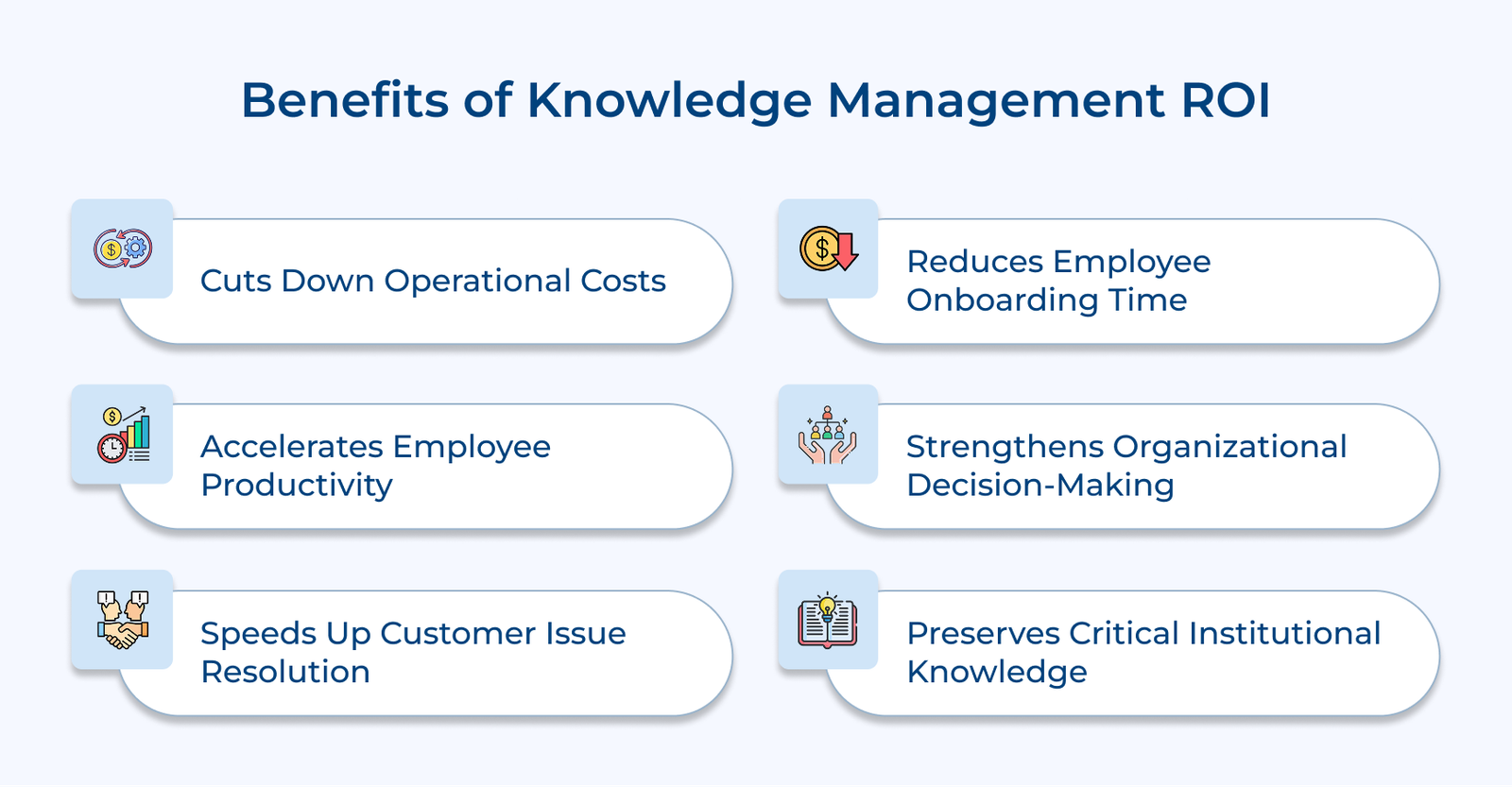
1. Cuts Down Operational Costs
Employees often spend time solving problems that have already been solved. A well-managed knowledge system reduces duplicate work, while knowledge management ROI helps measure the cost savings created through improved efficiency.
2. Accelerates Employee Productivity
Knowledge workers lose significant time every day hunting for information that should be instantly accessible. Measuring knowledge management ROI reveals how a stronger knowledge base directly compresses search time and pushes output higher.
3. Speeds Up Customer Issue Resolution
Support teams resolve issues more quickly when accurate information is easy to find. Tracking this benefit through knowledge management links faster resolution times to measurable improvements in customer service performance.
4. Reduces Employee Onboarding Time
New hires become productive sooner when they have access to clear and organized knowledge resources. Measuring the returns of knowledge management helps quantify the time and training costs saved through a structured onboarding process.
5. Strengthens organizational decision-making
When the right knowledge reaches the right person at the right moment, decisions get sharper and faster. Measuring knowledge management quantifies how information accessibility translates into better business outcomes over time.
6. Preserves Critical Institutional Knowledge
Organizations risk losing valuable expertise every time experienced employees leave. Tracking the ROI highlights the value of capturing and preserving knowledge so teams can continue working effectively without disruption.
Below are the essential steps to build a knowledge management ROI model that helps you demonstrate the impact of your knowledge initiatives.
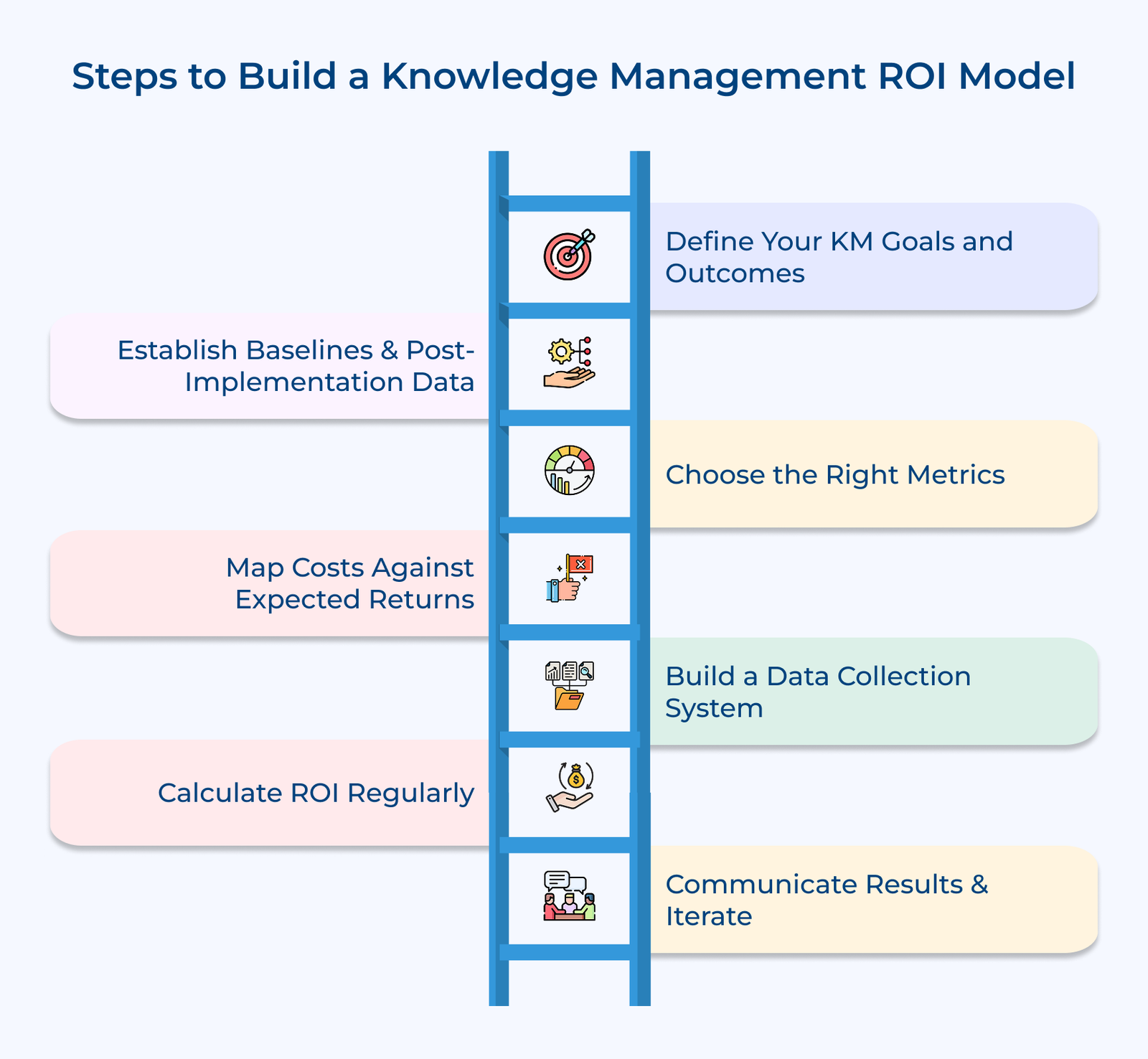
Measuring ROI starts with defining what success looks like for your knowledge management initiative. Clear goals give every metric a purpose and make knowledge management ROI easier to measure because each KPI can be tied to a specific business outcome.
Key considerations:
Many organizations struggle with the step because they focus on implementing a knowledge management system instead of defining the business problems it should solve. Missing that foundation makes it difficult to demonstrate meaningful ROI later.
Pro tips:
Measuring improvement is impossible without knowing where you started. Accurate baseline data provides a reliable point of comparison and makes knowledge management ROI easier to calculate by showing the impact of your knowledge management initiatives over time.
Capturing the current state means documenting how employees search for information, resolve issues and complete knowledge dependent tasks before your KM system is fully implemented. The data becomes the benchmark against which future improvements are measured.
Actionable tips:
Choosing the right metrics is more important than tracking a large number of KPIs. Focus on the metrics that reflect real business outcomes and help measure knowledge management ROI instead of collecting data that adds little value.
Key factors:
A metric loses its value if it changes without influencing business decisions. Keep only the KPIs that provide useful insights and support better decision-making. Review your metrics regularly to ensure they remain aligned with changing business goals and organizational priorities.
Every knowledge management initiative involves costs, so understanding the value it delivers is essential. Comparing costs with expected returns creates a reliable foundation for measuring knowledge management ROI and helps demonstrate the business impact of your investment.
Key ways:
A reliable knowledge management ROI model depends on accurate and consistent data. Setting up a structured data collection system before implementation helps you measure performance from day one and avoids gaps that make future analysis difficult.
Key takeaways:
Reliable data depends on consistent processes as much as the technology collecting it. Clear ownership and accurate reporting help ensure your ROI model remains trustworthy as your knowledge management program grows.
ROI isn’t a number you calculate once and then file away in a report nobody reopens. Knowledge management values compound and shift over time, which means your calculation needs a consistent schedule to actually reflect reality. Regularly tracking knowledge management ROI helps organizations identify long-term trends, optimize investments and make better strategic decisions.
Best practices:
A single ROI calculation provides only a snapshot of performance. Tracking results consistently over time reveals meaningful trends and helps you make better decisions based on reliable data.
Measuring knowledge management ROI is only valuable if the results are shared and used to improve future decisions. Presenting clear findings helps stakeholders understand the impact of your knowledge management initiatives and identify areas that need attention.
Pro tips:
An ROI model should continue evolving as your organization changes. Regular reviews and clear communication help keep your knowledge management strategy aligned with business goals and support better decision-making over time.
The following are the most impactful KM ROI metrics to track for measuring business value and understanding how your knowledge management initiatives contribute to organizational success.
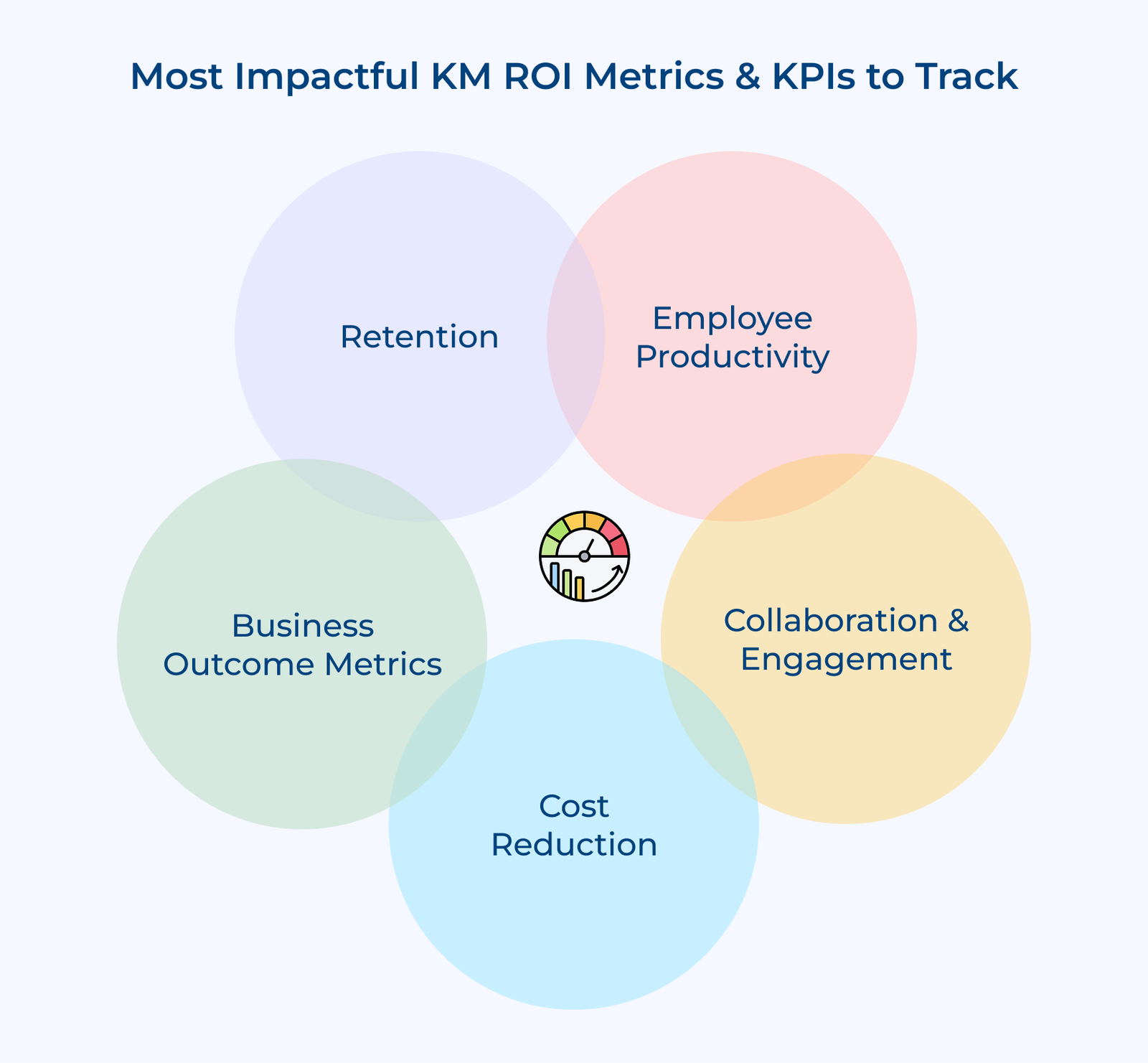
Employee productivity is one of the clearest ways to measure the impact of a knowledge management system. Tracking the right metrics helps you understand how quickly employees find information, complete tasks, solve problems independently and reach full productivity.
1. Knowledge Search Time Reduced
Track how many minutes employees spend locating information before and after your KM system is optimized. A measurable reduction improves knowledge management ROI by recovering valuable work hours across the organization.
2. Task Completion Speed
Measure how quickly employees complete knowledge-dependent tasks compared with a baseline period. Faster completion with consistent quality indicates that employees can access the information they need without unnecessary delays.
3. First-Contact Resolution Rate (internal)
Track how often employees resolve a problem or question without escalating it to a colleague or manager. A higher first-contact resolution rate strengthens knowledge management ROI by reducing internal dependencies and improving productivity.
4. Time to Competency for New Hires
Measure how long it takes a new employee to perform their core responsibilities independently. A shorter learning period shows that your knowledge resources help employees become productive faster while reducing the need for constant support.
Collaboration and engagement metrics show how actively employees use, share or contribute knowledge across the organization. Consistent participation indicates that knowledge is accessible, trusted and helps teams work together more effectively.
1. Cross-team Knowledge Contributions
Measure how many employees from different departments actively contribute content to your shared knowledge base. High cross-team participation improves knowledge management ROI by making knowledge sharing a regular part of everyday work.
2. Knowledge Article Engagement Rate
Track how often employees view, save or revisit knowledge articles. High engagement shows that your content is relevant, useful and supporting employees in their daily work. Tracking the metric over time also helps identify which articles deliver the most value and which ones need updates or improvements.
3. Internal Community participation
Monitor activity levels inside internal forums, Q&A threads and collaborative knowledge spaces over time. Growing participation strengthens knowledge management ROI by encouraging employees to both seek and share knowledge, creating a more self-sustaining workplace.
4. Expert identification and access rate
Measure how easily employees can find and connect with subject matter experts when specialized guidance is needed. Faster access to expertise helps resolve issues more efficiently and improves collaboration across teams.
5. Knowledge sharing frequency per employee
Track how often employees create new knowledge or update existing content during a predefined period. The metric highlights active contributors while encouraging continuous knowledge sharing across the organization.
Cost reduction metrics show how a knowledge management system helps lower operational expenses over time. Tracking the metrics makes it easier to measure savings, justify investments and identify opportunities to improve efficiency.
1. Support ticket volume reduction
Track the month-over-month reduction in internal IT or HR support tickets after improving your knowledge base. Fewer tickets improve knowledge management ROI by reducing the time employees spend answering repetitive questions.
2. Redundant work hours eliminated
Measure how many hours employees spend repeating research or solving problems that have already been addressed. Reducing duplicate work lowers operational costs and allows teams to focus on higher-value activities.
3. Training and onboarding cost per employee
Compare the total cost of onboarding new hires before and after implementing a structured knowledge management system. A meaningful reduction in onboarding costs improves knowledge management ROI and demonstrates the financial value of organized knowledge.
4. External consulting spend reduction
Track changes in spending on external consultants after improving access to internal knowledge. Lower consulting costs indicate that employees can solve more problems using existing organizational expertise.
5. Meeting hours saved
Measure the reduction in meetings held only to share information that could have been documented in the knowledge base. Fewer knowledge-transfer meetings free up valuable time for managers and employees.
Business outcome metrics measure how your knowledge management system contributes to organizational performance. The metrics connect knowledge initiatives to results such as revenue growth, better decision-making, improved quality and higher customer satisfaction.
1. Revenue Per Knowledge-Enabled Employee
Compare revenue generated by employees who actively use your KM system with those who use it less frequently. Higher revenue from active users demonstrates stronger knowledge management ROI and highlights the value of effective knowledge access.
2. Decision-Making Cycle Time
Measure the time it takes teams to move from identifying a business problem to making a decision. Shorter decision cycles indicate that employees can access reliable information quickly and act with greater confidence.
3. Product or Service Error Rate
Track how often knowledge gaps lead to mistakes in product delivery, quality control or customer-facing processes. A declining error rate strengthens knowledge management ROI by showing that better knowledge access leads to greater accuracy and fewer costly errors.
4. Customer satisfaction score (CSAT) impact
Measure changes in customer satisfaction scores as employees gain faster access to accurate and up-to-date knowledge. Better informed teams provide more consistent support, leading to a stronger customer experience.
Retention metrics measure how effectively your organization preserves critical knowledge as employees leave or change roles. Tracking the KPIs helps reduce knowledge loss, maintain business continuity and protect the long term value of your knowledge management system.
1. Employee Turnover Rate in Knowledge-Critical Roles
Track employee turnover in roles that hold specialized expertise and institutional knowledge. Lower turnover and stronger knowledge retention improve knowledge management ROI by protecting essential business knowledge and reducing operational disruption.
2. Knowledge Capture Rate Before Exit
Measure the percentage of departing employees who successfully document and transfer their critical knowledge before leaving. A high knowledge capture rate reduces the risk of losing valuable expertise and supports smoother transitions.
3. Post-Exit Knowledge Retrieval Success Rate
Track how often teams can locate and apply knowledge left behind by former employees. A high retrieval rate improves knowledge management ROI by showing that important organizational knowledge remains accessible after employees leave.
4. Expertise Gap Identification Speed
Measure how quickly your organization identifies critical knowledge gaps after an experienced employee departs. Faster identification helps teams address missing expertise before it affects productivity or business performance.
5. Knowledge Base Freshness Score
Track the percentage of knowledge content reviewed and updated within a defined period. A high freshness score improves knowledge management ROI by ensuring employees have access to accurate and current information.
Check out the most common pitfalls in KM ROI measurement and learn how avoiding these mistakes can help you produce more accurate results.
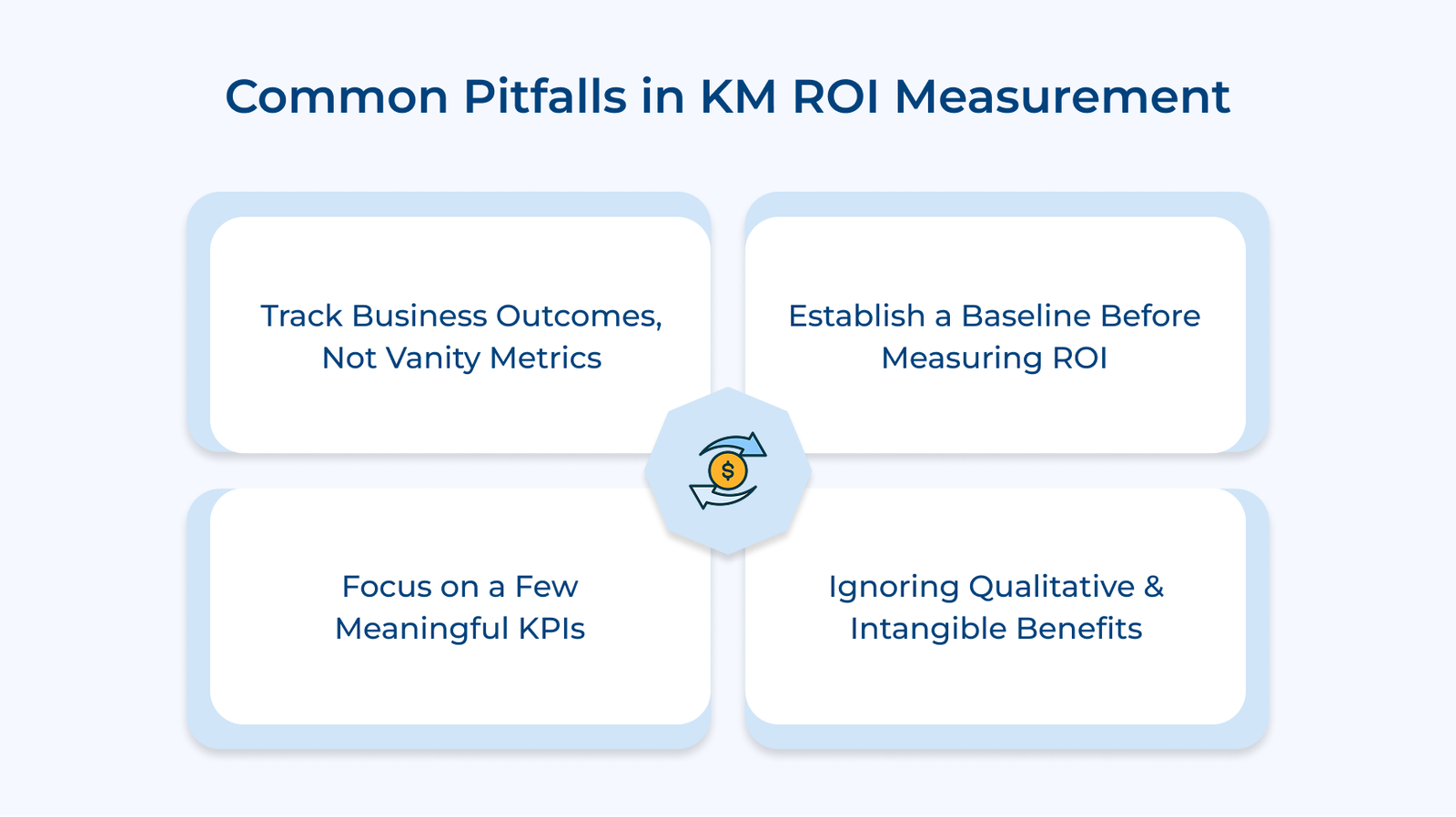
1. Tracking Vanity Metrics Instead of Business Impact
Many teams focus on metrics such as page views and login counts because they are easy to measure. The numbers rarely explain how a knowledge management system improves business performance, making knowledge management ROI difficult to demonstrate.
2. Skipping the Baseline Measurement Entirely
Many organizations implement a knowledge management system before recording their starting point. Without baseline data, it becomes difficult to compare results and accurately measure the impact of future improvements.
3. Measuring Too Many Metrics at Once
Tracking too many KPIs can make reports difficult to understand and distract attention from the metrics that matter most. Focusing on a small set of meaningful indicators makes knowledge management ROI easier to measure and interpret.
4. Ignoring Qualitative and Intangible Benefits
Some benefits, such as greater employee confidence, improved collaboration and easier knowledge sharing, are difficult to express as financial values. Including the outcomes alongside quantitative metrics provides a more complete view of the impact of your knowledge management system.
Steps for a better implementation:
Knowledge management ROI answers a simple question: is your knowledge management system creating measurable business value? Consistent measurement helps you understand what is working, identify opportunities for improvement and make better decisions based on reliable data.
Key takeaways:

A platform like Omni24 brings knowledge from multiple sources into a single location, making information easier to find and use. Faster access to reliable knowledge reduces duplicate work, improves productivity and supports stronger Knowledge Management ROI.
Most organizations benefit from quarterly ROI reviews, with lighter monthly check-ins on core metrics. Frequent reviews catch declining trends early, before small inefficiencies grow into expensive, harder-to-fix problems.
Yes. Knowledge management ROI often improves through lower support ticket volumes, shorter onboarding times and less time spent on repetitive tasks. Tracking the metrics helps quantify the cost savings created by your knowledge management system.
Effective training helps employees use knowledge management systems correctly and consistently. Higher adoption rates and better knowledge utilization improve productivity, making it easier to achieve stronger knowledge management ROI.
The tools that help in tracking the knowledge management ROI are as follows:
Grow Customer Relationships and stronger team collaboration with our range of products across the Conversational Engagement Suite.
Omnichannel Customer Support & Help Desk Software
AI Enabled Business Messaging and Chatbot Software
Sales Engagement & CRM Software
Call Center Software & Virtual Phone System
Product Marketing & Experience Platform
Customer Experience & Feedback Management Software

 Ecommerce Conversion Rate Optimization: The Comprehensive Guide
Scroll to top