9 Important Lead Scoring Examples for Better Sales Decisions
Learn about the practical lead scoring examples that help businesses rank prospects. They also help prioritize sales efforts and focus on leads most likely to convert into loyal customers.
Learn about the practical lead scoring examples that help businesses rank prospects. They also help prioritize sales efforts and focus on leads most likely to convert into loyal customers.
Your sales team spends hours chasing leads that never convert, while serious buyers quietly move on. Poor lead prioritization doesn’t just slow things down. It quietly drains revenue and keeps conversion rates stuck at disappointing levels across the funnel.
Competitors win customers every day, not because they have more leads, but because they spot buying intent sooner. Meanwhile, sales reps juggle endless prospect lists with no clear signal on who needs attention now and who can wait.
So let us go through the top lead scoring examples to help you bring order to that chaos. You’ll see how high-performing teams use clear, data-backed signals to focus on the right leads at the right time and turn interest into real sales.
Lead scoring examples refer to practical systems businesses use to rank potential customers based on how likely they are to buy. The examples include assigning points for actions such as downloading whitepapers, visiting pricing pages or attending webinars. Each action carries a different weight depending on how strongly it signals buying intent.
The examples give sales teams a clear way to decide which prospects deserve immediate follow-up and which should stay in nurturing. The result is fewer missed opportunities and more time spent on leads that actually matter.
Key objectives:
Below are the top lead scoring examples that will refine your approach, boost your conversion rates and streamline your sales efforts.
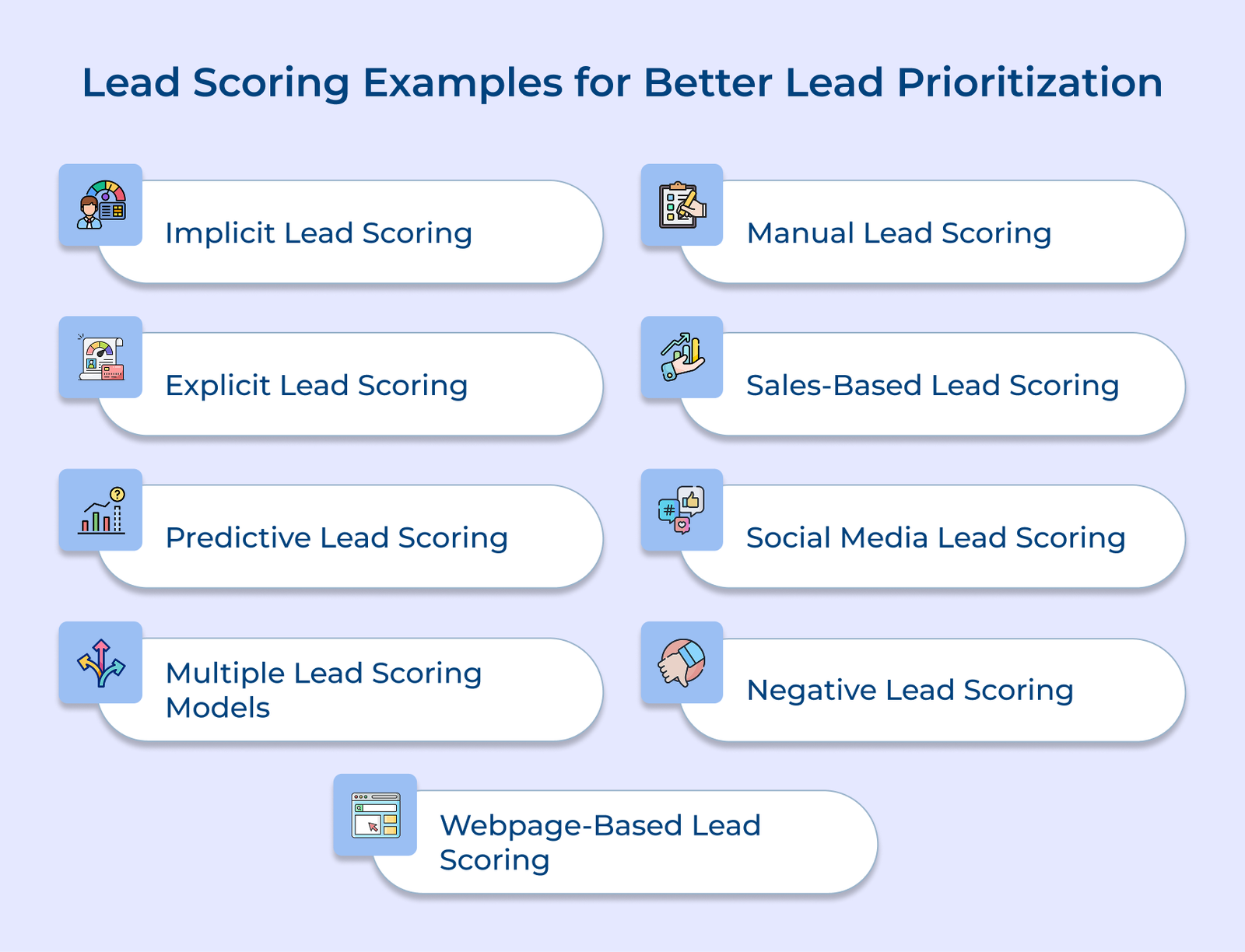
Implicit lead scoring example is widely leveraged as it helps to track what prospects do rather than what they say. It helps reveal genuine purchase intent without requiring direct input by observing digital behaviors.
Key metrics:
Implicit lead scoring works exceptionally well for B2B software companies and consulting firms. The businesses typically have longer sales cycles where prospects research extensively before making contact decisions.
Explicit lead scoring focuses on the details prospects willingly share through forms, surveys or conversations. It’s especially useful for businesses with complex products where qualification matters, like enterprise software or professional services.
Key ways:
Consider that a prospect says they manage a 500-person team, use only basic tools and need implementation within three months. The lead deserves a much higher score than someone with five employees just gathering general information.
Predictive lead scoring uses data from past customers to forecast which prospects are most likely to buy. The advanced approach processes thousands of data points simultaneously to predict which prospects will most likely convert into customers.
Technology companies and SaaS platforms benefit most from predictive lead scoring systems. The businesses typically have extensive customer databases with rich behavioral data that machine learning algorithms can analyze effectively for pattern recognition.
Pro tips:
Not all customers behave the same way and neither should your scoring system. Multiple lead scoring models let you build different frameworks for each customer segment or product line. It ensures you evaluate leads on the right criteria.
Key metrics:
Start by asking yourself which customer segments behave most differently. Then create separate models for each group and test them against your historical conversion data to validate accuracy.
Manual lead scoring depends on the judgment of your sales team to evaluate prospect quality. It’s especially useful in complex B2B deals where software alone can’t capture relationship dynamics or subtle buying signals.
Sales teams can use manual scoring by combining quantitative data with qualitative insights from direct prospect interactions. Representatives assess conversation quality, pain point urgency and decision-making authority to assign scores that reflect real relationship potential.
Best practices:
Sales-based lead scoring focuses on how prospects interact directly with your sales team. It’s especially effective in high-touch B2B environments, like consulting, where personal relationships often matter more than digital clicks.
Quality of Conversations
Leads who ask detailed questions, share business challenges and engage in real discussions score higher than those who give surface-level responses
Phone Call Engagement
The metric measures prospect responsiveness to sales outreach and their willingness to invest time in conversations. Leads who consistently answer calls, schedule follow-up meetings and arrive prepared for discussions demonstrate serious buying intent.
Progress Toward Decisions
The most valuable scoring indicator comes from prospects who actively request proposals, negotiate terms, or discuss implementation timelines. The behaviors show strong purchase intent and mark the most valuable leads for sales focus.
Social media lead scoring tracks how prospects interact with your company and industry content across platforms. It’s especially useful because many B2B buyers now research extensively on LinkedIn and other networks before speaking with sales.
A software company might track LinkedIn engagement by assigning 10 points when a prospect shares an industry article and 15 points when they comment on a company post. Engaging with multiple team members could add another 25 points. This kind of scoring model helps sales teams spot high-intent prospects without overthinking the data.
The model helps identify prospects who actively participate in industry conversations and demonstrate genuine interest through consistent social engagement. The leads typically convert at higher rates because they’ve already invested time researching your company and solutions.
Negative lead scoring reduces points for prospects whose actions or characteristics suggest they’re unlikely to buy. It keeps sales teams from spending time on leads that won’t convert and ensures focus stays on better opportunities.
Key metrics:
Businesses use the metrics by automatically reducing lead scores when prospects demonstrate disqualifying characteristics or behaviors. It helps sales teams avoid unfit leads and focus on qualified prospects.
Webpage-based lead scoring assigns points to specific site pages depending on how strongly they indicate buying intent. The method becomes essential because not all website visits indicate equal interest levels or purchasing readiness.
Businesses use this method by giving higher scores to pages like pricing, demo requests or product comparisons. Leads who explore several of the high-intent pages in one session usually signal they’re actively evaluating and ready for sales follow-up.
Pro tips:
Check out the implementation of the lead scoring strategy to learn how businesses can effectively prioritize prospects for better conversions.
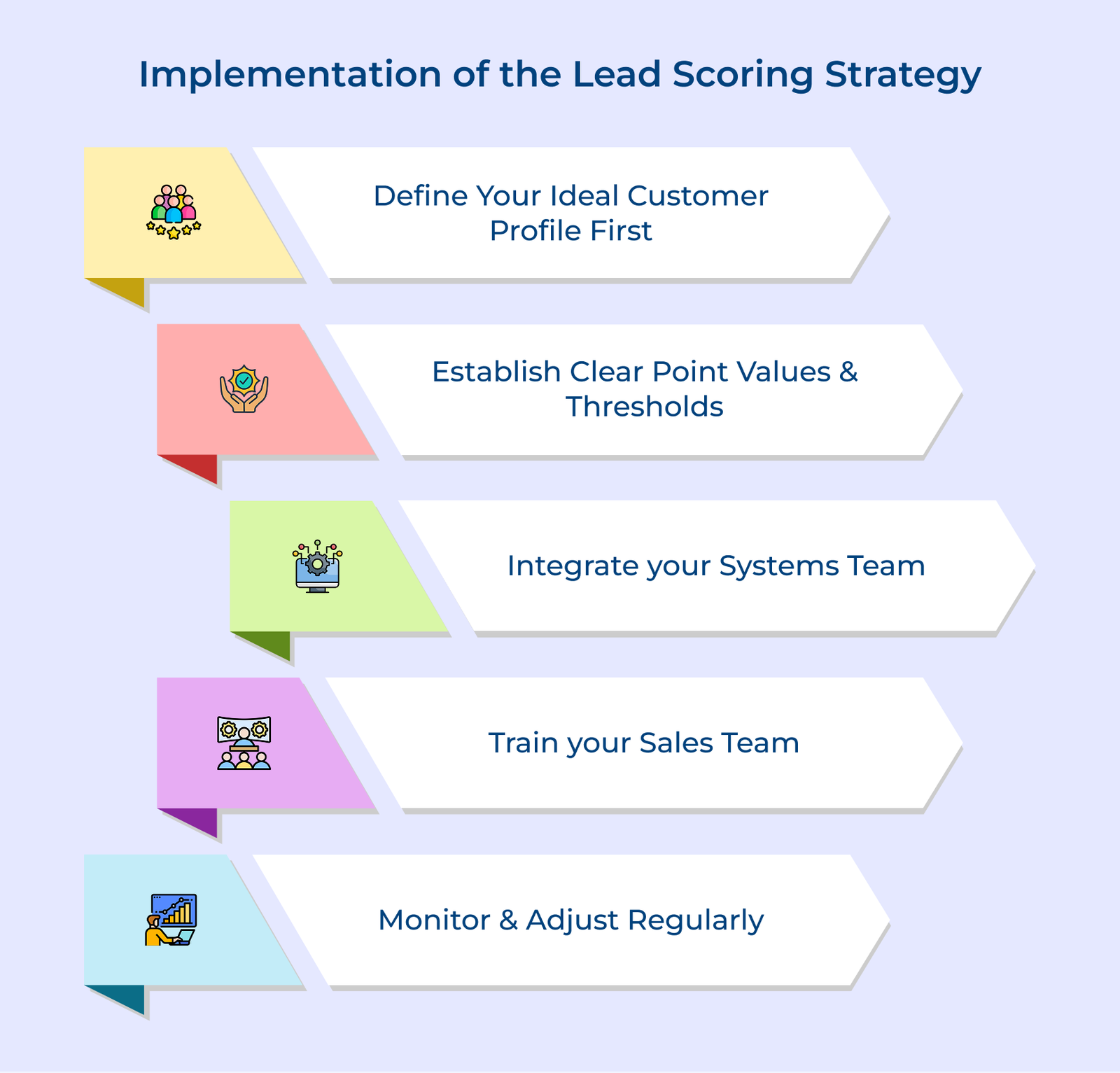
Define Your Ideal Customer Profile First
Begin by identifying the common traits of your best customers, such as company size, industry and decision-making style. It ensures your scoring system focuses on prospects most likely to become long-term clients.
Establish Clear Point Values and Thresholds
Assign specific point values to different actions and demographics based on historical conversion data and sales team input. Set thresholds that determine when a lead should be passed to sales versus kept in nurturing.
Integrate Your Systems Team
Explain how scoring works and what higher or lower scores mean. When sales reps understand the logic, they’ll trust the process and prioritize leads with more confidence.
Train Your Sales Team
Explain how scoring works and what higher or lower scores mean. When sales reps understand the logic, they’ll trust the process and prioritize leads with more confidence.
Monitor and Adjust Regularly
Check performance monthly by reviewing conversion rates at different score levels and gathering input from the sales team. Adjust your scoring rules as buyer behavior and market trends change.
Below are some industry giants demonstrating how different business models require unique approaches to lead scoring, each tailored to their specific customer journey.
Amazon
Amazon Web Services utilizes predictive lead scoring by analyzing a company’s tech stack, cloud job postings and infrastructure spending. Their algorithms spot businesses likely to adopt cloud services by analyzing digital footprints and competitor insights.
The implementation dramatically improved the efficiency of their enterprise sales team by focusing outreach on companies showing genuine signs of cloud adoption. The approach cut wasted sales efforts and boosted qualified pipelines for enterprise accounts or long-term contracts.
Nike
Nike employs behavioral lead scoring through their Nike Run Club as well as training apps by tracking workout frequency, goal achievement rates and social sharing behaviors. They give higher scores to users who regularly engage with fitness content and show commitment to improvement over casual app use.
The scoring system enables Nike to identify their most passionate customers and deliver personalized product recommendations at optimal moments. It increases conversions for premium gear and limited-edition releases among highly engaged members.
Apple
Apple uses implicit lead scoring by tracking enterprise visitors who view business solutions, join demos and download Mac deployment specs. Their scoring prioritizes IT decision-makers from companies showing sustained interest in workplace technology modernization initiatives.
The strategic approach helps Apple’s business team focus on organizations genuinely considering technology upgrades rather than casual browsers. The system boosts sales productivity and ensures qualified prospects get attention during key evaluation stages.
Airbnb
Airbnb implements explicit lead scoring for host acquisition by evaluating property owners who complete detailed listings, upload quality photos and provide comprehensive descriptions. Their system prioritizes hosts demonstrating commitment to exceptional guest experiences through thorough profile completion.
The approach helps Airbnb identify property owners likely to become successful long-term hosts rather than casual participants. The scoring enables targeted onboarding support for high-potential hosts while ensuring quality inventory growth.
Zappos
Zappos uses social media lead scoring combined with customer service data to identify potential brand advocates and high-value customers. They score leads by tracking social engagement, service chats and referrals to gauge buying potential and influence.
The scoring system allows Zappos to nurture relationships with customers who become organic brand ambassadors, driving word-of-mouth marketing. The strategy builds community while identifying customers who drive revenue and authentic referrals.
Lead scoring turns prospect management into a clear, structured process by showing which leads need immediate focus and which should be nurtured over time. The examples highlight how different scoring methods address specific business challenges.
The key is choosing a model that fits your industry and regularly refining it with real conversion data. Master the lead scoring fundamentals to build predictable sales pipelines that consistently deliver qualified opportunities.

Lead scoring assigns points to a prospect’s actions and traits that show buying interest. Let’s assume that downloading a whitepaper might earn 10 points, while visiting a pricing page could add 25. The total score helps sales teams decide who to contact first.
Calculate lead scores by adding points from demographic information and behavioral actions, then subtracting negative indicators. Consider: company size (20 points) plus email engagement (15 points) plus demo request (30 points) minus competitor employee (50 points) equals a final score of 15 points.
A standard lead scoring model typically ranges from 0 to 100 points with thresholds like cold leads (0-25), warm leads (26-50), hot leads (51-75) and sales-ready leads (76-100). Companies usually adjust the ranges to match their sales cycle and conversion patterns.
Lead scoring principles include focusing on behaviors that signal real buying intent. Regularly updating scoring criteria based on conversion data, aligning sales and marketing teams on qualification standards. It also involves maintaining simplicity to ensure consistent application across your entire organization.
Options range from small business tools like Veemo Sales to platforms like Marketo and Salesforce Pardot for larger teams and Leadfeeder for tracking website visitors. The best choice depends on how well it integrates with your CRM.
Update in real time for activities like site visits or email clicks so sales see immediate signals. Then review your overall scoring model every quarter to adjust for changes in buyer behavior and market conditions.
Grow Customer Relationships and stronger team collaboration with our range of products across the Conversational Engagement Suite.
Omnichannel Customer Support & Help Desk Software
AI Enabled Business Messaging and Chatbot Software
Sales Engagement & CRM Software
Call Center Software & Virtual Phone System
Product Marketing & Experience Platform
Customer Experience & Feedback Management Software
 Scroll to top