Top 10 Sales Manager KPIs for Businesses in 2026
Learn about the key sales manager KPIs. Learn how to track performance, guide strategic decisions and improve sales outcomes to drive overall business success.
Learn about the key sales manager KPIs. Learn how to track performance, guide strategic decisions and improve sales outcomes to drive overall business success.
Managers often struggle with a simple but crucial question: which numbers actually matter? Performance management can feel like flying blind -too much data, too little clarity. The real challenge isn’t collecting information; it’s knowing which signals deserve attention. When managers rely on gut feeling or outdated metrics, they miss early warnings in the pipeline, overlook growth opportunities and fail to support their teams effectively. The result is predictable: missed targets, low morale and revenue losses that better insight could have prevented.
The solution is to focus on the set of sales manager KPIs that give a clear, honest picture of how the team is performing and where it’s headed. These KPIs help managers move from reacting to leading with intent. Tracking them allows sales leaders to spot problems early, make smarter decisions and guide their teams toward consistent growth. Here’s a closer look at the ones that matter most and why every sales manager should care.
Sales manager KPIs (Key Performance Indicators) refer to measurable tools used to assess how effectively a sales leader is driving results. The metrics give organizations a clearer picture of what’s working, what’s not and where improvements are needed. Instead of relying on guesswork, sales managers use KPIs to track progress, make informed decisions and ensure that day-to-day sales efforts support broader business goals.
The process starts with setting clear targets based on current performance benchmarks across areas like revenue, team output and customer relationships. Once in place, the indicators are monitored regularly, helping managers spot trends, respond to challenges early and keep performance on track. They also serve as a foundation for coaching, allocating resources and shaping future strategy.
Key principles:
The following are six key benefits that make KPI tracking essential for modern sales leadership success. Let’s check them out in more detail.
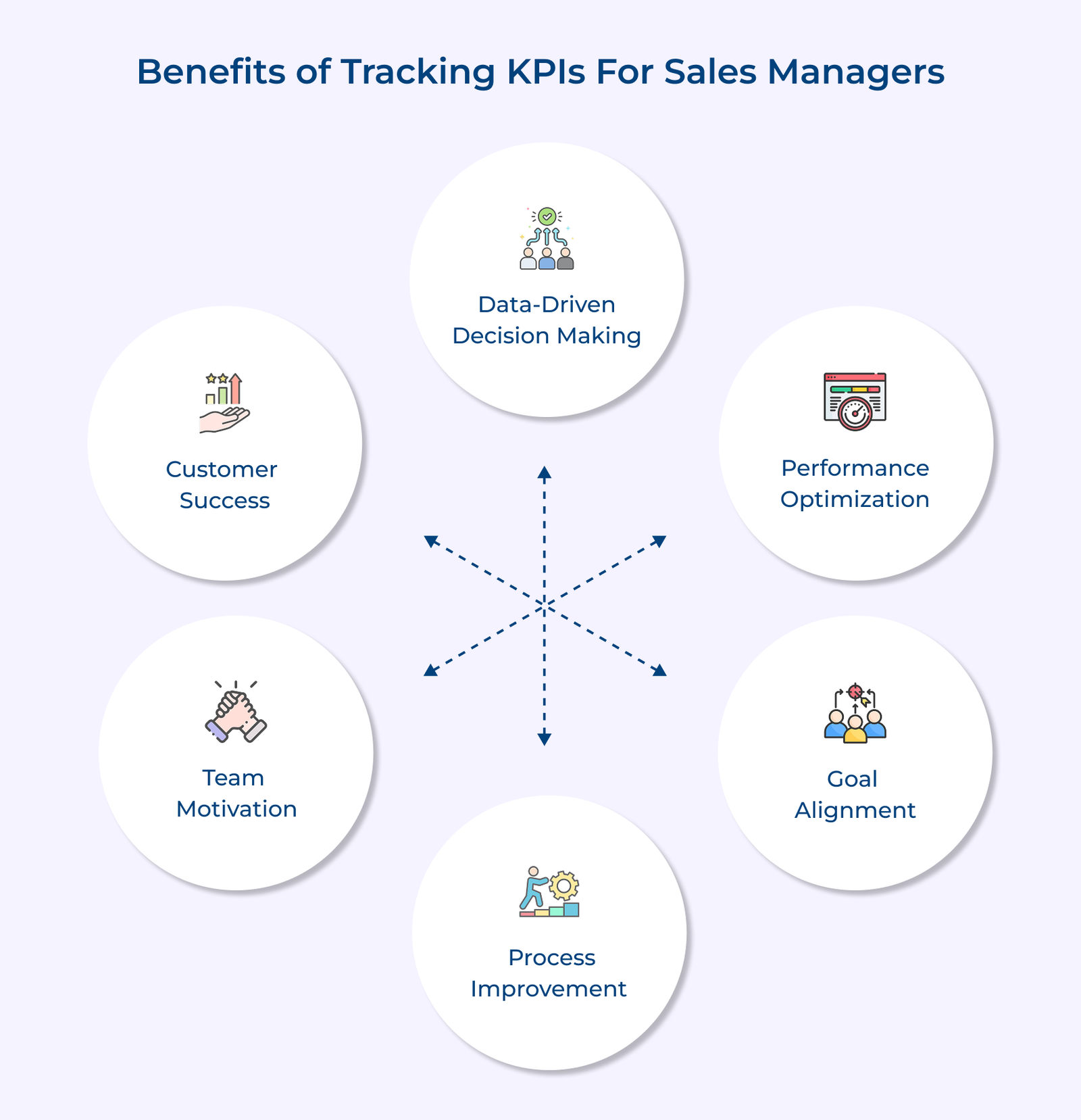
When managers base their choices on actual performance data and not just instincts, they’re more likely to invest in the right resources. Looking at past trends also helps them spot what’s likely to happen next and adjust course before problems grow.
Tracking KPIs regularly helps managers see who’s excelling and who needs help. Using sales productivity software, they can offer support where it’s needed and share what’s working across the team. It prevents issues from dragging on unnoticed.
When KPIs are tied directly to company priorities, everyone understands what they’re working toward. It makes it easier for managers to steer the team’s efforts and helps reps see how their daily work contributes to the bigger picture.
KPIs highlight where deals get stuck or fall through. Managers can fix specific problems in the sales process, be it the slow follow-ups or low win rates at a certain stage, making the whole system more effective.
When reps can see how they’re doing in real time, they stay more focused and driven. KPIs give people clear, fair sales goals to aim for and make it easier for managers to spot or reward great work.
Tracking customer-related metrics helps managers ensure their team isn’t just closing deals but building lasting relationships. It also reveals patterns in customer behavior that can guide smarter sales approaches and stronger retention.
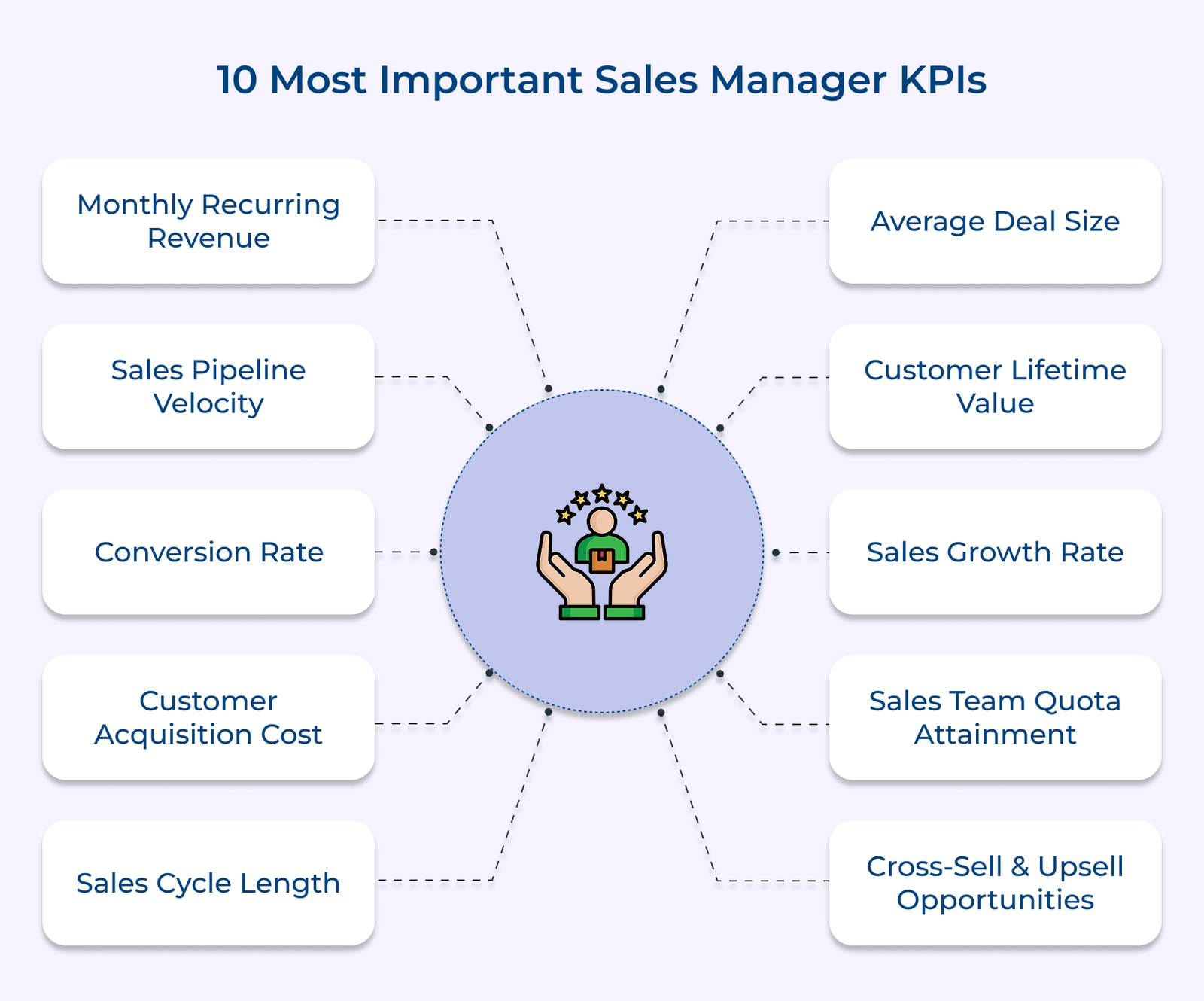
Let’s go through the 10 most important sales manager KPIs that can help you elevate your team’s performance and drive business growth.
MRR gives sales managers a consistent view of how much revenue they can expect each month. Breaking it down by source helps them see which parts of the business are stable, growing or shrinking. It’s very important for planning and setting team priorities.
Formula:
Total MRR = Base MRR (existing customers) + Expansion MRR (upgrades/add-ons) – Contraction MRR (downgrades/cancellations)
Primary sources:
Managers usually review the figures during monthly check-ins and quarterly planning. A balanced MRR mix, steady new customer growth alongside strong expansion revenue indicates both acquisition and retention efforts are working well.
Pro tips:
Pipeline velocity shows how quickly leads move from first contact to close. It’s a simple but powerful way for managers to gauge how efficiently their sales process is working and how soon revenue might land. A faster pipeline velocity means leads closing quicker, which can be a strong sign of a focused, effective sales team.
Formula:
Pipeline Velocity = (Number of Qualified Opportunities × Average Deal Value × Win Rate) ÷ Average Sales Cycle Length (in days)
The metric is usually reviewed weekly during pipeline check-ins and factored into monthly revenue forecasts. While the ideal number will vary by industry, what matters most is consistent improvement over time.
Actionable tips:
Conversion rate measures how many leads or opportunities turn into actual customers. It’s a straightforward way to judge how well your sales process works from first contact to final close. A strong conversion rate means your team is good at qualifying leads, building trust and closing deals. A weak one often points to issues in messaging, targeting or follow-through.
Formula:
Conversion Rate = (Number of Closed Won Deals ÷ Total Number of Opportunities) × 100
You can also calculate stage-by-stage conversion rates: (Number of Deals that Moved to Next Stage ÷ Total Deals in Current Stage) × 100
Sales managers often review this data in weekly team syncs and monthly reviews. Instead of chasing a perfect number, the goal is steady improvement, especially during times of change, like entering a new market or testing a new strategy.
Best practices:
CAC shows how much it costs to bring in a new customer. It helps sales managers understand whether their team is using time, tools and budget effectively or spending too much to win new business. When CAC is too high, it can cancel out the value that new customers bring.
Formula:
CAC = Total Sales and Marketing Costs ÷ Number of New Customers Acquired
Detailed Formula: (Sales Team Salaries + Marketing Expenses + Software Costs + Sales Tools + Training + Advertising) ÷ Number of New Customers
Let’s assume that if a company spends $100,000 on salaries, tools, marketing, training and signs 50 new customers, the CAC is $2,000 per customer. After streamlining content and lead scoring, the company drops its spending to $80,000, while still gaining 50 customers. The CAC now falls to $1,600, improving efficiency by 20%.
Key takeaways:
Sales cycle length tracks how long it takes to turn a lead into a customer from first contact to a signed deal. It’s a key indicator of how smoothly and efficiently their sales process runs. A shorter sales cycle usually means fewer delays, quicker revenue and a more focused team. Longer cycles often point to friction in the process that’s slowing things down.
Formula:
Average Sales Cycle Length = Total Days for All Closed Deals ÷ Number of Closed Deals
For specific stages: Days in Stage = Average Time Spent in Each Sales Stage
Let’s consider if three deals close in 45, 60 and 75 days, the average cycle length is 60 days. After spotting delays during product demos, the company improved that step and brought the average down to 50 days.
Pro tips:
Average deal size tells you how much revenue, on average, each closed deal brings in. It helps sales managers evaluate how effectively the team is selling and supports accurate forecasting. Larger deal sizes can signal stronger value communication or better account targeting, while shrinking values may point to pricing issues or rushed closes.
Formula:
Average Deal Size = Total Revenue from All Closed Deals ÷ Number of Closed Deals
For specific segments: Segment Deal Size = Total Revenue from Segment ÷ Number of Deals in Segment
Sales managers typically review the metric in pipeline reviews and during monthly forecasting meetings. It’s especially useful when deciding on commission plans, pricing strategies or how to split up territories.
Actionable tips:
CLV estimates how much total revenue a customer is likely to bring in over the entire time they do business with you. It’s a critical number for sales managers as it tells you how much you can afford to spend to win a customer and which accounts are worth the most long term. A strong CLV helps shift focus from one-time deals to building relationships that continue to deliver value over time.
Formula:
CLV = Average Purchase Value × Average Purchase Frequency × Average Customer Lifespan
For subscription businesses: CLV = Average Monthly Revenue per Customer × Average Customer Lifespan (in months)
Create value-based customer segments
Group customers based on how they buy, how often they engage and how long they stay. Use the insight to tailor offers, outreach and product recommendations so that each group gets what they’re most likely to value.
Implement strategic retention programs
Build retention into your process. Schedule regular check-ins, offer helpful guidance and make it easy for customers to grow with your product over time. Proactive support reduces churn rates and boosts long-term revenue.
Sales growth rate tracks how much your revenue is increasing or decreasing over a given period. It’s a simple but essential metric for sales managers. It helps gauge whether your team is gaining traction, holding steady or losing ground. You can see how well your strategy is working and where adjustments might be needed by watching the number over time.
Formula:
Sales Growth Rate = [(Current Period Sales – Previous Period Sales) ÷ Previous Period Sales] × 100
For specific segments: Segment Growth Rate = [(Current Segment Sales – Previous Segment Sales) ÷ Previous Segment Sales] × 100
Enhance sales team productivity
Offer focused sales training and tools that helps the sales team improve how they find or close solid leads. The more efficiently they work, the more deals they can close.
Develop market expansion strategies
Use market research to spot new industries, regions or customer types worth pursuing. Focus your team on those with clear demand and room to grow.
Optimize sales process efficiency
Take a close look at your sales workflow. Tweak those areas to keep the pipeline moving and reduce delays from first contact to close.
Quota attainment shows how much of their assigned sales target your team hits. It’s one of the most direct ways to measure both individual and team performance. The metric helps managers spot strong performers, recognize who’s falling behind and determine where extra support or coaching might be needed.
Formula:
Individual Quota Attainment = (Actual Sales Revenue Achieved ÷ Sales Quota Target) × 100
Team Quota Attainment = (Total Team Revenue ÷ Total Team Quota) × 100
Sales managers generally review quota attainment during weekly team meetings and monthly performance reviews. They use the metric to identify top performers and those who need additional support. A healthy benchmark shows at least 70% of the team reaching their quotas consistently. It becomes particularly important during performance evaluations and compensation reviews.
Best practices:
The metric tracks how well your team grows revenue from existing customers, either by offering complementary products (cross-sell) or by moving customers to upgraded versions of what they already use (upsell). It shows if your team is tapping into the full potential of each customer relationship.
Formula:
Cross-sell/Upsell Rate = (Number of Customers Who Purchased Additional Products ÷ Total Number of Customers) × 100
Revenue Impact = (Revenue from Cross-sell/Upsell ÷ Total Revenue) × 100
Sales managers usually review the metric during quarterly business reviews and strategic account planning. A steady increase in cross-sell and upsell activity is a strong indicator that your team is deepening customer engagement, not just closing one-off deals.
Key takeaways:
Below are the key challenges that can significantly impact sales managers’ ability to make data-driven decisions and optimize sales processes.

Ineffective Data Collection
Many sales teams rely on manual or disjointed systems to gather performance data. The result is often inconsistent, outdated or missing information. It slows down analysis and leads to decisions based on guesswork rather than facts.
Poor Data Quality Management
When sales reps frequently enter inconsistent or inaccurate data into their CRM systems. This creates a domino effect of unreliable reporting and misleading insights. Without standardized data entry protocols and regular audits, the quality of KPI tracking suffers significantly.
Insufficient Real-time Visibility
When sales reps enter data inconsistently or skip it altogether, KPI tracking becomes unreliable. Without clear guidelines for input and regular cleanup, even the best dashboards end up filled with noise instead of useful insight.
Misaligned KPI Selection
It’s easy to fall into the trap of monitoring too many numbers or focusing on ones that don’t reflect business goals. It spreads the team’s attention thin and makes it harder to prioritize what really matters.
Limited Analysis Capabilities
Having data isn’t the same as knowing what it means. Without the right tools or training, many managers struggle to spot patterns or uncover root causes. It leads to missed opportunities for improvement.
Inadequate Team Engagement
If KPI tracking feels like surveillance rather than support, reps are less likely to engage. Without their cooperation, data goes missing or gets filled in carelessly, turning a potentially helpful process into a time sink.
Implementation steps to ensure you overcome the challenges:
Below are some leading brands that leverage sales manager KPIs to drive their sales performance and achieve remarkable business growth.
Amazon
Amazon’s sales managers closely monitor customer satisfaction alongside traditional performance metrics. They track things like customer review scores, repeat purchase behavior, conversion rates and same-day delivery performance.
Key operational KPIs include inventory turnover and first-contact resolution rates for customer support. Amazon ensures smooth operations by giving equal weight to customer behavior and sales performance. The strategy has helped them grow their market share while maintaining high service standards.
Nike
Nike emphasizes product category performance and channel-specific metrics. Sales managers track sell-through rates, digital engagement, store-level conversions and seasonal inventory movement. They also measure omnichannel effectiveness and how well different customer segments are performing in key markets.
Nike uses this data to refine its product strategy, ensuring the right items are available in the right places at the right time. The flexibility helps them stay aligned with customer demand and manage stock efficiently.
Puma
Puma zeroes in on regional performance, focusing on wholesale account results, retail space productivity and e-commerce conversions. They also track new product launch success, sales rep effectiveness and acquisition costs across different sales channels.
The local-market view helps Puma move quickly when performance shifts. Sales teams can adapt promotions, adjust stock and focus on the most effective sales channels to keep growth steady.
Apple
Apple blends in-store and online KPIs with ecosystem-focused tracking. They look at revenue per square foot, attach rates for services and customer retention across product lines. Other priorities include upgrade cycles and how well sales staff understand the products.
The setup lets Apple fine-tune everything from store layouts to new product rollouts. The result is a consistent, high-value experience for customers and strong long-term loyalty.
Adidas
Adidas tracks a mix of retail and digital metrics. It includes omnichannel conversions, product category performance and how each customer group responds to different campaigns. Sales managers also watch how influencer collaborations and sustainability-focused products affect revenue.
Adidas keeps its messaging and inventory in sync with what customers care about by tracking both product and audience impact. It helps them stay competitive in both performance wear and lifestyle segments.
Not every sales metric is worth tracking. The real value comes from identifying the few key indicators that reflect progress toward your business goals. Sales managers who focus on the right KPIs – those that tie directly to growth, efficiency and customer value are better equipped to improve team performance. Strong KPI tracking looks at both the short and the long view.
Your KPI list shouldn’t be static. Business priorities shift, teams evolve and markets change. It means your KPIs should be reviewed regularly and updated when needed. The best frameworks stay lean, focused and meaningful, so your team knows exactly what’s being measured.

Sales managers track KPIs because they provide objective data to make informed decisions about team performance and business strategy. The metrics help identify areas needing improvement, spot emerging trends and allocate resources. KPIs also create accountability within the team, establish clear performance standards and help predict future sales outcomes. Sales managers can optimize their team’s performance and drive sustainable business growth by tracking the right metrics.
Start with the data. Look at your team’s past performance and current capacity. Factor in your market, product complexity and deal cycles. Set goals that are challenging but doable and involve your team in the process. When reps help shape the targets, they’re more likely to own the results. Remember, KPIs aren’t permanent. Adjust them as conditions change.
Focus on a mix of effort and results. Activity KPIs like calls made or meetings booked show how much work is being done. Outcome KPIs like conversion rates, deal size and revenue growth) show whether that work is paying off. Don’t forget long-term indicators, too, like customer retention and lifetime value.
Use a reliable CRM that captures data automatically and doesn’t rely on spreadsheets or guesswork. Set up clear dashboards to monitor key metrics and schedule regular reviews to spot trends early. Make sure your team understands how to enter data correctly and don’t just collect numbers, use them to guide decisions.

Grow Customer Relationships and stronger team collaboration with our range of products across the Conversational Engagement Suite.
Omnichannel Customer Support & Help Desk Software
AI Enabled Business Messaging and Chatbot Software
Sales Engagement & CRM Software
Call Center Software & Virtual Phone System
Product Marketing & Experience Platform
Customer Experience & Feedback Management Software

 9 Key Sales Trends For Businesses to Follow in 2026
Scroll to top
9 Key Sales Trends For Businesses to Follow in 2026
Scroll to top