SLA Management Guide: Best Practices & Challenges
SLA management ensures service providers meet agreed performance standards. Learn about its importance, key challenges and best practices to improve customer satisfaction.

SLA management ensures service providers meet agreed performance standards. Learn about its importance, key challenges and best practices to improve customer satisfaction.
Many businesses struggle with unclear service commitments. Customers expect one thing, delivery falls short and trust takes a hit. Teams then spend their time justifying misses instead of fixing them. Clients walk away, revenue slips and penalties start adding up. Once confidence drops, even long-term customers begin exploring other options, usually turning to competitors who deliver with more consistency.
Clear SLA management fixes this problem. It defines service expectations upfront, keeps performance visible, and highlights gaps before they become real issues. Learn how to build practical systems that help you meet commitments, retain clients, and run your service operation with fewer surprises and more control.
SLA management refers to the process of clearly setting, tracking or maintaining service expectations between a provider and a customer. It’s like making a clear promise, say, that your website will stay online 99.9% of the time and then making sure you deliver on it. Good SLA management lays out what’s expected, monitors performance in real time and ensures any issues are fixed quickly.
Service level management is not a one-time setup; it’s a cycle. Tools track things like response time or system uptime and if anything slips below the agreed standard, alerts go off, fixes happen or data is logged to spot bigger patterns or recurring problems.
Key types:
Below are the critical roles that SLA management plays in business operations and why it’s indispensable for both service providers and recipients.
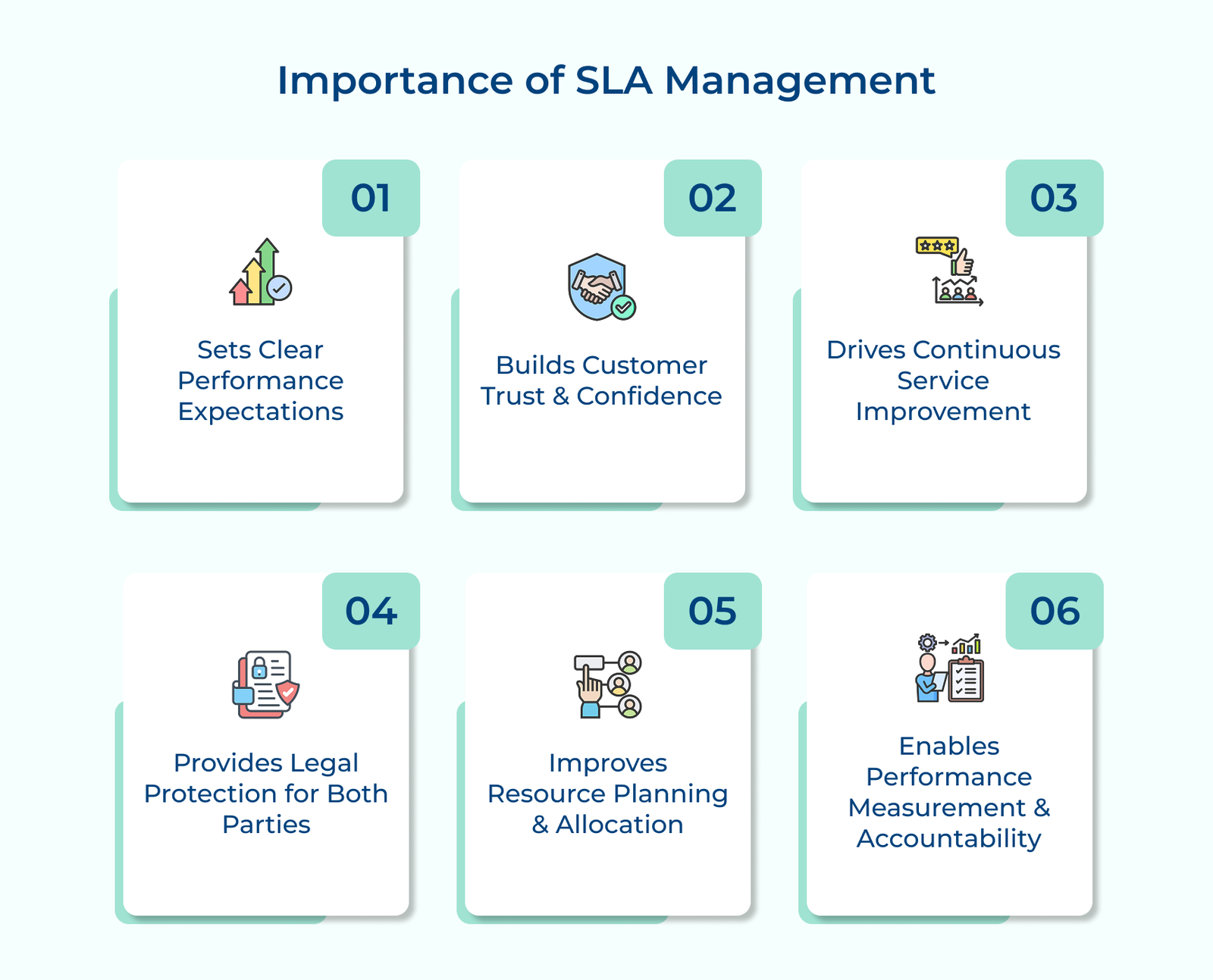
1. Sets Clear Performance Expectations
SLAs spell out exactly what’s expected, using numbers instead of vague promises. Everyone on both sides knows what “good” looks like, which helps avoid misunderstandings later.
2. Builds Customer Trust and Confidence
When you put service promises in writing and back them with data, it shows you mean business. The transparency earns customer confidence and lays the foundation for long-term relationships.
3. Drives Continuous Service Improvement
Tracking performance regularly helps you spot weak areas early. Instead of reacting after things go wrong, you can make steady improvements and keep your service sharp.
4. Provides Legal Protection for Both Parties
A service level agreement management is a two-way safety net. Customers have clear grounds to raise concerns and service providers have protection from vague or unfair expectations.
5. Enables Better Resource Planning and Allocation
Defined service levels help you calculate exactly how much infrastructure and staffing you need to meet commitments consistently. It prevents both costly over-provisioning that wastes money and dangerous under-provisioning that leads to service failures.
6. Facilitates Performance Measurement and Accountability
When performance is tied to specific metrics, teams stay focused. It shifts conversations from opinion-based debates to clear, data-backed assessments of what’s working and what’s not.
Check out the key practices that can transform your SLA management from mere documentation to a dynamic tool for success.
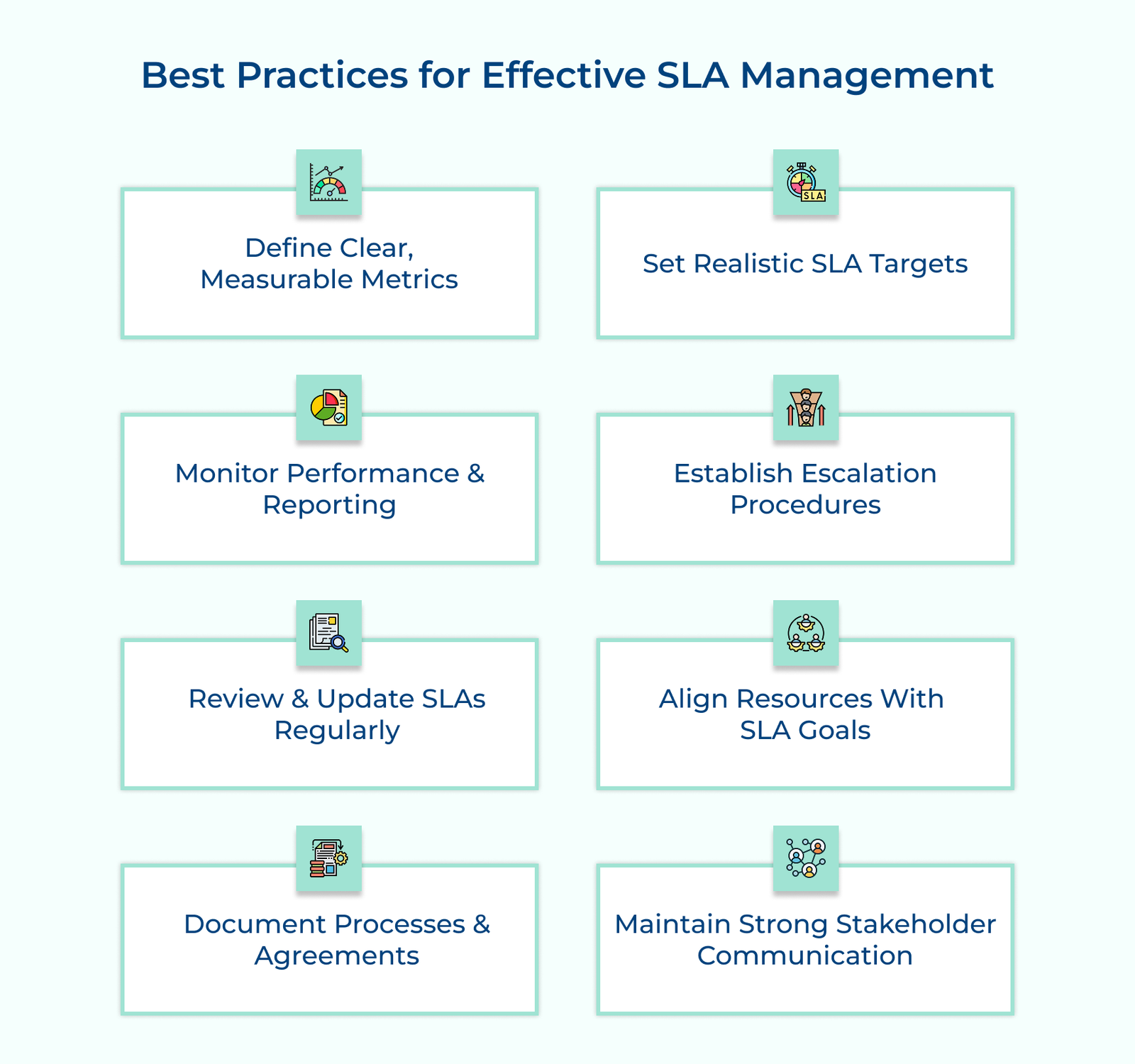
Vague service promises are confusing. That’s why every SLA should be built around specific, trackable numbers. When both sides agree on what counts as “good service,” it’s easier to hold each other accountable and avoid arguments later.
Setting realistic and achievable targets means working with what your team can deliver, not what sounds impressive on paper. When goals are out of reach, they don’t motivate; they frustrate. Teams burn out trying to hit impossible benchmarks and customers lose trust when promises are routinely broken.
Start by looking at your historical performance data. What’s your team been able to do reliably? Use it as your baseline. Then, build in a small buffer for the unexpected because things will go wrong sometimes. The goal is to stretch your team, not snap them.
Comprehensive monitoring means knowing how your services are performing before your customers tell you something’s wrong. If you skip it, you’re just guessing and often too late.
Instead of waiting for complaints, use real-time tracking to catch issues early and understand patterns over time. When done right, monitoring isn’t just a safety net; it’s a warning system.
Pro tips:
Having proper escalation and response procedures isn’t optional; it’s what keeps small problems from turning into disasters. When something breaks, the last thing you want is a team scrambling to figure out who’s in charge. Without structure, confusion takes over, time is wasted and customers pay the price.
Define clear roles and responsibilities for different types of service incidents
Defining clear roles prevents confusion during high-pressure situations by ensuring every team member knows exactly what they’re responsible for when different types of incidents occur. The clarity eliminates delays caused by people assuming someone else is handling the problem
Key roles:
Establish multiple communication channels to reach the right people quickly
If your only contact method fails, your whole response can stall. That’s why it’s crucial to set up more than one way to reach key people, especially during emergencies or outside business hours.
Key channels:
Regular review along with the updates involves systematically evaluating your SLA performance and making necessary adjustments to keep agreements relevant. If not, your SLAs become outdated documents that don’t reflect current business needs or technological capabilities anymore. Before implementing regular review and updates, consider the four essential questions that will guide your review process effectively:
Adequate resource planning alignment means matching your available infrastructure, staffing and budget resources precisely with the service commitments you’ve made in your service level agreement management. Without proper alignment, you’re essentially writing checks your operational capacity can’t cash, leading to consistent failures and frustrated customers. Proven methods for ensuring your resources align perfectly with your service-based SLA commitments:
But how do you know if your resource planning is working in practice? The answer lies in monitoring whether you’re consistently meeting SLA targets without your teams feeling constantly overwhelmed or your systems running at maximum capacity all the time.
Good documentation isn’t just paperwork; it’s how your team remembers, learns and improves. When it’s done well, it captures what happened, why it happened and how it was handled so the next person doesn’t have to figure it out from scratch. When businesses don’t make a record of it, knowledge leaves when people do. Here are four practical ways to document your SLA work:
Consider a scenario where your primary SLA specialist suddenly leaves the company during a critical customer negotiation. The replacement team member can quickly understand historical performance patterns, previous customer concerns and successful resolution strategies without starting from scratch.
Check out the common challenges organizations face in SLA management under the following constraints and explore practical ways to overcome them.
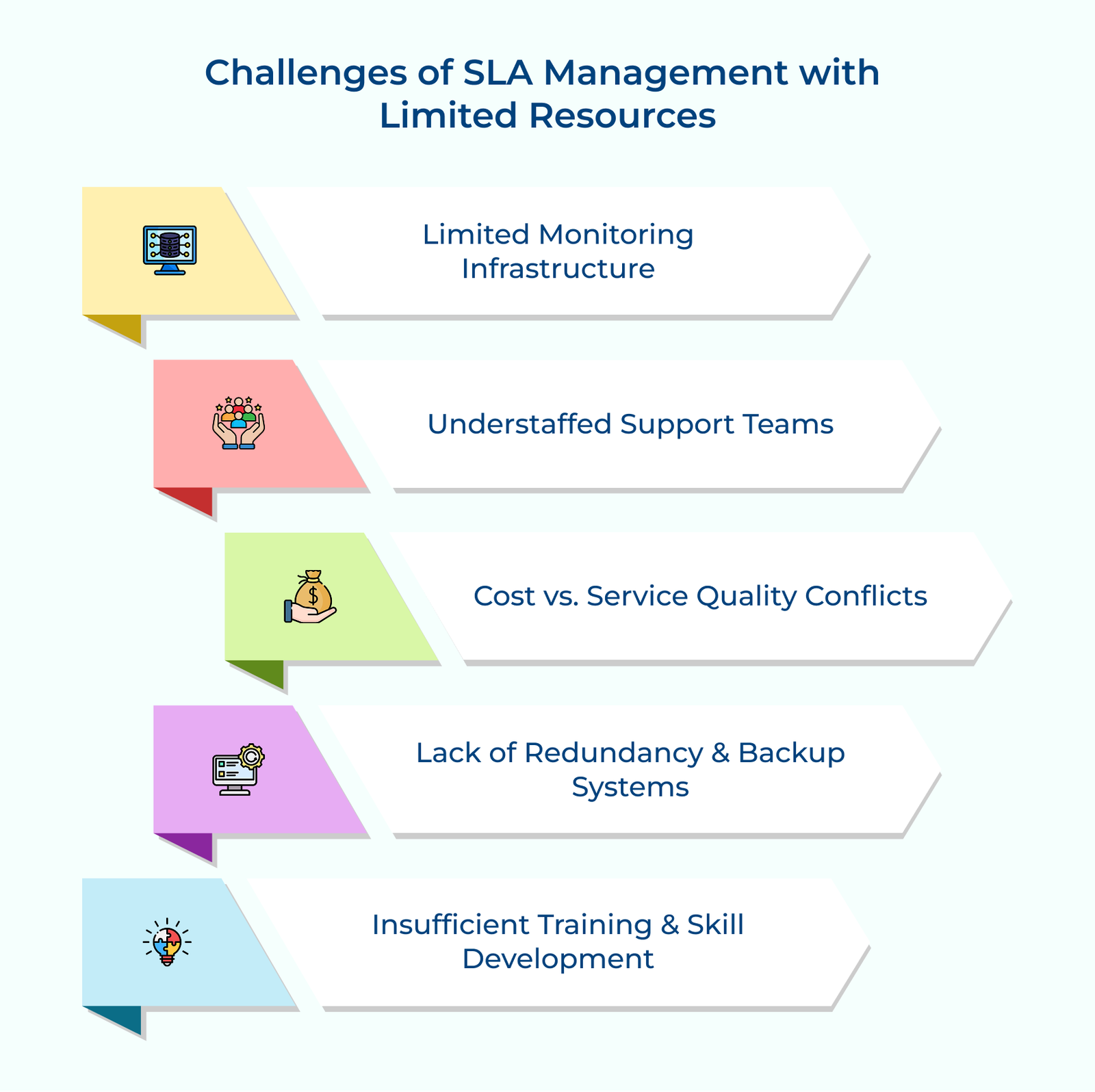
1. Inadequate Monitoring Infrastructure Investment
When budgets are tight, monitoring is often the first to get shortchanged. Basic tools might catch major issues, but they miss the early warning signs. Without full visibility into system performance and customer impact, teams can’t act until things are already broken. It means more scrambling, more missed SLAs and more unhappy customers.
2. Understaffed Support Teams Creating Bottlenecks
Small teams stretched across multiple roles often carry service level agreement responsibilities on top of everything else. It’s risky. If one key person is out sick, on leave or just overloaded, critical tasks can stall. A single absence can cause a chain reaction of missed commitments with no one else trained or available to step in.
3. Competing Priorities Between Cost Control and Service Quality
Trying to cut costs while maintaining high service levels is a balancing act and not always a fair one. When leadership prioritizes savings over reliability, teams are left trying to meet high expectations without the tools or staff they need. The tension causes confusion, burnout and inconsistent service.
4. Lack of Redundancy and Backup Systems
Redundancy sounds like a luxury when money’s tight, but without it, everything rides on systems that must not fail. When they do and they will eventually, there’s nothing in place to take over. Recovery becomes slow, expensive and damaging. One outage without a backup can undo months of good service.
5. Insufficient Training and Skill Development Programs
When budgets are cut, training usually goes first. Teams are stuck trying to manage complex SLAs and technical tools they haven’t been properly taught to use. Mistakes become more common, not because people aren’t trying, but because they haven’t been given the chance to learn.
Implementation steps:
Below are the real-world examples that demonstrate how major companies implement service-based SLA management strategies:
1. Amazon Web Services (AWS) Cloud Infrastructure
AWS handles SLAs by offering tiered uptime guarantees from 99.5% to 99.99% depending on the service. If they miss the mark, customers automatically get service credits. Performance is tracked and made public through real-time dashboards, giving users full visibility.
The clarity and accountability have helped AWS build deep customer trust. Clients know what to expect and they know AWS will take responsibility when things go wrong. It’s one reason AWS can charge a premium and still maintain loyalty.
2. Zappos Customer Service Excellence
Zappos commits to clear response times and generous return policies without hiding behind rigid rules. Their customer service reps are trained to solve problems on the first call, with the freedom to prioritize doing the right thing over following a script.
The practical approach turned customer service into a core business strength. Happy customers stuck around and told others, helping Zappos grow fast without spending heavily on ads.
3. Apple Retail Store Service Standards
Apple’s Genius Bar sets clear timelines for repairs or device support and every location follows the same standards. Staff are trained using uniform programs to keep service quality consistent, whether you’re in New York or Tokyo.
The reliability makes customers more comfortable with Apple’s high prices. People trust that if something goes wrong, help is easy to get and that trust drives repeat purchases.
4. Airbnb Host and Guest Support
Airbnb sets different response time goals based on the type of issue. Urgent safety or booking problems get fast responses and clear escalation steps. Less urgent questions have longer but defined response windows.
Support is offered in multiple languages, around the clock. The reliable structure has helped users feel safer using the platform, especially during emergencies far from home. It’s a key reason many hesitant users have become repeat travelers.
.
5. Netflix Streaming Service Availability
Netflix ensures smooth streaming by using regional content delivery networks and planning for high-traffic periods. They monitor usage patterns and adjust capacity before problems arise. The behind-the-scenes infrastructure has allowed Netflix to grow rapidly without major service issues. Smooth playback even during peak hours has been central to keeping users subscribed.
When expectations are specific and tracked, teams know what to aim for and customers know what they can rely on. You keep service quality on track with the right systems in place, monitoring, realistic targets and open communication.
Real success comes from finding the right balance. You can set high standards, but they have to match your resources. That’s where planning and honest collaboration with stakeholders come in. Documenting your processes, setting clear escalation paths and reviewing performance regularly means you’re not starting from scratch every time something goes wrong. Instead, you’re building a system that learns, adapts and improves.

SLA management improves satisfaction by setting clear expectations and following through. When customers know what kind of support they’ll get and see that you consistently deliver on it, they’re more likely to trust you. Resolving issues on time and keeping them informed builds confidence.
Businesses need to track performance against agreed targets and keep detailed records. Automated monitoring tools help spot issues early and keep everything documented, from incidents to resolution steps. It not only proves you’re meeting your commitments but also helps catch problems before they grow into bigger compliance risks.
SLA management keeps service agreements relevant. Instead of a one-time contract that gets ignored, a managed SLA adapts as needs change and performance data comes in. It helps both sides stay aligned, know what’s expected and have clear steps to follow if something goes wrong. It strengthens the partnership and keeps things running smoothly.
Automation helps by handling the routine work. Monitoring tools track performance in real time, send alerts when you’re close to breaching an SLA and generate reports automatically. It cuts down on manual effort, reduces mistakes and lets your team focus on fixing issues instead of chasing data.
Communication is what keeps SLA management working. Everyone involved, internal teams and customers, needs to know what’s expected, what’s happening or what to do when things go off track. Regular updates, clear escalation paths and honest reporting help prevent confusion, especially when problems need quick coordination.
Grow Customer Relationships and stronger team collaboration with our range of products across the Conversational Engagement Suite.
Omnichannel Customer Support & Help Desk Software
AI Enabled Business Messaging and Chatbot Software
Sales Engagement & CRM Software
Call Center Software & Virtual Phone System
Product Marketing & Experience Platform
Customer Experience & Feedback Management Software

 What is Customer Perceived Value (CPV)? The Ultimate Guide
Scroll to top
What is Customer Perceived Value (CPV)? The Ultimate Guide
Scroll to top