Sales Pipeline What is Sales Pipeline

What is Sales Pipeline? Key Elements, Stages & Examples

Discover what is the sales pipeline, its key elements, stages and examples. Learn how a well-structured sales pipeline can help manage leads, track progress and increase conversions for better sales outcomes.

No credit card required. Easy setup

Sales Pipeline What is Sales Pipeline

Trusted by Leading Brands

Build, Track & Close Deals Faster with a Powerful Sales Pipeline

Supercharge your sales process! Learn how to build, track, and close deals faster with a powerful sales pipeline that drives revenue growth.

Visual Stages

Easily track and manage deals with a clear, visual representation of each sales stage. The visual format helps quickly assess deal status, spot bottlenecks and keep the sales process moving smoothly toward closure.

Progress Tracking

Monitor deal progression with ease, allowing for a streamlined and efficient sales process. Identify how deals are advancing through each pipeline stage, ensuring no opportunity is overlooked.

Forecasting Accuracy

Refine sales forecasts by leveraging historical data and analyzing current pipeline trends. Now predict future sales with greater confidence and make informed decisions to align resources effectively.

Prioritization

Evaluate the potential and status of every deal to prioritize high-value opportunities. Make sure no time is wasted on low-value leads and improve overall sales performance.

Actionable Insights

Gain actionable insights into your sales team’s performance and effectiveness by analyzing detailed pipeline data. Keep the sales strategies always aligned with business goals.

Improved Organization

Keep every deal, task and follow-up organized within the sales pipeline. Keep the sales teams on top of every aspect of the sales process, ensuring long-term success.

Sales teams often find themselves overwhelmed, juggling multiple prospects at different stages without a clear strategy in place. Without a structured approach, sales efforts become inefficient. Opportunities slip through the cracks, revenue forecasts become unreliable and team performance suffers.

The B2B sales pipeline has emerged as a game-changing tool for streamlining the sales process. Businesses can transform their chaotic sales efforts into a systematic approach by building a well-defined sales funnel. Let us take a detailed look at the topic to understand how businesses can visualize their entire sales process and identify areas for improvement.

What is a Sales Pipeline?

A sales pipeline refers to a visual representation of the sales process that illustrates the journey of potential customers from initial contact to final sale. It outlines the various stages a prospect goes through before becoming a customer. The pipeline metaphor reflects how leads flow through the entire sales process.

The sales funnel typically works by breaking down the sales process into distinct stages, such as lead generation, qualification, proposal, negotiation and closing. As leads enter the pipeline, they are moved through the stages based on their level of engagement.

Key objectives:

  • Streamline the sales process for increased efficiency and consistency.
  • Provide visibility into the sales funnel to identify areas for improvement.
  • Facilitate accurate sales forecasting and resource allocation.
  • Enable better lead nurturing and relationship management.
  • Measure and optimize conversion rates at each stage of the sales process.

Importance of Sales Pipeline

Let’s explore the sales pipeline importance to understand how it helps track deals, improve forecasting, prioritize opportunities and streamline the sales process for better conversions.

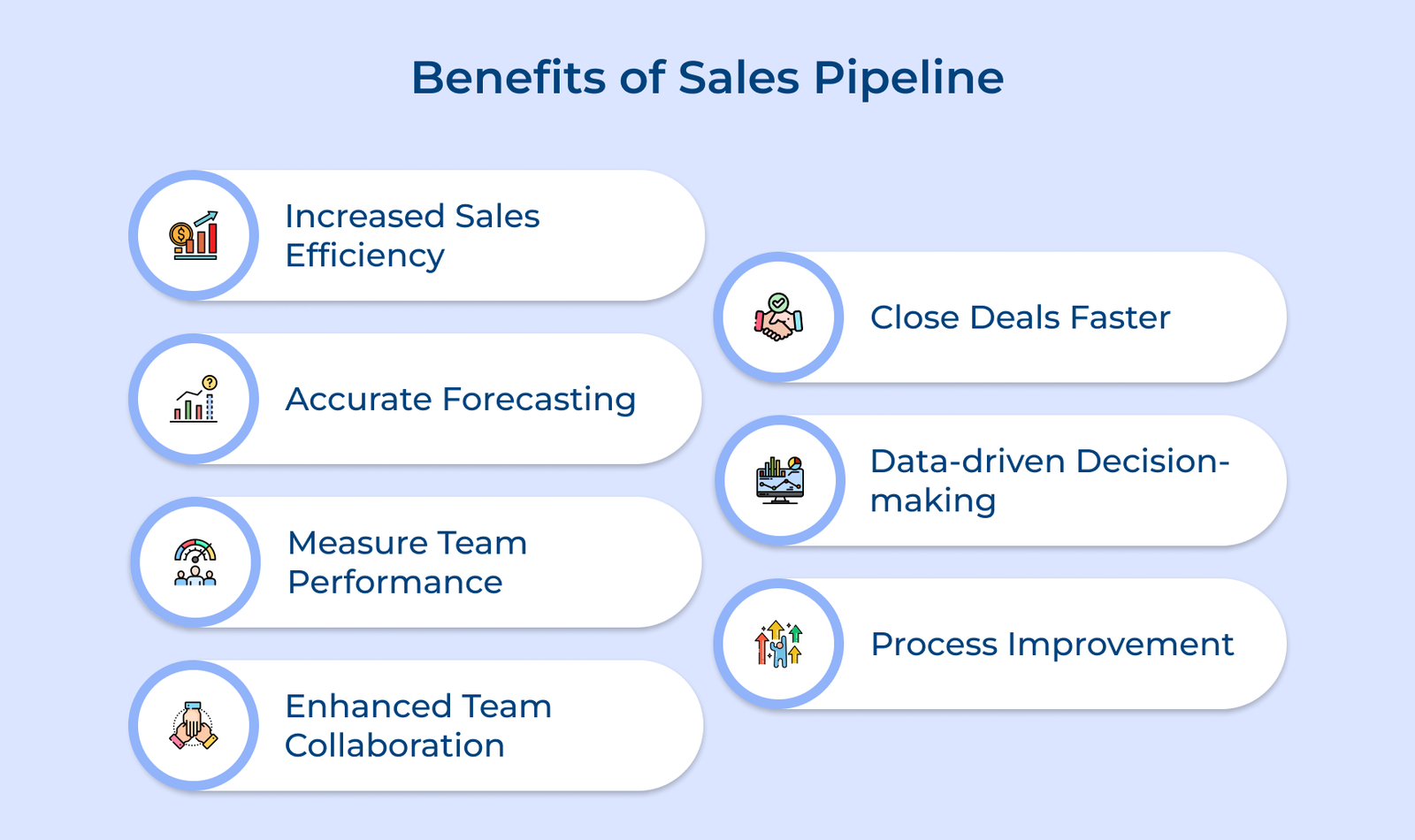
Benefits of Sales Pipeline

1. Increased Sales Efficiency
A sales pipeline provides a clear, structured approach to the sales process. Sales teams can prioritize their efforts more effectively by organizing leads and opportunities into distinct stages. The visual nature of the pipeline helps identify which deals need immediate attention. It reduces wasted effort on low-potential leads and increases sales efficiency.

2. Accurate Forecasting
One of the most significant advantages of a sales funnel is its ability to improve sales forecasting accuracy. Managers can make more informed predictions about future sales by tracking the progress of deals through various stages. The visibility into the pipeline allows for better resource allocation, inventory management and financial planning.

3. Measure Team Performance
A sales pipeline provides valuable metrics for evaluating individual and team performance. Managers can track key performance indicators (KPIs) such as conversion rates, average deal size and time spent in each pipeline stage. The data enables leaders to identify top performers, pinpoint areas for improvement and provide targeted support.

4. Enhanced Team Collaboration
The sales funnel enhances better collaboration among team members and across departments. Team members can easily share information, update statuses and coordinate their efforts with a centralized view of all ongoing deals. Transparency promotes a more cohesive approach to sales by ensuring that everyone is working towards the same goals.

5. Close Deals Faster
Pipelines help representatives move deals through stages more efficiently by providing a clear roadmap of the sales process. Sales teams can address potential roadblocks early, reducing delays and improving deal velocity. The structured approach also ensures that no crucial steps are missed.

6. Data-driven Decision-making
Sales pipelines generate a wealth of data that can inform strategic decision-making. Businesses can gain insights into which sales strategies are most effective, which offerings are in demand and where market opportunities lie by analyzing pipeline metrics.

7. Sales Process Improvement
The systematic nature of a sales cycle makes it easier to identify areas for improvement in the sales process. Businesses can refine their sales strategies over time by analyzing data on deal progression, win rates and common sticking points. Continuous improvement can lead to higher conversion rates, increased customer satisfaction and greater revenue growth.

Key Elements to Consider Before Building a Sales Pipeline

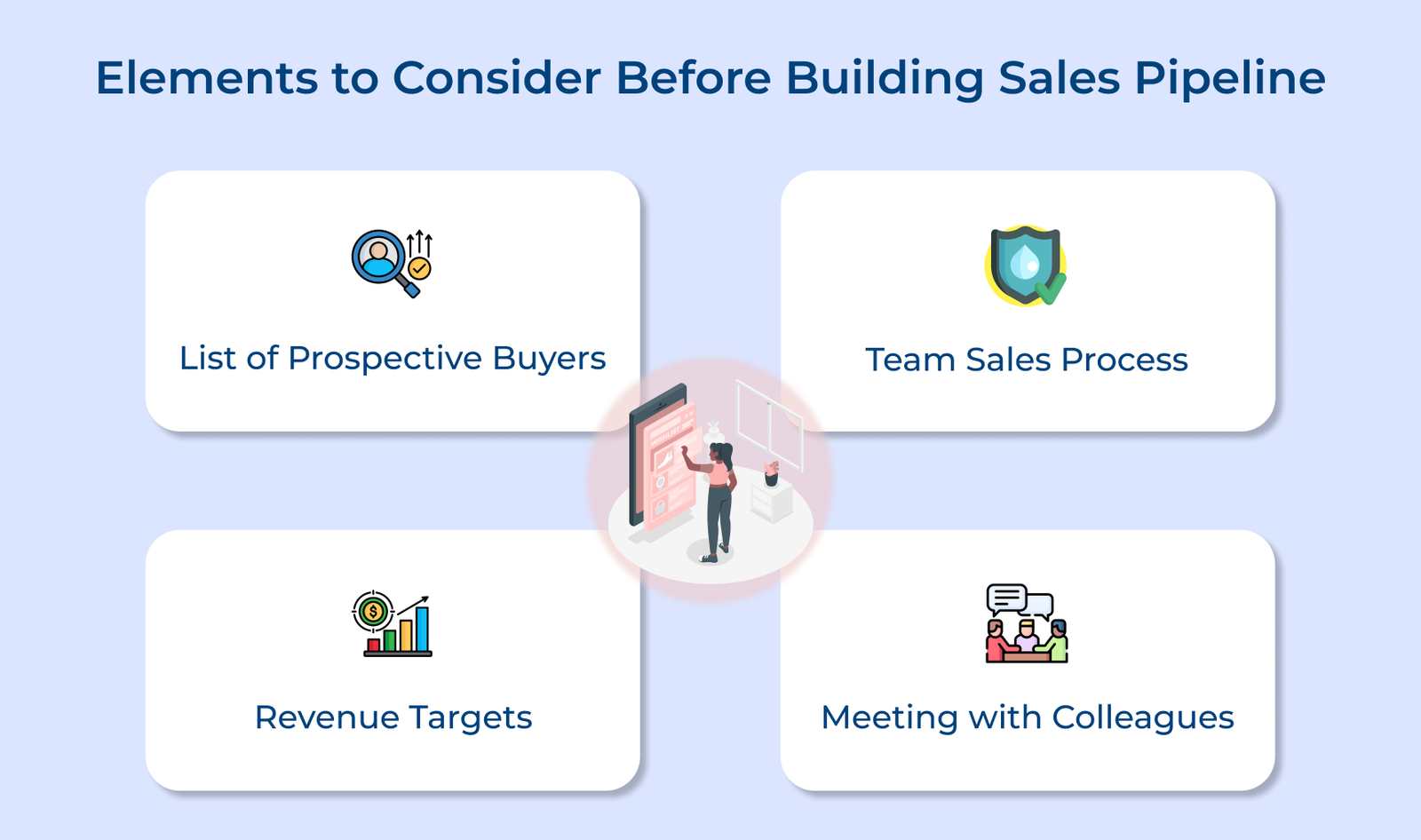
Let’s explore the key elements that businesses should consider before building a sales pipeline:

Elements to Consider Before Building Sales Pipeline

1. A List of the Prospective Buyers

Start by compiling a comprehensive list of potential customers. It should include detailed information about each prospect, such as their industry, location and pain points. Identify decision-makers within the organizations and gather their contact information. The list will form the foundation of the pipeline, providing a clear picture of the target market.

2. The Team’s Sales Process

Clearly define and document the sales process. It should outline each stage a lead goes through from initial contact to closing the deal. Typical stages might include prospecting, qualification, needs assessment, proposal/quote, negotiation and closing. Ensure that each stage has specific criteria for moving a lead forward or disqualifying it.

3. The Revenue Targets

Establish clear, measurable revenue goals for the team. The targets should be realistic and based on historical data, market conditions and the company’s growth objectives. Break down the targets into smaller, manageable goals for each sales representative or team.

4. A Meeting Scheduled with Colleagues

Plan a collaborative meeting with key stakeholders from sales, marketing and customer success teams. The meeting is essential for aligning everyone’s understanding of the sales process, defining roles and gathering insights that can inform the pipeline structure.

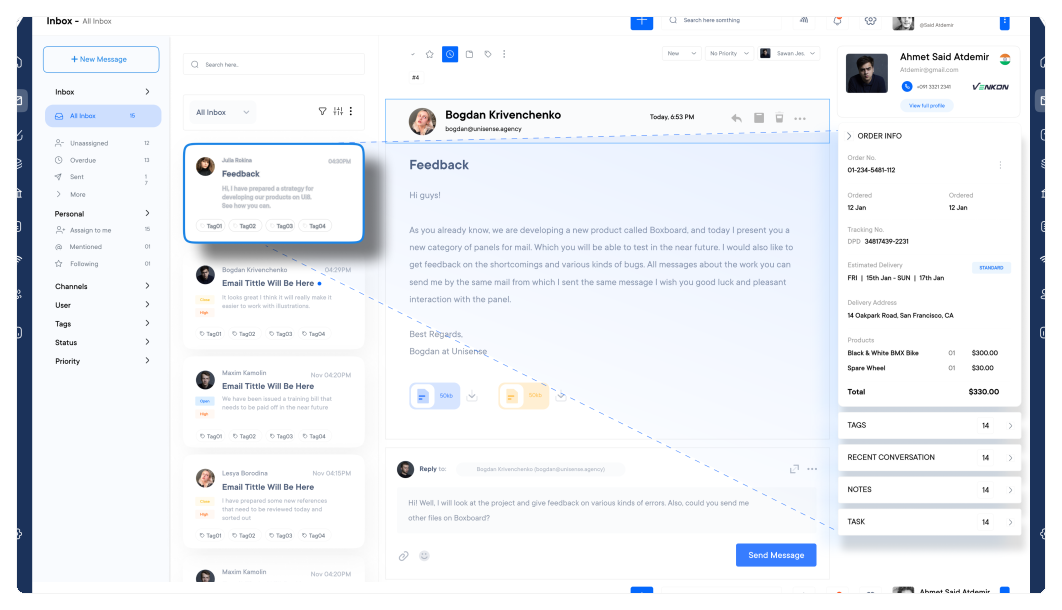
Omnichannel Helpdesk and Ticketing System

Turn Every Support Issues into Personalized Conversations with Veemo’s Omnichannel Helpdesk and Ticketing System. Make customer happiness your top priority with a digital first customer experience (CX) approach

Radically new solutions for data

Sed ut perspiciatis unde omnis iste natus error sit voluptatem accusantium doloremque laudantium, totam rem aperiam, eaque ipsa quae ab illo inventore veritatis et quasi architecto beatae vitae dicta sunt explicabo.

Radically new solutions for data

Sed ut perspiciatis unde omnis iste natus error sit voluptatem accusantium doloremque laudantium, totam rem aperiam, eaque ipsa quae ab illo inventore veritatis et quasi architecto beatae vitae dicta sunt explicabo.

What are the Stages of the Sales Pipeline?

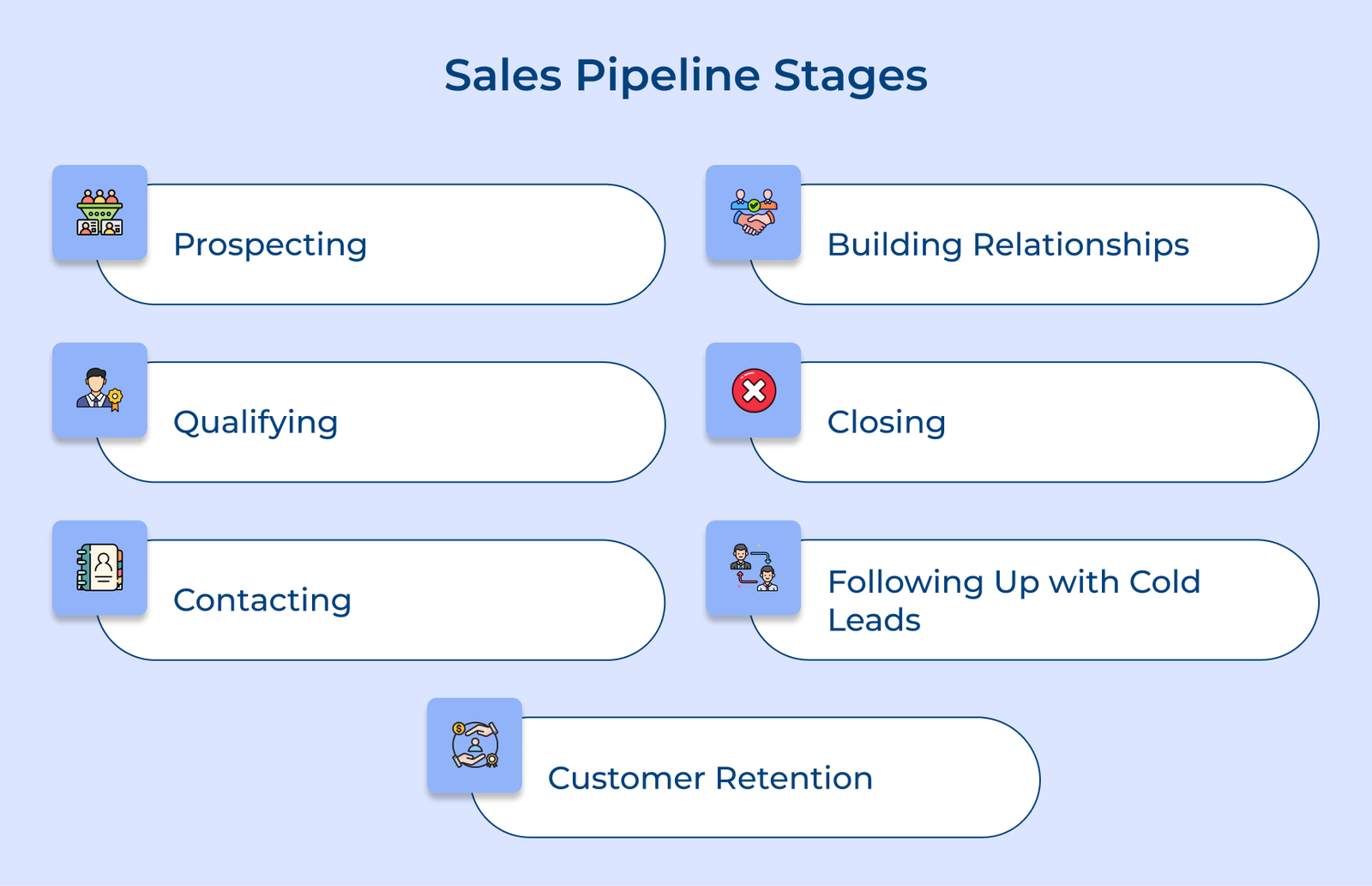
Let us take a look at the key stages of the sales pipeline and how they contribute to building a streamlined sales strategy that maximizes conversions.

Sales Pipeline Stages

1. Prospecting

Prospecting is the initial stage where the business identifies potential customers who might be interested in the product or service. It involves researching the target market, generating leads through various channels and creating a list of prospects to pursue.

Let’s assume that a software company selling project management tools might use LinkedIn to identify companies in the tech industry that are growing rapidly. They create a list of the companies and their key decision-makers as potential prospects.

2. Qualifying

Once the business identifies potential leads, the next step is to qualify them. The stage involves assessing whether a prospect has a genuine need for the offering, the budget to afford it and the authority to make purchasing decisions.

Qualification often involves initial conversations or surveys to gather more specific information about the prospect’s needs, challenges and buying timeline. The stage is critical for focusing the efforts on the most promising leads and avoiding wasted time on those unlikely to convert.

3. Contacting

Once prospects are qualified, the business initiates more formal contact to introduce the product or service. It often involves sending personalized emails, making phone calls, or arranging initial meetings.

Let’s consider that the sales rep sends a tailored email to the IT director. It highlights how their project management tool has helped similar companies improve efficiency. They propose a brief demo call to showcase the software’s features.

4. Building Relationships

Once initial contact is made and the prospect shows interest, the focus shifts to building a relationship. Businesses might share relevant content, provide product demonstrations, or offer free trials.

The key is to position the business as a trusted advisor rather than just a salesperson.
Businesses gain a deeper understanding of the prospect’s needs and decision-making process.

5. Closing

The closing stage is where the business aims to convert the prospect into a customer.
It typically involves presenting a formal proposal or quote, negotiating terms and addressing any final concerns.

Make sure the business has the adaptability and creativity necessary to come up with solutions that benefit all sides. The closing stage may involve multiple touchpoints and stakeholders, especially in complex B2B sales.

6. Following Up with Cold Leads

Not all leads will progress smoothly through the pipeline. Some may go cold due to timing issues, budget constraints, or other factors.

The follow-up stage involves periodically reaching out to cold leads to rekindle interest.
It might include sharing new product features, case studies, or industry insights that could reignite their interest. The key is to stay on their radar without being pushy, so when their circumstances change, the solution is top of mind.

7. Customer Retention

The final stage of the pipeline focuses on retaining and growing relationships with existing customers. It involves ensuring customer satisfaction through excellent support, regular check-ins and proactive problem-solving.

Businesses secure repeat business and increase the likelihood of referrals by nurturing the relationships. A virtuous cycle is created that feeds back into the prospecting stage of the pipeline.

How to Build a Sales Pipeline: 7 Steps

Following are the key steps to create a powerful sales pipeline that will boost your sales performance, improve forecasting and streamline the entire process.

How to Build a Sales Pipeline

1. Define the Stages of the Sales Pipeline

Defining the stages is a crucial first step in building an effective sales pipeline.
Begin by analyzing the current sales process, examining how leads typically progress from initial contact to closed deal. The analysis helps identify strengths, weaknesses and areas for improvement in the existing approach. Identify key milestones in the customer journey.

Ensure the defined stages align with the business model. Consider factors like sales cycle length, product complexity and target market characteristics. The stages should reflect the unique aspects of the sales process and accommodate the decision-making patterns of the typical customers.

Pro tips:

  • Involve the sales team in defining stages to gain insights from their front-line experiences.
  • Regularly refine stage definitions based on performance data and changing market conditions.

2. Identify Opportunities that Typically Continue Through Each Stage

Building a sales pipeline is crucial for tracking and managing potential deals through various stages of the sales process. Understanding how many opportunities typically continue through each stage helps businesses forecast revenue and identify bottlenecks. The typical progression of opportunities through pipeline stages often follows a funnel shape, with fewer opportunities advancing to later stages.

Let’s assume that out of 100 initial leads, 50 might qualify for further engagement, 25 may progress to the proposal stage and 10 might close successfully. The information allows sales teams to set realistic targets and optimize their strategies for each stage.

Actionable tips:

  • Use automation to track opportunity progression and gather accurate data.
  • Regularly analyze conversion rates between stages to identify areas for improvement.
  • Establish clear criteria for moving opportunities between stages to ensure consistency.

3. Understand the Commonalities Between Leads that Convert at Each Stage

Understanding commonalities between converting opportunities at each stage is crucial for building an effective sales funnel. The insight allows businesses to optimize their sales process, increase conversion rates and predict outcomes more accurately. Companies can replicate winning strategies and allocate resources more efficiently by identifying patterns in successful deals.

The approach has wide-ranging implications, from improving lead qualification to enhancing closing techniques. Sales teams can focus on high-potential opportunities and address objections proactively. It facilitates better alignment between marketing and sales efforts, ensuring a smoother customer journey.

Pro tips:

  • Regularly analyze data from closed-won deals to identify common characteristics and behaviors.
  • Develop ideal customer profiles for each pipeline stage based on successful conversions.
  • Implement a scoring system that reflects these commonalities to prioritize leads effectively.

4. Continuously Add Leads to the Pipeline

Continuously adding leads to the pipeline is crucial for maintaining a robust sales process. Diversify the approach by utilizing content marketing, social media outreach and targeted advertising to implement effective lead generation strategies. Leverage multiple channels for prospecting to cast a wider reach of potential customers where they are most active.

Establish a consistent lead qualification process to ensure the business focuses on high-quality prospects. Use criteria such as budget, authority, need and timeline (BANT) to evaluate leads efficiently.

Pro tips:

  • Set specific, measurable goals for lead generation and track progress regularly.
  • Personalize outreach efforts based on prospect data and preferences to increase engagement.

5. Maintain the Health of the Pipeline

Building a healthy sales pipeline is crucial for consistent revenue growth. Regularly updating lead status and information ensures the business has accurate data to make decisions. It includes tracking interactions, qualifying leads and adjusting priorities as needed.

Addressing stagnant opportunities promptly is essential to maintain pipeline momentum. Identify leads that haven’t progressed – whether that’s re-engaging the prospect, adjusting the approach, or disqualifying the lead to focus on more promising opportunities.

Pro tips:

  • Set up weekly pipeline review meetings to assess progress and strategize.
  • Develop a lead scoring system to prioritize high-potential opportunities.

6. Periodically Review and Clean the Pipeline

Regularly reviewing and cleaning the sales pipeline is crucial for maintaining its effectiveness. During the reviews, focus on removing or reassessing inactive leads that haven’t progressed in a specified timeframe.

The review prevents clutter and allows the business to concentrate on high-potential opportunities. Update opportunity values and close dates to ensure accurate forecasting.

How to implement:

  • Automation: Set up automatic reminders for pipeline reviews and flag leads that have been inactive for a predetermined period.
  • Establish clear criteria: Define specific benchmarks for lead activity and progression to guide the decision-making process during reviews.
  • Involve the team: Conduct collaborative pipeline reviews with the sales team to gain diverse perspectives and insights on lead potential.

7. Define the Sales Pipeline Metrics

Defining and tracking key metrics is crucial to build an effective sales pipeline. Start by identifying relevant KPIs such as lead conversion rate and sales cycle length. Establish clear benchmarks and goals for each KPI based on industry standards. It provides targets for the team to strive towards and helps identify areas for improvement.

Pro tips:

  • Regularly analyze the metrics, holding weekly or monthly meetings to discuss trends and adjust strategies.
  • Provide training to the sales team on the importance of accurate data entry and how to use the tracking systems effectively.
  • Use visualization tools like dashboards to make metrics easily digestible, allowing for quick identification of bottlenecks and opportunities in the sales funnel.

How to Measure the Quality of a Sales Pipeline?

Below are the most important factors to consider when evaluating the quality of a sales pipeline and how these insights can improve overall sales performance. Effective sales management relies on accurate pipeline quality assessment.

How to Measure the Quality of a Sales Pipeline

1. Number of Deals in the Pipeline
The metric provides an overview of the pipeline’s health and potential revenue. A robust pipeline should have a consistent flow of deals at various stages. Monitor the number over time to identify trends and ensure the business is maintaining a healthy volume of opportunities. If the number drops your sales pipeline report may indicate issues with lead generation.

2. Conversion Rate
The conversion rate measures the percentage of leads that progress through each stage of the sales pipeline. Track conversion rates between stages to identify bottlenecks or drop-off points. Let’s consider that if a business has a low conversion rate from qualified leads to proposals, it may need to improve its value proposition or sales presentation skills. A high conversion rate indicates an efficient sales process.

3. Average Deal Size
The metric helps businesses understand the typical value of deals in the pipeline. It’s calculated by dividing the total value of all deals by the number of deals. Tracking the metric over time can reveal shifts in the target market or the effectiveness of the upselling strategies. An increasing average deal size indicates improved sales techniques or a shift towards higher-value customers.

4. Average Win Rate
Average Win Rate is the percentage of deals that result in a sale. A high win rate suggests effective qualifying and closing strategies. A low rate may indicate issues with lead quality, sales skills, or product-market fit. Compare win rates across different sales reps, products, or customer segments to identify best practices and areas for improvement.

5. Sales Velocity
The metric combines several factors to measure how quickly deals move through the pipeline. It’s typically calculated as (Number of deals x Average deal size x Win rate) / Average sales cycle length. A higher sales velocity indicates a more efficient sales process. Focus on strategies that can increase deal size and win rate, or reduce the sales cycle length to improve the metric.

Examples of Sales Pipeline

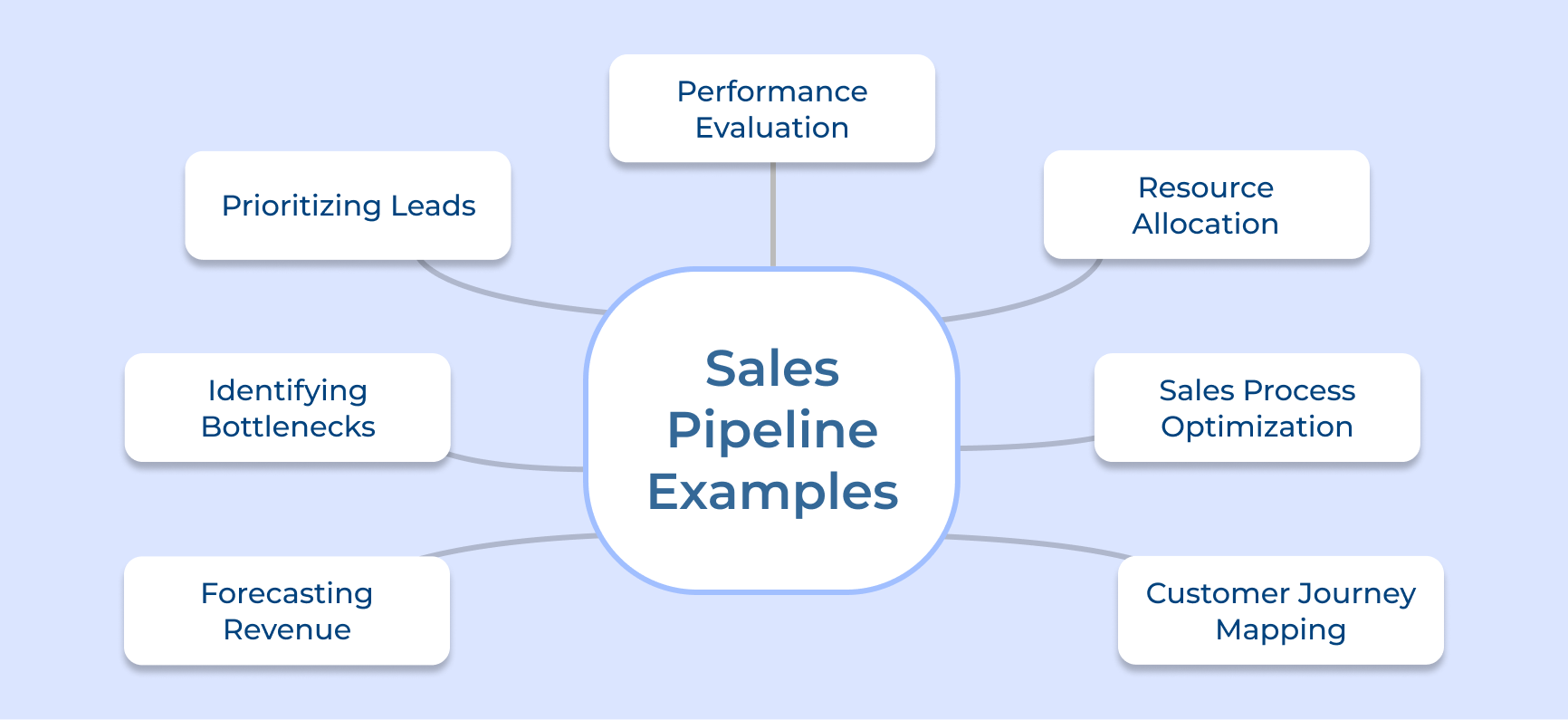
Let’s check out the various sales pipeline examples to showcase how different industries effectively manage their sales efforts for maximum results.

Sales Pipeline Examples

1. Forecasting Revenue

A well-maintained sales pipeline allows businesses to predict future revenue more accurately. Companies can estimate potential income for upcoming periods by analyzing the number of deals, their stages and historical conversion rates. The forecasting ability is crucial for budgeting, resource allocation and strategic planning.

2. Identifying Bottlenecks

The sales funnel helps pinpoint where deals are getting stuck or falling through.
Managers can quickly identify bottlenecks in the sales process by visualizing the flow of opportunities through various stages. The insight enables targeted interventions, such as additional training for sales reps or refining specific stages of the sales approach.

3. Prioritizing Leads

A sales pipeline helps in prioritizing leads based on their potential value and likelihood to close. Sales teams can focus their efforts on the most promising prospects by categorizing leads at different stages and assigning values to each opportunity. The targeted approach improves efficiency and increases the chances of closing high-value deals.

4. Performance Evaluation

The sales cycle provides a clear framework for evaluating individual and team performance. Managers can assess metrics such as conversion rates, deal velocity and win rates for each sales representative. The data-driven approach enables fair performance evaluations and helps in identifying areas where others may need support or training.

5. Resource Allocation

Understanding the distribution of deals across the pipeline stages helps in allocating resources effectively. Let’s assume that if there’s a surge of opportunities in the proposal stage, additional support might be needed to handle the increased workload. Similarly, if early stages are lacking, more resources could be directed towards lead generation.

6. Sales Process Optimization

Businesses can identify patterns and trends that inform process improvements by analyzing pipeline data over time. Let’s consider that if data shows that deals consistently stall at a particular stage, it might indicate a need to refine the approach at that point. The continuous optimization leads to a more efficient and effective sales process.

7. Customer Journey Mapping

Sales pipelines aren’t just tools for sales teams; they also provide valuable insights into the customer journey. Businesses can better understand their customers’ decision-making processes and motivations by tracking how prospects move through the pipeline. The information can be used to refine marketing strategies, improve product offerings and enhance the customer experience.

Best Practices for Sales Pipeline Management

Explore the essential best practices to streamline your pipeline, improve deal tracking and boost overall sales performance. Effective sales operation strategies are crucial for maintaining a healthy pipeline.

Sales Pipeline Management Best Practices

Feed the Pipeline Regularly
A consistent flow of new leads is essential for a thriving sales pipeline. Implement ongoing lead-generation strategies such as content marketing and referral programs. Regularly collaborate with the marketing team to ensure a steady stream of qualified leads. Don’t wait until the pipeline is depleted to start prospecting; make it a continuous process.

Always Follow Up
Persistence is key in sales. Develop a systematic follow-up process for each stage of the pipeline. Use a mix of communication channels like email, phone calls and social media. Personalize the follow-ups based on the prospect’s needs and previous interactions. Remember, it often takes multiple touchpoints before a deal closes, so don’t give up too quickly.

Take Dead Deals off the Radar
A cluttered pipeline can distract the business from viable opportunities. Regularly clean the pipeline by removing or archiving deals that have gone cold. Establish clear criteria for when to consider a deal “dead,” such as no response after a certain number of follow-ups or an explicit rejection.

Make Pipeline Reviews a Priority
Schedule regular sales pipeline review meetings with the team. The reviews should analyze the overall health of the pipeline and strategize on moving stalled opportunities forward. Use the sessions to share best practices, address challenges and ensure everyone is aligned on priorities.

How to Choose the Best Sales Pipeline Management CRM

Following are some effective steps for businesses to ensure they select the best cloud CRM for sales pipeline management to enhance their sales pipeline and drive business growth. A cloud CRM offers flexibility and accessibility, crucial for modern sales teams.

How to Choose Sales Pipeline Management CRM

1. User-friendly Interface
The tool should have an intuitive, easy-to-navigate interface. The sales team will be using the tool daily, so it mustn’t have a steep learning curve. Look for platforms with customizable dashboards, drag-and-drop functionality and clear visual representations of the pipeline. The easier it is to use, the more likely the team will adopt it consistently.

2. Customization Options
Every business has unique sales processes and requirements. Choose a tool that allows businesses to customize pipeline stages and workflows to match their specific needs. The ability to create custom reports and dashboards is also valuable for tracking the metrics that matter most to the organization.

3. Mobile Accessibility
Mobile access is crucial. The sales team should be able to update deals, access customer information and view pipeline status on the go. Look for tools with robust mobile apps or responsive web interfaces that work well on various devices.

4. Reporting and Analytics Features
Advanced reporting and analytics capabilities are essential for making data-driven decisions. The tool should offer real-time insights into pipeline health, sales forecasts and team performance. Look for features like customizable reports, data visualization options and predictive analytics to help businesses identify trends.

5. Scalability and Support
Consider the company’s growth plans when choosing a tool. Ensure that the platform can scale with the business and deals without compromising performance. Good customer support can significantly impact the team’s success with the tool.

4 Sales Pipeline Tools

Following are the top sales pipeline tools that can help you stay organized, close deals faster and improve overall efficiency.

1. Veemo Sales

Veemo Sales delivers a comprehensive customer relationship management solution designed for sales teams seeking robust pipeline management capabilities. The cloud-based platform combines intuitive interface design with powerful automation features, creating an environment where sales professionals can focus on relationship-building rather than administrative tasks. Veemo Sales particularly excels at serving small to medium-sized businesses seeking enterprise-level functionality without the associated complexity.

The platform’s architecture emphasizes flexibility and customization, allowing organizations to adapt the CRM to their specific sales processes rather than forcing standardized workflows. Veemo sale centers on creating a unified workspace where contact management, communication tools and pipeline visualization coexist seamlessly.

Key features:

  • Visual Pipeline Management: Salesmate provides customizable, drag-and-drop pipeline views that allow teams to track deals through multiple stages.
  • Smart Contact Management: The platform automatically enriches contact records with social media profiles, company information and interaction history. It creates a comprehensive customer views that help sales representatives personalize their approach to each prospect.
  • Built-in Communication Suite: Salesmate integrates email, text messaging and meeting scheduling directly within the CRM. The sales teams can engage with prospects through their preferred channels without leaving the platform.
  • Automation Workflows: Users can create sophisticated automation rules that trigger actions based on deal movement, contact behavior, or time-based conditions.
  • Advanced Analytics and Reporting: The platform offers customizable dashboards and reports that provide actionable insights into pipeline health, team performance and revenue forecasting.

2. Zoho CRM

Zoho CRM offers a comprehensive sales pipeline management solution as part of its broader business software ecosystem. The platform caters to businesses of all sizes with flexible deployment options, including cloud-based and on-premises installations. Zoho’s approach emphasizes affordability without sacrificing functionality, making enterprise-level sales pipeline features accessible to smaller organizations with limited budgets and technical resources.

3. HubSpot

HubSpot Sales Hub functions as part of HubSpot’s integrated CRM ecosystem, making it ideal for businesses seeking alignment between marketing and sales departments. The platform offers tiered pricing models, which makes it accessible for even the growing companies. HubSpot emphasizes user experience with an intuitive interface that minimizes onboarding time and maximizes adoption rates across sales teams of varying technical expertise.

4. Pipedrive

Pipedrive delivers a highly visual, activity-driven sales pipeline management system designed with simplicity in mind. The platform focuses on usability and clean interface design, making it particularly appealing to SMBs seeking straightforward pipeline visualization without complexity. The company’s philosophy centers on removing administrative burdens from sales representatives, allowing them to concentrate on relationship-building activities that drive revenue growth.

Streamline the Sales Process with the Sales Pipeline

Implementing a well-structured sales pipeline is crucial for streamlining and optimizing the sales process. Organizations can effectively track progress and make data-driven decisions to improve conversion rates by utilizing a sales funnel.

A sales pipeline is necessary because it brings transparency and accountability to the sales process. Sales teams can prioritize efforts, forecast revenue more accurately and align their activities with business goals. It facilitates better communication between team members and managers, ensuring everyone is on the same page. A robust sales funnel is not just a luxury—it’s a necessity for staying ahead.

FAQs about the Sales Pipeline

Businesses need tools like CRM software, lead generation tools, email marketing platforms and analytics tools. The tools help businesses track leads, communicate with prospects, automate processes and analyze performance. Having the right tools in place improves efficiency, ensures accurate data management and leads to more effective sales pipelines.

Start by segmenting the leads based on qualification, engagement and priority. Remove any outdated or irrelevant leads and ensure all relevant data is accurate. Regularly update the pipeline to keep it organized and focused on high-quality leads. Streamline the sales process to move leads efficiently through the pipeline.

The sales funnel represents the entire process that a potential customer goes through, from awareness to purchase. The sales pipeline is a focused view of individual deals and their progress through the sales process. The sales funnel is more general and overarching, while the sales pipeline is more specific.

Prioritize leads based on readiness to buy, utilize CRM software for the organization, set clear goals and regularly adjust the strategy as needed. Businesses can improve productivity, increase revenue and drive growth by efficiently managing the sales funnel.

A typical sales pipeline consists of several stages: prospecting, connecting, qualifying, presenting, handling objections, closing and follow-up. Prospecting involves identifying potential customers while connecting involves making initial contact. Qualifying ensures the prospect is a good fit and presenting involves showcasing the product or service. Handling objections addresses any concerns, closing seals the deal and follow-up maintains the relationship.