A. Customer Support Agent Performance Report
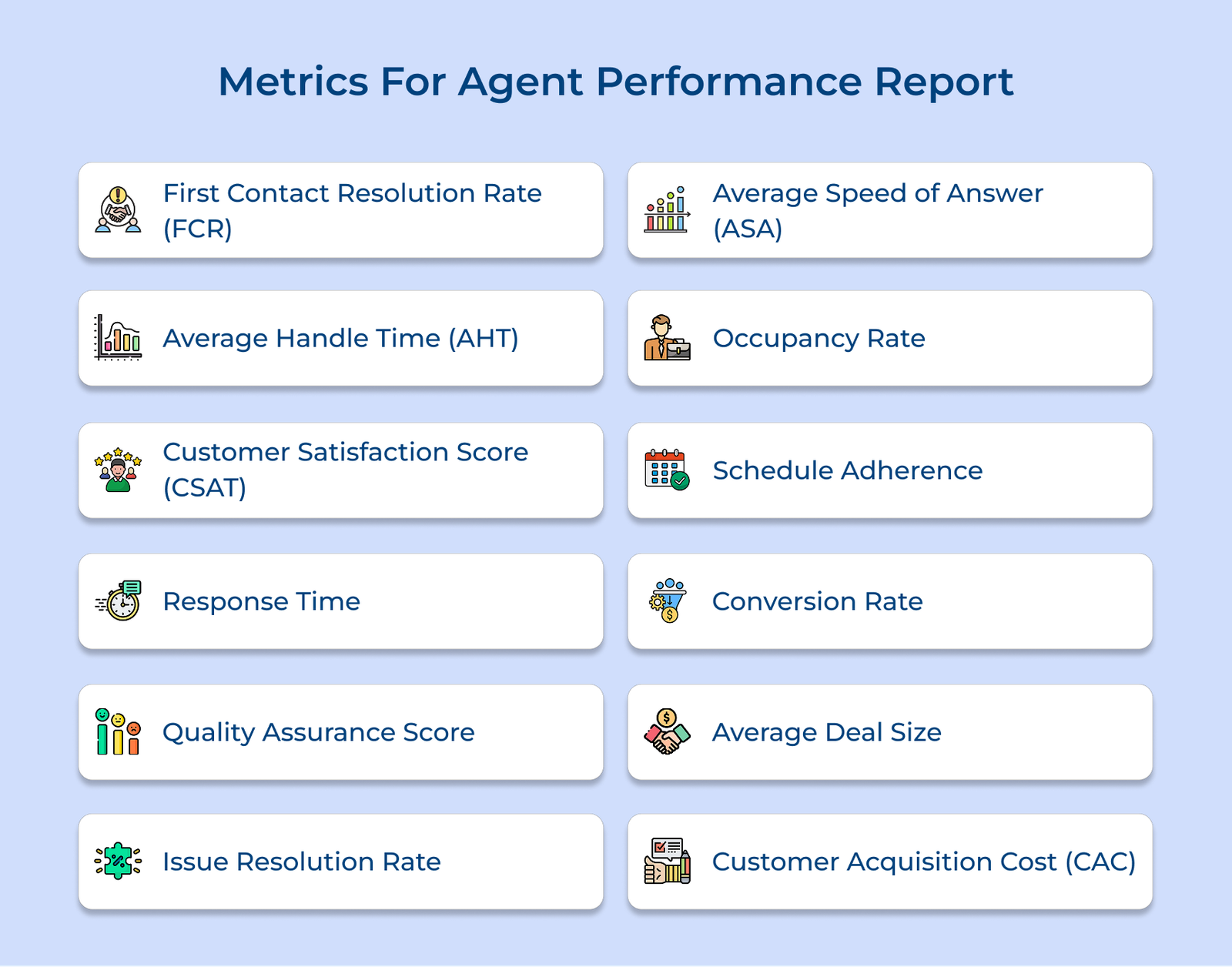
1. First Contact Resolution Rate (FCR)
The first contact resolution rate measures the percentage of customer issues resolved during the first interaction. It’s a reflection of an agent’s ability to understand and solve problems without follow-ups.
A high FCR helps businesses boost customer satisfaction and operational efficiency. It not only showcases agent competency, but also reduces team workload and highlights how well agents understand their product features.
FCR = (Number of issues resolved in first contact / Total number of issues) × 100
A FCR rate between 70-75% is ideal for technical support teams, though it can vary depending on product complexity and support channels.
Actionable tips:
- Develop a comprehensive knowledge base and decision trees to help agents resolve common issues quickly.
- Offer regular training on product updates and advanced troubleshooting to strengthen agent problem-solving skills.
2. Average Handle Time (AHT)
Average handle time measures the total time an agent spends on a customer case. It covers everything from the interaction to hold time and any after-call work or documentation.
AHT is an important metric to get an idea of agent efficiency and resource allocation. Maintaining the balance between speed and quality ensures a great customer experience while optimizing support department operations.
AHT = (Total Talk Time + Total Hold Time + After Call Work Time) / Total Number of Handled Cases
An ideal AHT is between 6-8 minutes for technical support as it gives enough time for thorough issue resolution.
Pro tips:
- Use standardized templates and macros for common responses to cut down documentation time without losing quality.
- Implement smart routing systems to direct cases to agents with the right expertise for quicker resolution.
3. Customer Satisfaction Score (CSAT)
Customer satisfaction measures how satisfied customers are with their support experience. Businesses typically collect it right after the interaction with their users.
CSAT gives you clear insight into the quality of support you provide. It also helps in identifying the agents who excel in customer interactions along with the ones that may need coaching in communication or technical skills.
CSAT = (Number of Satisfied Customers / Total Number of Survey Responses) × 100
Benchmark:
A strong CSAT score is typically above 85% for technical support teams, reflecting consistent high-quality service.
Best practices:
- Encourage agents to practice active listening and empathy to build rapport with customers.
- Regularly monitor quality to give specific feedback on customer interaction skills and technical accuracy.
B. Customer Service Agent Report
4. Response Time
Response time measures how quickly an agent acknowledges and begins addressing a customer inquiry across all communication channels.
Quick response times show respect for the customer’s time, setting a positive tone and preventing frustration before the issue is even addressed. Fast responses also help keep customer service operations running smoothly.
Response Time = Time First Response Sent – Time Inquiry Received
Benchmark:
Best practice is to keep response times under 60 seconds for live channels (chat/phone). While it should be under 4 hours for email to balance customer expectations with operational efficiency.
Key takeaways:
- Use automated acknowledgment messages to reassure customers that their inquiry has been received and provide an estimated response time.
- Implement a priority-based routing system to help agents address time-sensitive inquiries more quickly.
5. Quality Assurance Score
Quality assurance score measures how well agents adhere to company protocols and communication standards during their interactions with customers. It covers various aspects like greetings, problem-solving or closing procedures.
QA scores ensure consistent service delivery, maintaining brand standards and highlighting areas where agents need coaching. Regular monitoring drives continuous improvement in customer service operations.
QA Score = (Points Earned / Total Possible Points) × 100
Benchmark:
A strong QA program typically targets scores of 90% or higher to ensure top-tier customer experience across all touchpoints.
Actionable tips:
- Develop detailed scorecards to help agents understand the key elements of quality service.
- Hold regular calibration sessions where agents can review successful interactions and learn from top performers.
6. Issue Resolution Rate
Issue resolution rate tracks the percentage of customer inquiries successfully resolved by agents, focusing on effectiveness rather than just speed.
The metric directly impacts customer satisfaction as businesses can know if their agents have the right tools, knowledge and authority to resolve issues efficiently.
Resolution Rate = (Number of Resolved Issues / Total Number of Issues Handled) × 100
Benchmark:
Top-performing teams typically maintain a resolution rate above 80%, ensuring most customers get satisfactory solutions.
Pro tips:
- Create comprehensive solution guides to help agents find the best resolutions for common issues.
- Set up clear escalation paths so agents know when and how to involve supervisors for complex issues.
C. Call Center Agent Performance Report
7. Average Speed of Answer (ASA)
Average speed of answer gives the time it takes for an agent to answer an incoming call after it enters the queue. It does exclude the IVR time but including any hold time before connecting to an available agent.
ASA directly impacts customer patience and satisfaction, with faster answer times indicating efficient queue management. The metric helps managers understand if they have enough agents during peak periods and if calls are being distributed effectively.
ASA = Total Wait Time for All Calls / Total Number of Calls Answered
Industry standards suggest an ASA of 20-30 seconds for general customer service calls, balancing customer expectations with operational efficiency.
Best practices:
- Use a real-time dashboard to alert agents of queue buildups, allowing them to adjust wrap-up times.
- Develop flexible scheduling based on historical call volume data to ensure adequate coverage during peak periods.
8. Occupancy Rate
Occupancy rate measures the percentage of time agents spend actively handling calls or call-related tasks. It usually covers the talk time, hold time and after-call work compared to their total available time (excluding breaks or training).
The metric helps managers understand agent workload and productivity. Maintaining a balanced occupancy rate prevents burnout while ensuring the resources are being used efficiently.
Occupancy Rate = (Total Handle Time / Total Available Time) × 100
Benchmark:
A healthy occupancy rate for most call centers is between 75-85%, allowing for effective service while giving agents time to recover between calls.
Pro tips:
- Use automated work state tracking to help agents manage their time between calls.
- Implement structured break schedules aligned with predicted call volumes to maintain consistent coverage.
9. Schedule Adherence
Schedule adherence tracks how closely agents follow their assigned schedules, including start times, breaks and end times. The metric ensures the right number of agents are available when needed, to ensure the operations keep running smoothly.
Maintaining good schedule adherence is essential for service levels and prevents understaffing as it can lead to longer customer wait times. It also helps managers identify patterns that may require schedule adjustments or further training.
Formula:
Schedule Adherence = (Time in Scheduled Activities / Total Scheduled Time) × 100
Benchmark: Call centers typically aim for 90-95% schedule adherence to keep operations running smoothly. The target gives flexibility while ensuring staff availability is enough to meet the demand of customers.
Actionable tips:
- Use workforce management software to send automated reminders for schedule changes or break times.
- Implement a point-based reward system to recognize agents with strong schedule adherence.
Sales Agent Performance Report
10. Conversion Rate
Conversion rate measures the percentage of qualified leads an agent successfully converts into sales. It can be taken as the ability of an agent to guide prospects through the sales funnel.
A high conversion rate showcases an agent’s persuasion skills and product knowledge. The sales managers can identify their top performers and the ones who may need additional training in closing techniques.
Conversion Rate = (Number of Sales / Number of Qualified Leads) × 100
Actionable tips:
- Host role-playing sessions to practice handling common customer objections and crafting effective responses.
- Create personalized scripts from successful sales calls to help agents refine their closing strategies.
11. Average Deal Size
Average deal size calculates the typical revenue generated from sales closed by an agent. It gives insights into their ability to maximize opportunities and negotiate effectively.
The metric gives a picture of an agent’s skill in upselling and cross-selling. Understanding average deal sizes helps managers set realistic revenue goals and identify opportunities to increase sales through strategic bundling.
Average Deal Size = Total Revenue Generated / Number of Deals Closed
Key takeaways:
- Develop product bundling strategies to help agents naturally suggest add-ons during sales conversations.
- Create value proposition templates to assist agents in effectively promoting premium offerings.
12. Customer Acquisition Cost (CAC)
CAC measures the resources an agent spends to acquire new customers. The metric helps businesses assess the efficiency of sales efforts and resource allocation. Understanding CAC allows sales managers to refine processes and ensure profitable customer acquisition strategies.
CAC = Total Sales Costs / Number of New Customers Acquired
Actionable tips:
- Analyze successful sales patterns to pinpoint the most efficient strategies for different customer segments.
- Implement a lead scoring system to help agents prioritize high-potential opportunities.
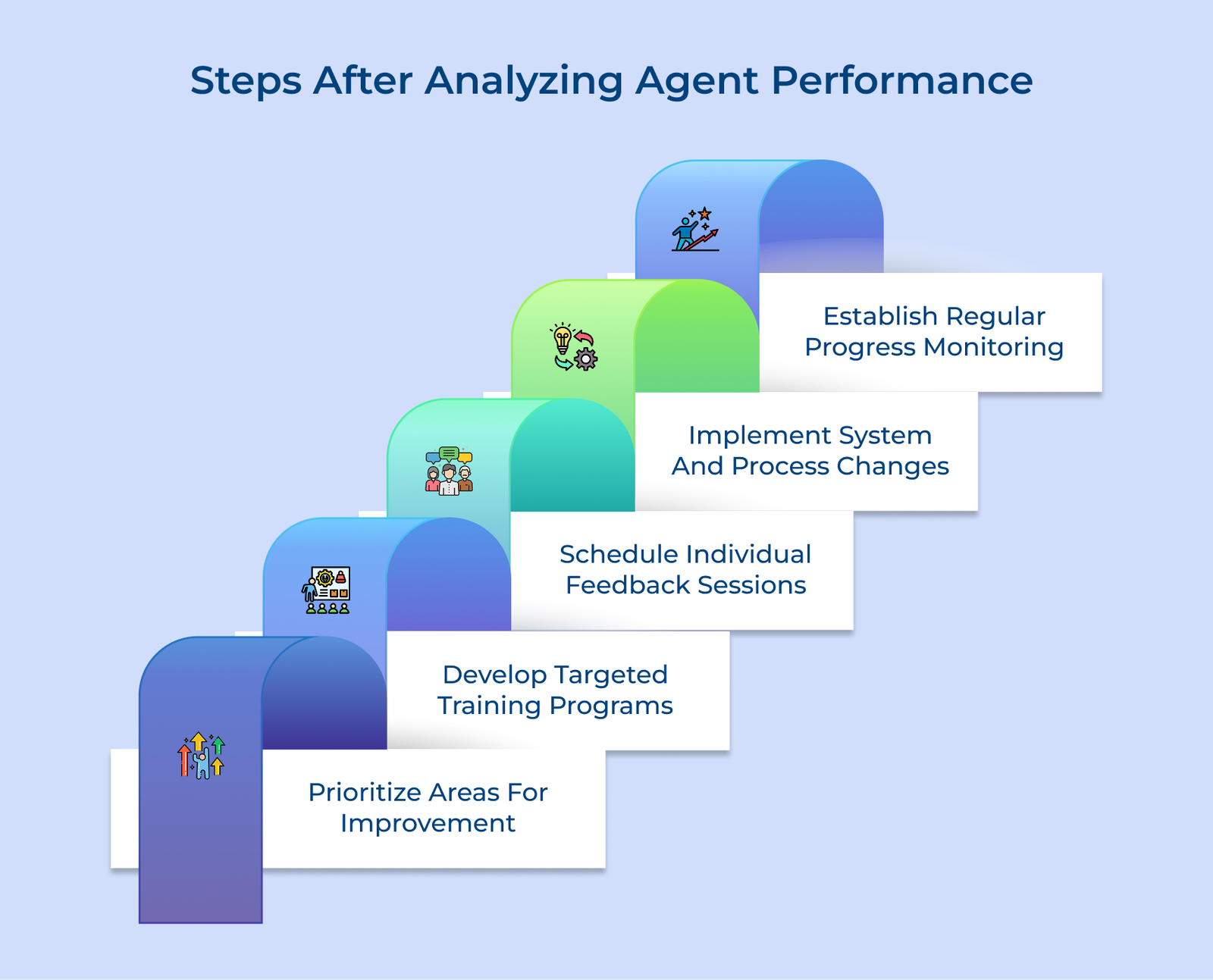
Best Practices Needed After Analyzing An Agent Performance Report
Check out the essential best practices that managers should take after reviewing the reports to drive meaningful improvements in team performance and customer service quality.