How to Create B2B Sales Strategies: 11 Effective Ways
Learn key B2B sales strategies to boost growth, improve customer relationships and drive conversions. Discover actionable tips to enhance your sales approach and achieve lasting success.

Learn key B2B sales strategies to boost growth, improve customer relationships and drive conversions. Discover actionable tips to enhance your sales approach and achieve lasting success.
Many businesses struggle to consistently win new clients even when they offer strong products or services. Sales cycles drag on, conversions stay low and getting through to decision-makers feels harder than ever. As buyer behavior shifts and digital tools change how businesses interact, traditional sales tactics are falling flat. Companies sticking to outdated methods are losing ground to competitors who adapt faster and sell smarter.
Businesses need clear, modern sales strategies built on real-world insights. Using data, building genuine relationships and tapping into the right tools can help the sales teams create a reliable system to close high-value clients. Let’s dive into the B2B sales strategies that can sharpen your approach and improve your results.
B2B sales strategies refer to approaches designed to sell products or services to businesses rather than individual consumers. Unlike B2C, which focuses on emotional appeals and quick transactions. The B2B sales involve longer cycles, multiple decision-makers and high-value deals that require strong, lasting relationships.
The strategy begins by identifying prospective customers whose needs align with your offerings. Sales teams then build relationships through personalized touchpoints, such as presentations, demos and negotiations, while addressing the client’s business challenges.
Key principles:
Let’s go through the key benefits of b2b sales strategies that make the approach particularly valuable for organizations selling to other businesses.
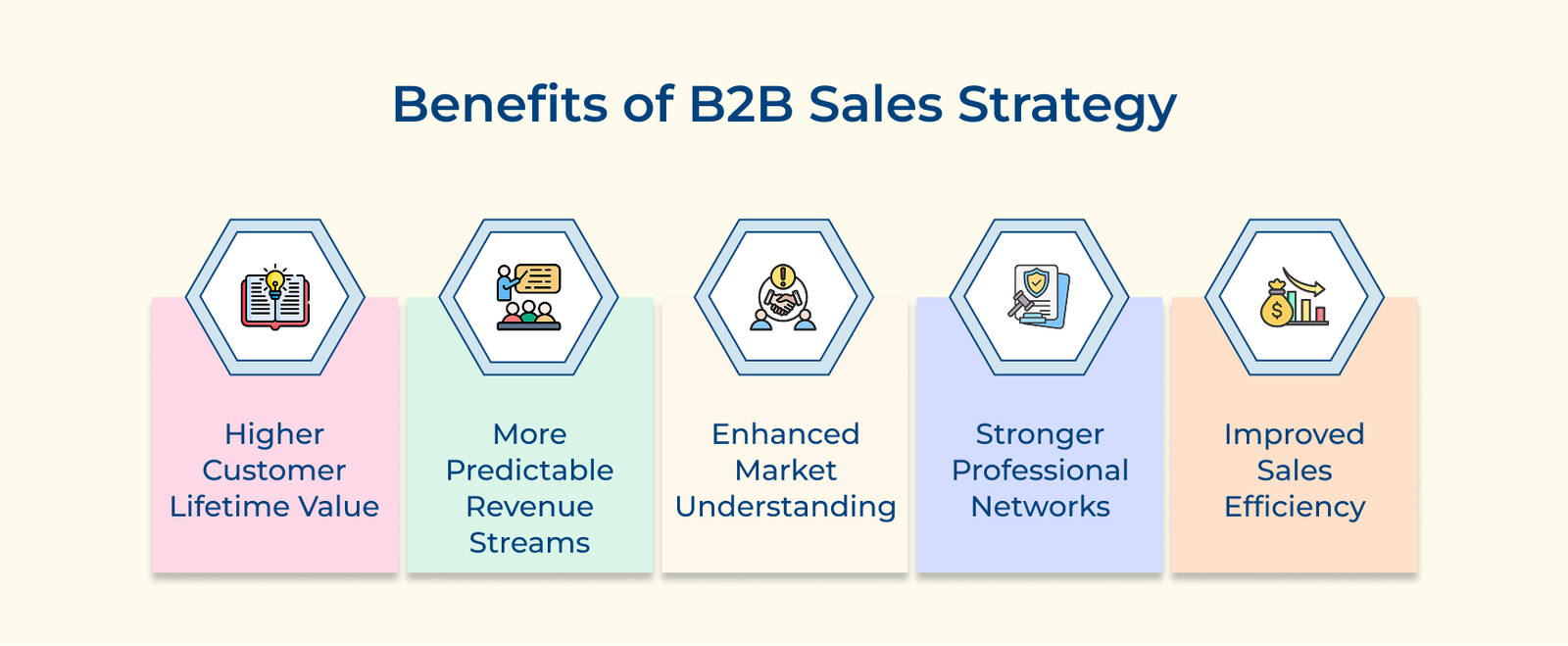
1. Higher Customer Lifetime Value
B2B relationships lead to larger deals and repeat business over time, providing steady revenue through long-term contracts. Satisfied clients often expand their purchases, driving sustainable growth for your business.
2. More Predictable Revenue Streams
B2B sales offer better income forecasting through long-term contracts and service agreements. The predictability helps plan resources efficiently, make informed investment decisions and maintain stable cash flow across business cycles.
3. Enhanced Market Understanding
Frequent interactions with business clients offer valuable insights into industry trends and market demands. Continuous feedback from decision-makers helps shape product development and improve services to better meet your target audience’s needs.
4. Stronger Professional Networks
B2B sales strategies build strong connections within your industry, enhancing relationships with key decision-makers. The networks often lead to referrals and open doors for mutually beneficial strategic partnerships.
5. Improved Sales Efficiency
B2B sales focus resources on high-value prospects, allowing your team to prioritize quality over quantity. The targeted approach boosts conversion rates and maximizes the efficiency of your sales efforts.
Below are eleven successful B2B sales strategies that can help you win more clients and skyrocket your business growth.
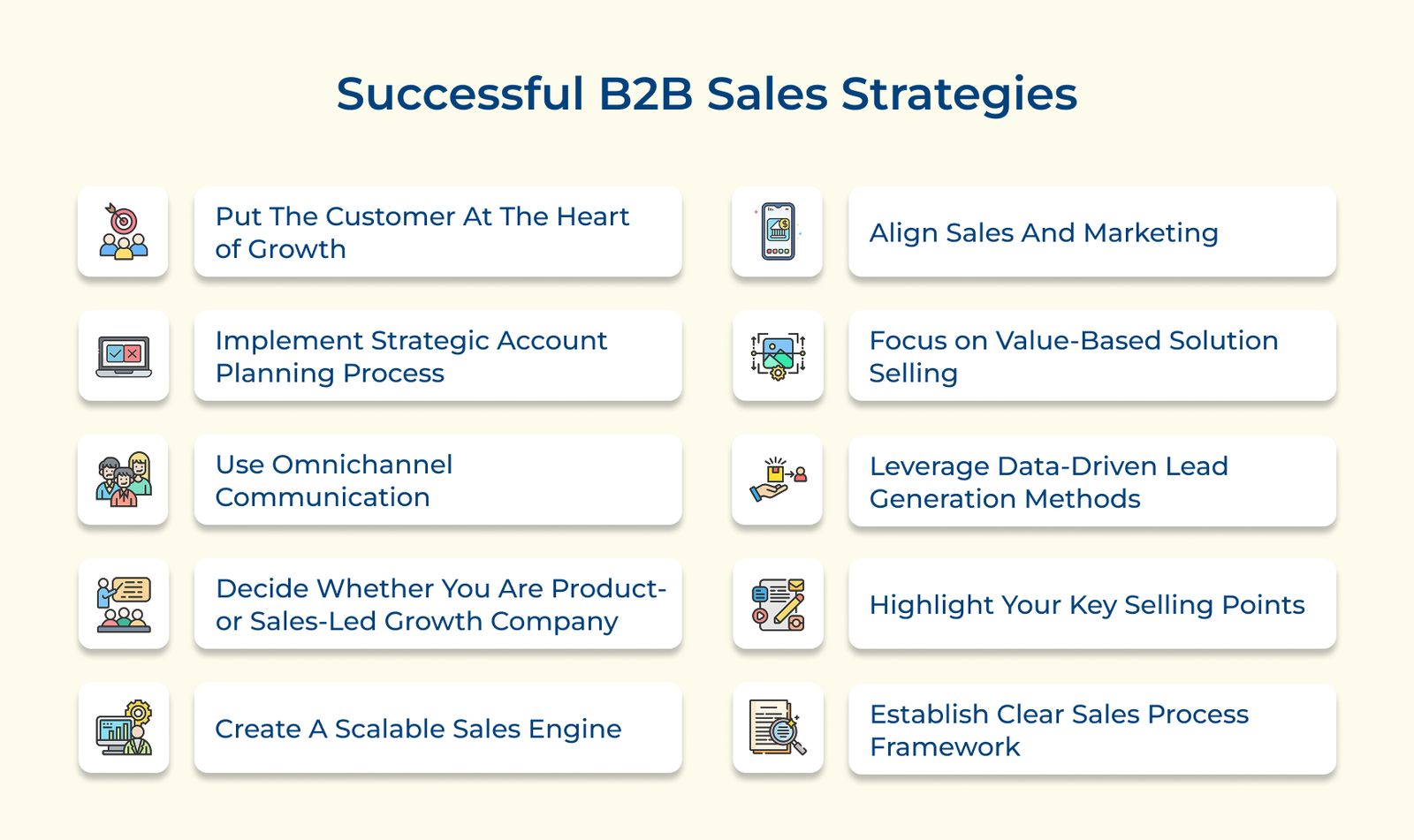
Customer-centric growth puts customer needs and experiences at the core of business decisions. You build lasting relationships that drive sustainable growth through improved satisfaction and retention by aligning solutions with your audience’s pain points.
Creating detailed buyer personas involves crafting comprehensive profiles of your ideal customers, covering their roles, challenges and decision-making patterns. The insight lets you tailor products and marketing messages to address their needs more effectively. Customer journey mapping tracks every customer interaction, from initial awareness to post-purchase support. Regular feedback through surveys, interviews and data analysis ensures continuous improvement, keeping your business aligned with evolving customer needs.
Pro tips:
Strategic account planning is a structured approach to nurturing and growing relationships with your most valuable clients. It ensures strong connections with key decision-makers, identifies expansion opportunities and protects accounts from competitors.
Account profiles go beyond basic company details, incorporating organizational structures and decision-making processes. Setting engagement milestones helps track progress and ensures consistent communication, while the profiles act as dynamic guides for your strategy. Creating relationship maps identifies connections across departments and decision-makers, enabling tailored strategies to expand your influence.
Actionable tips:
Omni-channel communication delivers a seamless, integrated experience across all customer touchpoints. The approach ensures that whether current customers interact through email, phone, social media platforms or in-person meetings they receive consistent information and service quality which builds trust. B2B businesses using omnichannel approaches see an 11% year-over-year revenue growth.
Consistent messaging across channels strengthens your brand and value proposition. You can identify the best channel combinations for different customer segments and refine your strategy for continuous improvement by tracking engagement metrics.
Best practices:
Your growth strategy shapes your go-to-market approach and resource allocation. Understanding, if growth will come from product adoption or sales efforts, helps align your team structure and investments with your business model and customer acquisition plan. The strategy dictates how you present your value proposition to potential B2B buyers.
Product-led companies focus on user experience and self-service, while sales-led organizations prioritize relationship-building and tailored solutions. Success metrics also differ between the approaches. The choice between product-led and sales-led growth influences team structure along with resource allocation.
Key takeaways:
A scalable sales engine is a streamlined approach that enables growth without increasing resource demands. The framework allows your team to handle higher volumes while maintaining quality and consistency, laying the foundation for sustainable growth. Standardizing successful B2B sales processes involves documenting best practices and creating repeatable workflows that ensure consistent performance.
Automation tools eliminate repetitive tasks, like email follow-ups and data entry, allowing your team to focus on high-value activities. A strong training system helps new team members quickly adapt sales processes through onboarding, ongoing development and performance assessments.
Pro tips:
Sales and marketing alignment ensures both teams work toward common business goals. The alignment eliminates silos and enhances a unified approach to customer acquisition. When aligned, they build stronger customer relationships and drive better results. Numerous studies show that companies with aligned sales and marketing see up to 208% more revenue.
The collaboration ensures everyone understands their role in achieving business objectives. Joint content strategies allow marketing to create materials that directly support sales like case studies, white papers and presentations tailored to customer needs. Both teams contribute insights to move prospects efficiently through the sales funnel.
Actionable tips:
Value-based solution selling focuses on addressing customer challenges with tailored solutions, moving beyond product features to demonstrate clear business value. It positions your company as a strategic partner that solves real problems, not just a product seller. In-depth customer research helps uncover pain points and objectives, enabling you to frame your offerings in terms of tangible benefits.
Converting benefits into measurable ROI helps customers justify their investment, with custom value propositions showcasing how your solution delivers results. The approach includes financial metrics and business impact assessments that resonate with decision-makers at all levels.
Best practices:
Data-driven lead generation leverages analytics to identify and target the most promising prospects, improving efficiency by focusing resources on leads with the highest conversion probability. The approach removes the guesswork, creating more predictable sales outcomes.
A comprehensive lead scoring system prioritizes prospects based on factors like company size, engagement level and buying signals. Regular refining scoring criteria ensures your team focuses on the most qualified leads. Analyzing conversion patterns provides insights that help design targeted campaigns for specific customer segments.
Key takeaways:
Effectively highlighting key selling points sets your offering apart by clearly communicating your unique value proposition and competitive advantages. It helps prospects see why your solution is the best fit for their needs. Compelling case studies showcase real-world success stories, demonstrating how your solution addresses specific business challenges.
Presentations backed by solid data and evidence build trust. The approach includes competitive differentiators and unique features that address customer needs. Clear visualizations of benefits help decision-makers quickly grasp your value.
Pro tips:
A clear sales process framework provides structure, guiding opportunities from initial contact to closed deals. The systematic approach ensures consistency, improves performance tracking and makes the sales process more predictable.
A well-defined framework helps new team members understand expectations and boosts overall efficiency. Defining pipeline stages helps track deal progress and identify potential bottlenecks. Each stage has specific criteria, ensuring sales reps know exactly what needs to be done, preventing anything from slipping through the cracks.
Best practices:
Social selling uses professional networks to build relationships and establish industry authority, allowing sales teams to connect with prospects in a natural, non-intrusive way. The approach is especially effective in B2B, where trust and relationship-building are key. Creating valuable content that addresses industry challenges helps position your team as trusted advisors.
Regularly sharing insights and expertise draws potential buyers to your brand, setting your sales team apart from mere vendors. Active participation in industry discussions and sharing customer success stories or testimonials provides social proof, building trust.
Best practices:
Let’s go through the role of AI and automation in B2B sales strategy, exploring how the technologies drive smarter decision-making to accelerate growth.
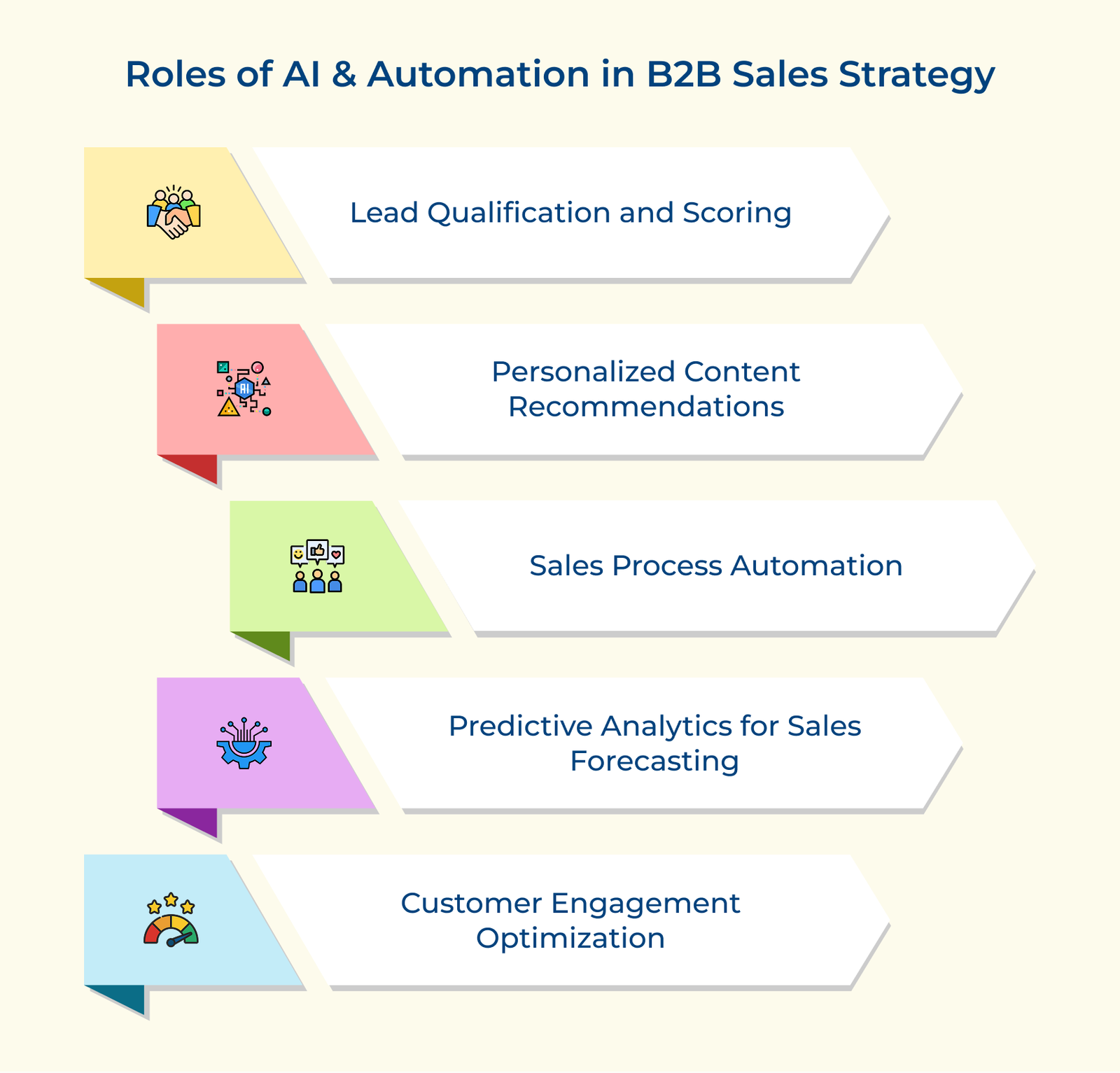
AI algorithms analyze large data sets to identify high-potential clients based on behavior and characteristics. Machine learning refined lead scoring by learning from successful conversions, helping sales teams focus on the most promising leads.
AI-powered systems track customer interactions across various touchpoints to understand their interests and needs. The technology then recommends tailored content for each prospect at different buying stages, ensuring timely, relevant messaging that advances deals.
Automation takes care of routine tasks like email follow-ups and scheduling, freeing up sales reps to focus on building relationships. Smart workflows update CRM records and trigger important notifications, boosting efficiency.
AI analyzes past sales data and market trends to provide accurate revenue forecasts. It identifies patterns in successful deals and pipeline risks, empowering sales leaders to make informed decisions on resource allocation.
AI tools track customer interactions, offering real-time insights into engagement levels. They recommend the best times to detect churn risks, enabling proactive relationship management and uncovering expansion opportunities within existing accounts.
Let’s go through some major brands that have successfully implemented B2B sales strategies to expand their business reach.
Amazon
Amazon has developed a robust B2B marketplace strategy through Amazon Business, offering features like bulk pricing, approval workflows and business-specific product categories. It combines its consumer marketplace expertise with the unique needs of B2B buyers.
The strategy has transformed Amazon’s business model, leveraging existing infrastructure and technology to establish a strong B2B presence. It has enabled them to capture a significant share of business purchasing and gain valuable insights into organizational buying behaviors.
Zappos
Zappos brings its renowned customer service to B2B with the Zappos at Work program. It offers tailored corporate purchasing solutions for businesses needing footwear and accessories for employees. The focus on personalized service and bulk ordering sets them apart.
The B2B initiative has allowed Zappos to diversify revenue streams beyond individual consumers. It leverages its service reputation to build strong relationships with corporate clients across various industries.
Nike
Nike’s B2B strategy focuses on strategic partnerships with retailers and key sectors like athletic organizations. They’ve built a sophisticated wholesale network with custom ordering systems and dedicated account management for business partners.
The approach has solidified Nike’s market position by enhancing strong business relationships. Their B2B partnerships serve as a vital channel for market expansion, brand presence and stable revenue through long-term contracts.
Puma
Puma’s hybrid B2B strategy blends traditional wholesale partnerships with direct-to-business customization programs. Their specialized divisions for team sports and corporate merchandising cater to businesses seeking tailored sportswear solutions.
The approach has strengthened Puma’s presence in both retail and institutional markets, creating multiple growth channels. They’ve reinforced their market position and expanded their reach by offering customized solutions alongside efficient wholesale operations.
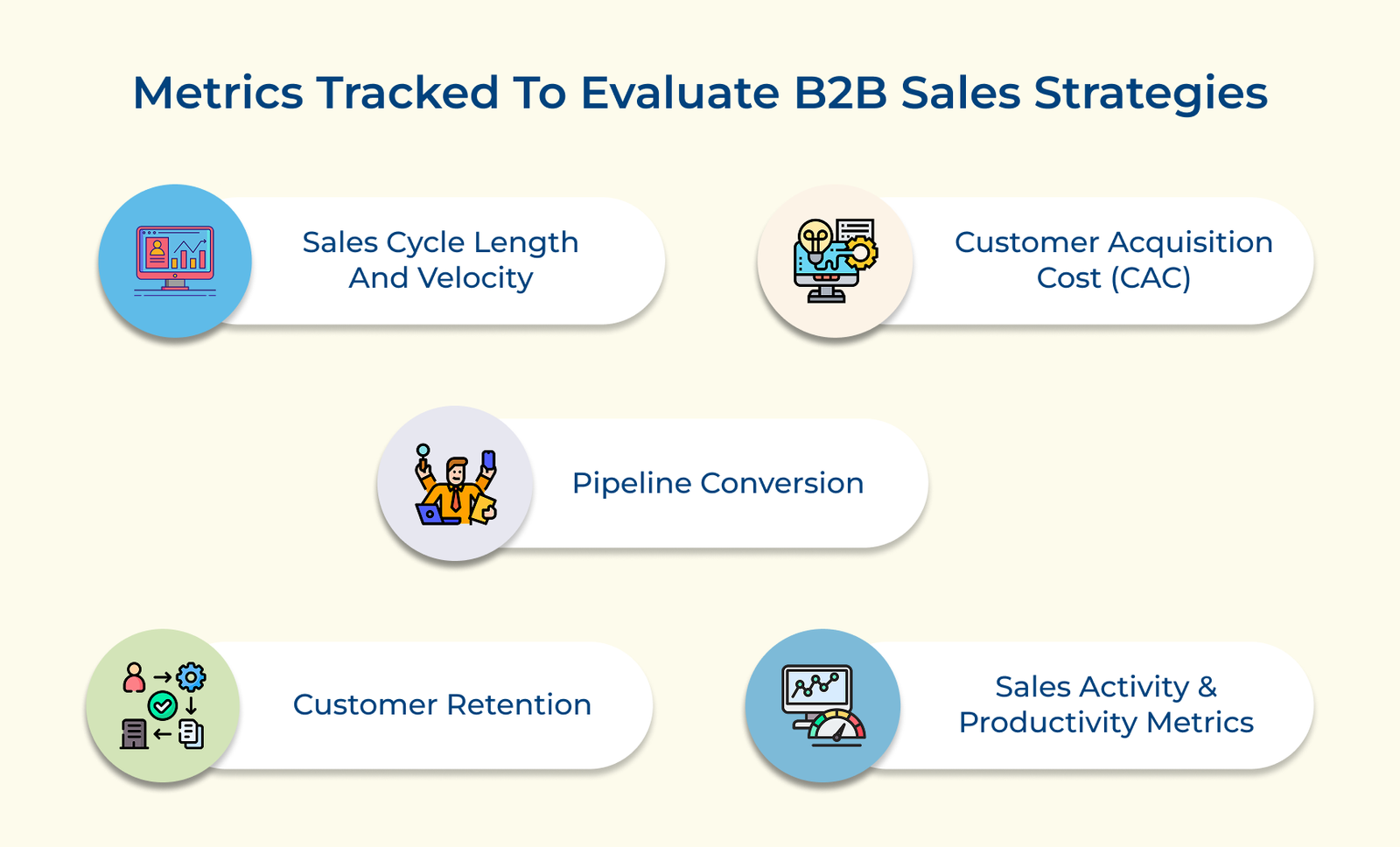
Let’s go through the essential measurements that can help evaluate success and identify areas for improvement in B2B sales strategies.
Key questions:
1. Sales Cycle Length and Velocity
The time it takes to move prospects through your sales pipeline reveals key insights into process efficiency. Tracking deal progression helps identify bottlenecks, optimize workflows and improve revenue forecasting.
2. Customer Acquisition Cost (CAC)
Understanding the balance between acquisition costs and customer value helps assess the sustainability of your sales strategy. A healthy ratio reflects efficient resource use and profitable, long-term customer relationships.
3. Pipeline Conversion
Your conversion rate from qualified opportunities to closed deals reveals the effectiveness of your sales approach. You can pinpoint drop-off points and identify the most effective sales tactics by analyzing success rates at each pipeline stage.
4. Customer Retention
Tracking customer retention and growth reveals the long-term success of your sales strategy. It includes monitoring renewals, upsells and account expansion. Strong retention metrics indicate effective solution delivery and relationship management.
5. Sales Activity and Productivity Metrics
Tracking key sales activities such as meetings, proposals and deal progress helps assess team performance. It also measures individual and team productivity, highlighting the most effective sales actions.
A successful B2B sales strategy blends customer-centric approaches, data-driven decisions and strategic relationship building. You can form lasting partnerships that fuel sustainable growth by understanding customer needs and providing value-based solutions. Implement scalable processes and leverage tools like AI to elevate sales performance.
Regular monitoring of key metrics ensures strategies stay effective and adaptable to market changes. Success lies in aligning your organization around customer success. When support, sales and marketing teams collaborate seamlessly, it builds a foundation for continuous growth.

Any business selling products or services to other businesses—whether a software company, manufacturer, service provider or wholesaler needs a strong B2B sales strategy. Even small businesses targeting corporate clients require a structured approach to identify, engage and convert leads effectively.
The ideal strategy depends on your business model, target audience and available resources. Consider factors like product complexity, sales cycle length and customer needs. Companies with complex solutions may benefit from consultative selling, while standardized products could focus on digital sales channels.
A sales strategy is a detailed plan outlining how your business will position itself in the market and attract B2B customers. It covers target audience identification, value proposition, sales process and resource allocation, essentially your roadmap to revenue growth.
A B2B inside sales strategy is an approach where sales representatives sell solutions to other businesses using phone calls, emails, video conferencing and digital tools rather than traditional face-to-face meetings. It typically involves a structured, metrics-driven process focused on shorter sales cycles, higher efficiency and leveraging technology to nurture customer relationships systematically.
B2B sales strategies should be reviewed quarterly to assess performance metrics and make minor adjustments. A comprehensive update is recommended annually or whenever significant market shifts, competitive changes or internal restructuring occurs. Consider pipeline health, conversion rates and customer feedback when determining if your strategy needs any kind of refinement. Being agile in response to market dynamics helps businesses gain a significant competitive advantage.
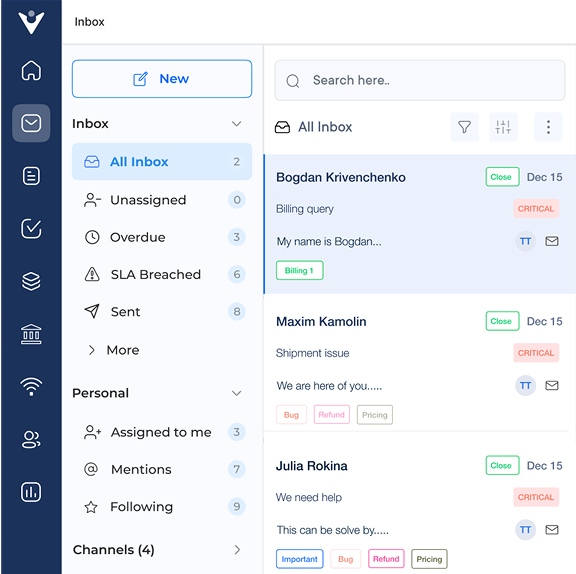
Grow Customer Relationships and stronger team collaboration with our range of products across the Conversational Engagement Suite.
Omnichannel Customer Support & Help Desk Software
AI Enabled Business Messaging and Chatbot Software
Sales Engagement & CRM Software
Call Center Software & Virtual Phone System
Product Marketing & Experience Platform
Customer Experience & Feedback Management Software

 10 Effective Ways to Humanize Customer Experience
Scroll to top
10 Effective Ways to Humanize Customer Experience
Scroll to top