1. First Contact Resolution Rate (FCR)
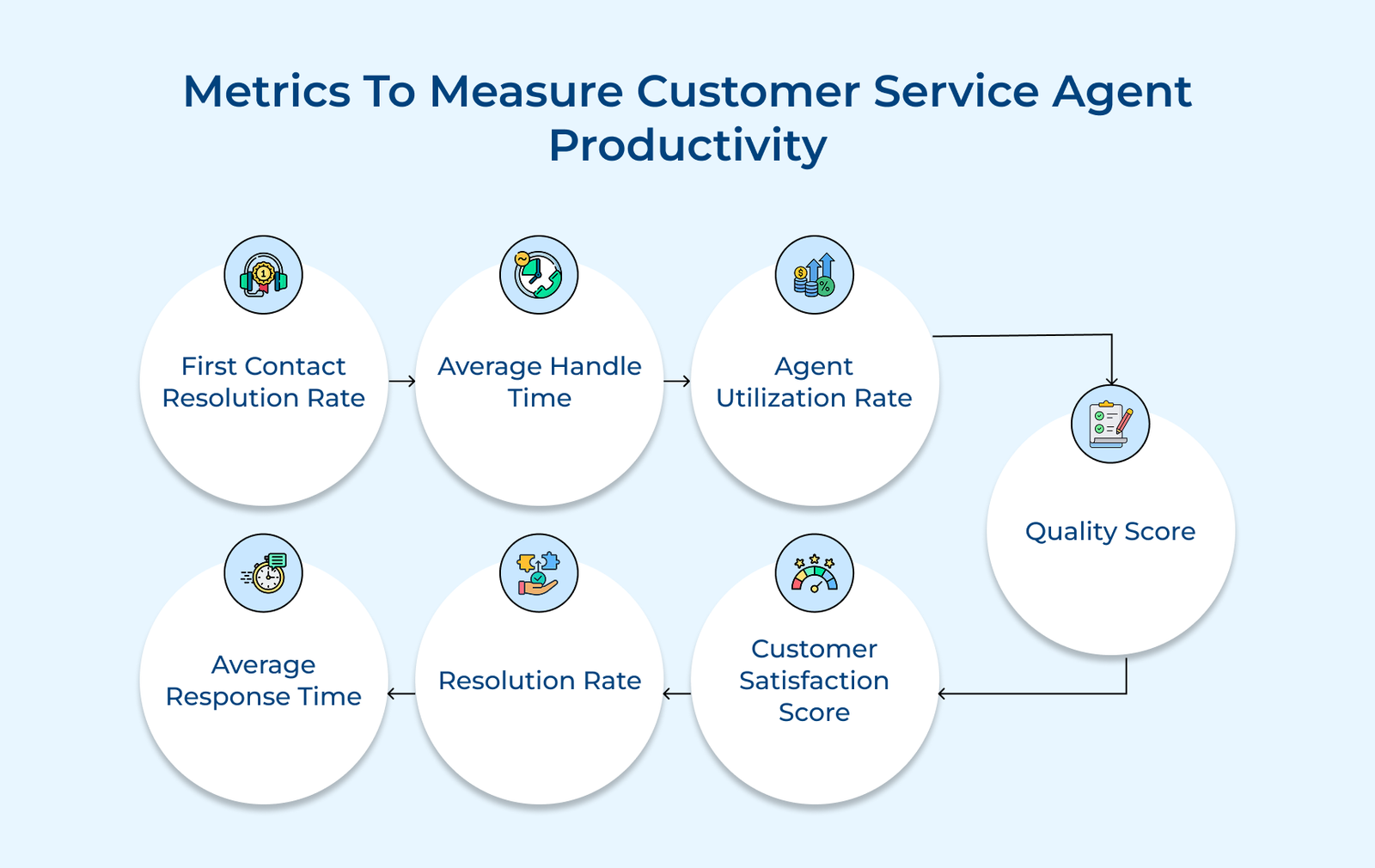
First contact resolution measures an agent’s ability to resolve customer issues on the first interaction. A high FCR indicates strong problem-solving skills and in-depth product knowledge, leading to higher customer satisfaction.
Consistently achieving high FCR shows agents are mastering their role and utilizing resources effectively. A lower FCR may suggest the need for further training, improved knowledge bases or refined processes.
Formula: FCR = (Issues resolved on first contact ÷ Total number of issues) × 100
2. Average Handle Time (AHT)
AHT measures the total time an agent spends on customer interaction, including talk time, hold time and after-call work. The metric gauges efficiency while accounting for varying issue complexities.
An optimal AHT shows that agents are handling cases efficiently without sacrificing thoroughness. AHT should be considered alongside quality scores to avoid prioritizing speed over service excellence.
Formula: AHT = (Talk Time + Hold Time + After-Call Work) ÷ Total Calls Handled.
3. Agent Utilization Rate
Utilization rate measures how effectively agents use their available time for customer-facing tasks. It helps identify potential productivity barriers and ensures optimal resource allocation during shifts.
High utilization rates suggest efficient time management, but excessively high rates may indicate burnout risks. It highlights the need for addressing through workflow improvements.
Formula: Utilization Rate = (Total Productive Time ÷ Total Available Time) × 100
4. Quality Score
Quality scoring measures how well agents adhere to procedures and uphold service standards during customer interactions. It evaluates factors like communication, problem-solving effectiveness and policy compliance.
Regular assessments highlight training needs and recognize exceptional performance. The scores provide valuable insights for coaching sessions and help maintain consistent service delivery across the support team.
Formula: Quality Score = (Total points earned ÷ Maximum possible points) × 100
5. Customer Satisfaction Score (CSAT)
CSAT measures customer satisfaction with the service provided by agents. The metric offers direct insights into their ability to meet customer expectations and deliver positive experiences.
High CSAT scores reflect strong communication, empathy and problem-solving skills. Tracking CSAT over time helps pinpoint top performers and those who may need additional support.
Formula: CSAT = (Number of satisfied customers ÷ Total number of customer responses) × 100
6. Resolution Rate
The resolution rate tracks an agent’s success in resolving customer issues, even if multiple interactions or escalations are required. It highlights problem-solving ability and persistence in complex cases.
The metric differs from first contact resolution because it focuses on overall success in closing issues rather than speed. A high-resolution rate reflects strong technical knowledge and coordination with other teams for full resolution.
Formula: Resolution Rate = (Number of tickets resolved ÷ Total number of tickets assigned) × 100
7. Average Response Time
Response time tracks how quickly agents start assisting customers after a request is made. The metric is particularly crucial in the modern service environment where customers expect prompt acknowledgment of their concerns.
A fast response time reflects efficient workflow and prioritization skills, but should be balanced with quality metrics to avoid compromising thoroughness. Some complex issues require more time for proper resolution.
Formula: Average Response Time = Total time taken to respond to all tickets ÷ Total number of tickets
Examples of Improving Agents Productivity
Below are some well-known companies that have transformed their support processes with remarkable results.
Amazon
Amazon transformed customer service with an AI-powered agent assistance system that offers real-time recommendations. Agents can efficiently manage complex queries without toggling between tools by using a unified dashboard with customer history, preferences and solutions.
The innovation boosted customer satisfaction and agent retention. Agents feel more confident tackling tough issues and the streamlined workflow enables them to focus on building meaningful stronger customer relationships instead of searching for answers.
Zappos
Zappos invests in a robust six-week training program, covering product knowledge, customer psychology and problem-solving. Agents are empowered with the autonomy to make decisions that benefit customers, bypassing management approval.
The focus on development enhances an engaged, confident team that delivers exceptional customer experiences. It has resulted in faster resolutions and higher satisfaction scores.
Nordstrom
Nordstrom’s omnichannel support system offers agents full visibility into customer interactions across all channels. Agents maintain complete context with seamless transitions between chat, email and phone.
The integration boosted the agent’s efficiency. They are enabled to provide more personalized service and resolve issues faster since they have immediate access to all relevant customer information.
Netflix
Netflix developed a data-driven coaching program powered by AI to analyze customer interactions and deliver personalized feedback. The system identifies successful patterns and offers real-time training to enhance agents’ communication skills.
The tailored coaching approach has elevated customer interaction quality. It helped agents continuously improve and adapt their communication style to better serve various customer segments.
Improve Your Agents Productivity With the Right Strategies & Tools
Improving agent productivity requires a strategic mix of technology, process optimization and human-focused approaches. Businesses can empower agents to perform at their best while maintaining high service quality by leveraging tools like AI-assisted support, knowledge management systems and automated workflows.
The key is ensuring productivity gains benefit both agents and customers. When companies invest in training, create supportive environments and provide efficient tools, they lay the groundwork for sustainable productivity that enhances customer experiences.
Key takeaways:
- Combine technology with human-centered support for lasting productivity improvements.
- Invest in training and knowledge management to help agents handle interactions confidently.
- Regularly measure productivity metrics to identify opportunities and ensure effective results for both agents as well as customers.