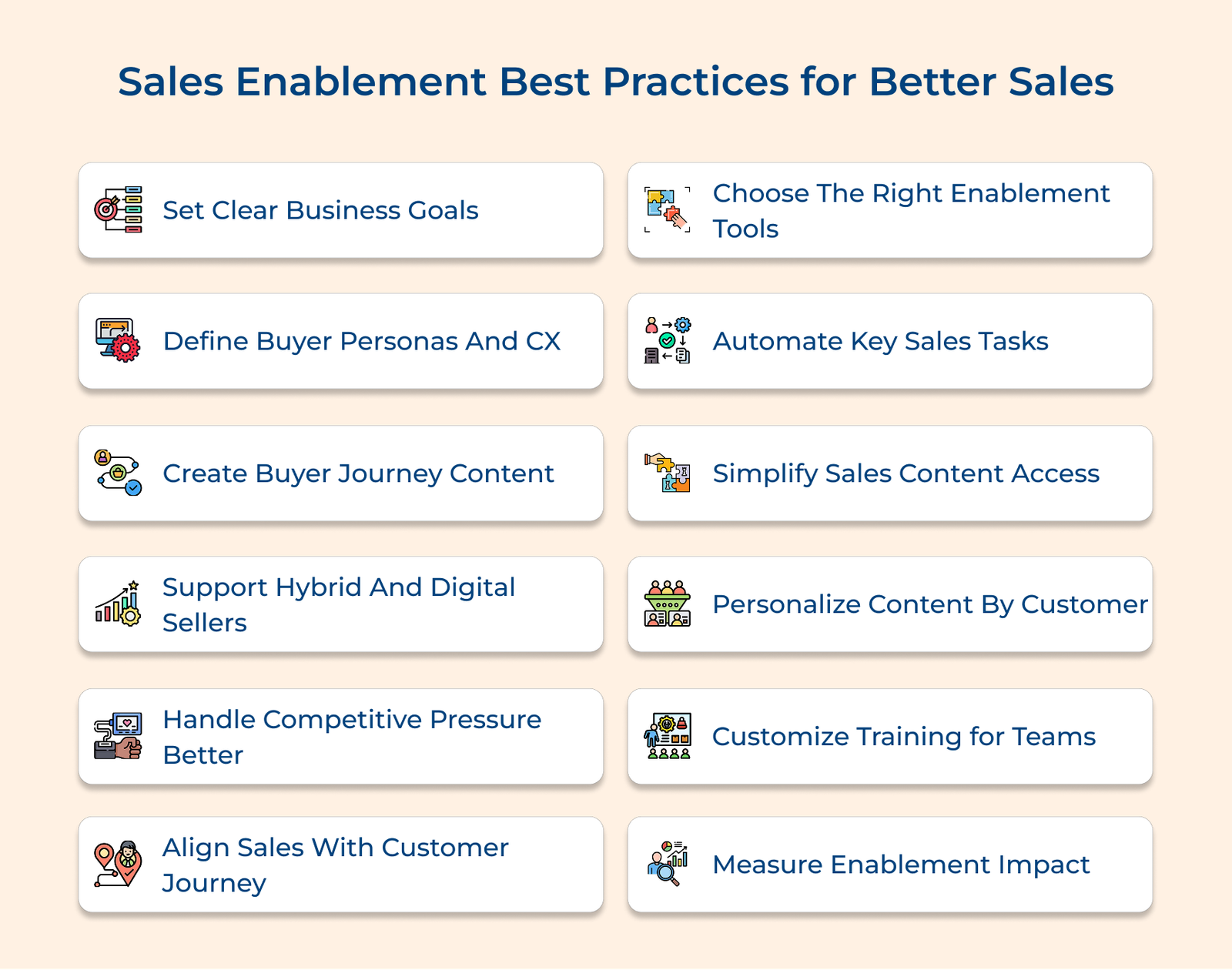
1. Define Business Outcomes and Goals
Setting clear goals is key to guiding your sales enablement strategy. Align the goals with broader business objectives to drive measurable results and demonstrate value. Involve stakeholders from sales, marketing and leadership to define specific, measurable targets. Break the larger goals into smaller milestones and establish clear metrics for tracking progress.
Let’s assume that a B2B software company aims to increase enterprise deal closure by 20% through enhanced sales enablement. They will set quarterly targets, tracking metrics like reduced sales cycles, better proposal quality and improved win rates.
Pro tips:
- Use a balanced scorecard with leading and lagging indicators to identify areas for improvement before they affect results.
- Ensure goals are SMART but adaptable to evolving market conditions.
2. Define Buyer Personas and Customer Experiences
Understanding buyer personas is crucial for sales teams to engage prospects effectively. The insight allows for personalized conversations, content and solutions tailored to each decision-maker’s needs. You can craft targeted sales strategies that resonate with different personas by conducting thorough research.
Assume there’s a manufacturing equipment supplier that creates personas for plant managers, procurement officers and CFOs. They will be documenting pain points, decision criteria and preferred content types to guide sales reps.
Actionable tips:
- Regularly update personas based on sales feedback and market trends to stay relevant.
- Include negative personas to help your team focus on the right prospects, saving time and resources.
3. Build Content based on the Buyer’s Journey
Mapping content to each stage of the buyer’s journey ensures your sales team has the right materials for every interaction. The approach addresses customer needs at the optimal time, guiding them from awareness to decision-making.
Let’s assume that a cloud services provider creates content for each stage. They use educational blog posts for awareness, solution briefs for consideration and ROI calculators with case studies for decision-making, helping reps guide prospects smoothly.
Best practices:
- Analyze engagement metrics to identify content that drives conversions at each stage.
- Host monthly content reviews with top performers to refine what resonates most with prospects.
4. Optimize Sales Enablement for Hybrid and Digital Sellers
Modern B2B selling demands flexibility across both digital and in-person interactions. Your sales enablement strategy should support reps across various channels, ensuring consistent effectiveness no matter how buyers engage.
Imagine there’s a consulting firm that equips its sales team with interactive digital presentations, video recording tools and virtual whiteboarding. They will need to provide training on virtual meetings and maintaining engagement online.
Pro tips:
- Record successful virtual sales calls and turn them into teachable moments.
- Host regular virtual role-playing sessions to sharpen digital selling skills.
5. Help Sales Reps Overcome Competitive Market Forces
Sales enablement must equip reps with the tools and insights to stand out. The support helps them tackle competitive challenges confidently and maintain strong win rates against market rivals.
Develop competitor battle cards and keep an updated competitive intelligence database. Train your team on objection handling and positioning against key competitors, empowering them to highlight your unique value.
Actionable tips:
- Hold monthly sessions where top performers share strategies for beating competitors.
- Create a database of winning responses to competitive scenarios, easily accessible during calls.
6. Align Your Sales Approach with the Customer Path
Modern B2B buyers follow complex, non-linear purchasing paths, so your sales approach must adapt to their buying behavior. The flexibility ensures value is delivered at every stage of their journey.
Map out common buying patterns and decision processes for your target markets. Create adaptable sales plays that fit various scenarios and stakeholder configurations, while guiding reps to identify buying signals.
Pro tips:
- Link successful deals to their unique buying paths and share insights across the team.
- Enhance feedback loops between customer success and sales to better understand post-purchase.
7. Use the Right Sales Enablement Technologies
Choosing the right sales enablement technologies is crucial for streamlining your sales operations and boosting efficiency. The ideal tech stack simplifies processes, enhances productivity and provides key insights into performance.
Begin by evaluating your current sales workflows to pinpoint areas where technology can help. Select tools that integrate seamlessly with your CRM and offer clear ROI through improved tracking.
Best practices:
- Conduct quarterly tech audits to identify tools top performers use and eliminate underutilized ones.
- Develop playbooks for each tool, outlining best practices tailored to your sales process.
8. Automate as Much as Possible
Sales automation frees your team from repetitive tasks, allowing them to focus on relationship-building and revenue-driving activities. You can reduce errors, standardize workflows and speed up the sales cycle by automating processes like follow-ups.
Identify repetitive tasks in your sales process that could be automated such as email follow-up data entry or proposal generation. Implement automation tools gradually starting with processes that offer the highest potential impact.
Key takeaways:
- Document automated processes with clear triggers and outcomes for transparency.
- Set up an automated feedback loop for reps to report issues or suggest improvements.
9. Make it Easy to Access Sales Content
Quick access to sales content is crucial for your team’s efficiency. Reps need the right materials at their fingertips without disrupting their flow. A well-organized system ensures smooth conversations and faster decision-making.
Use a centralized content system with smart search and filters. Structure your library with clear categories, tags and consistent naming based on the buyer journey or customer types.
Pro tips:
- Appoint content champions to maintain organization and train the team on efficient navigation.
- Analyze content search patterns to identify gaps and optimize your structure based on rep behavior.
10. Personalize Content for Different Customers
Generic sales content often falls short with sophisticated B2B buyers who seek tailored solutions. Your content strategy should focus on customization for different industries, company sizes and buyer roles. Personalized content creates a 20% Increase in sales opportunities.
Create modular content components that can be adapted to various scenarios. Use templates with customizable sections, ensuring brand consistency while allowing flexibility. Equip reps with tools and guidelines to personalize content effectively.
Pro Tips:
- Maintain a repository of successful customizations to inspire personalization strategies.
- Hold monthly content collaboration sessions where reps share their personalization tactics and win.
Examples of Sales Enablement Best Practices
Following are some leading B2B brands that have implemented sales enablement best practices to transform their sales operations and drive remarkable business growth.
Amazon’s B2B division leverages data-driven sales enablement through its Amazon Business platform. They gain insights into customer purchasing patterns and automate personalized recommendations by utilizing advanced digital tools. Their strategy focuses on real-time analytics and tailored selling for various business segments.
The results have been transformative for their B2B operations. Their enhanced sales enablement practices have led to accelerated onboarding of new customers, boosted customer satisfaction scores and significantly expanded their B2B market presence across industries.
Nike’s B2B sales enablement strategy focuses on equipping teams with in-depth product knowledge and industry insights. Their advanced digital learning platform offers continuous training on new products, technologies and retail partner needs, complemented by virtual demos.
The approach has deepened relationships with retail partners and distributors, enabling sales teams to deliver more strategic value. It has resulted in larger orders and stronger, long-term partnerships with key accounts.
Puma’s sales enablement strategy leverages content-driven techniques, emphasizing visual storytelling and detailed product information. Sales teams can quickly access customizable presentations, product specs and market trends with a centralized digital asset management system. Regular virtual training on new product lines further enhances their approach.
The strategy has boosted Puma’s competitiveness in the premium sports apparel market. It has enabled sales teams to craft more impactful presentations and drive higher conversion rates in B2B partnerships.
Zappos stands out in sales enablement by blending technical skills with a strong customer-first philosophy. Their comprehensive training programs prioritize relationship-building and long-term partner success over short-term sales goals.
The customer-centric approach has enhanced exceptional partner loyalty. It has resulted in more stable business relationships and sustained growth in their B2B wholesale division.
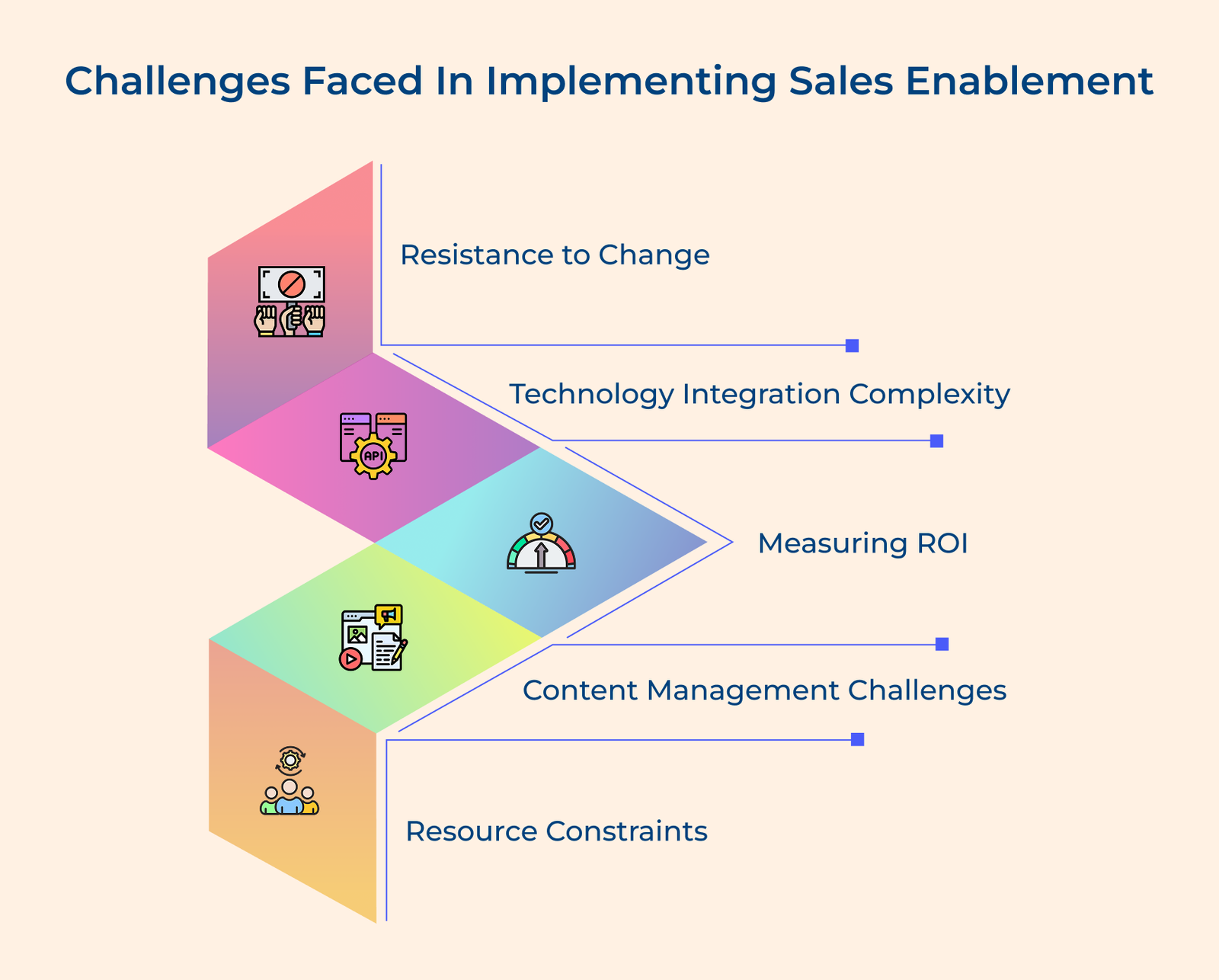
Challenges Faced In Implementing Sales Enablement Best Practices
Check out the key challenges businesses usually face when implementing sales enablement best practices and discover practical solutions to overcome them.