9 Best B2B Customer Retention Strategies in 2026
Explore key strategies to enhance B2B customer retention. Learn to build strong relationships, personalized experiences and proactive support to drive long-term business success.

Explore key strategies to enhance B2B customer retention. Learn to build strong relationships, personalized experiences and proactive support to drive long-term business success.
Retaining customers is one of the toughest challenges businesses face. While a lot of effort goes into bringing in new clients, too often, the focus stops there. As a result, valuable customers leave, driving up churn and cutting into long-term profits. B2B customer retention rates typically range from 76% to 81%—showing that while many companies manage to retain a majority of their clients, there’s still a significant gap that impacts revenue and growth.
The old model of chasing new business while ignoring existing relationships doesn’t work anymore. Modern B2B customers want reliable support, clear communication and real value. If they don’t get it, they’ll move on to competitors who simply do a better job of listening and responding. The good news? B2B customer retention doesn’t have to be complicated. Let’s find how!
B2B customer retention refers to the strategies businesses employ to build lasting relationships with business clients, ensuring they continue purchasing products or services over time. Unlike B2C, B2B relationships often involve complex contracts, long sales cycles and higher transaction values, making each client crucial to a company’s success.
Successful retention relies on proactive account management, delivering consistent value and enhancing strategic partnerships. Dedicated account managers engage regularly with clients to understand their evolving needs, address concerns and identify new collaboration opportunities. The approach enhances interdependence, integrating the supplier into the client’s operations.
Key objectives:
Check out the key benefits of B2B customer retention, highlighting how strengthening long-term relationships can create a more sustainable business model.
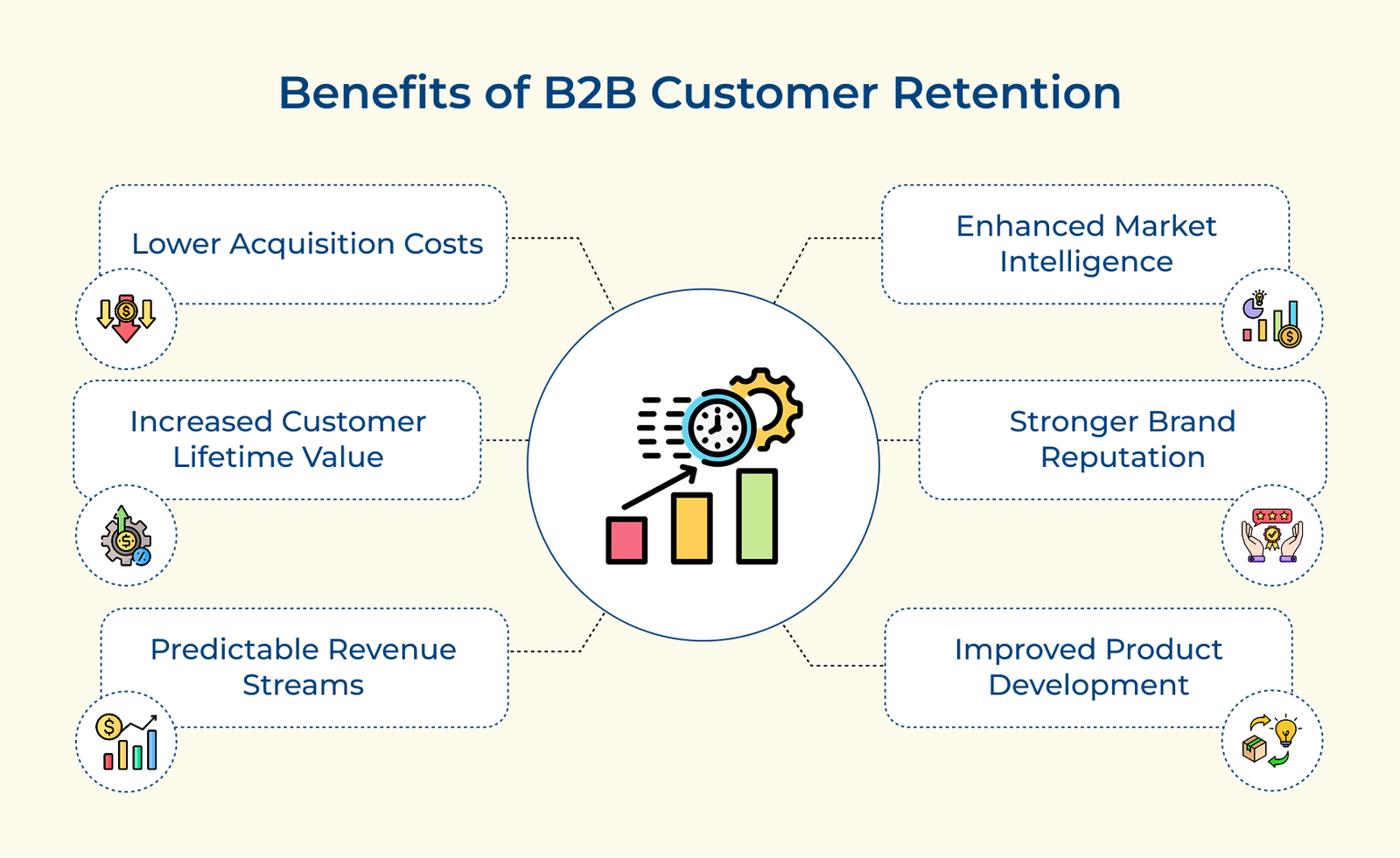
Focusing on retaining existing customers is far more cost-effective than acquiring new ones. Research shows that retaining current B2B clients can be up to five times cheaper. The cost efficiency comes from reduced marketing costs and quicker sales cycles.
Existing B2B customers are more likely to spend more over time as they build trust in your services. As they rely on your solutions, they naturally upgrade and explore additional offerings.
Long-term customer relationships offer stable income and forecasts for your business. Regular contracts and subscription-based services provide steady cash flow. The predictability makes it easier to plan investments and allocate resources for future growth.
Loyal customers provide honest feedback and valuable insights into your services, helping you stay ahead of industry trends. Their input allows you to adapt and improve your offerings to meet changing needs.
Happy long-term customers naturally become advocates for your business. They share testimonials and refer new clients. Their positive word-of-mouth creates credibility that attracts valuable prospects to strengthen your position.
Frequent interactions with loyal customers offer valuable insights into how they use your product and their challenges. The feedback drives better product development and keeps you ahead of their evolving needs.
Let us go through the latest B2B customer retention statistics to understand how maintaining long-term relationships can significantly drive sustained business growth.
1. Improving Customer Retention by 5% Increases Profits by 25-95%
Harvard Business Review studies reveal that even small improvements in customer retention lead to significant profit growth. Retained customers tend to spend more and need less support, boosting profitability over time.
2. 44% of Companies Focus More on Acquisition Than Retention
Invesp’s latest research highlights that many businesses still prioritize new customer acquisition over retention. The misalignment presents a major opportunity for companies ready to invest in nurturing existing relationships.
3. 82% of B2B Companies Lack a Structured Retention Program
Gartner’s research shows that while many companies recognize the importance of retention, few have formal programs in place. The gap presents a key opportunity for businesses to implement structured retention strategies.
4. Customer Success Teams Reduce Churn by 67%
ClientSuccess data shows that organizations with dedicated customer success teams experience lower churn rates. The teams actively address issues and ensure customers reach their goals, enhancing stronger long-lasting relationships.
5. 77% of B2B Customers Feel Indifferent Toward Their Suppliers
Gallup’s recent findings highlight that many B2B relationships lack emotional bonds, putting companies at higher risk of churn. Strengthening these connections through personalized interactions and consistent value is key to retention.
6. Digital Self-Service Portals Increase Retention by 32%
McKinsey’s recent research shows that companies embracing digital transformation, particularly through self-service options, experience higher customer satisfaction and retention. Customers increasingly prefer the ability to solve problems and access information independently.
Following are the key differences between B2B and B2C customer retention, highlighting how the strategies vary based on business models and customer needs.
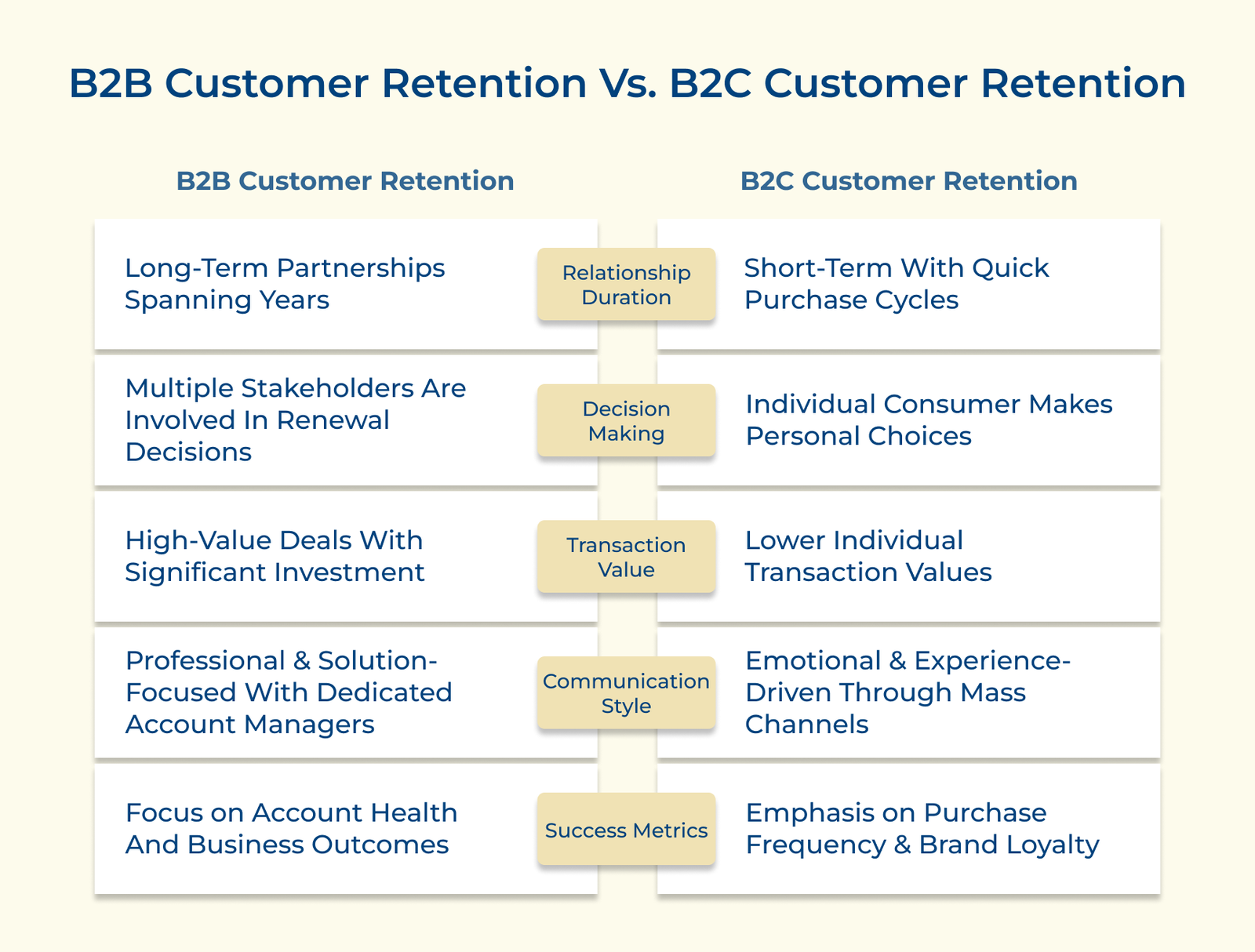
1. Relationship Duration and Complexity
B2B relationships are built on long-term, strategic partnerships, with businesses becoming deeply embedded in each other’s operations. The ties often involve tailored solutions, complex integrations and long-term contracts, enhancing mutual dependence.
The B2C relationships are centered around quicker, more transactional experiences. Customers can easily switch brands and companies must continually engage through marketing initiatives to sustain emotional connections.
2. Decision-Making Process
B2B retention requires managing relationships across multiple stakeholders within a client organization, each with unique priorities. Account managers must engage with everyone, from operational teams to top executives, ensuring consistency and alignment.
B2C decisions are driven by individuals who consider personal preferences, immediate needs and emotional connections to brands. The decision-making process is more straightforward. It’s highly influenced by emotions and competitive offers.
3. Transaction Value and Investment
B2B transactions involve substantial investments, with high implementation costs and long-term financial commitments. The stakes are high, requiring both parties to dedicate significant resources to nurturing successful, long-lasting partnerships.
B2C transactions typically involve lower individual purchase values but higher volumes. The focus is here on encouraging repeat business, driving frequent purchases through loyalty programs and tailored promotions.
4. Communication Approach
B2B communication centers on enhancing professional relationships with dedicated account management teams. Companies ensure they stay aligned with their client’s goals through regular business reviews, strategic sessions and structured feedback.
B2C communication revolves around building emotional connections through storytelling and broad marketing channels. Social media, personalized messaging and targeted promotions keep customers engaged in the brand.
5. Success Measurement
B2B retention is measured by in-depth metrics like account health scores, business impact and strategic alignment. The focus is on the value delivered and identifying opportunities for mutual growth.
B2C retention metrics track individual behaviors such as purchase frequency, customer lifetime value, and brand advocacy. The measures reflect emotional engagement and consumer loyalty rather than broader business outcomes.
Following are the powerful B2B customer retention strategies that will not only keep your clients coming back but also elevate your business to new heights.
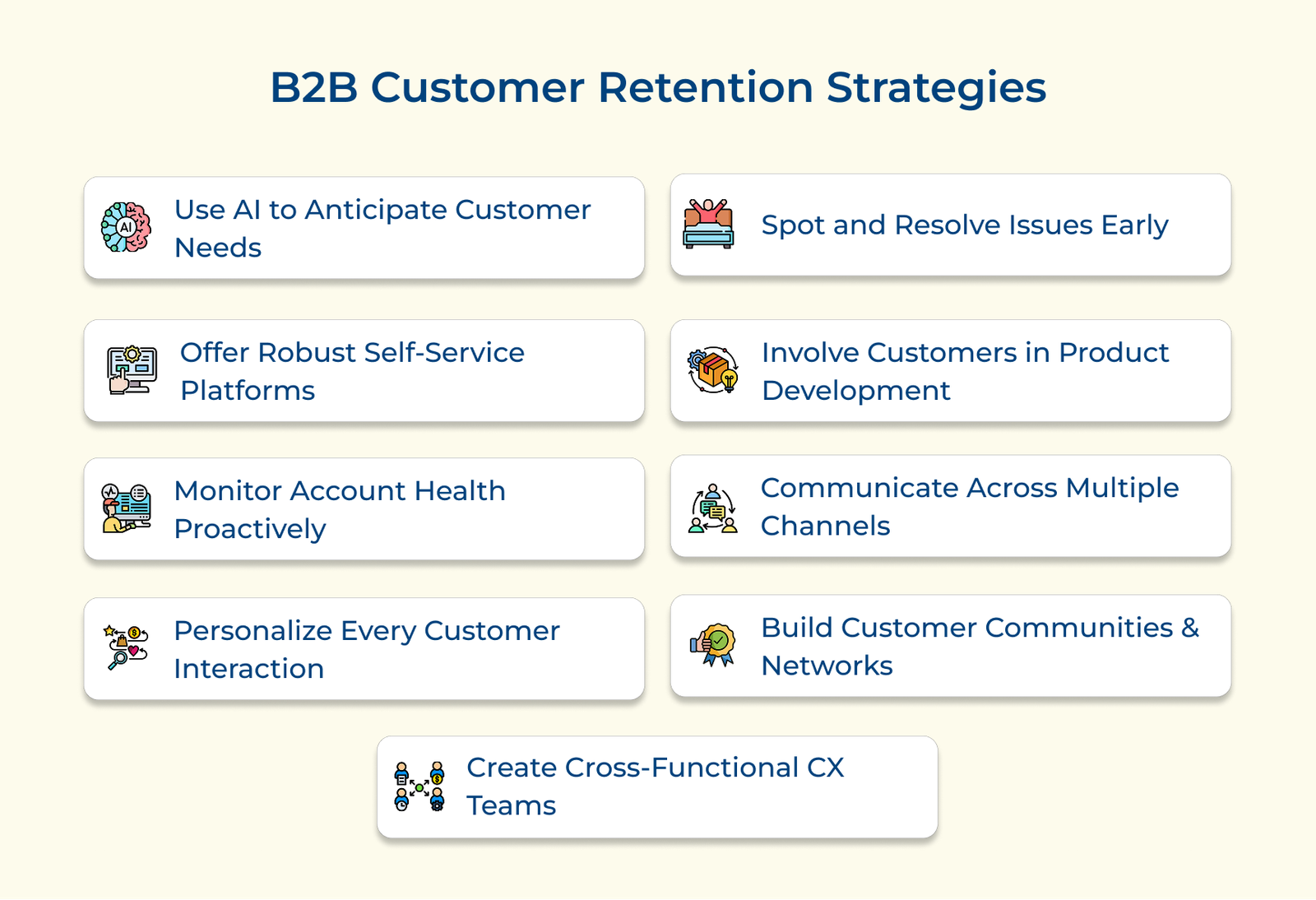
AI-powered prediction systems empower businesses to anticipate customer needs before they arise. The systems can flag potential issues and spot growth opportunities early on by analyzing historical data. Predictive analytics examines customer behavior patterns, identifying trends and anomalies. It allows teams to proactively address at-risk accounts and capitalize on upsell opportunities, enhancing customer journeys.
AI-driven recommendations offer personalized suggestions based on past interactions, helping teams engage customers more effectively. Automated early warning systems also track key indicators and notify customer success teams when accounts show signs of potential churn.
Pro tips:
Digital self-service platforms allow customers to resolve issues on their own, reducing support costs and boosting satisfaction by providing instant access to information. The platforms efficiently handle common needs, freeing up support teams for more complex problems.
A well-organized knowledge base forms the core of self-service support, offering comprehensive articles, troubleshooting guides and documentation. It’s regularly updated based on customer queries and feedback, ensuring it stays relevant.
Actionable tips:
Strategic account health monitoring offers a structured way to assess customer relationships, helping teams identify risks and uncover growth opportunities. The proactive approach enables data-driven decisions for better account management. Teams gain valuable insights into customer behavior by tracking engagement across various touchpoints like support interactions and product usage.
Product adoption rates reveal how effectively customers use different features and capabilities. Customer satisfaction scores provide direct feedback about the relationship’s health. The metrics combine to create a holistic view of account status and guide strategic decisions.
Best practices:
Personalization is key to effective B2B customer retention. 89% of leaders believe personalization is crucial to their business’ success in the next three years! Businesses enhance deeper relationships that lead to lasting loyalty by tailoring every interaction to meet specific client needs.
The first step is understanding each client’s communication style and preferences. Teams can then develop customized communication plans that ensure important messages reach the right stakeholders at the right time. Solutions are also tailored to address industry-specific challenges, improving retention rates by showing clients that their unique needs are understood and prioritized.
Pro tips:
Cross-functional teams play a crucial role in driving strong B2B client retention. The teams ensure customers receive consistent, top-notch service at every touchpoint by bringing together expertise from various departments.
Effective B2B retention begins with aligning sales teams with customer success managers, guaranteeing smooth transitions from sales to account management. Regular collaboration between the teams ensures customers experience continuous, high-quality service and attention.
Best practices:
Proactive identifying potential issues is key to maintaining strong B2B customer retention. Addressing challenges before they escalate can prevent dissatisfaction and reinforce long-term partnerships. Early intervention minimizes the risk of churn and strengthens client relationships.
The systems flag significant drops in engagement or product adoption by tracking key metrics. When the changes occur, customer success teams can quickly investigate and take action. Analyzing customer feedback trends also provides valuable insights into potential retention issues.
Pro tips:
A customer-focused approach to product development plays a key role in boosting B2B client retention. Businesses create solutions that genuinely address market demands by ensuring that product evolution matches customer needs.
Customer advisory boards provide valuable input by offering direct feedback on product roadmaps and feature priorities. Regular meetings with the boards help shape development decisions based on real customer insights, making the product more relevant and effective. Beta testing programs further engage clients, allowing them to refine the product through hands-on experience.
Actionable tips:
Effective B2B customer retention hinges on clear, consistent communication across multiple channels. It ensures customers can engage in ways that suit their preferences, helping to build stronger, longer-lasting relationships. A well-crafted communication strategy serves as the foundation for enduring business connections.
Omnichannel support systems create seamless experiences by allowing support teams to track interactions across email, phone, chat and social media. The integration ensures customers receive consistent, high-quality service, no matter how they reach out. Content distribution strategies ensure that valuable insights are shared through channels tailored to different stakeholders.
Best practices:
Building strong customer communities is crucial for B2B retention. The communities offer customers a space to connect, share experiences and strengthen their bond with your brand. When customers feel part of a community, they’re more likely to stay engaged long-term.
Virtual user groups bring customers together to discuss challenges and solutions, while industry-specific forums enhance idea exchange. The focused interactions help build valuable connections and deepen customer relationships. Peer learning sessions encourage knowledge sharing, allowing experienced users to help newer ones. It adds extra value, creating a sense of belonging beyond the product or service.
Pro tips:
Let’s go through some of the common challenges businesses face when implementing B2B customer retention strategies.
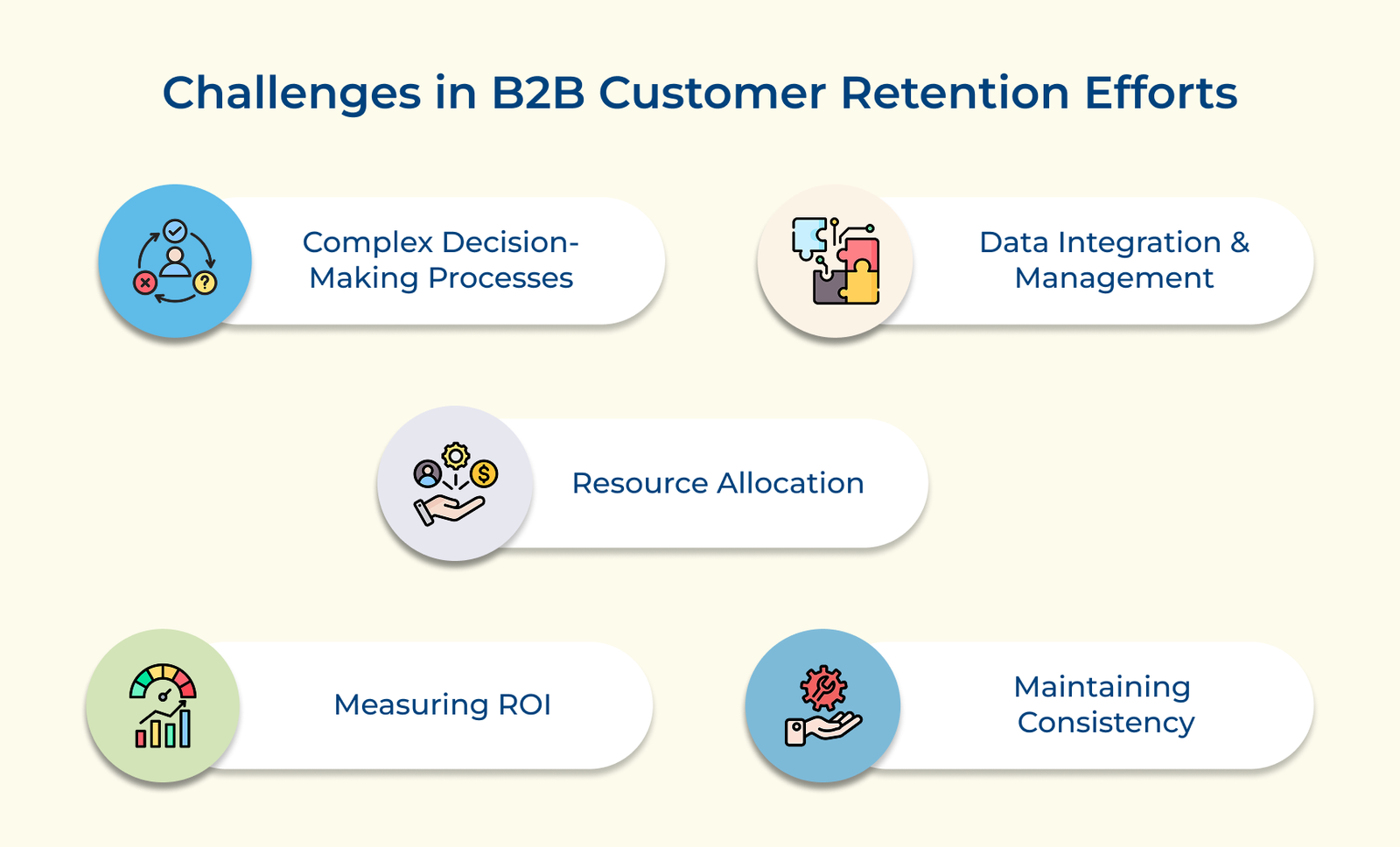
1. Complex Decision-Making Processes
B2B environments often involve several stakeholders with varying priorities, making it challenging to align retention efforts across all levels of the client organization. It can slow down progress and complicate relationship management.
Create stakeholder maps for each account and develop tailored communication plans that speak to the needs of different decision-makers. Building relationships at multiple levels within the client organization ensures a more holistic approach. It enhances better support and understanding throughout the partnership.
2. Data Integration and Management
Organizations often face challenges in consolidating customer data from various touchpoints.. It leads to a fragmented view that hinders effective tracking of behavior, engagement patterns and churn risks.
Implement a unified customer data platform that integrates data from all sources. Establish standardized data collection practices and invest in tools that offer clear, actionable insights through automated analysis and reporting, helping you better understand your customers.
3. Resource Allocation
Limited resources, such as budget, staff and time often make it difficult to fully implement retention strategies. Teams end up juggling immediate customer demands with long-term goals.
Focus retention efforts on high-value or at-risk customers. Use automation to handle routine tasks and create scalable processes that maximize efficiency without compromising service quality.
4. Measuring ROI
Measuring the impact of retention efforts can be tough, especially in B2B where relationships evolve over time. It’s hard to pinpoint which strategies drive success.
Set clear metrics and KPIs that align with retention goals. Build a framework that tracks both short-term and long-term indicators of customer satisfaction.
5. Maintaining Consistency
As organizations expand, ensuring consistent experiences across all touchpoints becomes challenging. Different teams and departments may have varying approaches, which can lead to inconsistent service.
Develop standardized processes and playbooks for customer interactions. Regularly train teams and enhance open communication channels to maintain consistent service quality across the board.
Below is the process of calculating customer retention rates. Understanding the metric is crucial for evaluating the effectiveness of your retention strategies.
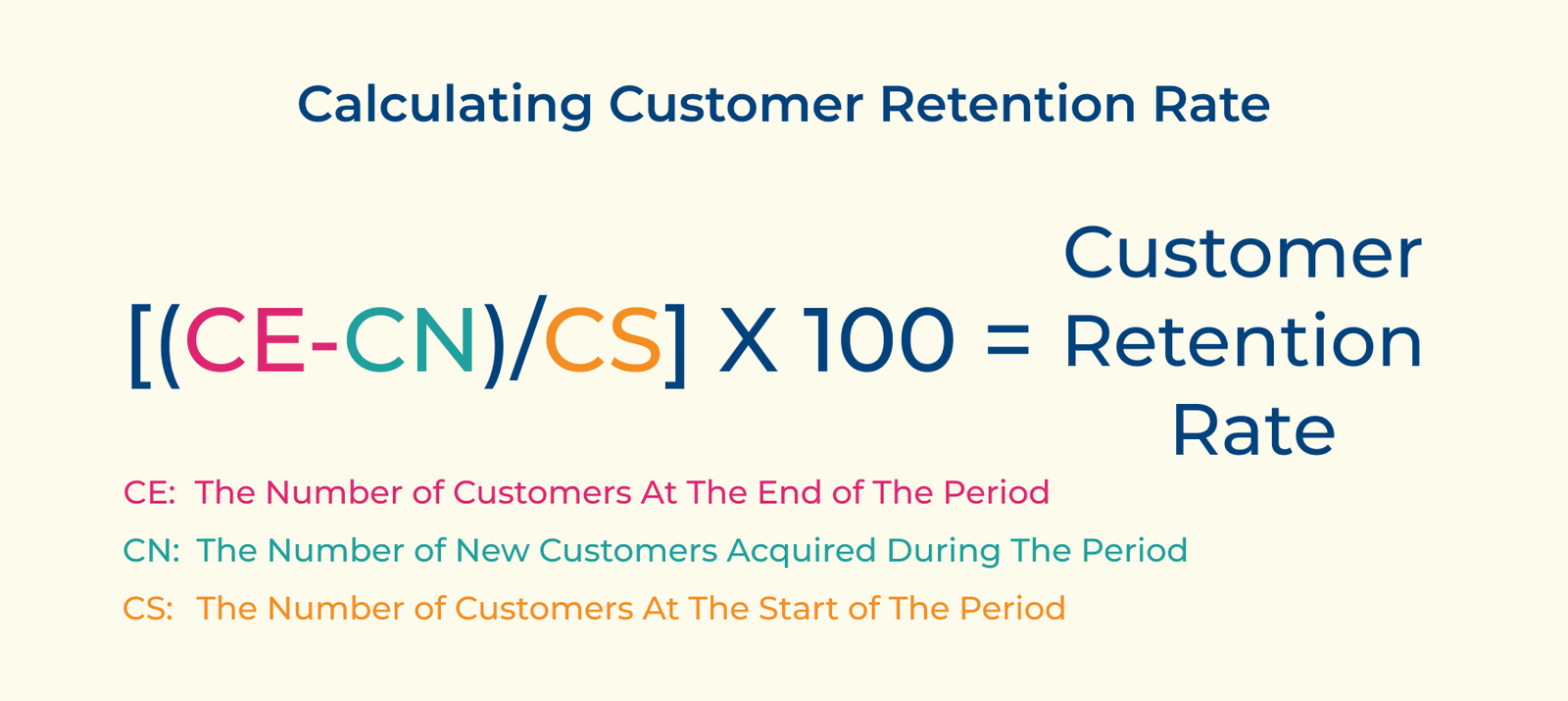
CRR = ((total number of customers at the end – number of new customers acquired) / Total number of customers at the beginning) × 100
A strong customer retention rate generally ranges from 75% to 85% in the B2B sector. It can vary depending on factors like industry, product complexity and contract length. Software-as-a-service (SaaS) companies, for instance, often target retention rates exceeding 90%.
1. Define Your Period
Select a consistent period for measurement like monthly, quarterly, or annually. Align the timeframe with your business cycles and contract lengths, while factoring in seasonal trends that might impact consumer behavior.
2. Count Starting Customers
Take a snapshot of all active customers at the beginning of the period. Define what qualifies as an “active” customer based on your specific business model and exclude dormant or churned accounts from the count.
3. Track New Customer Acquisition
Keep a record of all new customers who joined during the period. Ensure they’re fully onboarded and have made at least one purchase or completed their subscription setup.
4. Count Ending Customers
Count all active customers at the end of the period. Include both retained customers from the start and any new customers who joined during the period.
5. Apply the Formula
Plug the numbers into the customer retention rate formula:
Retention Rate = ((Ending Customers – New Customers) / Starting Customers) × 100
Check your calculations, compare them with previous periods and watch for any trends or irregularities that can inform your retention strategy.
Let’s calculate the quarterly retention rate for a B2B software company:
– Starting Customers (S) = 200
– New Customers (N) = 30
– Ending Customers (E) = 180
CRR = ((180 – 30) / 200) × 100
CRR = (150 / 200) × 100
CRR = 0.75 × 100
CRR = 75%
The example means the company retained 75% of its original customers during the quarter. While it is within the typical range, it suggests there’s potential for improvement, especially through enhancing customer success initiatives to reduce churn and boost retention even further.
B2B customer retention is vital for long-term business success. Businesses can reduce churn by focusing on building lasting relationships through personalized experiences, proactive support and data-driven insights. Implementing effective retention strategies from self-service platforms to cross-functional teams creates multiple touchpoints for engagement.
The connections help businesses stay in tune with their clients’ needs, ensuring consistent value and enhancing loyalty. Businesses need to combine technology, human interaction and informed decision-making. Companies can turn their customers into loyal advocates by investing in understanding customers, building strong relationships and continually improving services. It, in turn, strengthens their market position and drives sustainable growth.

B2B customer churn happens when clients decide to end their relationship with your company, whether through contract cancellations, non-renewals or reduced service usage. Churn can be voluntary, where customers choose to leave or involuntary, due to issues like payment problems or technical glitches. Understanding the causes of churn helps uncover opportunities to improve retention and strengthen customer relationships.
The churn rate is calculated by dividing the number of customers lost during a given period by the total customers at the start of that period, then multiplying by 100. Let’s assume that if you begin with 100 customers and lose 5, your churn rate is 5%. It’s important to track both logo churn (the number of lost customers) and revenue churn (the value of lost business) for a complete picture of customer retention.
Customer retention should be a priority for every department in a B2B organization. Sales teams should focus on building lasting relationships, customer success teams on delivering real value, product teams on creating solutions that meet customer needs and leadership on driving retention-focused strategies. It’s a shared responsibility that influences the overall health of the business.
Customer retention should be tracked over different timeframes to get a full picture. Monitor monthly metrics for short-term trends, quarterly data for seasonal shifts and annual rates for long-term strategy insights. Keep your average contract length in mind when setting these periods.
Customer retention directly boosts profitability. It’s more cost-effective to retain existing customers than to acquire new ones. The long-term clients often spend more, refer others and require less support. Higher retention leads to predictable revenue, stronger customer lifetime value and healthier profit margins—making it a key driver of sustainable growth in B2B businesses.

Grow Customer Relationships and stronger team collaboration with our range of products across the Conversational Engagement Suite.
Omnichannel Customer Support & Help Desk Software
AI Enabled Business Messaging and Chatbot Software
Sales Engagement & CRM Software
Call Center Software & Virtual Phone System
Product Marketing & Experience Platform
Customer Experience & Feedback Management Software

 How to Create a Sales Roadmap: 9 Effective Steps
Scroll to top
How to Create a Sales Roadmap: 9 Effective Steps
Scroll to top