What is 360 Customer View? A Detailed Guide
A 360 customer view combines data from every interaction and touchpoint to give businesses a complete, real-time picture of each customer. It enables better personalization, service and decision-making.

A 360 customer view combines data from every interaction and touchpoint to give businesses a complete, real-time picture of each customer. It enables better personalization, service and decision-making.
Customer data sits in separate pockets. Marketing sees one version of a person, sales sees another and support sees something completely different. This split view makes it tough to deliver a steady, helpful experience. Customers end up repeating the same details, getting emails that don’t match their needs or talking to support teams that have no context. The whole thing chips away at trust and nudges them toward brands that seem to actually get them.
A 360 customer view changes the game. It pulls every piece of information like past purchases, into one complete profile. Once every team works off the same up-to-date picture, they can offer relevant help, make clearer decisions and treat customers like real people instead of ticket IDs. Guesswork fades and you understand what someone needs because you’ve connected the dots and built a full story around their behavior.
A 360 customer view refers to a detailed approach to understanding customers by collecting and analyzing data from every customer interaction throughout their journey with your organization. Instead of viewing customer behavior in fragments, the approach unifies it into a clear, accurate profile of their needs and interactions.
The view is built by pulling data from all sources, including sales history, support tickets, social media, website visits, email responses and more, bringing it together in one place. Once connected, patterns emerge that help you understand what customers need and how to serve them better. Your teams can act on the insights consistently, if someone is shopping, asking for help or exploring a product with shared access across departments.
Key principles:
Let’s go through the key components that contribute to a 360 degree customer view, providing you with the tools to enhance your strategy and drive success like never before!
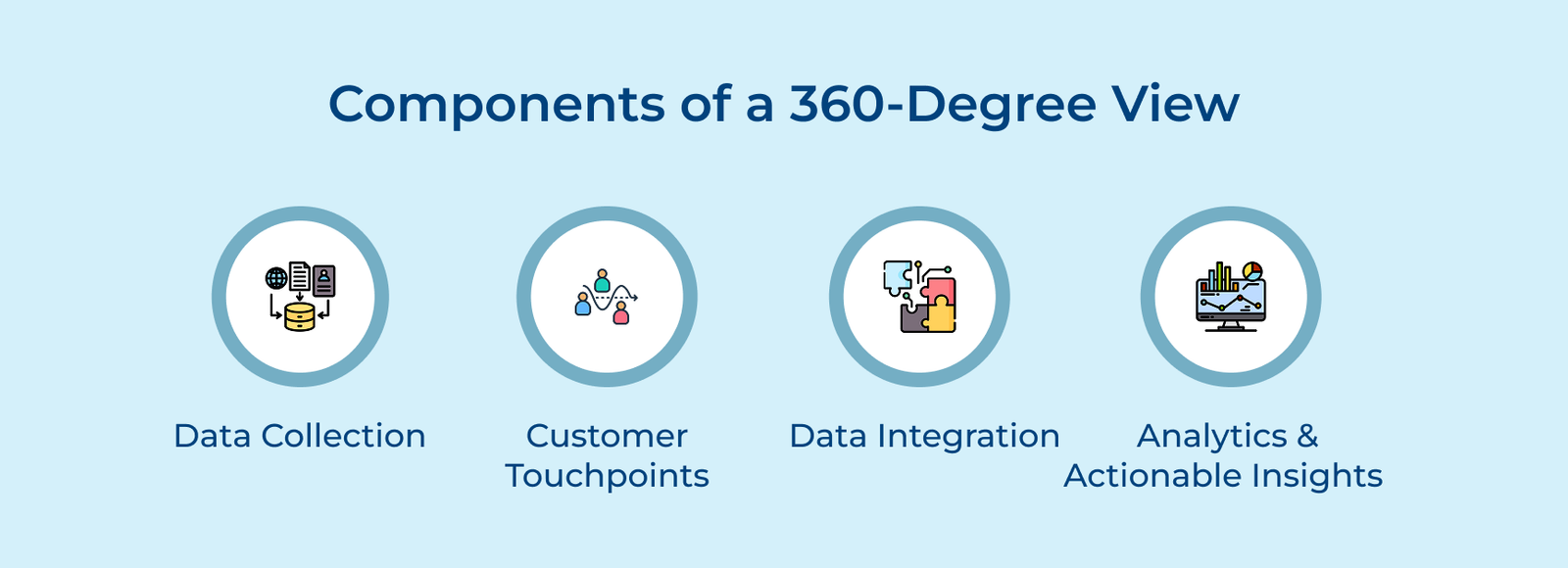
Data Collection
Building a full view of your customers starts with gathering the right information from who they are to how they interact with your business. It includes basics like age and location, but also purchase history or customer feedback. It’s essential to collect the data transparently and with consent, while also keeping it secure to maintain customer trust.
Customer Touchpoints
Touchpoints are moments when customers interact with your brand, like visiting your website, reading emails, or chatting with support. Each interaction shapes their overall experience and influences how they perceive your business.
Data Integration
Once the data is collected, the challenge is connecting it. Information often lives in separate systems, like marketing tools, sales software, service logs and integration brings it all together. The step involves cleaning the data, aligning formats and using the right tools to create one central, up-to-date customer profile that everyone in your organization can access.
Analytics and Actionable Insights
Analytics turns data into something useful. Instead of just knowing what happened, you can spot patterns, understand why it happened and even predict what customers might do next. The insights help you improve how you serve customers, be it in the form of you personalizing offers, fixing pain points or designing better products and support experiences.
Below are crucial practices that will empower you to cultivate a 360 degree customer view, ensuring that your business strategies are impactful.
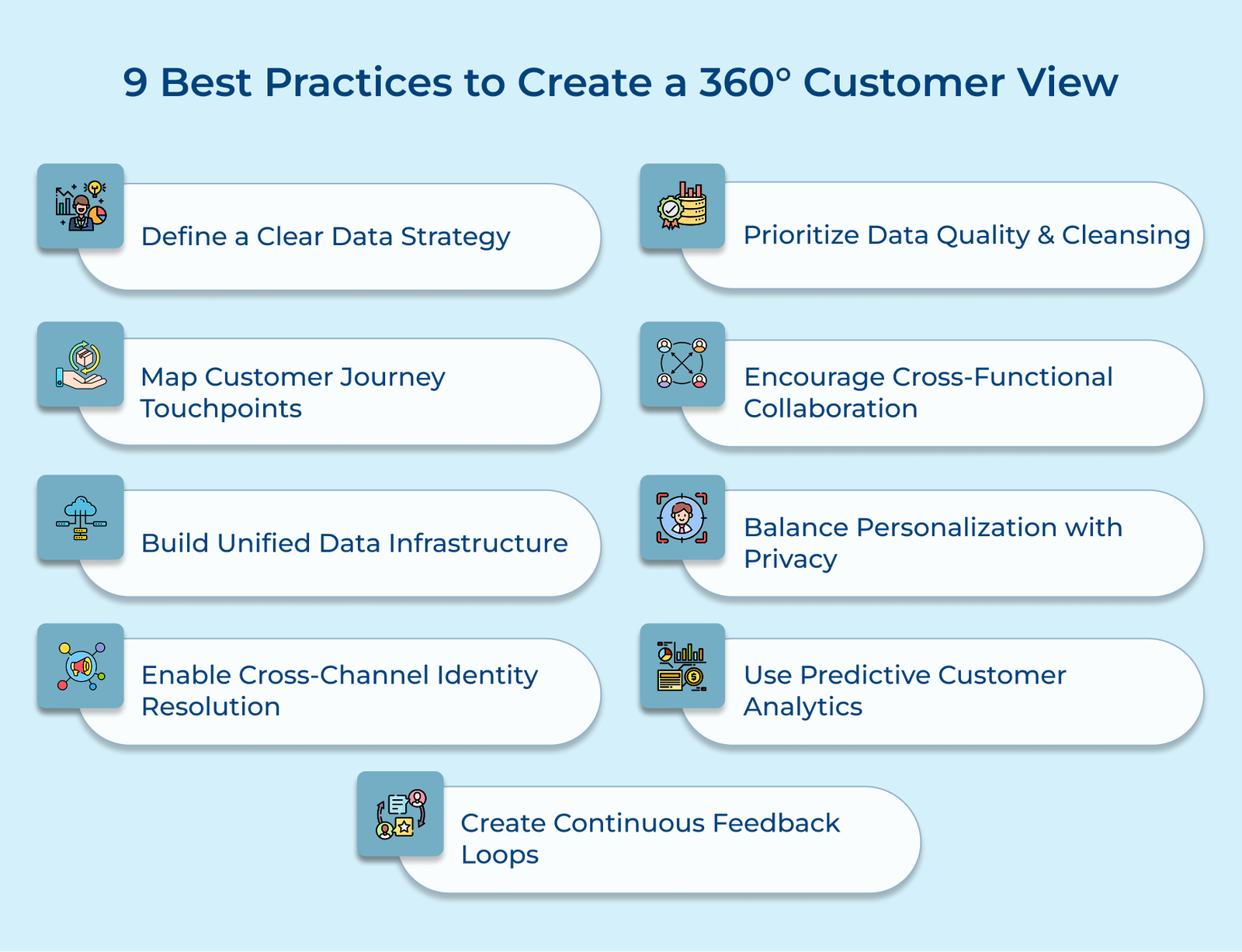
Before building a 360 degree customer view of your customers, you need to know what you’re trying to accomplish. A well-defined strategy helps you avoid collecting data that doesn’t serve a purpose and ensures teams aren’t buried in irrelevant details.
Define Business Objectives
Your customer data must serve specific business goals like increasing retention or improving product development. Start by gathering leadership from across departments to identify the key questions you need to answer about customers and how the insights will drive measurable business outcomes.
Identify Cross-departmental Customer Insights
Different teams look at customers through different lenses. Sales need insight into buying habits, support teams need service history and marketing wants engagement patterns. Create a shared outline of the types of customer information each team needs, so your data collection is focused and useful across the board.
Create Strong Governance Frameworks
You can’t build trust or use data effectively without solid governance. Decide how customer information will be collected, who can access what, how it will stay up to date and how you’ll protect sensitive details. Assign clear ownership so someone is always responsible for accuracy and compliance.
Customer journey mapping lays out every step a customer takes when interacting with your business from first contact through purchase and post-sale support. The view helps you spot where important customer data is being collected or missed entirely.
You can uncover pain points, moments of confusion or areas where the experience works well by seeing the journey from the customer’s point of view. The insights show you where your business can do better and where it can collect meaningful data to improve future interactions.
Pro tips:
A unified data infrastructure is what connects all your scattered customer information into one organized system. Without it, data remains locked away in separate tools, marketing knows one thing, support knows another and no one has the full picture. The disconnect makes it hard to truly understand or serve your customers.
Building a unified data infrastructure takes planning, but it’s the only way to ensure your customer data is accurate, connected and useful across your organization. Without it, even great data collection efforts can fall flat.
When customers use different devices or channels, like browsing on mobile and later calling support, they often seem like separate individuals in your systems. Cross-channel identity resolution is the process of connecting the fragmented pieces into one accurate profile.
Create Unified Customer Identifiers
A unified identifier is the anchor that connects all of a customer’s actions. It could be an email address, account number or a mix of multiple details. You’ll need clear rules about which identifiers take priority and how to match records when there are inconsistencies, like different spellings or missing information.
Implement Anonymous Visitor Tracking
People often interact with your business before ever logging in or providing their name. Using tools like cookies or device fingerprinting, you can track these early interactions and begin building partial profiles. Later, once the person shares identifiable information (like an email), you can link the earlier behaviors to their full customer record.
Design Robust Record Merging
Your systems may have multiple entries for the same customer. One might say “Jon,” another says “Jonathan.” Smart merging tools look for patterns and similarities, then combine matching records into one clean profile. The process must be careful, as merging the wrong records can lead to confusion or privacy issues.
No matter how advanced your systems are, they’re only as good as the data they rely on. If your customer profiles are filled with outdated, inconsistent or incomplete information, you’ll end up making poor decisions and possibly losing trust along the way. Strong data quality management ensures your 360-degree customer view stays accurate and useful.
Establish Automated Validation Protocols
Use automated tools to review new data before it enters your system. The checks look for things like invalid formats, missing fields or conflicting details and either fix or flag problems right away. Catching issues early keeps your customer database clean from the start.
Implement Regular Data Auditing
Over time, even well-maintained databases can slip. A structured audit helps regularly assess data health by spotting duplicates, outdated contacts and field inconsistencies. Set benchmarks so you can track progress and spot trouble areas before they affect performance.
Create Incomplete Data Processes
Incomplete data processes establish standardized approaches for handling customer records with missing or unverified information. The frameworks guide when to request more data, use modeling to fill gaps or segment incomplete records to preserve useful insights without skewing analysis.
Building a full view of your customers isn’t something one department can do alone. Salespeople might understand buying habits. Support sees where people struggle. Marketing knows what grabs attention. Product hears feedback on what works and what doesn’t. A complete picture only comes into focus when everyone shares what they know.
When teams collaborate around a shared understanding of the customer, decisions improve. Opportunities become clearer. Missteps are avoided. Most importantly, your business responds faster and smarter because everyone’s working from the same page.
Personalization helps you deliver better experiences. But collecting and using customer data comes with real responsibilities. People expect companies to respect their privacy and laws like GDPR or CCPA make that expectation a legal requirement. Mishandling data doesn’t just lead to fines as it also damages trust. The key is to find a thoughtful balance between using data and protecting it.
Personalization doesn’t have to come at the cost of privacy. When you respect people’s boundaries and give them real choices, they’re more likely to share information that helps you serve them better. Over time, that creates a stronger, more trusting relationship and a smarter, more complete view of your customers.
Predictive analytics helps you move from reacting to problems to preventing them. You can make informed guesses about what customers are likely to do next by analyzing patterns in your customer data, both past and present. Predictive analytics can be applied across the entire customer lifecycle to enhance every aspect of your customer relationship management strategy.
The models can identify which prospects are most likely to convert, which products existing customers might want next, when customers are at risk of churning and how different segments respond to various marketing approaches or service strategies.
Actionable tips:
Check out the benefits of adopting a 360 customer view to understand how it can transform your business strategy for the better.
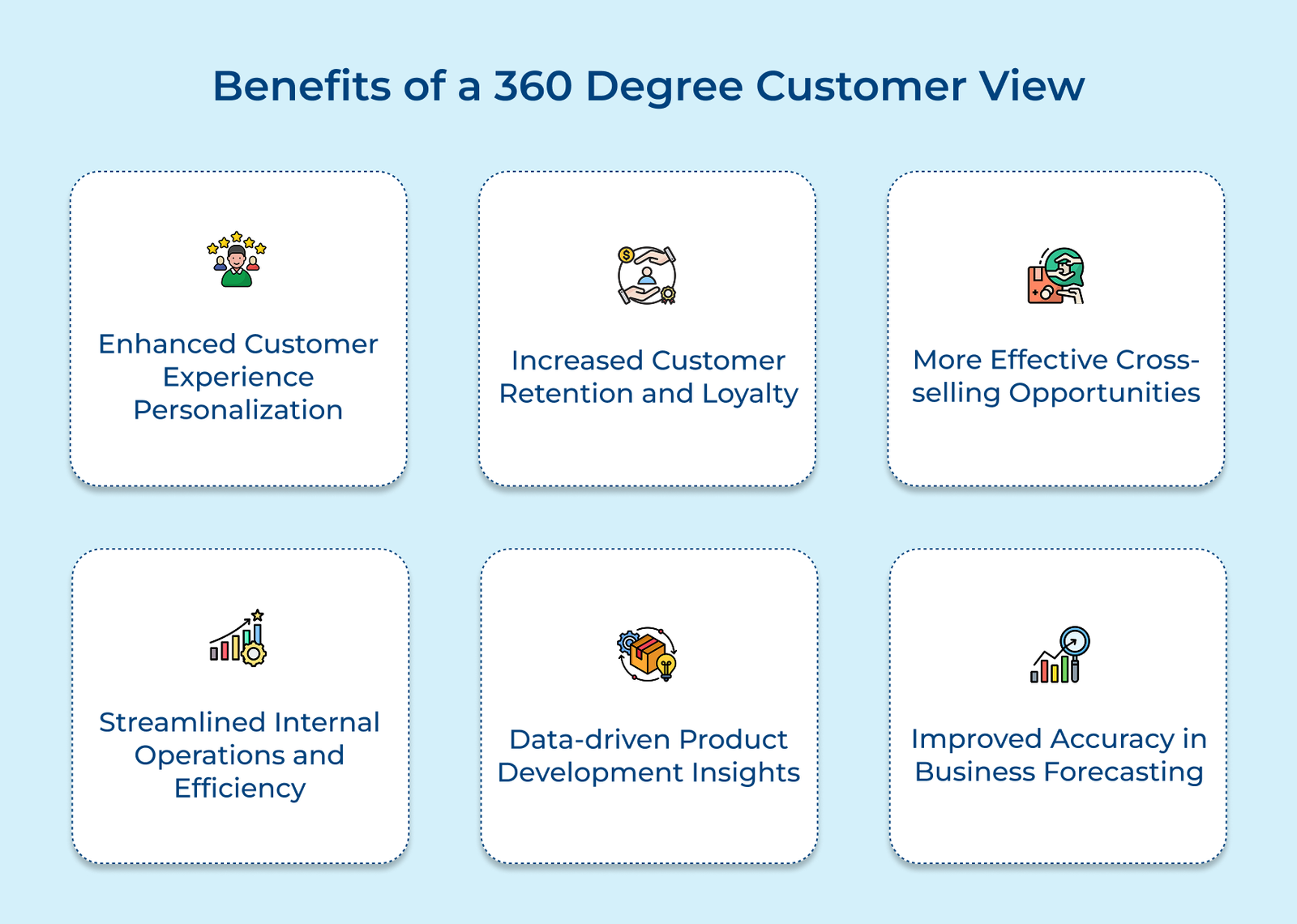
Enhanced Customer Experience Personalization
A full view of each customer allows your team to personalize interactions with real context. Support agents know past purchases and issues before the conversation starts. Marketers send messages based on actual behavior, not assumptions. Customers feel recognized, not just targeted.
Increased Customer Retention and Loyalty
You can notice early signs that someone may be losing interest, fewer logins, longer gaps between purchases or new complaints by tracking the entire customer journey. It gives you time to respond with meaningful solutions before they quietly walk away.
More Effective Cross-selling Opportunities
When you understand what someone’s already bought and when they’re more likely to say yes to the right follow-up offer. A 360-degree view helps you recommend products that make sense, when they make sense, reducing spammy outreach and boosting conversions.
Streamlined Internal Operations and Efficiency
When teams share one source of truth about a customer, you eliminate repeated questions and clunky handoffs. Everyone’s on the same page from sales to support to fulfillment, which saves time and reduces mistakes.
Data-driven Product Development Insights
You see where things work well or where they fall short by connecting how customers use your product with what they say about it and when they need help. It helps product teams focus on fixes or upgrades that matter.
Improved Accuracy in Business forecasting
Your business forecasts become more grounded with deeper customer insights. Instead of relying on guesswork or last year’s numbers, you can anticipate trends based on current behavior, improving how you plan for inventory, staffing and revenue.
Below are the key obstacles businesses encounter when striving for a 360 degree customer view and provide insights on how to navigate them effectively.
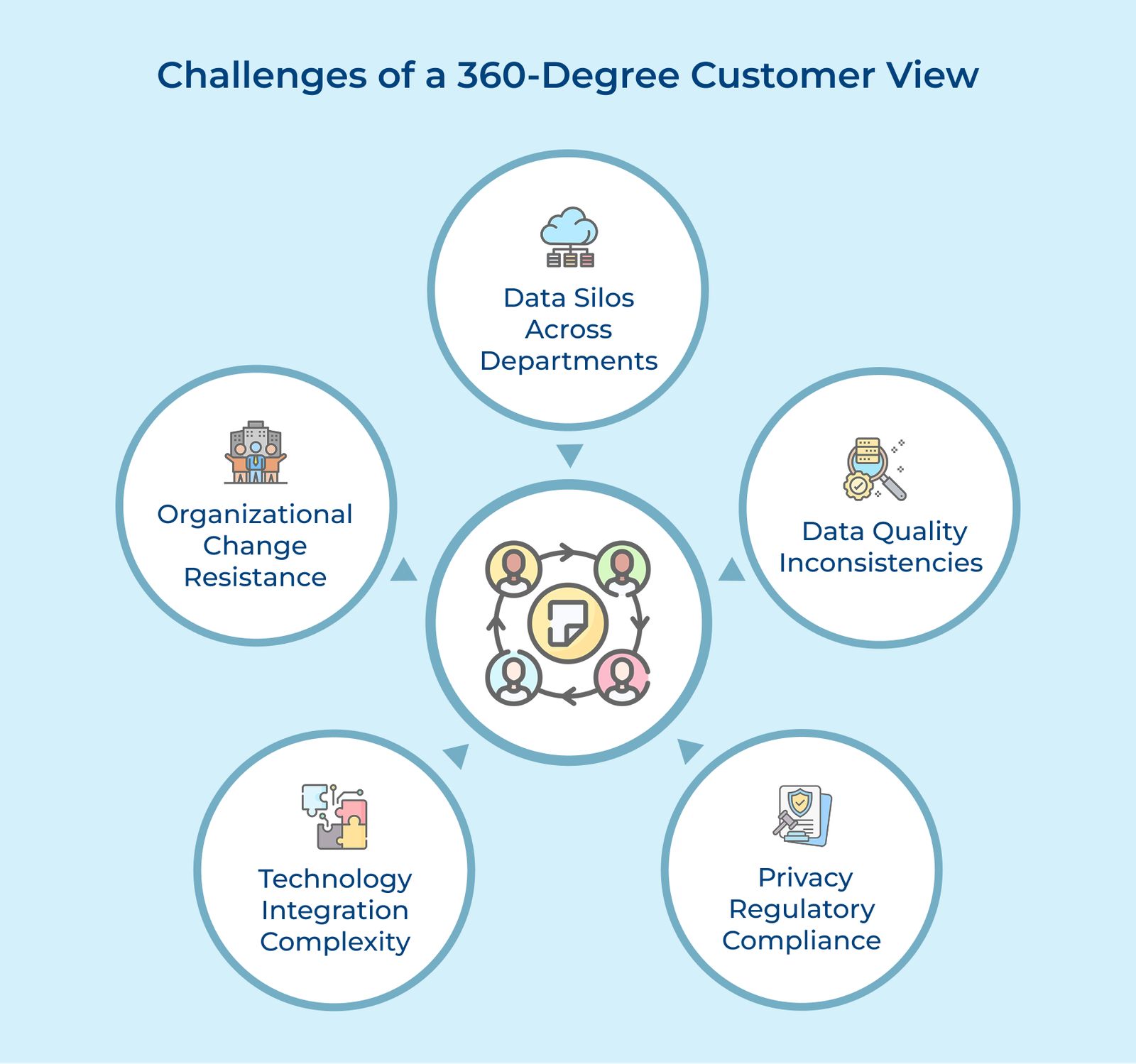
Departments often maintain customer data in isolation. Marketing might track ad interactions while sales stores purchase history, each in separate systems. The silos make it hard to see the full customer picture and result in inconsistent communication.
Set up a central customer data platform to serve as your single source of truth. Standardize your data structure and create automated connections between systems. Make it policy that all customer-facing teams use and contribute to this shared system.
Customer records often include duplicates, missing fields, outdated info or mismatched formats. The errors multiply when data from different systems is combined, leading to decisions based on unreliable information.
Use automated checks to clean and format incoming data. Run routine data audits to remove duplicates and outdated records. Assign clear data ownership so someone is always responsible for keeping records accurate and verified.
Data privacy laws are strict and vary depending on location or industry. Failing to follow them can lead to heavy fines, customer complaints and public distrust.
Build privacy into your system design from the start. Set up tools that record user consent and give customers control over what data they share. Only collect what you need and keep detailed records of how data is handled to stay audit-ready.
Many companies still rely on legacy systems that easily connect to newer tools. The lack of compatibility blocks data sharing and slows access to real-time customer insights.
Don’t try to overhaul everything at once. Start with a phased plan. Use API-based integrations to link older platforms with modern tools. Consider cloud-based data systems that come with ready-made connectors for faster setup.
Unifying customer data requires teams to shift how they work and share information. Some may resist giving up control of their data or question data from other departments. The people challenges are harder than the technical ones in many cases.
Get leadership to back the effort publicly and consistently. Create a cross-functional team to lead the project and represent all key departments. Update performance metrics to reward collaboration and run training sessions to show how shared data helps everyone do their jobs better.
Below are some businesses that have mastered the 360 customer view approach. Let’s check them out in more detail.
Amazon
Amazon builds its 360-degree customer view by combining data from browsing history, purchases, reviews, wish lists and support chats. They also link data from Prime Video, Alexa and physical stores to create a complete customer profile.
The integration lets Amazon anticipate customer needs, suggest relevant products and manage inventory based on likely demand. Their deep understanding of individual behavior supports personalized experiences and powers one of the most effective recommendation engines in e-commerce.
Starbucks
Starbucks relies heavily on its rewards app to build customer profiles, tracking purchases, location, drink preferences and payment methods. The data is merged with email responses, social activity and in-store behavior.
The result is more than just targeted offers. Starbucks uses the insights to shift traffic during peak times, offer timely rewards and streamline service, all of which improve customer satisfaction.
Disney
Disney uses MagicBands, streaming services, hotel data and merchandise history to create connected guest profiles. Their system links digital behavior with real-world park activity to map the full guest journey.
The approach allows Disney to manage crowds more efficiently, personalize experiences based on preferences and provide seamless transitions across parks, hotels or digital platforms. The payoff is smoother visits and higher guest spending.
Sephora
Sephora gathers data through its Beauty Insider program, mobile app, virtual try-ons, purchase history and in-store consultations. Quiz answers and product reviews are also factored into individual profiles.
The data-driven approach turns Sephora into more than a retailer, it becomes a personalized beauty guide. Customers get tailored product suggestions based on skin type, tone and preferences, deepening loyalty.
Spotify
Spotify builds its customer view from listening habits, playlist creation, time-of-day usage, and social sharing. They combine it with demographic information and third-party app integrations to map out unique music profiles.
The insights help Spotify deliver hyper-personalized playlists, surface new artists and boost listener retention. Understanding what users like and when makes their recommendations feel intuitive.
A 360-degree customer view turns scattered data points into a complete picture of who your customers are, not just what they’ve bought. It connects interactions across all departments and channels, helping you understand each customer’s full experience with your business over time.
The most successful businesses recognize that creating the unified customer view isn’t just a technical challenge but a strategic imperative. Building a unified view means connecting systems, improving data accuracy and handling personal information with care. Done well, it equips teams across marketing, sales and support with better context, helping them make smarter decisions.
Key takeaways:

A 360-degree customer view is a single, complete profile that brings together all the data your business has about a customer. It pulls from every touchpoint, like purchases, support conversations, website visits, emails, social media platforms and in-person interactions to give you a full picture of their relationship with your company over time.
Your business can respond more intelligently with a full view if each customer. Marketing teams can create messages based on actual behavior, not just broad categories. Customer support teams can resolve issues faster with full context. Sales teams can spot the right time for follow-ups or product suggestions. Product teams can see what’s working and what’s not, based on how customers use what you offer.
Major hurdles include disconnected systems that don’t share data, inconsistent data formats and duplicate or outdated customer records. Privacy regulations also add complexity, requiring careful handling of personal information and clear consent from customers.
Core tools include a Customer Data Platform (CDP) to centralize information, integration software to connect systems and identity resolution tools to match customer records across channels. Analytics platforms and dashboards then turn the data into insights that teams can use day-to-day.
Timelines vary, but most organizations take 8 to 18 months, depending on the complexity of their systems and data quality. A phased rollout, starting with the most valuable use cases, often works best. Success depends as much on team collaboration and process changes as it does on the technology itself.
Look for clear signs of impact like better customer retention, faster service resolution, increased lifetime value and improved satisfaction scores. Internally, it’s also a success if teams use the shared data to make decisions, adoption is as important as the data itself.

Grow Customer Relationships and stronger team collaboration with our range of products across the Conversational Engagement Suite.
Omnichannel Customer Support & Help Desk Software
AI Enabled Business Messaging and Chatbot Software
Sales Engagement & CRM Software
Call Center Software & Virtual Phone System
Product Marketing & Experience Platform
Customer Experience & Feedback Management Software

 How To Create an Effective Sales Funnel Report? 7 Key Steps
Scroll to top
How To Create an Effective Sales Funnel Report? 7 Key Steps
Scroll to top