What is Customer Feedback Analysis?
Customer feedback analysis helps you interpret customer opinions, identify patterns and uncover improvement areas. It also helps to make informed decisions that enhance offerings and customer experience.

Customer feedback analysis helps you interpret customer opinions, identify patterns and uncover improvement areas. It also helps to make informed decisions that enhance offerings and customer experience.
Thousands of customers told you exactly what was wrong and that information is sitting unread in a spreadsheet somewhere. A support ticket marked “resolved” hides a frustrated user who never came back and a four-star review with one offhand complaint gets filed away as a win because nobody had a structured way to read past the surface. The feedback existed, but the signal just never made it to the people who needed it.
Businesses now collect more customer input than at any point in history, and the numbers show that up to 75% of customers do not think businesses are acting on their feedback. The guide covers practical techniques to build a repeatable customer feedback analysis process that surfaces what customers actually mean, not just what they say.
Customer feedback analysis refers to the structured process of collecting customer opinions and turning them into clear actionable insights. It examines comments about products, services and experiences across multiple channels. The practice helps businesses understand customer sentiment and identify patterns in their feedback.
Imagine reviewing thousands of customer conversations and identifying consistent patterns. The focus is not on isolated praise or complaints but on repeated signals that reveal strengths and weaknesses in the overall experience.
Key objectives:
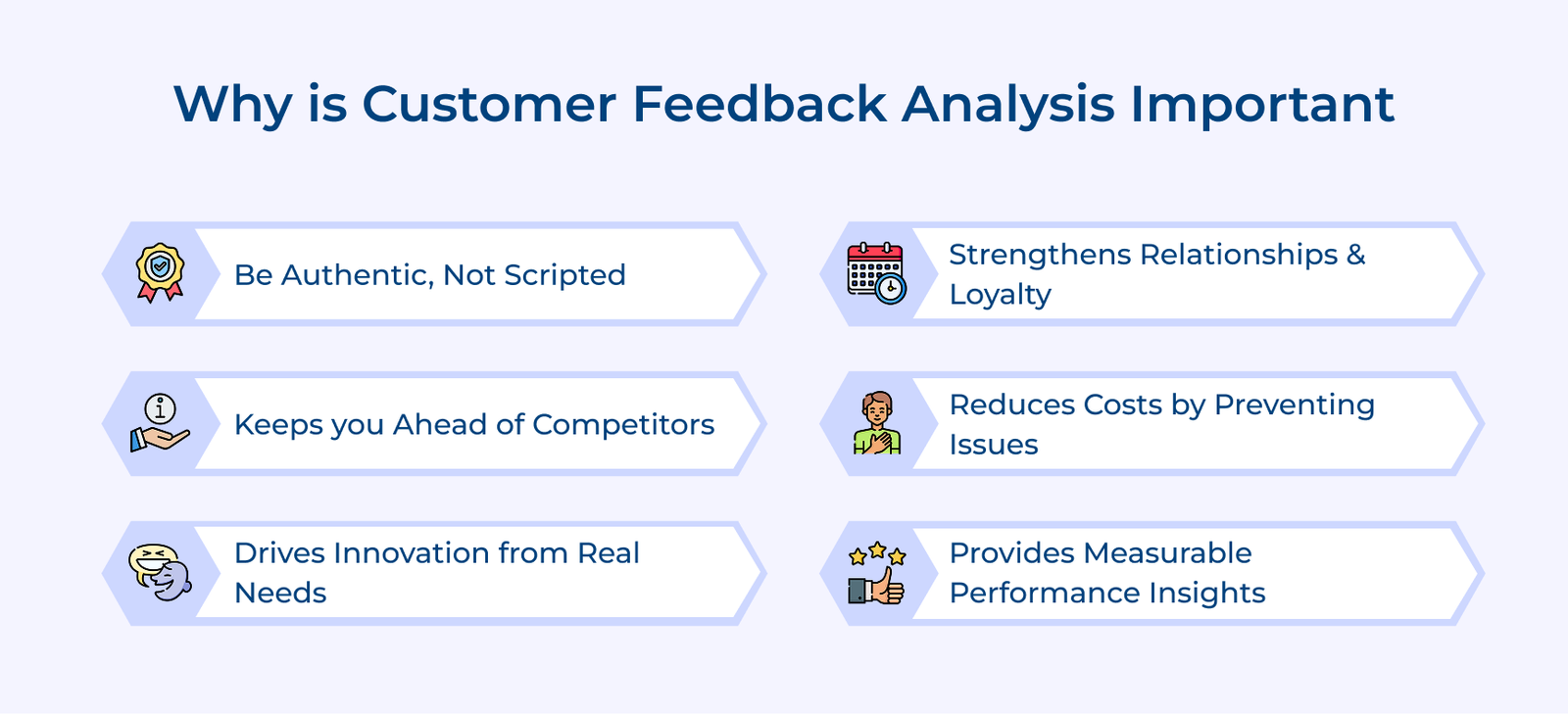
The following are six compelling reasons why analyzing what your customers tell you matters so much. Let’s check them out in more detail.
Reveals What Customers Actually Want
Assumptions about customer preferences are often incomplete. Feedback highlights the features customers value most and the problems they want solved first. Direct input replaces guesswork with evidence.
Strengthens Client Relationships and Builds Customer Loyalty
Listening and responding to feedback shows customers that their opinions matter. Visible improvements based on their input increase trust and encourage repeat business. Consistent action builds credibility and strengthens long-term relationships.
Reduces Costs by Preventing Bigger Problems
Catching issues early through feedback costs far less than fixing major disasters later. You can address small complaints before they snowball into product recalls or reputation damage. Prevention always beats damage control.
Drives Innovation Based on Real Needs
Customer suggestions often reflect real usage experiences. Insights from the interactions guide product improvements and feature development aligned with actual demand. Clear patterns in feedback help prioritize updates that deliver the greatest impact.
Provides Measurable Proof of Business Performance
Feedback data offers clear benchmarks to evaluate progress. Tracking satisfaction trends over time provides measurable evidence of improvement linked to specific actions. Consistent measurement supports more informed decisions and stronger accountability.
Check out five practical methods that businesses use to make sense of what their customers are telling them.
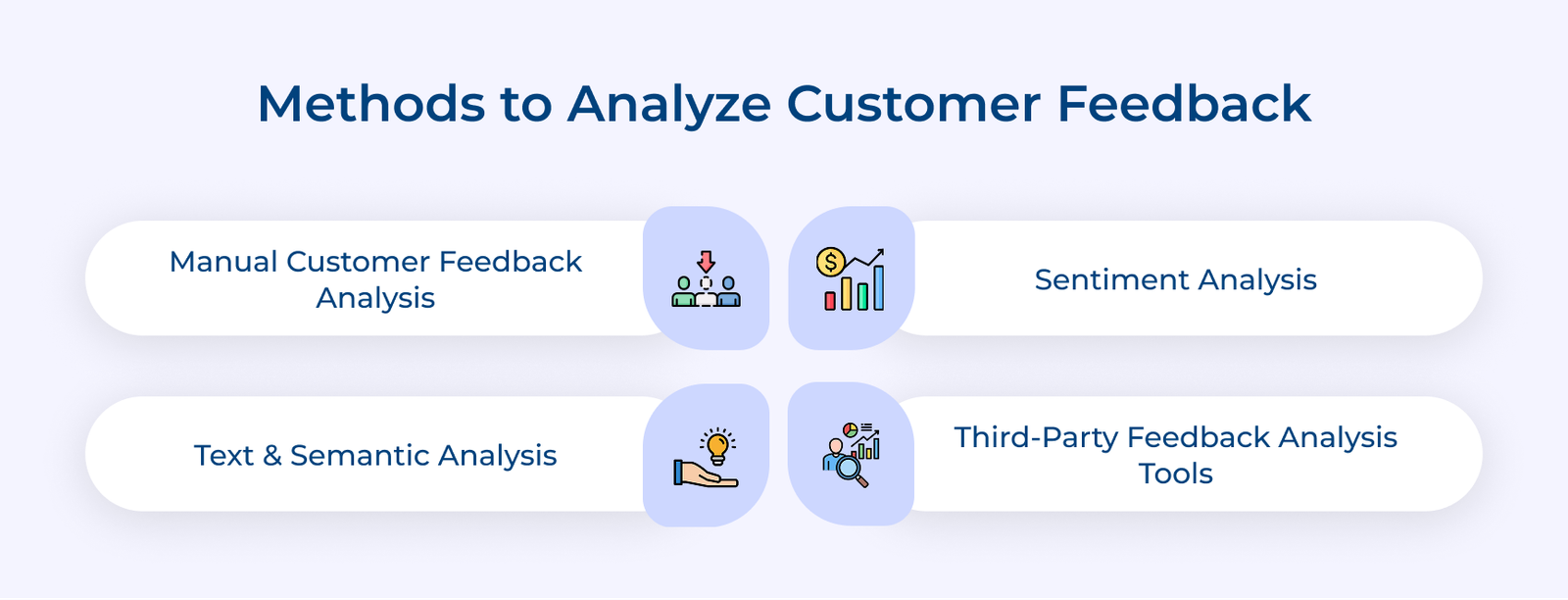
Manual analysis involves reviewing customer comments directly and identifying patterns without relying on automation. Surveys, customer reviews and support tickets are examined closely to understand what customers are communicating. The approach provides context that automated systems may overlook.
Pro tips:
Human judgment helps interpret tone and intent more accurately. You can sense when a customer is joking versus when they’re genuinely frustrated. Your brain connects dots that algorithms might overlook because you bring real-world experience to the interpretation.
Sentiment analysis uses software to classify customer feedback as positive, negative or neutral. The system scans language patterns and assigns emotional scores based on wording or tone. Large volumes of comments can be processed quickly, making it easier to spot overall trends.
Key questions:
Technology works best when you combine it with human judgment. Automated sentiment scores give you the big picture trends across thousands of responses. You then dive deeper into specific comments to verify what the numbers are telling you.
Text analysis reviews the words and phrases customers use to describe their experiences. It highlights recurring themes, repeated topics and common language patterns across surveys, reviews or support messages. Clear patterns reveal what customers mention most and which issues appear consistently
Actionable tips:
Semantic analysis moves beyond individual words and focuses on meaning. It recognizes that phrases such as not bad carry a different tone than clearly positive statements. Concept mapping shows how different parts of the customer experience connect and influence each other.
Third-party tools are software platforms built to collect and analyze customer feedback at scale. Providers such as Qualtrics, Medallia and SurveyMonkey centralize data from multiple channels. The platforms combine various analysis methods into one unified system that you can access.
Key questions:
The platforms automate tasks such as tagging comments and generating reports. Built-in visualizations convert raw data into clear charts and summaries that stakeholders can review quickly. Cost and training requirements should be weighed against the efficiency gains.
The following are six reliable sources that businesses use to gather genuine customer insights. Let’s check them out in more detail.
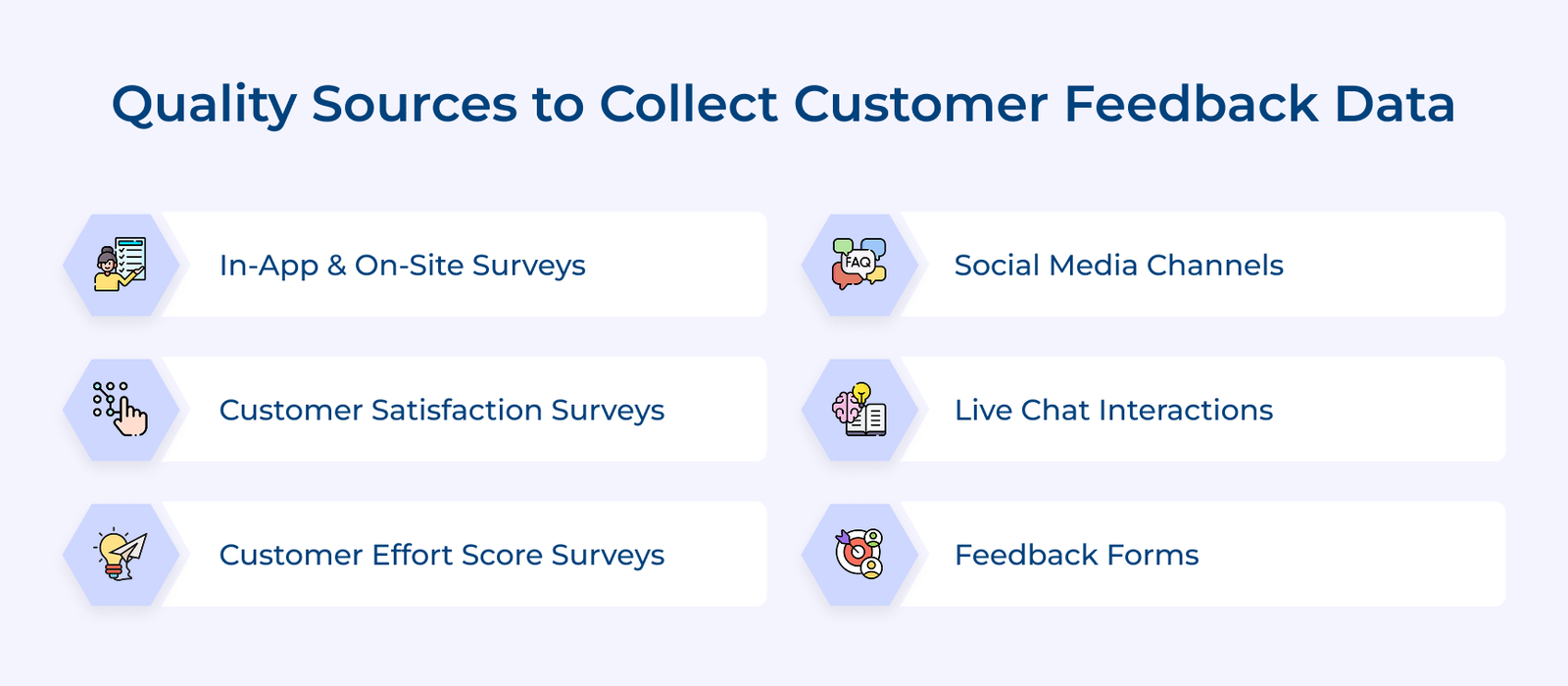
In-app and on-site surveys collect feedback while customers are actively using your product or browsing your website. Questions appear at key moments, so responses reflect fresh experiences instead of distant memories.
Key ways:
The approach connects feedback to real behavior. A software company can trigger a survey after a user tries a new feature to assess clarity and ease of use. Survey responses combined with usage data reveal patterns such as longer completion times or repeated errors, helping teams identify areas that need adjustment.
CSAT surveys measure satisfaction with specific interactions through simple rating scales that range from unsatisfied to satisfied. Responses provide a quick numerical view of how customers feel after moments such as a purchase or support conversation.
CSAT works well because it converts opinions into measurable scores while leaving space for short explanations. An ecommerce business can send a survey after checkout to evaluate the buying experience and identify which steps caused ease or frustration.
CES surveys ask customers how easy or difficult it was to complete a task or resolve an issue. The emphasis is on effort rather than satisfaction, helping you understand how much work customers must put in to achieve their goals.
Key points:
CES is valuable because ease strongly influences repeat business. A B2B company can send a CES survey after system setup to assess how smooth the implementation felt. Responses reveal areas that require simplification to reduce frustration and improve retention.
Social media platforms act as open feedback channels where customers share opinions publicly without being asked. Platforms such as Twitter, LinkedIn, Facebook and Instagram contain ongoing conversations about solutions that customers start on their own.
The source reflects candid sentiment because responses are not shaped by survey questions. An ecommerce brand can monitor Instagram comments and tagged posts to observe how customers use products in daily life. It can identify recurring praise or problems that may not appear in formal surveys.
Live chat transcripts capture real-time conversations between customers and support teams as issues arise. The discussions reveal concerns and expectations in the customer’s own words during moments that matter most.
Key ways:
The source stands apart from surveys because it contains detailed, situation-specific insights. A software company can review chat logs to identify features that repeatedly confuse users and pinpoint interface elements that require clearer instructions or labeling.
Below are practical tips to elevate your customer feedback analysis, ensuring you make the most of every customer interaction.
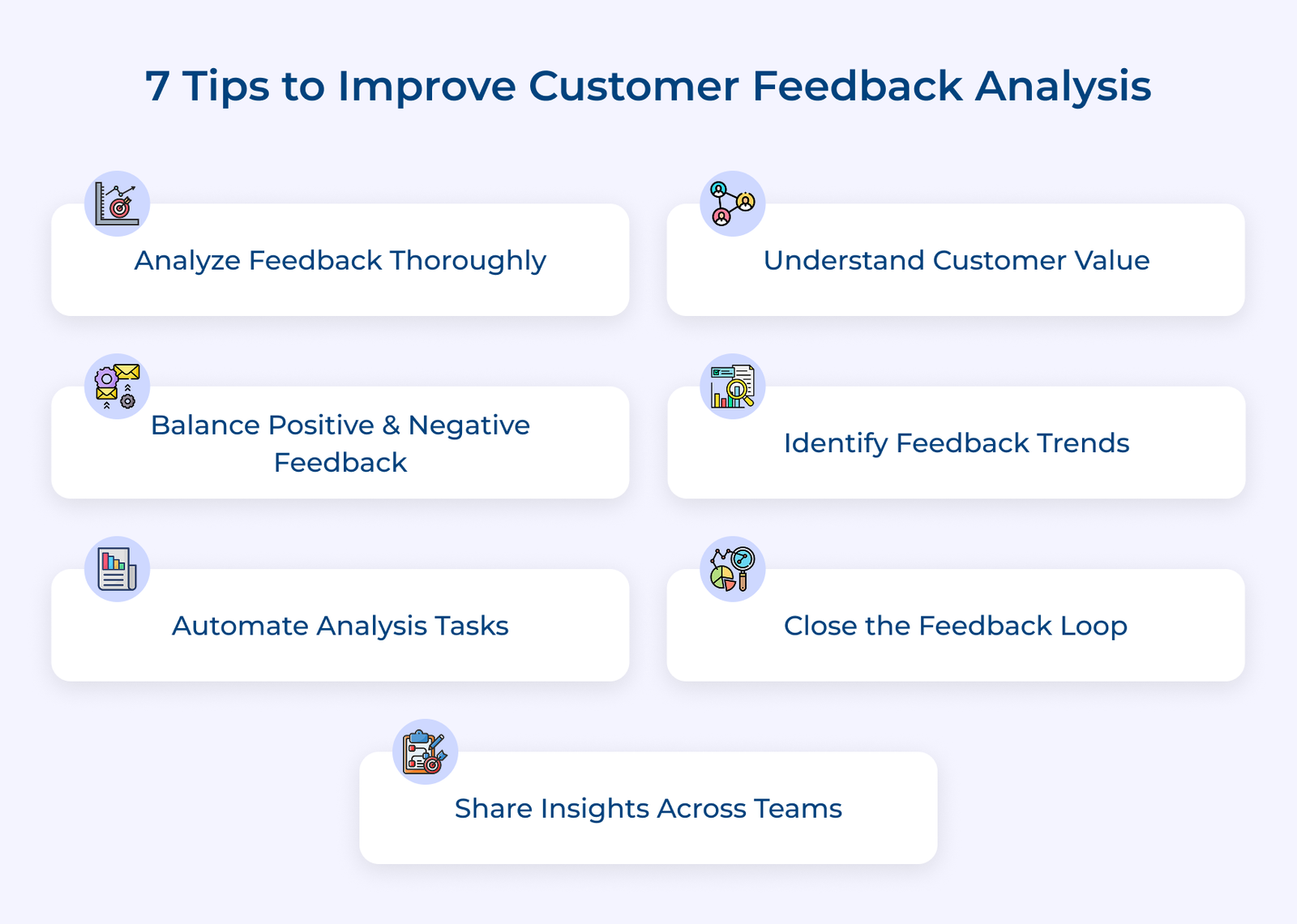
Analyzing all customer feedback requires reviewing every comment and review regardless of the source. Valuable insights often appear in unexpected places. Ignoring certain channels creates gaps in understanding and leads to incomplete conclusions.
Key approaches:
Understanding each customer’s unique value requires recognizing that not all feedback carries the same business impact. Input from a long-term, high-revenue client may require faster action than similar comments from a short-term or low-value account.
Key questions:
The questions support smarter prioritization. A feature request from a high-revenue client in a growth segment deserves closer review than the same request from a smaller account. Use the insight to design a weighted feedback system that highlights input from high-value customers. Segment feedback within analysis tools so teams understand not only how many customers request a change but also which tiers those customers represent.
Balancing negative and positive feedback means giving equal attention to both criticism and praise. Positive insights highlight what delights customers, while negative feedback uncovers friction, creating a full picture of your customer experience
Extract Lessons from Complaints and Praise
Critical feedback points to problems, but positive feedback reveals what sets your business apart. When customers praise certain features or interactions, they signal what drives loyalty and what should remain unchanged during updates or improvements.
Identify What you’re Doing Right to Replicate
Understanding successes allows you to reinforce effective strategies and apply winning elements to weaker areas. If onboarding delights customers but billing frustrates them, analyze onboarding to extract principles that can improve the billing experience.
Use Criticism to Prioritize Improvement Areas
Complaints highlight where the experience breaks down and guide meaningful change. Categorize negative feedback by frequency and impact to address the issues that affect the most customers or cause the strongest frustration first.
Identifying trends means looking beyond individual comments to find recurring themes that point to systemic issues or opportunities. Treating feedback as isolated remarks risks missing the bigger picture that emerges when multiple customers highlight similar experiences.
Pro tips:
Trend identification requires distinguishing meaningful patterns from random variation or seasonal spikes. A holiday surge in shipping complaints might reflect broader industry delays rather than internal issues.
Combine quantitative thresholds with qualitative data to confirm that trends reflect real changes in customer experience. Set clear benchmarks for when patterns demand action and always verify context before making decisions based on feedback trends.
Automating repetitive analysis tasks uses software to handle routine data processing that would otherwise consume hours of manual work. Your team’s time is better spent interpreting insights and making strategic decisions rather than sorting thousands of comments manually.
Key takeaways:
Closing the feedback loop means showing customers how their input influenced real change. Customers who see results from their suggestions stay engaged and keep sharing valuable insights, while ignored feedback leads to disengagement.
Key questions:
You can close the loop through different channels depending on the feedback source and customer value. High-value clients might get personal emails showing how their enterprise request shaped your roadmap. Broader audiences could see product updates highlighting community feedback that inspired new features.
Best practices:
Sharing insights across teams means distributing customer feedback to every department that touches the customer experience. Product, sales and support teams all benefit when they see a complete view of what customers are experiencing or saying.
Distribute feedback findings to all relevant departments
Teams often work in silos and make decisions based on partial information. Marketing might highlight features customers find confusing, while the product builds solutions to problems already addressed. Sharing feedback ensures each department acts on the full story.
Connect product teams directly with customer pain points
Product developers gain clarity when they hear customers describe struggles in their own words. Reviewing support transcripts and survey responses helps teams build features that solve real problems rather than assumptions.
Help sales teams understand common customer objections better
Sales benefit from learning which customer concerns arise after purchase. Post-purchase feedback shows which promises cause disappointment and which value propositions actually resonate, helping sales set accurate expectations upfront.
The following are four powerful options that businesses rely on to make sense of what their customers are telling them.
Veemo Survey is a feedback collection and analysis platform that helps businesses design surveys or gather customer insights using customizable questionnaire templates. The platform simplifies survey setup and provides clear analytics to help teams understand response patterns and overall sentiment.
Key features:
Omni24 is an AI-powered customer experience platform that converts customer feedback into clear, usable insights. The system gathers input from multiple channels and analyzes patterns in sentiment or recurring issues so teams can respond with focus.
Key features:
Qualtrics is an enterprise-level experience management platform that combines advanced survey design with detailed analytics. Large organizations use it to manage high volumes of feedback across many touchpoints. Built-in analysis tools help teams detect patterns and shifts in customer sentiment with clarity.
Medallia focuses on real-time feedback collection and analysis so businesses can respond to issues as they arise. The platform brings together data from surveys, social media, chat and other channels to present a unified view of customer experience across departments.
SurveyMonkey provides a simple starting point for businesses beginning structured analysis. The platform offers intuitive survey creation and clear reporting dashboards. Ready-made templates support both basic satisfaction surveys and more detailed research projects.
Check out four challenges that businesses commonly face and how they can trip up even experienced teams.
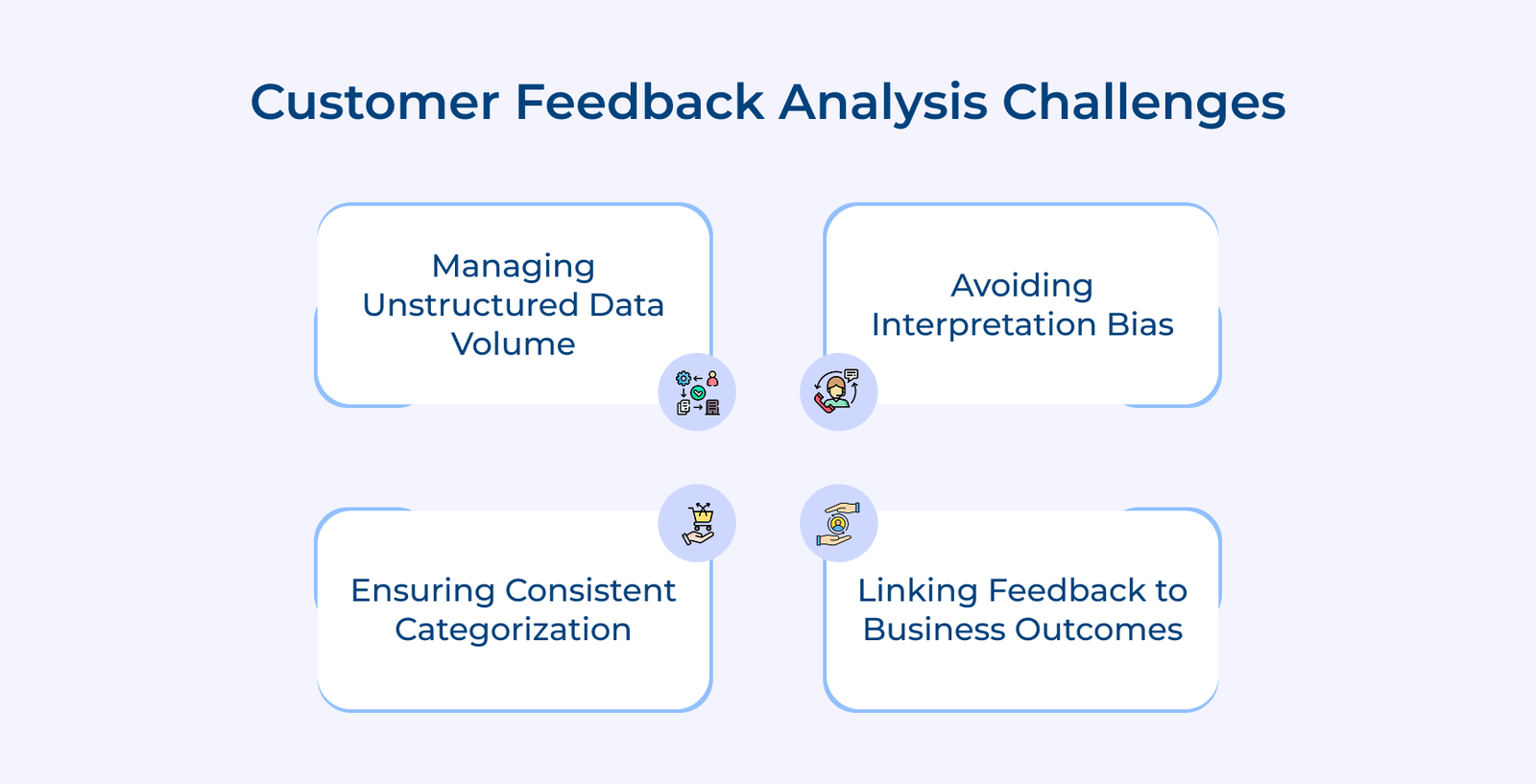
1. Overwhelming Volume of Unstructured Data
Businesses receive thousands of comments, reviews and messages in different formats with no consistent structure. Reading everything manually is not realistic. Teams struggle to separate meaningful patterns from background noise when every comment appears urgent at first glance.
2. Bias in Interpretation and Selection
Analysts often give more weight to feedback that supports existing beliefs and overlook input that challenges assumptions. Extreme complaints or glowing praise attract attention, while balanced and moderate experiences receive less focus, even though they represent the majority.
3. Inconsistent Categorization Across Team Members
Team members may label the same feedback in different ways because interpretation depends on personal experience and perspective. A pricing concern might be tagged as a product issue by one person and a sales issue by another. Inconsistent tagging reduces the reliability of trend analysis.
4. Disconnecting Feedback from Business Outcomes
Feedback is sometimes reviewed without linking it to metrics such as retention, revenue or customer lifetime value. Teams may work to improve satisfaction scores without confirming that those improvements influence measurable business results.
Implementation tips to overcome the challenges:
Customer feedback analysis turns raw opinions into practical direction when approached with structure and consistency. Tools or methods help, but steady listening across channels and clear follow-through matter more than any specific platform you use.
Real progress happens when you respond to customers and share insights across teams so everyone sees the same customer reality. Begin with one feedback source, learn from it and expand gradually as you gain clarity and observe measurable improvements from the actions you take.

Analyzing feedback shows the difference between how customers actually experience your business and how you assume they do. The gap highlights missed expectations, hidden friction and overlooked strengths. Decisions based on evidence reduce risk and help you catch dissatisfaction early before customers leave.
Customer feedback provides direct insight into what works well and what creates frustration in real use. Careful analysis supports smarter product updates, stronger retention and better resource allocation toward issues that truly affect customers instead of imagined problems.
Insightful data reveals repeated patterns across customers or explains the reasons behind behaviors. Non-insightful data often reflects isolated opinions without context. Focus on feedback that appears consistently, links to measurable outcomes or includes specific details rather than vague statements.
Customer feedback arrives in large volumes across many unstructured formats and requires careful interpretation. Ambiguous language, personal bias and inconsistent categorization complicate analysis. Connecting individual comments to meaningful business impact demands time, structure, and disciplined review.

Grow Customer Relationships and stronger team collaboration with our range of products across the Conversational Engagement Suite.
Omnichannel Customer Support & Help Desk Software
AI Enabled Business Messaging and Chatbot Software
Sales Engagement & CRM Software
Call Center Software & Virtual Phone System
Product Marketing & Experience Platform
Customer Experience & Feedback Management Software

 7 Effective Knowledge Management Best Practices in 2026
Scroll to top
7 Effective Knowledge Management Best Practices in 2026
Scroll to top