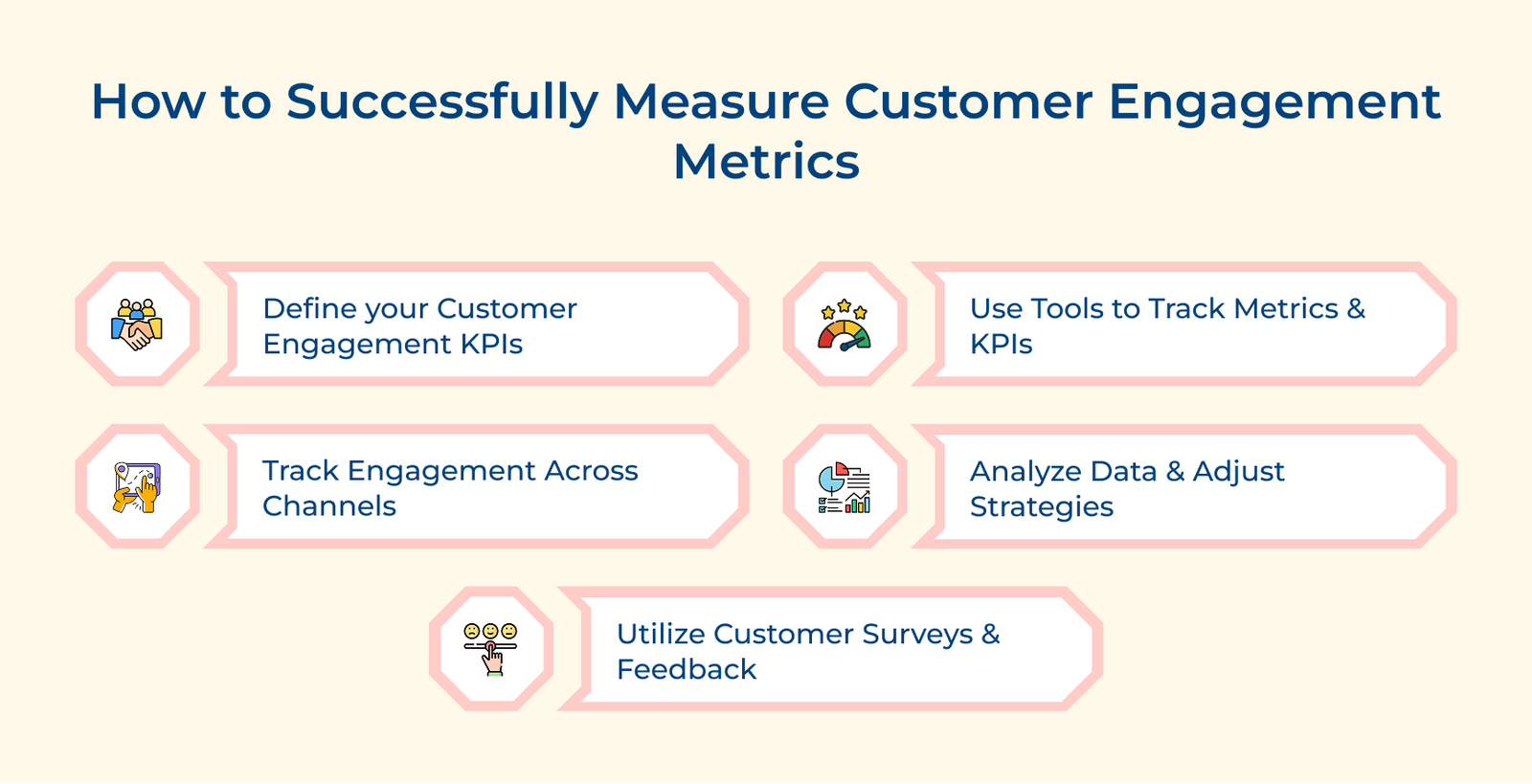
1. Define Your Customer Engagement KPIs
Businesses must define their customer engagement key performance indicators (KPIs) before automating customer service. Metrics such as website traffic, click-through rates, email open rates, and sales conversion rates can be used. Once you have identified the relevant metrics, establish specific KPIs that align with your goals and objectives.
Tailoring the KPIs to align with the specific business goals and objectives is essential. If your primary focus is driving website conversions, metrics like click-through and sales conversion rates become highly relevant. Clearly defining the KPIs will help you establish a benchmark for measuring progress and evaluating the impact of the customer engagement efforts.
Actionable tips:
Identify relevant metrics: Analyze your business goals and customer journey to identify the key metrics that reflect meaningful customer engagement.
Set specific KPIs: Ensure your KPIs are specific, measurable, attainable, relevant and time-bound (SMART).
Regularly review and refine: As your customer engagement strategies evolve, adjust your KPIs to measure your efforts’ impact accurately.
2. Use Tools to Track Your Metrics and KPIs
Accurately measuring customer engagement is dependent on utilizing the right tools for tracking and analyzing the metrics. Different tools cater to specific areas of customer engagement, providing valuable insights into user behavior across various channels. Leverage suitable tools that align with the chosen metrics and KPIs to measure customer engagement accurately.
Google Analytics offers robust capabilities for monitoring website traffic and user behavior. Social media management tools like Hootsuite and Sprout Social enable efficient tracking of social media engagement metrics. Employing the right tools streamlines the data tracking and analysis process, providing valuable insights into your customer engagement performance.
Actionable tips:
Leverage Google Analytics: Track website traffic, user behavior, and conversion rates to gain a comprehensive understanding of how customers interact with your site.
Employ social media management tools: Tools like Hootsuite or Sprout Social enable you to track social media engagement and provide valuable data for optimizing the social media strategy.
Utilize email marketing software: Monitor metrics like open rates, click-through rates and conversions to gauge the effectiveness of the email marketing efforts.
3. Track Engagement Across Channels
Your customers engage with the brand across multiple channels – social media, email, website and in-store. You must track the metrics and KPIs across all channels to accurately measure customer engagement. Businesses can gain a comprehensive view of customer engagement and identify the most effective channels for their business.
Monitoring customer engagement across all the platforms will give you a holistic understanding of your audience’s behavior and preferences. The comprehensive view lets you identify which channels are most effective in engaging your customers, enabling you to allocate resources and optimize your customer engagement strategies strategically.
Actionable tips:
Implement cross-channel analytics: Use tools with cross-channel tracking capabilities to aggregate and analyze data from various touchpoints.
Integrate data sources: Connect different data sources, such as social media platforms, website analytics, and CRM systems, to consolidate customer engagement data.
Create unified customer profiles: Businesses can build a 360-degree view of each customer’s engagement, preferences, and behavior.
4. Analyze Your Data and Adjust Your Strategies
You need to analyze the data to understand what’s working and what’s not. Use the valuable insights gained from your data to adjust your strategies accordingly. Let’s take the example of an e-commerce website that observes a high bounce rate on its product pages. They can adjust their strategies by optimizing the page layout, improving the product descriptions, or simplifying the checkout process.
Identify your engagement strategies’ patterns, strengths, and weaknesses to refine your approach. If the data reveals low social media engagement, consider adjusting your content strategy, experimenting with different formats or platforms, or increasing your social media advertising investment. Regularly analyzing and acting upon your data-driven insights ensures continuous improvement in customer engagement.
Actionable tips:
Conduct regular data analysis: Use visualizations and reports to gain actionable insights from your data, such as identifying the most engaging content or pinpointing bottlenecks in the customer journey.
Test and iterate: Based on the insights gained, implement A/B testing to compare the effectiveness of different approaches and iterate based on the results.
Maintain flexibility: Regularly monitor your KPIs and be open to adjusting your approaches to ensure continued improvement in customer engagement.
5. Utilize Customer Surveys and Feedback
Customer surveys and feedback are invaluable tools for measuring customer engagement. They provide insights directly from your target audience. Designing targeted surveys and implementing mechanisms to collect feedback will help you gather both types of data.