1. Emotional Intelligence
AI can recognize emotion-related keywords like “frustrated” or “satisfied,” but it doesn’t understand how people feel. Its responses are based on patterns, not empathy. It might detect the word “angry” and reply with a pre-written message but it doesn’t sense the stress in a voice, the pause before a word or the subtle shift in tone.
Real-world scenario:
A customer contacts support about a delayed birthday gift for their child. Consider the responses:
- AI says: “Your order #12345 is delayed. The new delivery date is Tuesday.”
- A human says, “I can hear the gift is really important. Let me check if we can speed up the delivery or find something just as special in time.”
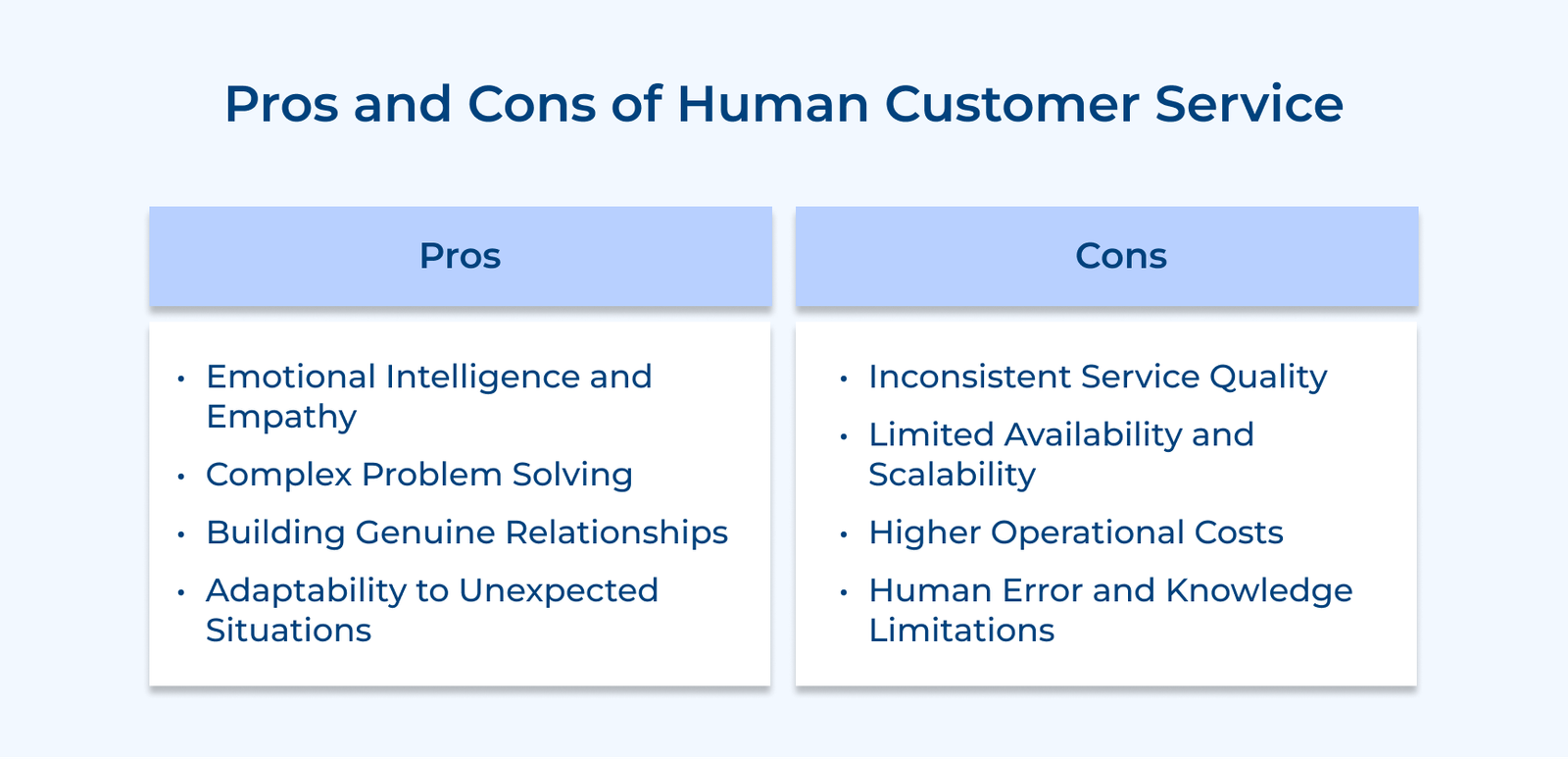
Human representatives naturally sense emotional nuances through tone, pacing, word choice and even silence. They draw on personal experiences to genuinely empathize with customers’ feelings. Their communication adapts intuitively to subtle emotional shifts that AI might miss, creating a more authentic connection.
Key takeaways:
- Humans excel when emotional connection matters, making them better suited for sensitive situations like complaints, service failures or moments requiring empathy.
- AI works fine when the emotional stakes are low, but it can feel cold or robotic when a customer just wants to be heard.
2. Availability and Scalability
AI customer service runs around the clock. It maintains the same performance level at 3 AM as at 3 PM. AI can instantly scale to handle sudden traffic spikes during product launches, promotions or outages without added cost or prep time.
Human support teams work fixed shifts. During holidays or sudden traffic spikes, customers may face long waits. Scaling up requires time, like hiring, training and onboarding don’t happen instantly. Consider that if a power outage hits thousands of customers at once, AI can respond to everyone immediately. A human team, no matter how skilled, will leave many waiting in line.
Pro tips:
- AI offers 24/7 support and handles unpredictable demand without causing customer wait times.
- Human staffing suits predictable schedules but struggles to scale during peak times, affecting service quality.
3. Problem Complexity and Resolution
AI handles routine, clearly defined issues well, but falters when problems are complex, unusual or need real-world context. Most systems follow set paths and lack the broader understanding to navigate exceptions or adapt beyond what they’ve seen before.
Humans think creatively and connect the dots in ways machines can’t. They understand nuance, read between the lines and know when a rule might need to be bent. Their ability to adapt makes them better suited for tricky situations.
Real-world scenarios:
- “I need to return this gift, but I don’t want my spouse to know about the purchase.”
- “My flight was canceled, but I have to be at my daughter’s wedding tomorrow.”
- “The product I bought doesn’t work with my setup, but I’ve already modified it slightly.”
4. Personalization Approach
AI personalizes by analyzing data, digging through purchase history, browsing habits and past interactions. It spots patterns across thousands of customers and remembers every interaction, offering fast, consistent suggestions based on what’s most likely to work.
Humans personalize by remembering. A good support rep might suggest beach gear simply by remembering a casual mention of a trip, not from a database, but from the conversation. They pick up on tone and context that AI often misses, offering help that feels more real. Consider that AI suggests products based on purchase patterns; a human might recall a beach trip, mention and recommend items for it.
Actionable tips:
- AI offers reliable, scalable personalization by processing more data than any human could manage.
- Humans offer deeper, more meaningful personalization through memory, context and connection.
5. Learning and Improvement
AI learns by analyzing large volumes of structured data and updating its algorithms. It can spot trends humans might miss, but its improvement relies on batch updates, not real-time shifts during conversations.
Human reps learn on the go. They adjust their approach based on what works, share tips with teammates and apply lessons immediately. The informal learning lets them respond to new problems faster than AI systems.
Key takeaways:
- Humans adapt more quickly to unfamiliar situations.
- AI improves more evenly across the system once a pattern is established.
6. Cost and Resource Efficiency
AI requires a sizable initial investment, but once in place, the cost per interaction is minimal. It can manage thousands of requests at once without added expense, avoiding ongoing costs like hiring, training or office space. As a business grows, AI costs remain steady.
Human service grows more expensive with scale. Each agent can only handle so much at a time and businesses must keep hiring as demand rises. It means higher and steadily increasing costs. Let’s assume that when expanding to new markets, AI handles 100 or 10,000 inquiries at the same cost, while human support costs rise with every new customer.
Best practices:
- AI is cost-effective for high-volume, repetitive tasks.
- Human agents are worth the investment for complex, high-stakes issues where quality matters more than scale.
7. Knowledge Breadth vs. Depth
AI possesses encyclopedic knowledge covering every product, policy and procedure in perfect detail. It instantly accesses complete technical specifications, account histories and solution databases without memory limitations or knowledge gaps. The knowledge remains limited to information explicitly added to its programming.
Human agents may not recall every technical detail on demand, but they bring a broader context. They understand things like industry shifts, cultural references or how a customer’s mention of a competitor might shape the conversation. Consider that when a customer mentions issues with a competitor, a rep understands the context, while AI may miss the implied comparison.
Key takeaway:
- Humans excel when service needs a broader context, like cultural cues or competitor knowledge not found in documentation.
- AI reliably provides accurate technical information, avoiding gaps or inconsistencies from human memory.
8. Communication Style and Adaptability
AI customer service follows structured patterns. Even when it sounds natural, its language is shaped by rules designed to be clear, consistent and easy to understand. It helps maintain accuracy but limits its flexibility.
Have you ever noticed how conversations with different friends have their own distinct “language”? One friend likes technical details, another prefers stories. Human agents adapt to such preferences; AI often doesn’t. If you say, “My router drops a signal in the back bedroom,” a human might ask, “Does it happen at certain times?” An AI might reply with a formal, less natural-sounding diagnosis.
Key takeaways:
- Humans adapt naturally to different communication styles, helping customers feel more comfortable and understood.
- AI keeps responses consistent and clear, but may come off as stiff or overly formal when the tone doesn’t match the customer.
Use Case Where AI and Human Customer Service Work Together
Check out the various use cases where AI and human agents are working together seamlessly to drive business success.