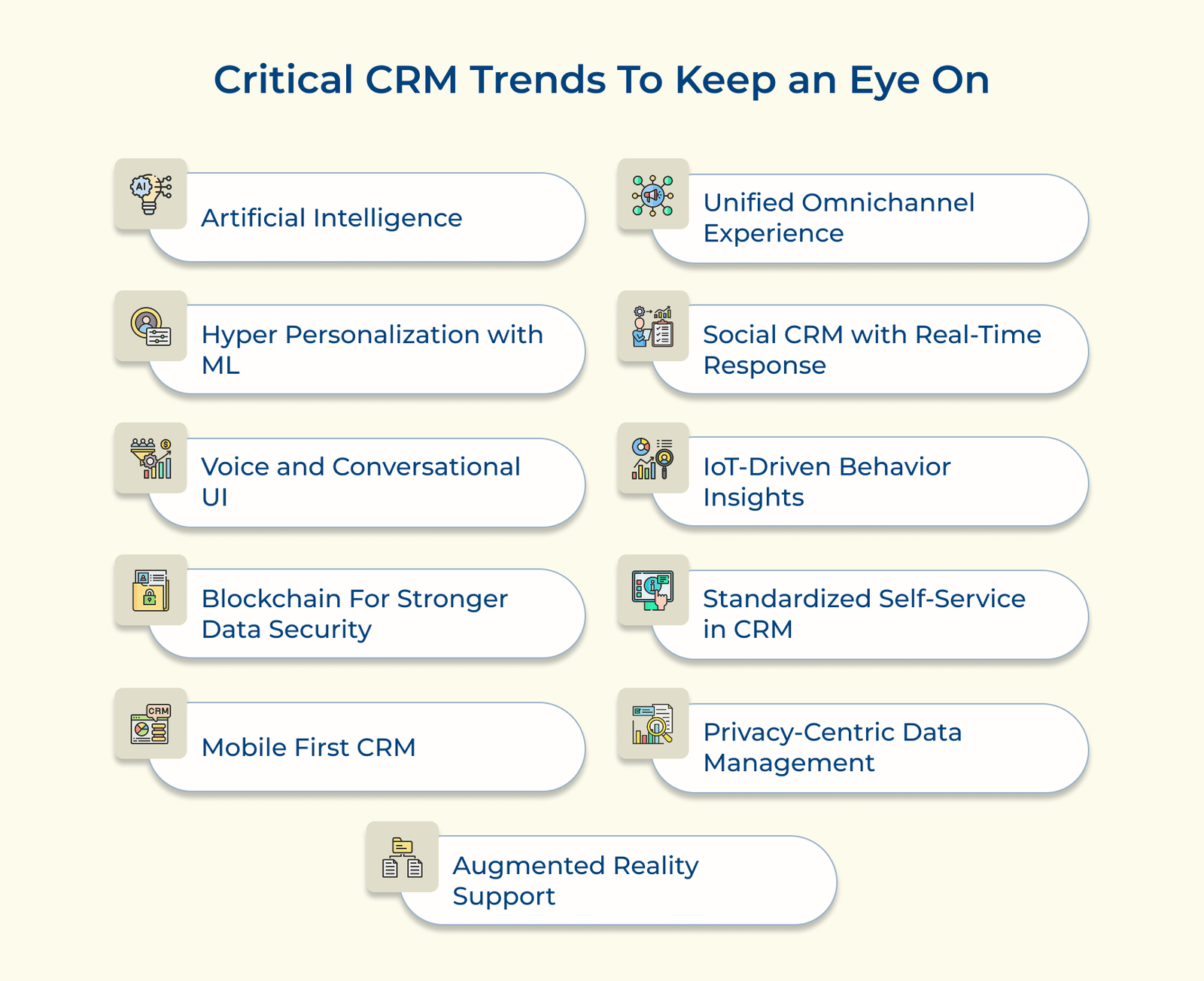
1. Intervention of Artificial Intelligence
AI in CRM represents the next evolution in how businesses understand and serve their customers. With today’s vast amounts of customer data, manual processing isn’t feasible. AI allows businesses to quickly make sense of the data and act on it in real-time.
AI-powered CRM systems go beyond simple data analysis to predict what customers might need next. The systems continuously learn from customer interactions and automatically adjust their predictions to become more accurate over time.
Pro Tips:
- Start with a pilot in one department, then expand based on clear results and team feedback.
- Focus on cleaning and organizing your existing customer data before implementing AI tools to ensure maximum effectiveness.
2. Hyper-Personalization Through Advanced Machine Learning
Hyper-personalization enhances customer experience by tailoring interactions to each individual. It’s crucial in today’s market where loyal customers expect brands to understand their preferences and anticipate their needs.
Machine learning analyzes customer interactions across all touchpoints. It is needed to build detailed profiles, covering everything from purchase history to communication preferences. The insight helps businesses create experiences that feel personal and seamless.
Pro Tips:
- Leverage customer feedback loops by regularly asking for input on personalized recommendations and adjusting your approach.
- Monitor key moments in the customer journey and design specific personalization triggers for these critical interfaces.
3. Integration of Voice and Conversational UI
Voice and conversational interfaces are transforming how users interact with CRM systems. The technology makes CRM easier by letting users perform tasks with natural speech instead of navigating complex menus. It’s particularly valuable for marketing teams who need hands-free access while in the field.
Voice commands have revolutionized how marketing teams input and access CRM data. Sales representatives can now update customer records and add meeting notes simply by speaking. The system automatically transcribes conversations and organizes the data, saving time that would otherwise be spent on manual entry.
Pro Tips:
- Set up custom voice commands aligned with your team’s most frequent tasks and specific industry terminology.
- Record training sessions where successful team members demonstrate voice command usage for common scenarios.
4. Blockchain Integration for Enhanced Data Security
Blockchain technology brings unprecedented security and transparency to CRM systems. As data breaches grow more advanced, businesses need a way to protect customer information. Blockchain provides an unalterable record of all customer interactions, ensuring data integrity.
Smart contracts automate compliance and transaction verification, eliminating the need for human oversight. Every customer interaction is recorded on the blockchain, creating a secure, unchangeable audit trail. The automation reduces errors and ensures consistent adherence to regulations across all touchpoints.
Pro Tips:
- Allocate time for thorough team training on blockchain principles, focusing on practical applications in daily customer interactions.
- Run parallel systems initially, keeping traditional records alongside blockchain to ensure a smooth transition and data validation.
5. Mobile-First CRM Development and Implementation
Mobile-first CRM design focuses on making systems work seamlessly on smartphones and tablets. It reflects how both marketing teams and customers now primarily interact through mobile. The approach ensures key CRM functions are smooth and accessible on any device.
A real estate agent can update property details directly from their phone while conducting a house tour. They can take photos, add notes and schedule follow-ups all while walking through the property. The immediate data entry ensures nothing gets forgotten when they return to the office.
Pro Tips:
- Conduct field tests with your team in various network conditions to identify potential connectivity challenges.
- Host monthly showcase sessions where team members share their mobile CRM success stories and shortcuts.
6. Unified Omnichannel Customer Experience Management
Omnichannel CRM creates a consistent customer experience across all interaction points. The customers might reach out via email, social media, or visit in person, they should always receive the same level of service and information.
Customers might start browsing products on their mobile phone, continuing research on their laptop and finally make a purchase in-store. A unified system tracks the customer’s journey, so when they arrive, store staff can access their research history instantly.
Pro Tips:
- Schedule regular cross-department meetings to ensure all teams understand how their channel interactions affect the overall customer journey.
- Mystery shop your own business across different channels to identify inconsistencies in the customer experience.
7. Social CRM with Real-Time Response
CRM has evolved to make social media a key part of customer management. Modern systems blend traditional data with social data, giving a full picture of user behavior and preferences. The integration is crucial as customers now expect quick responses on their social platforms.
A key advancement in CRM trend implementation is the use of automated social listening tools. The tools monitor brand mentions, complaints and inquiries across platforms. When a customer tweets about a product issue, the system instantly notifies the team and provides context from the user’s history.
Pro Tips:
- Train your social response team to maintain conversation threads within your CRM to capture the complete customer journey.
- Map out response scenarios for different social platforms, considering each platform’s unique communication style.
8. IoT Integration for Customer Behavior Analysis
Integration of IoT devices with CRM systems represents one of the most transformative trends in customer relationship management. The CRM trend links product usage data with customer profiles, giving you deeper insight into how customers engage with your products.
Connected devices now feed real-time usage data directly into CRM systems. A manufacturer can track feature usage, identify maintenance needs and suggest upgrades at the right time.
The direct feedback loop helps improve both product development and customer support.
Pro Tips:
- Establish clear data collection boundaries and communicate them transparently to build customer trust.
- Organize quarterly reviews of IoT data patterns to identify opportunities for product improvements.
9. Self-service via CRM will be standardized
CRM trends are making self-service a standard, not a luxury. Modern customers want to resolve simple issues on their own and expect easy-to-use tools from businesses. The shift helps reduce support costs while improving customer satisfaction.
AI-powered knowledge bases revolutionize how customers find solutions to their problems. The CRM system improves with each interaction, making it easier to find answers. The systems continuously adapt their responses based on customer feedback and usage patterns.
Pro Tips:
- Schedule regular customer feedback sessions to understand which self-service features are most valuable.
- Design your knowledge base structure based on actual customer support ticket patterns.
10. Privacy-Centric Data Management and Compliance
The growing amount of detailed customer data in CRM systems has made privacy protection essential. Customers now prioritize data security when choosing which businesses to trust.
Advanced encryption methods protect customer data at every interface. The CRM system automatically encrypts sensitive information as it’s collected, stored and transmitted. The approach ensures that data remains secure even as it flows between different parts of the organization.
Pro Tips:
- Conduct monthly privacy audits by following a customer data journey from entry to deletion.
- Set up privacy champions within each department who receive specialized training and support others.
11. Augmented Reality (AR) Support
Augmented Reality is changing how businesses connect with customers by blending digital data with real-world interactions. As companies look for more engaging ways to serve customers, AR integration in CRM systems offers an immersive, interactive solution.
AR has revolutionized product visualization and customer support processes. When integrated with CRM customer data, AR can provide unique experiences during product demonstrations. A furniture retailer’s CRM system allows users to use their phone to visualize how a sofa will look in their living room. Simultaneously, it helps them access their style, preferences and previous purchase history.
Pro Tips:
- Begin with a pilot program in your showroom where customers can experience AR product visualization while staff gather direct feedback.
- Host virtual product demonstrations that combine AR features with real-time customer interaction data from your CRM.
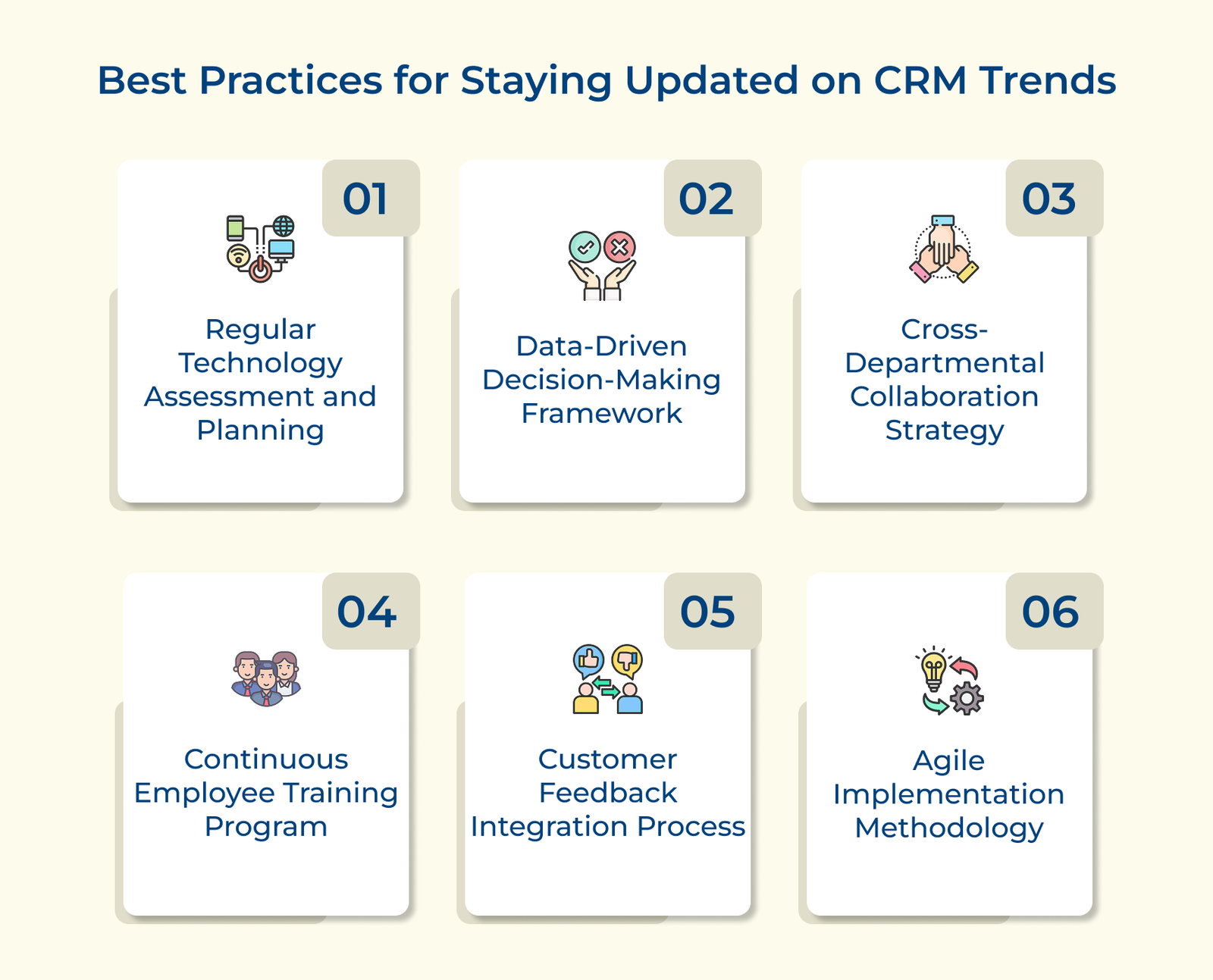
Best Practices for Businesses to Consider for Following Up with CRM Trends
Below are the best practices businesses can adopt to leverage new technology while keeping operations efficient and customers satisfied.